

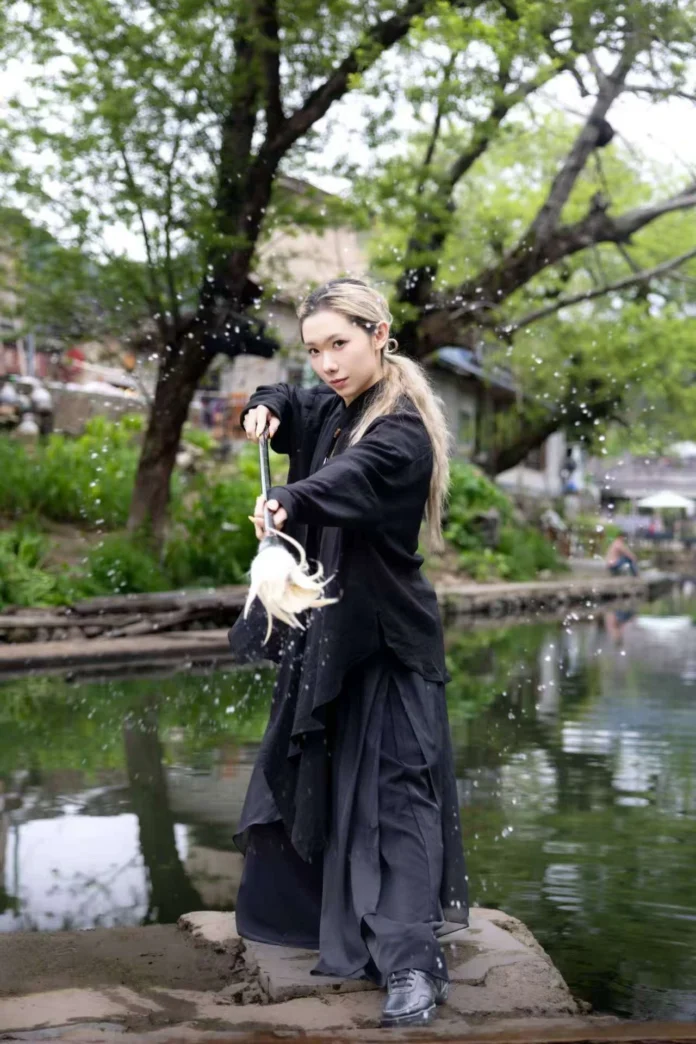
At first, it is not entirely clear whether Jiaying Gao is writing or dancing. A long brush touches the floor. Water darkens the surface for a moment. A line appears, lengthens, thickens, trembles, and begins to vanish. The dancer’s body follows the brush, or perhaps the brush follows the body. What begins as calligraphy gradually becomes choreography; what looks like writing soon becomes drawing, painting, breathing, and remembering.
This ambiguity is one of the work’s strengths. Gao does not simply combine dance and calligraphy as two separate art forms placed beside one another. Rather, she turns writing itself into a choreographic event. Each stroke is produced not only by the hand, but by the whole body: the rotation of the torso, the transfer of weight, the suspension of breath, the pressure of the feet against the floor, and the controlled release of force through the arm into the brush. The result is not calligraphy accompanied by dance, but a choreography of inscription.
In Vapour Words Disappear, Gao performs with water and brush on the floor, creating an ephemeral script that never settles into permanence. Some marks resemble Chinese characters; others dissolve into abstract strokes, curves, pools, and fading traces. At moments, she writes large characters with the solemn concentration of a scholar; at others, she draws with the intuitive freedom of a painter. Yet the work never becomes simply a demonstration of calligraphic skill. Gao keeps a precise distance from the marks she makes. She does not illustrate language. She approaches it, withdraws from it, circles around it, and lets it disappear.
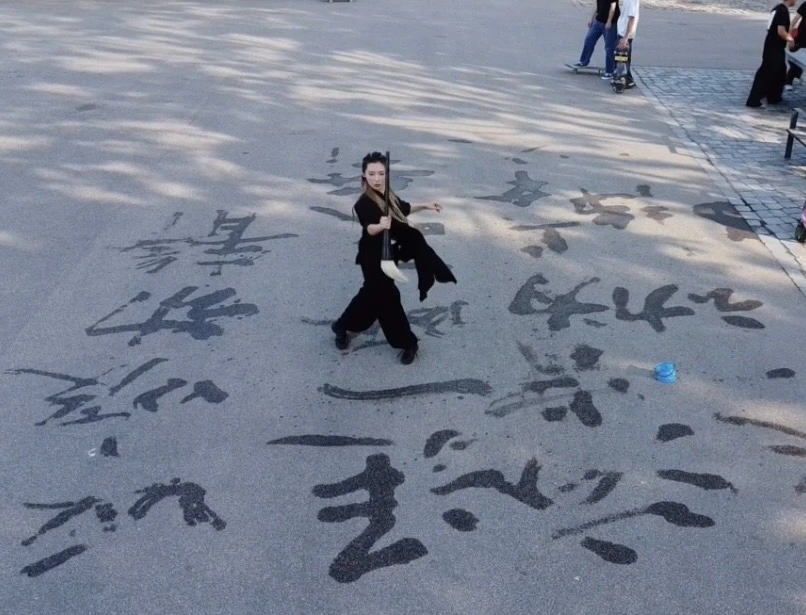
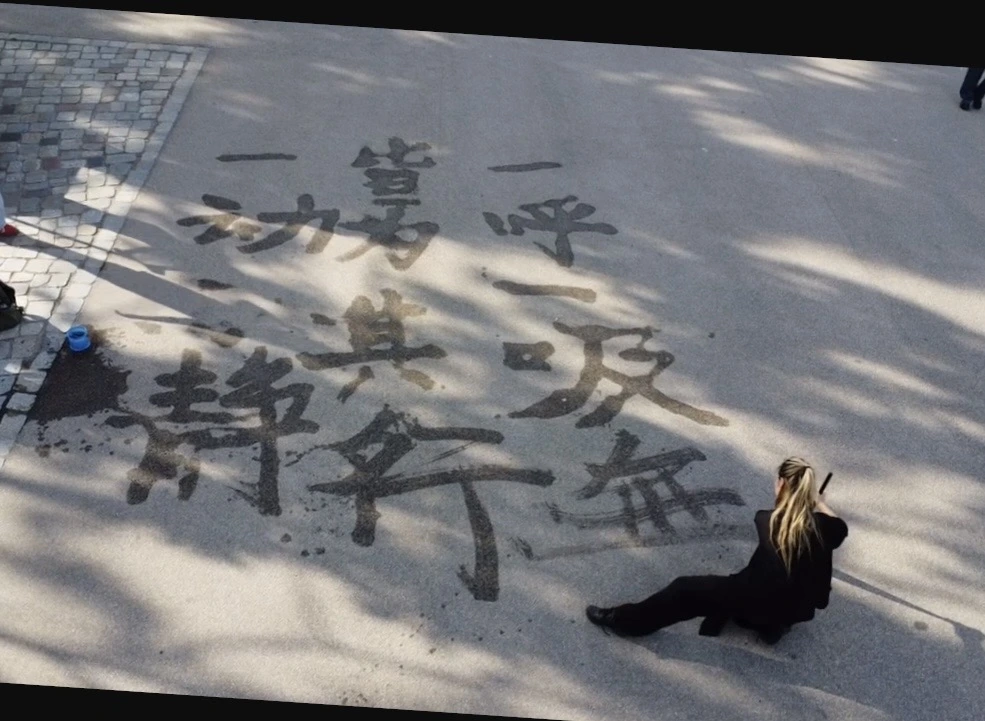
The most compelling moments occur when the marks become difficult to read. Some do not look fully like words, Chinese characters, or paintings. They hover between script and image, between linguistic sign and bodily trace. This illegibility is not a weakness, but one of the work’s most generous gestures. It allows writing to be experienced beyond language, as pressure, rhythm, density, direction, and disappearance. For viewers who cannot read Chinese, the work remains open: not as a text to be decoded, but as a physical and atmospheric event.
This openness gives the floor a strangely pictorial quality. It becomes less a writing surface than a landscape. Like ink in Chinese painting, the water creates an ambiguous spatial field: near and far, full and empty, visible and fading. There is no colour, and yet one senses tonal variation. A saturated stroke feels close, almost bodily; a drying trace recedes, becoming pale, atmospheric, nearly unreachable. The work produces depth not through perspective, but through disappearance.
Sound plays an unexpected role. When the brush is newly filled, the stroke is smooth and quiet, almost liquid. But as the water begins to run out, friction starts to speak. The brush scratches against the floor; the stroke becomes hollow, broken, no longer full. One hears the dryness before one fully sees it. The material condition of the brush changes the movement, and the movement changes the meaning of the writing. Gao does not conceal this depletion. She performs it.
This attention to friction gives the work a tactile intelligence. The audience is not only watching the line; they are sensing its resistance. The floor is no longer a neutral stage but an active surface, one that receives, absorbs, refuses, and erases. In this sense, the work changes how dance is watched. Attention moves between the dancer’s body and the trace it leaves behind, between the gesture and its afterlife, between movement and the floor’s slow return to emptiness.
The work’s tempo is equally subtle. At the beginning, one might expect the whole performance to unfold slowly, in a meditative rhythm. But Vapour Words Disappear has its own inner pulse. Sometimes Gao moves with extreme slowness, allowing the audience to watch the stroke grow wider and wider beneath the brush. At other times she accelerates, moving faster than the water can hold. The trace cannot always keep up with the body. The gesture arrives, but the mark is already failing. The dance becomes a negotiation between intention and evaporation.
The atmosphere of the space becomes part of that negotiation. In warm conditions, the words disappear quickly. Heat, air, humidity, and floor texture become quiet co-performers, determining how long each mark can survive. Gao’s authorship is therefore never absolute. Each word is made in collaboration with the environment, and each disappearance is partly choreographed by the room itself.
Because the weather is warm, the words vanish almost as soon as they are formed. This gives the performance a quiet urgency. Gao repeatedly attempts to write a large word, but the act is always threatened by its own disappearance. There is something almost Sisyphean in this effort: the repeated return to the floor, the refilling of the brush, the attempt to write again what cannot remain. Yet the work is not tragic in any simple sense. Its repetition becomes remembrance, resistance, and release. The point is not to preserve the word, but to inhabit the time of its appearing.
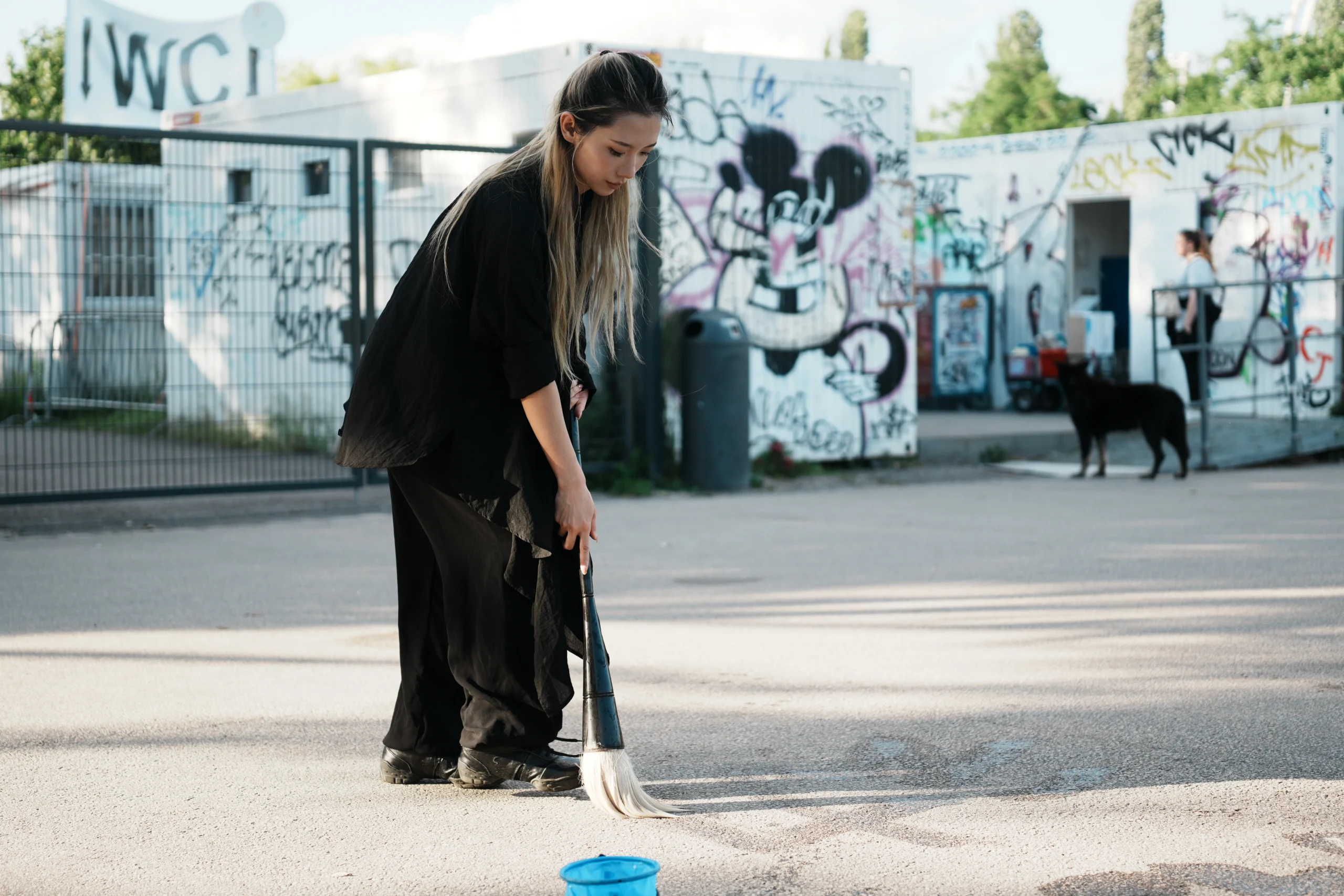
The work reveals Gao’s calligraphic skill, but it also reveals something more internal than technique. The brushwork carries the memory of training: control of weight, wrist, breath, centre, rhythm, and force. At the same time, it exposes the instability of all such control. A stroke may begin with authority, then fracture. A character may appear legible, then turn into mist. The performer’s discipline is visible precisely because the medium refuses permanence.
Although Gao evokes the image of the scholar-calligrapher, she does not simply reproduce a traditional literati practice. She relocates it through the dancing body, through public space, and through a contemporary performance vocabulary. What might historically be associated with the solitary, often masculine figure of the calligrapher is here reworked through embodied authorship, breath, labour, and exposure. Tradition is not presented as heritage to be preserved intact, but as a practice to be tested through movement, disappearance, and relation.
There is a strong sense of breathing throughout the work. The words breathe. The dancer breathes. The floor seems to inhale and exhale through moisture and dryness. Presence and absence are not opposites here, but phases of the same movement. A stroke appears, expands, thins, evaporates. The body returns. The brush is refilled. Another mark begins. The work quietly evokes a yin-yang logic: fullness and emptiness, memory and forgetting, action and erasure, expression and silence.
As the performance continues, the audience’s attention shifts from what is written to when it disappears. One begins to watch time itself. When will Gao return to the place where the first word has already vanished? When will the brush need water again? When does a stroke stop being a word and become only a trace? These questions make the work almost meditative, not because it is still, but because it trains perception. The audience is invited to notice the smallest transformations: a dark line becoming grey, a wet surface turning matte, a gesture outlasting its material evidence.
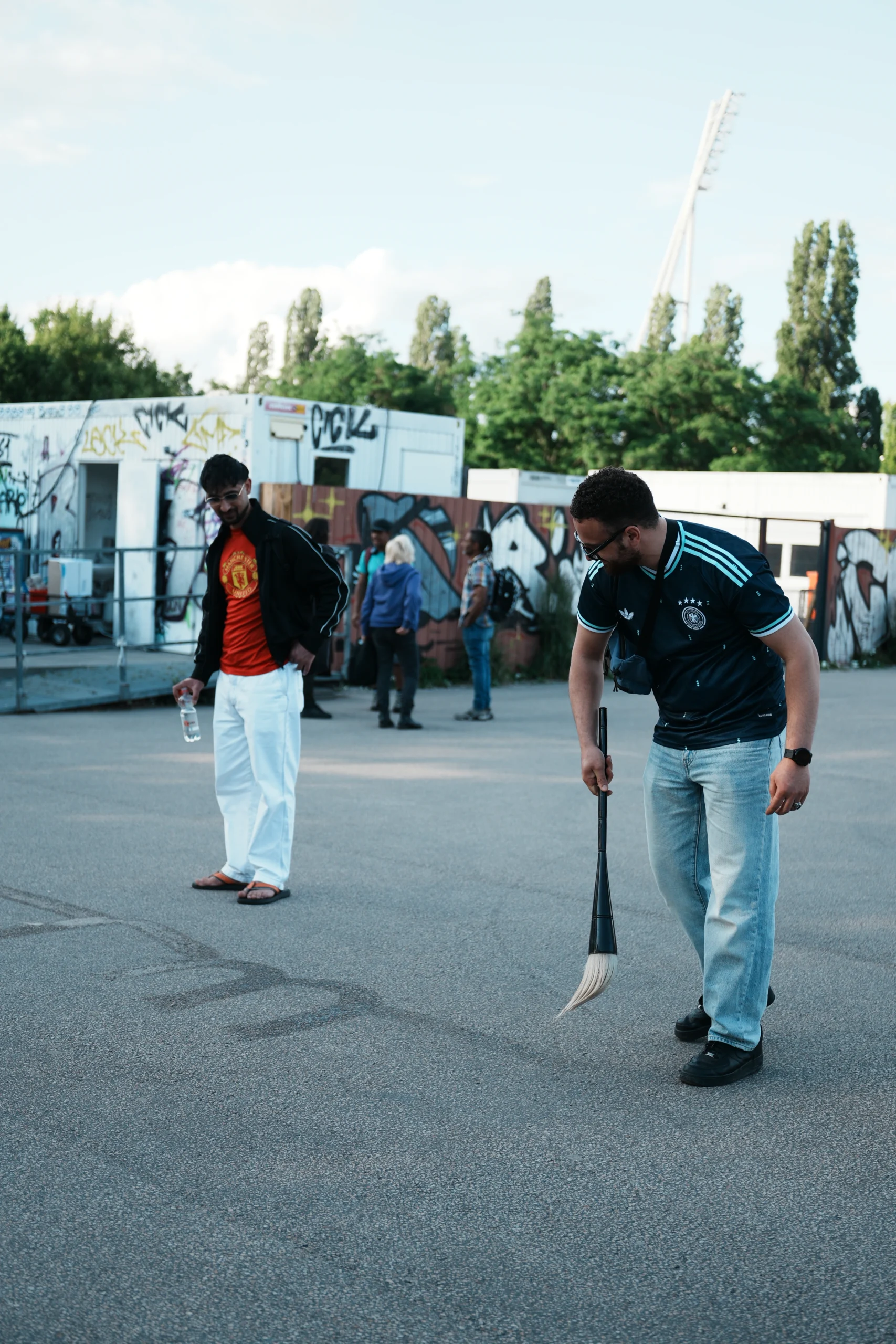
At certain moments, audience members come forward and write their own words on the floor. Some use Chinese; others write in different languages. The surface gradually becomes a collective script, a place where people leave what they want to say, or perhaps what they cannot say elsewhere. Yet every contribution shares the same fate. It will dry, fade, and disappear.
Here the floor becomes a temporary archive of private utterances. It is an archive without storage, a record that refuses to remain. Its value lies not in preservation, but in the shared act of release. The audience does not merely observe the work; they enter its fragile economy of appearance and disappearance. Their words are held briefly by the floor, then returned to air.
This gives Vapour Words Disappear a quiet politics of erasure and memory. Beneath its meditative surface, the work asks what kinds of language are allowed to remain, what forms of expression vanish before they are recognised, and how memory might persist even when material evidence has disappeared. It is a question that extends beyond calligraphy. What do we remember when we express ourselves? What do we remember when we dance? What remains when a temporary art form leaves the space almost exactly as it found it?
By the end, what remains is not the word itself. Nor is it the completed image of writing. The floor is almost clean again, as if the performance has performed a kind of spiritual and visual cleansing. Yet something has shifted. The traces may have vanished from the surface, but they linger in the eye, the ear, and the body of the spectator. Perhaps they have already vapoured into memory. Perhaps that is enough.
What is striking about Gao’s work is its refusal to choose between discipline and fragility, tradition and experiment, writing and dancing, visibility and disappearance. Vapour Words Disappear is at once a performance, a painting process, a calligraphic meditation, and a participatory ritual. It leaves almost nothing behind, and yet its disappearance is precisely what gives it force. For a brief time, dancer, water, brush, floor, and audience share the same air. In that shared temporality, the work finds its most delicate and persuasive form.

