

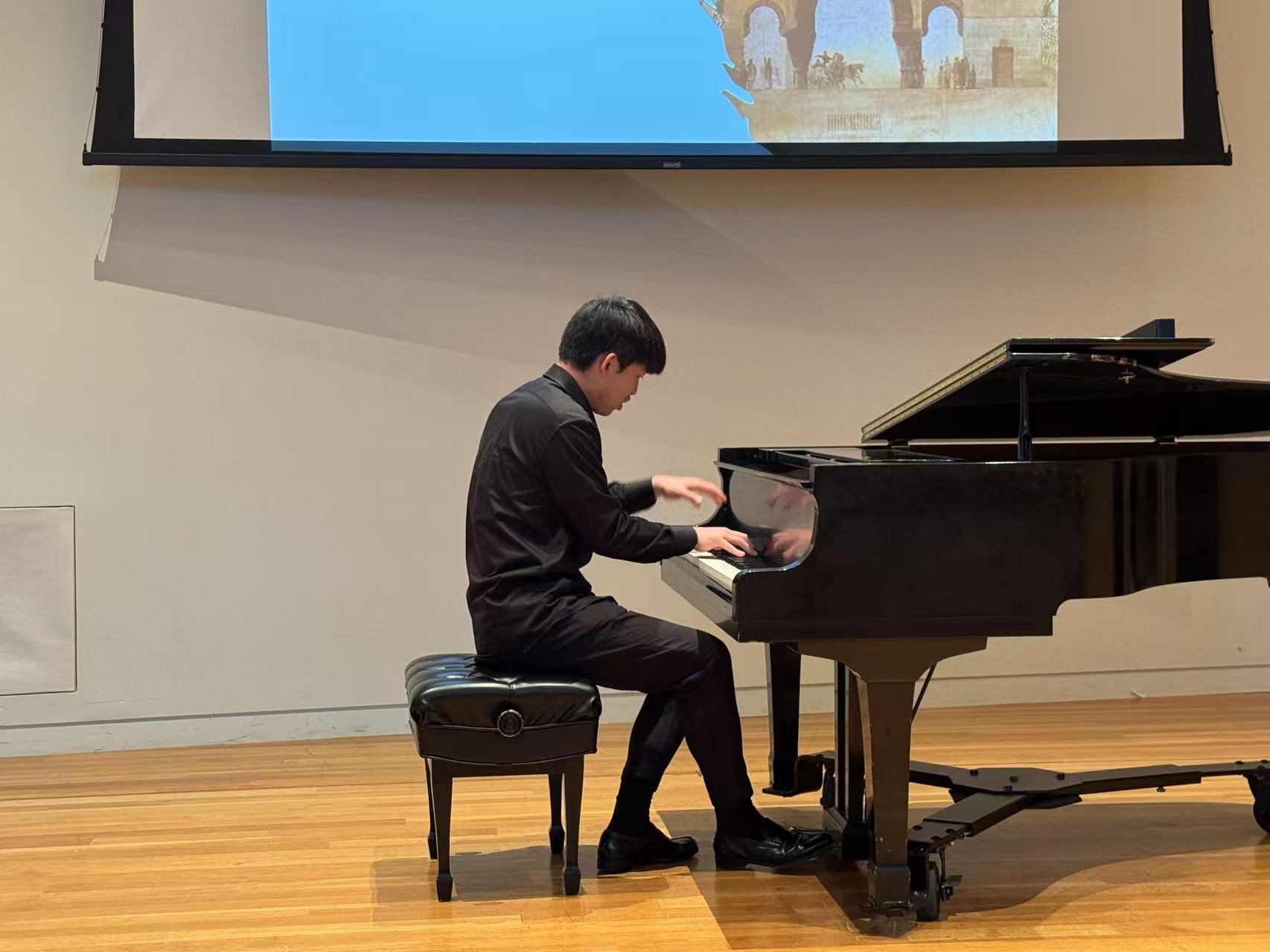
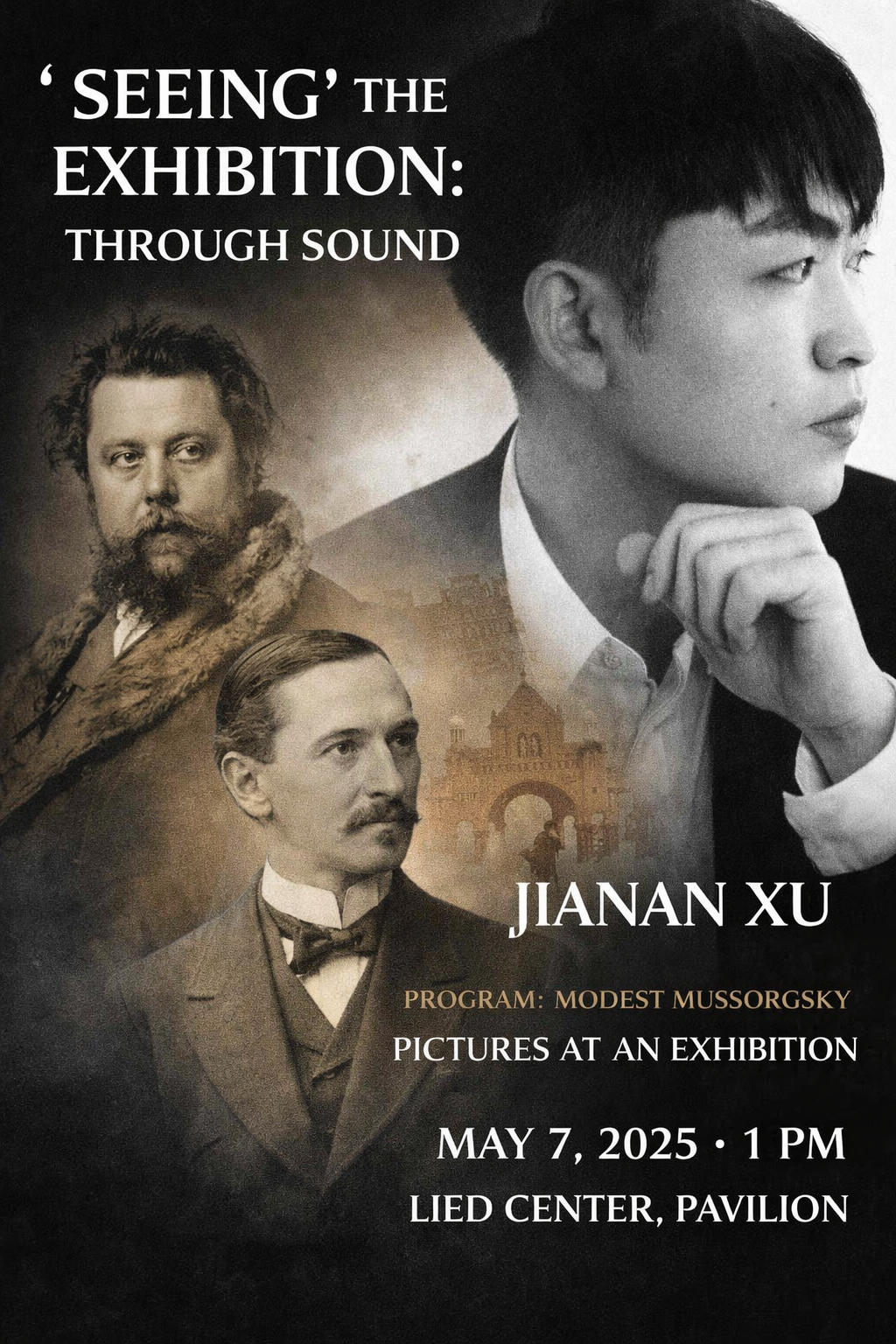
On May 7, 2025, the Lied Center Pavilion in Lawrence, Kansas hosted an especially moving evening of music. Art-music enthusiasts, students, and community audience members from Lawrence and the surrounding area gathered in a hall filled with focused attention and quiet anticipation. Pianist Jianan Xu presented a solo recital marked by both intellectual depth and artistic immediacy, and the concert quickly became a space where music, painting, and imagination converged. Praised by pianist Solomon Mikowsky for his “incredible technique and musical sensitivity,” Xu has earned top prizes at the Charleston International Piano Competition and the Kansas University International Piano Concerto Competition. He maintains an active international profile as a performer, pedagogue, and juror, and is a member of the Shanghai Musicians Association and its Piano Committee.
The program centered on Modest Mussorgsky’s Pictures at an Exhibition. Celebrated for its vivid pictorial character, sharp emotional contrasts, and highly individual pianistic language, the work is widely regarded as one of the most conceptually rich and technically demanding pieces in the piano repertoire. By building the evening around this single, monumental work, Jianan Xu demonstrated a clear command of musical architecture, narrative pacing, and stage presence—and continued his artistic direction of engaging audiences in deeper dialogue through performance.
Rather than following a conventional “performance–applause–curtain call” format, the recital moved naturally between playing and spoken commentary. With calm yet compelling remarks, Jianan Xu guided listeners into the world the music evokes: from the gallery stroll of “Promenade,” to the playful “Ballet of the Unhatched Chicks,” from the somber darkness of “The Catacombs,” to the untamed force of “The Hut on Hen’s Legs (Baba Yaga).” Before each movement began, a clear and vivid image had already taken shape in the audience’s mind. This artistically sensitive guidance allowed listeners to sustain imagination through understanding, and to deepen their listening through imagination.
At the keyboard, Jianan Xu’s playing revealed a high level of artistic control. His touch was both refined and weight-bearing, his tonal layers clearly articulated, and his structural shaping as solid as architecture while remaining flexible and breathing. Especially in the recurring “Promenade” theme, he used natural rhythmic expansion and contraction, along with subtle shifts in sound, to shape a psychological process of walking, pausing, and gazing—so that the work unfolded like an ongoing interior monologue. In the final movement, “The Great Gate of Kiev,” he created a broad, majestic sonority with a bell-like sense of space, driving the music toward a radiant yet restrained culmination. When the last chord fell, sustained applause rose throughout the hall.
The concert sparked an enthusiastic local response. After the performance, many audience members lingered inside and outside the hall, exchanging impressions and discussing their experiences. A number of local listeners described it as a rare kind of encounter: they not only heard a major piano work, but—through the performer’s guidance—genuinely approached the music’s inner world. Some noted that it was the first time they had felt so clearly how music can “tell a story,” while others felt that this kind of concert made a classic work feel immediate and alive.
For Lawrence, a city with an active arts atmosphere, the evening carried particular significance. Through an open and inclusive stage presence, Jianan Xu built a bridge for local audiences to approach the classical canon. He turned the concert hall into a public space for shared imagination and emotion, where listeners of different backgrounds could find resonance. This audience-centered approach—grounded in artistic communication—has undoubtedly left a deep and lasting echo within the city’s musical culture.

