

Artist: Xinyu Huang, Iris Jingyi Zeng
Duration: 31 Oct – 3rd Nov 2025
Venue: Safe House 1, 139 Copeland Road, London, SE15 3SN
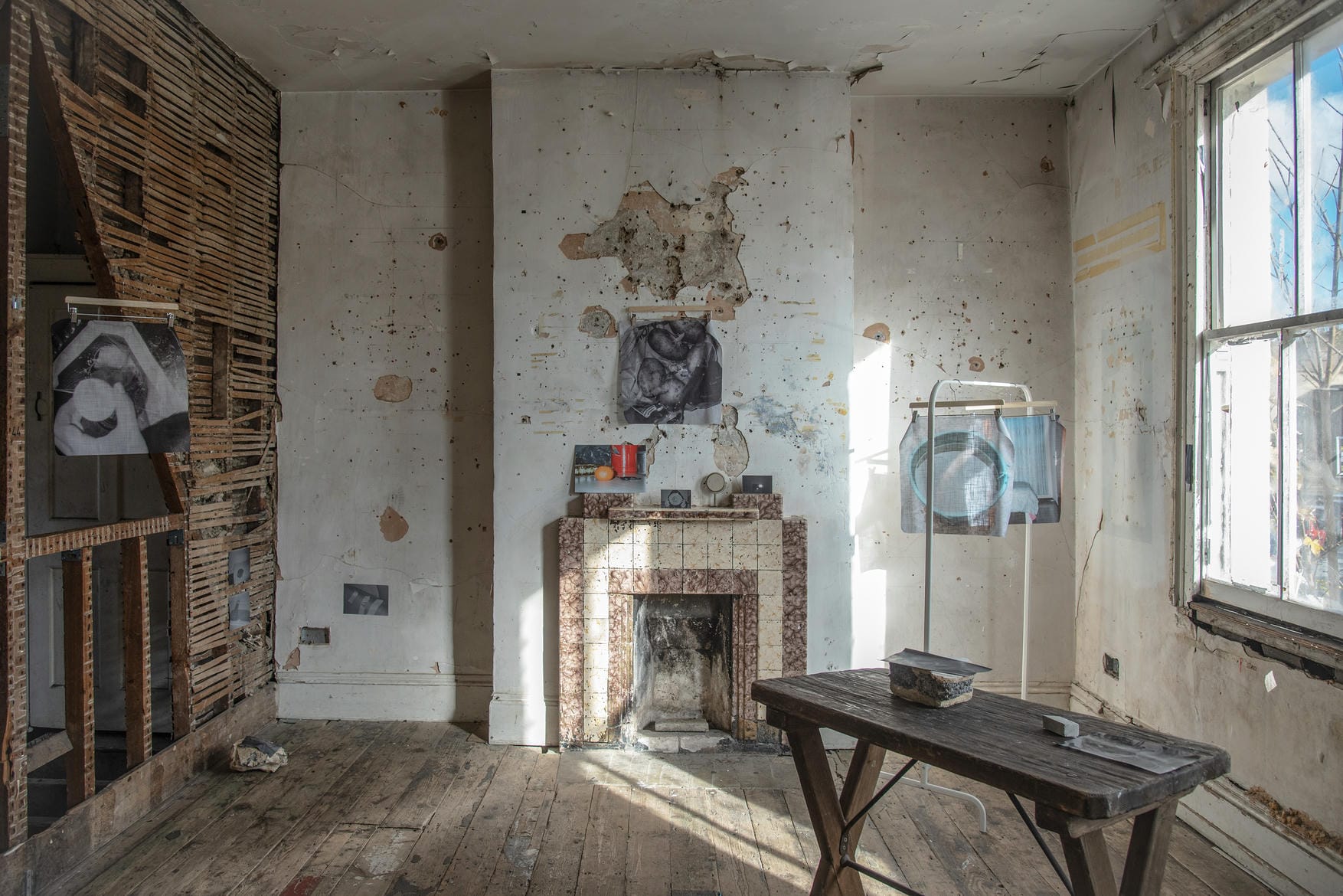
Unnamed, Unhollow, Unwritten, Unsevered is a duo exhibition by Xinyu Huang and Iris Jingyi Zeng at Safehouse 1 in London, presented as part of PhotoMonth London 2025. Inside this fragile Victorian-era structure, the two artists construct a temporary sense of “home”. Here, home is neither stable nor definable, nor a place to return to. It forms quietly in the intervals between moving and dwelling, only to dissolve at the moment it takes shape. It circulates silently through the body and memory, leaving subtle yet persistent traces. These traces gesture toward the fissures and unbreakable bonds between generations, as well as the points of self-anchoring one attempts to hold onto while navigating through a shifting life trajectory. The exhibition title, Unnamed, Unhollow, Unwritten, Unsevered, reflects the artists’ ongoing encounters with home amid continual migration and provisional dwellings — wandering at the threshold of “home”, and touching “home” within the perception that wanders.
The exhibition unfolds through four interwoven bodies of work. Xinyu Huang’s Home and Thirty- One form the soft layer of “home” through color imagery and the warmth of everyday objects, while Iris Jingyi Zeng’s Where the Trees Remember and Under the Tree trace the remnants of space, the shadows of time, and the immediate attachments a migrating body keeps reaching for, articulated in black-and-white, in negatives, and in the touch of stitching.
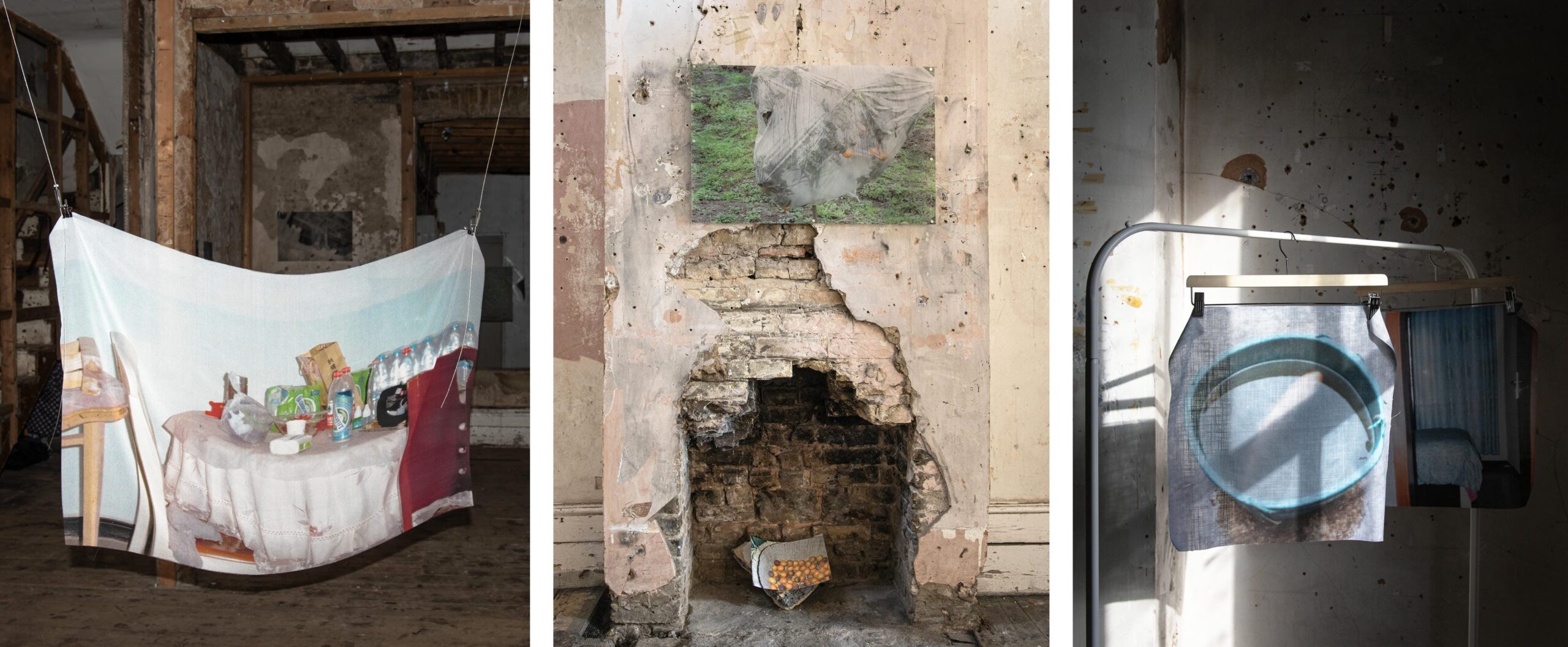
The Home series was photographed in the old houses of Xinyu’s paternal and maternal grandparents, the places where her parents grew up. This “home” is not part of her lived environment, yet it forms the backdrop of her life. She never truly inhabited it, but was shaped by it through language, family history, and intergenerational memory. She approaches its traces through a tactile mode of seeing, not to understand their meaning, but to understand the distance between herself and these marks. The images, printed on fabric, hang with a gentle downward pull in the space, forming a temporary, soft, and unstable structure, like a curtain drawn up yet always on the verge of loosening, allowing the shape of “home” to appear and dim with the movement of air. Her sensing of this “home” also gestures toward her relationship with her parents and elders: intimate by birth, yet marked by a vast expanse of intergenerational blankness.
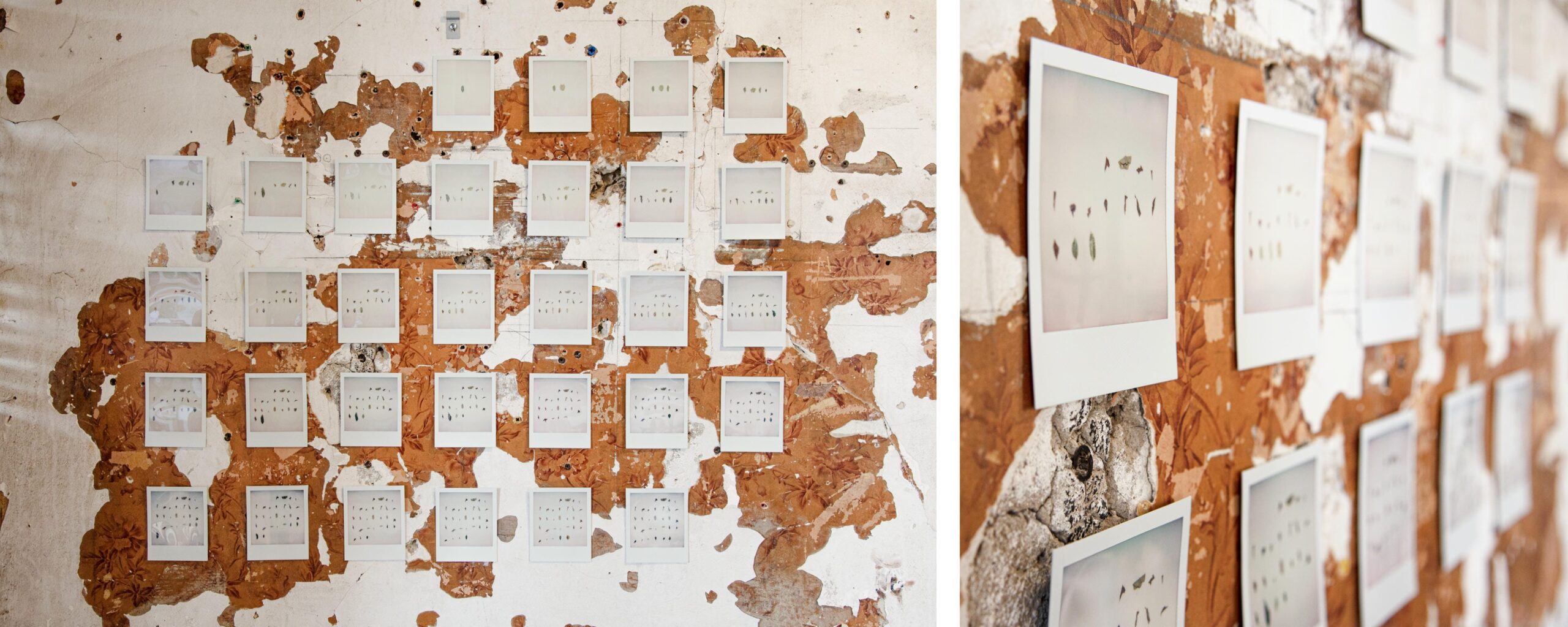
Thirty-One is a diary of May 2024, attending to the texture of time in a lighter, more delicate way. Each day that month, Xinyu brought home a leaf, arranged them according to the positions of that month’s calendar, and made a single Polaroid. Thirty-one leaves, each with its own quiet arc of withering, form a calendar that offers a purposeless, simple, and unguarded way of looking at the traces of time and life, or rather, of being in a mutual gaze with them. The deviations, warmth, grain, and unpredictability of Polaroid film make time itself tangible. The work is not a record of withering, but a record of the daily act of seeing. It is an ongoing breath that quietly murmurs, again and again, “I am still here” — a gentle locating of the self amid drift and uncertainty.
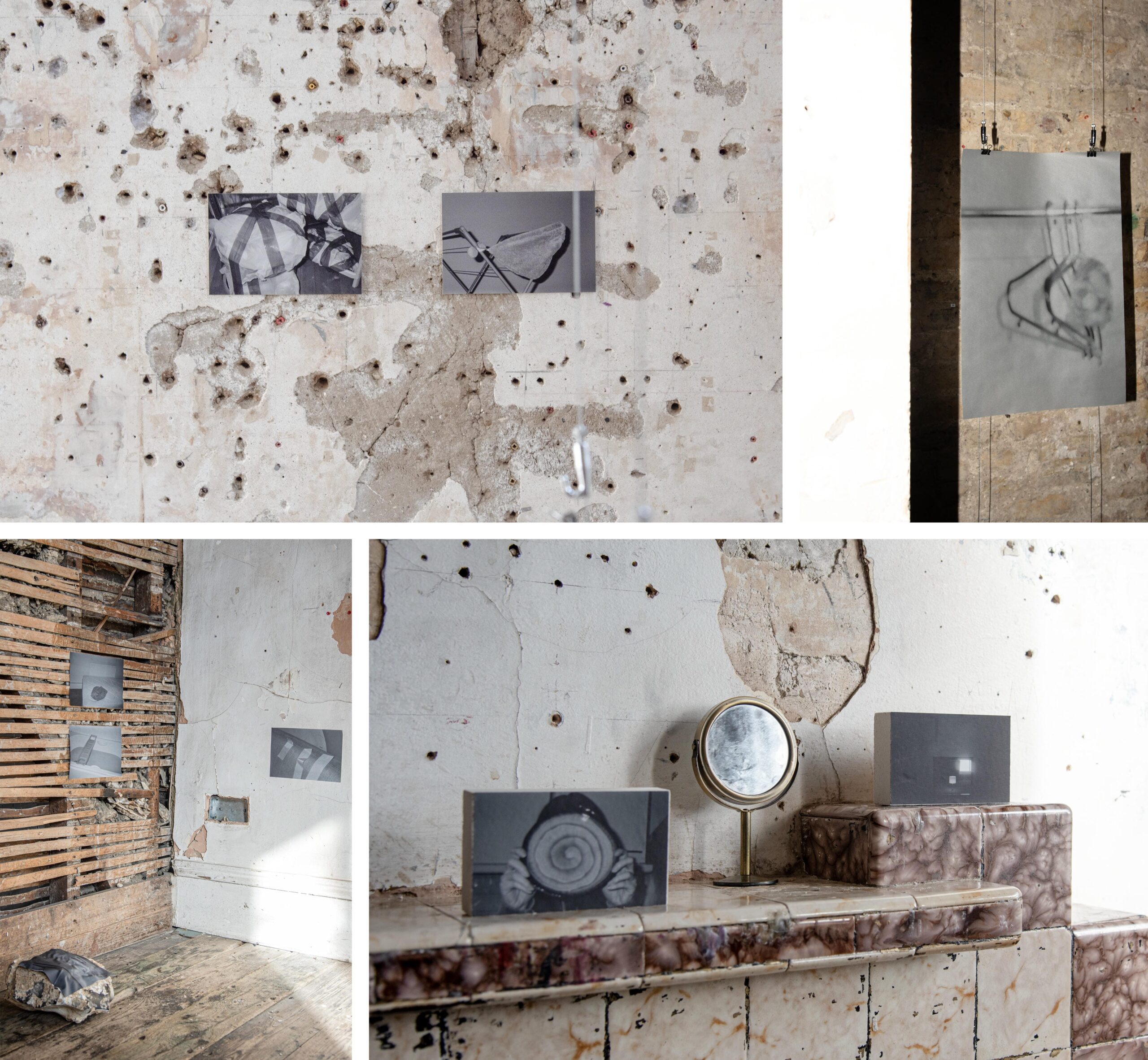
Where the Trees Remember begins at a moment when a home is gradually being emptied. Iris starts recording from the departure of her first flat mate, as she herself sets out with a new life, leaving behind the place in which she lived the longest since moving away from home. A “home” is being dismantled even as another begins to form. The traces of the old and the blankness of the new overwrite one another, while the tactile memories carried by objects, like the roots of a tree, rearrange themselves in the act of transplantation. The black-and-white images catch the tremor of light on a cup, the disassembled furniture, the plants by the window, the scuffs left on the floor — shifts of temperature as objects are moved, replaced, and set anew. They are not a recollection of memory, but a suspension of it at the threshold between presence and absence. Here, “home” is transitional, yet never hollow. It stretches through the very act of change, like a root system adjusting its direction as it moves, revealing a subtle form of presence that emerges within migration.
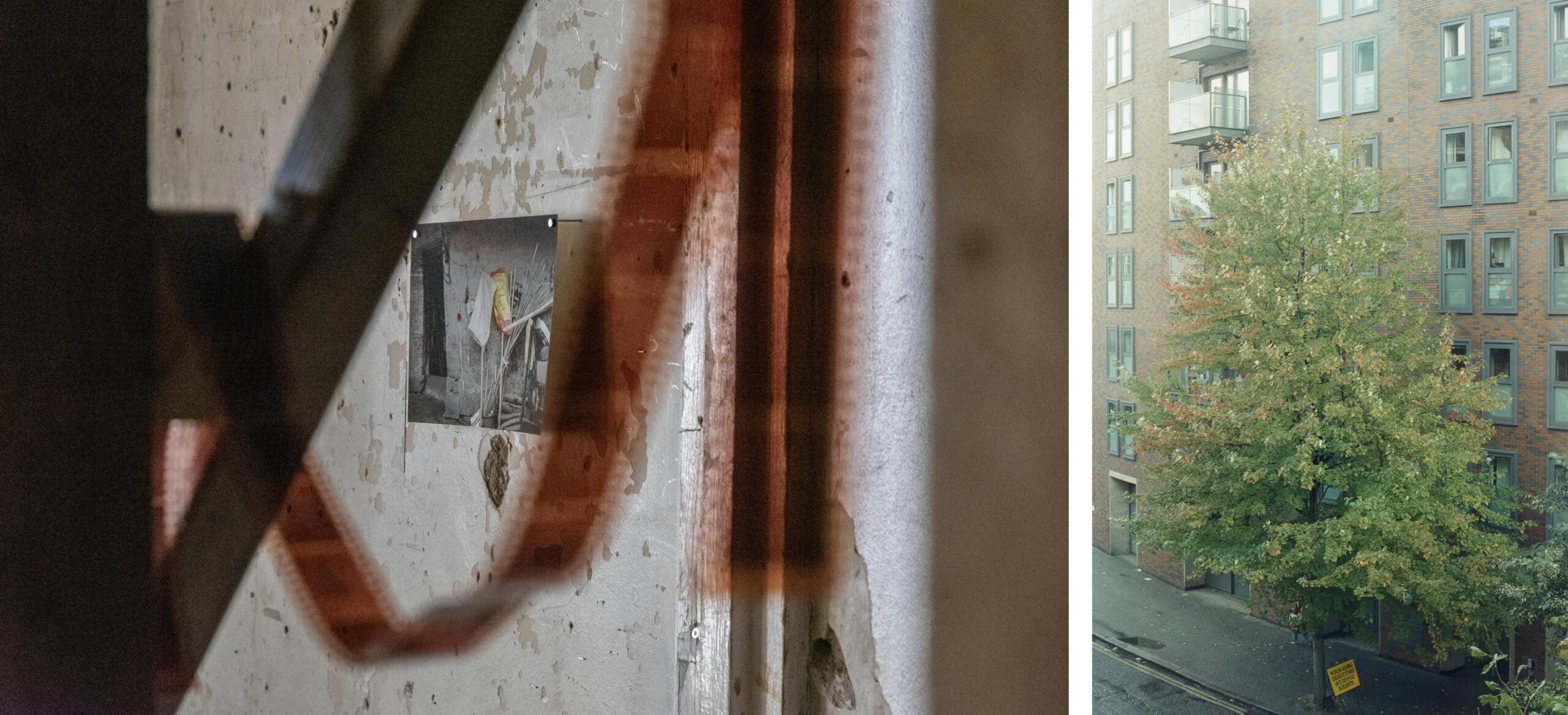
Under the Tree turns its gaze to a large tree just outside the balcony. On a summer afternoon when a road sign had been placed beneath it for construction work, Iris noticed the tree and began a sustained, patient observation that carried her from summer into winter. The still road sign accompanied the tree as it moved from fullness to bareness, becoming a stable anchor amid the shifting rhythms of passersby and traffic. On the day the last leaves fell, the sign was removed, and winter arrived. The falling leaves, the turning light, and the cyclical breath of the seasons are reassembled, through the softness of the negative and the touch of stitching, into a form of seeing that rests closer to the body. The stitching resembles both mending and holding on, a gesture toward grasping a stable coordinate within a life of continuous moving. The work is soft, thin, and delicately fragile, stirring with the slightest wind, weaving a breathing rhythm with the color images floating in the space.
What binds the four bodies of work into a shared exhibition is not simply their engagement with “home”, but the way they collectively reveal how “home” appears within lives marked by continual relocation and shifting ground. “Home” is not a location, nor a fixed emotional memory, but a perceptual field that is continually being generated. It is composed of traces, of repeated gestures of locating oneself, of histories inherited but never lived, of intimacies and distances taking shape. It arises from the surface of ordinary life as much as from the unfinished echoes of memory, at once tangible and vacant, residual yet continuously rewritten.
The two artists’ parallel upbringings, together with their trajectories of moving across different cultural contexts further clarify this theme. The rapidly shifting landscape of East Asia, especially within contemporary Chinese society, shaped by accelerated urbanization and continual collisions of changing circumstances, has produced a distinct intergenerational structure and a uniquely discontinuous texture of lived experience. “Home” thus appears both intimate and distant, tender and detached: it is somehow held in suspension, yet inscribed deeply into the body through language, habit, and culture. As they move across cities, countries, cultures, and languages, “home” becomes at once a pull and a rupture in their lives — both an origin and a direction that remains in continual formation.
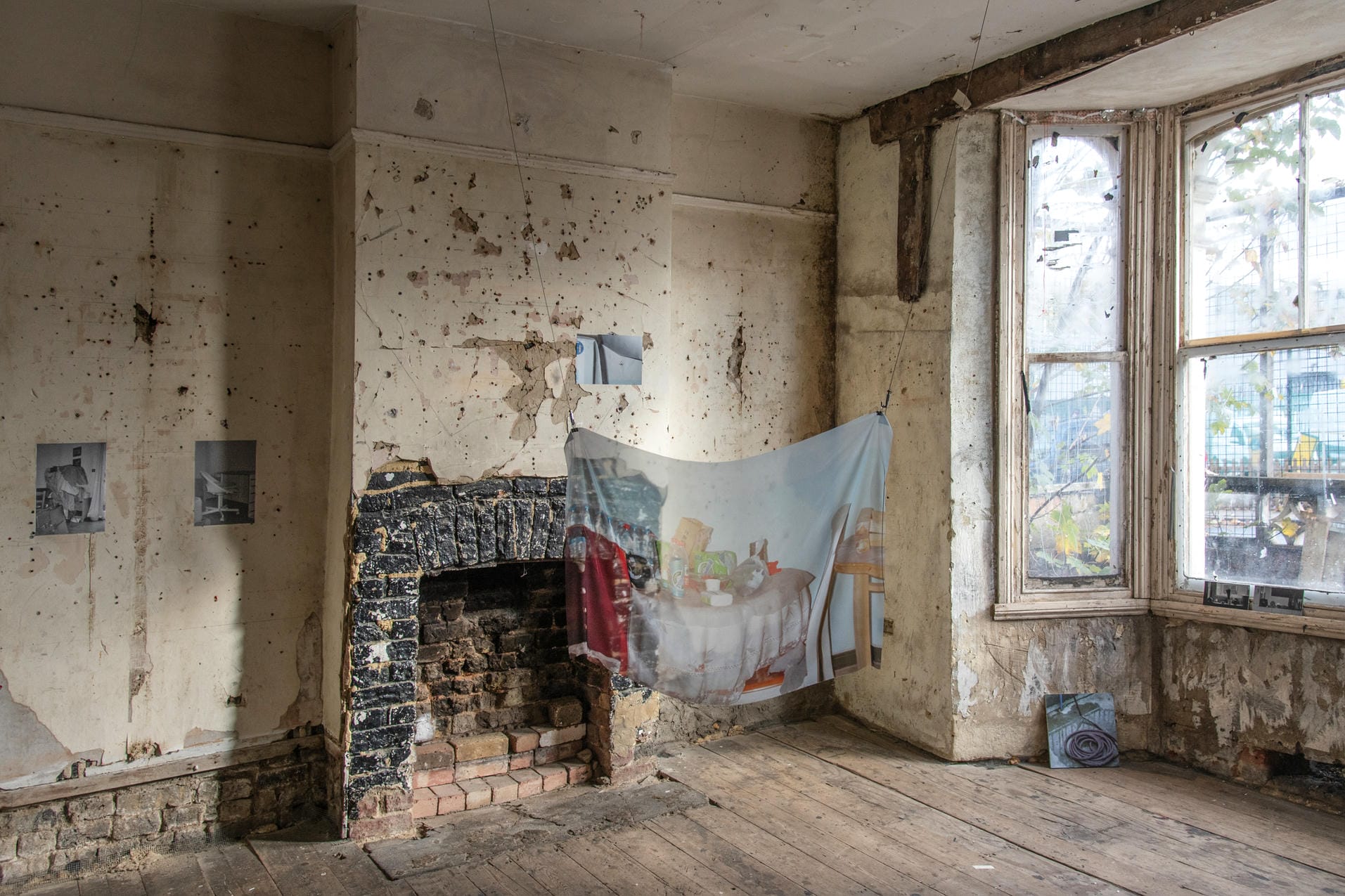
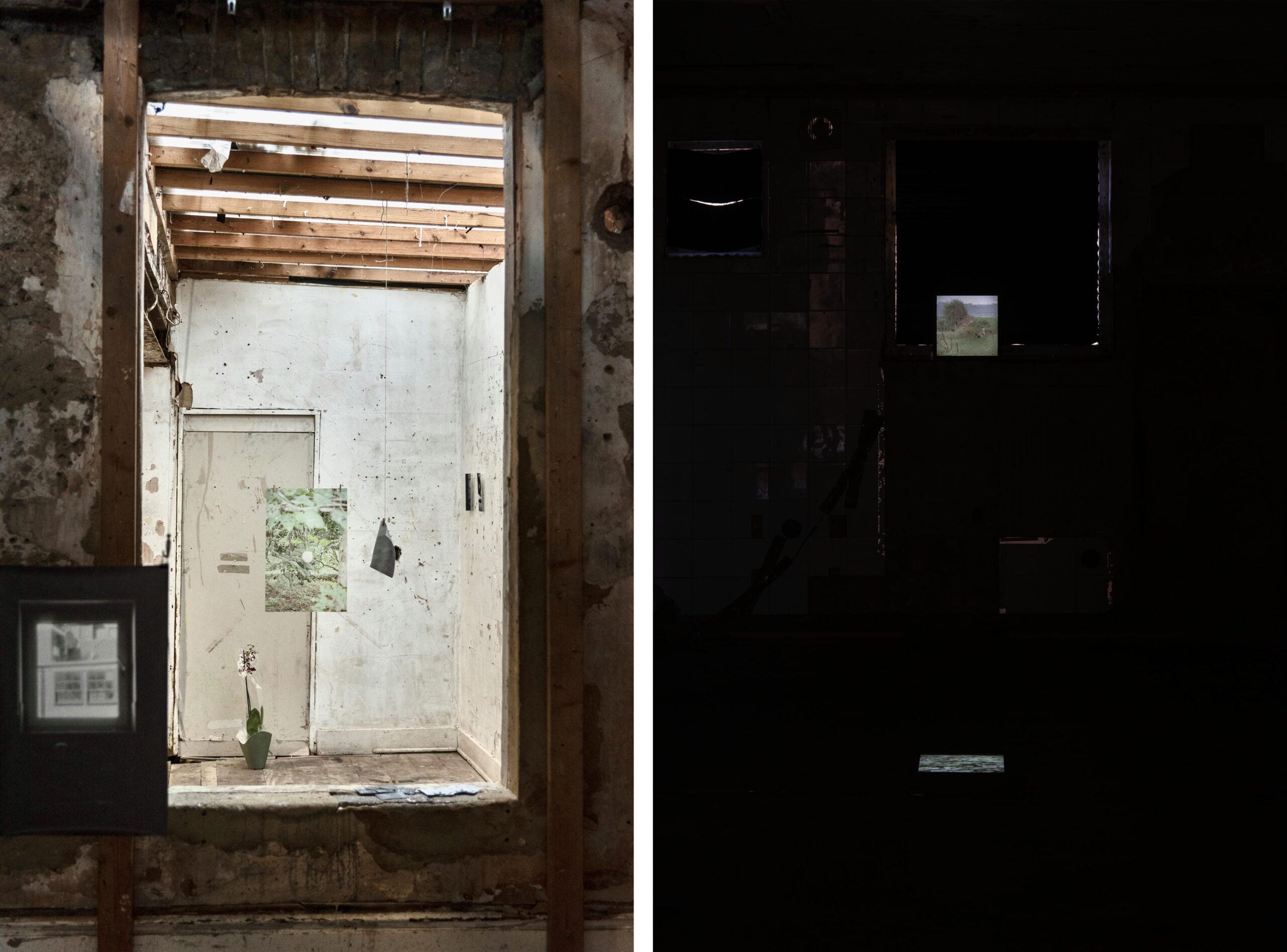
The spatial character of Safehouse 1 is not part of the exhibition’s theme, yet it resonates naturally with the works. Peeling walls, exposed beams, fissures, sealed doors, casually nailed planks, and the traces of a space seemingly always on the verge of being altered constitute a porous environment in which the works are gently woven rather than rigidly installed. Images and space approach one another slowly, forming a rhythm of breath between color and monochrome, between objects and plants.
The fabric prints hang with a gentle downward drift, set in counterpoint to the hardness of the beams, creating a temporary, soft, and unstable structure, like a curtain raised and always ready to loosen again, allowing the shape of “home” to appear and fade with the movement of air. Broken bricks and branches sit quietly, paper surfaces gather slight creases as nails do not align, echoing the cracks of the room. The works settle into the fireplace, gather around raw holes in the wall, move across its fractures and along shifting lines of sight, allowing image and architecture to meet in the seams where “home” takes shape.
On the middle floor, a darkened room is almost entirely sealed from light, with four lightboxes as the only source of illumination, letting the image to appear in the dark as an instance of light, like the form of “home” coming into view within suspended silence.
Unnamed, Unhollow, Unwritten, Unsevered is not to answer what “home” is, but to show how it is sensed, touched, and brought into being. It offers a view of “home” as something held between rupture and connection, steadiness and unsteadiness, as memory and trace suspended yet indelibly present. It is a quiet and intimate attempt to build a personal history through fragments, gestures, and remains. Here, “home” is not a place to return to, but a state continually felt between movement and pause — an unnamed yet unhollow, unwritten yet unsevered “home” that is simply there, quietly present.

