

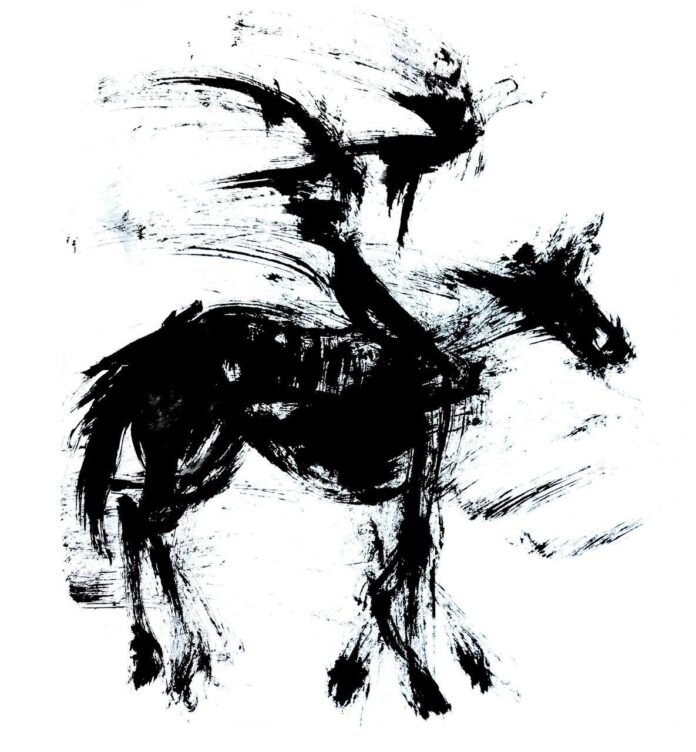
Maya Yaroshenko belongs to a generation of artists whose visual language is inseparable from displacement, fracture, and constant motion. Born in Moscow in 2004 into a family with both Russian and Ukrainian roots, her biography from the outset has been shaped by cultural intersections that, in recent years, have become painfully charged. Sensing instability early on, her family left Russia in 2016. Maya was twelve.
The following eight years were spent in Israel – a formative period in which her artistic identity began to take shape. It was there that drawing shifted from an intuitive impulse into a disciplined daily practice. Crucial to this transition was her mentorship under Ilya Gefter, a major Israeli artist of Russian origin known for working exclusively with mature, established practitioners. Gefter made a rare exception for Maya, recognising in her an unusual sensitivity to form and movement, and a seriousness of intent far beyond her age.
Even during her early studies, her works were described as strikingly alive and emotionally charged. Still lifes, traditionally exercises in restraint, appeared tense and tactile in her hands, as if vibrating from within. What distinguished her work was not virtuosity for its own sake, but an ability to compress feeling into gesture.
Another armed conflict, another relocation.
Today, Yaroshenko lives in the United Kingdom, studies at university, and is steadily building her career as a contemporary artist. Her practice remains in flux-deliberately so. Instead of allowing herself to settle into a recognizable style, she continues to push visual language for its limits, seeking forms capable of sustaining complex and often contradictory emotional states.
It is among the different mediums she has used that ink has proved the most accurate and expressive. It can be done quickly, but lacking in depth. It can be intense, but restrained. Ink records hesitation, resistance, pressure – it does not forgive indecision. To heighten contrast and extend the expressive range of her drawings, Yaroshenko frequently incorporates digital post-processing, not as an aesthetic shortcut, but as a way of amplifying what is already present in the physical mark.
Her ambition is not decorative. She aims to unsettle, to surprise, and to articulate emotional conditions that are difficult to name yet instantly recognisable to anyone living within a tense and rapidly shifting world.
This has had an appeal that has traversed continents. Her works have been exhibited in Russia, Israel, the UK, and Italy, where her works have drawn the attention of not only the audience but also pioneers within the field of modern art.
Trace of the Wind: Movement as Meaning
Created in 2019, Trace of the Wind is one of Yaroshenko’s most coherent and conceptually resolved series to date. The project draws inspiration from Chinese calligraphy – not in its ornamental aspects, but in its philosophy of movement as meaning. Each work is executed in black ink using a dry brush technique, later refined through digital intervention.
Here, motion itself becomes the primary carrier of sense. The recurring motif of the horse is not symbolical, in the traditional sense, and serves instead as the conduit for certain internal conditions, those of resistance, momentum, and endurance. The series revolves instead around the sense of wind as an external and internal push and holdback.
Windbound freezes the moment of resistive balance. The horse is poised against the unseen force, its body defined through the rapid, controlled movements. The image is poised in a state of balance, with the movements frozen, suspended. It is not about defiance as spectacle, but about the quiet discipline of standing one’s ground.
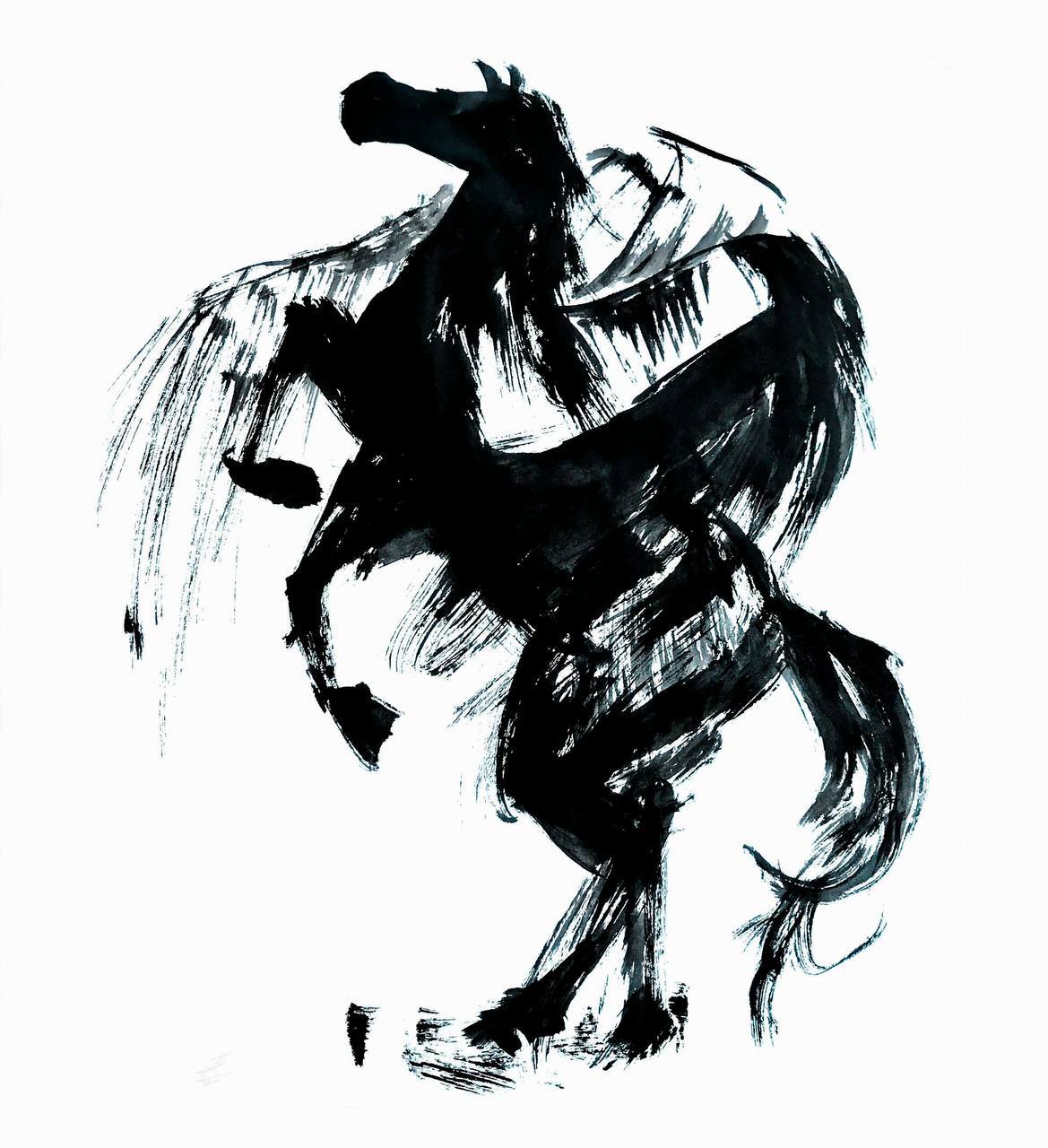
2019, ink, dry brush and digital, 32 × 32 cm
Storm Within turns the energy inside. The raising horse is not the symbol of power, but the response to the pressure that is building. The dry brushstroke breaks the body down into oscillating marks, implying volatility and discharge. The figure is clearly caught between falling apart and blowing its top.
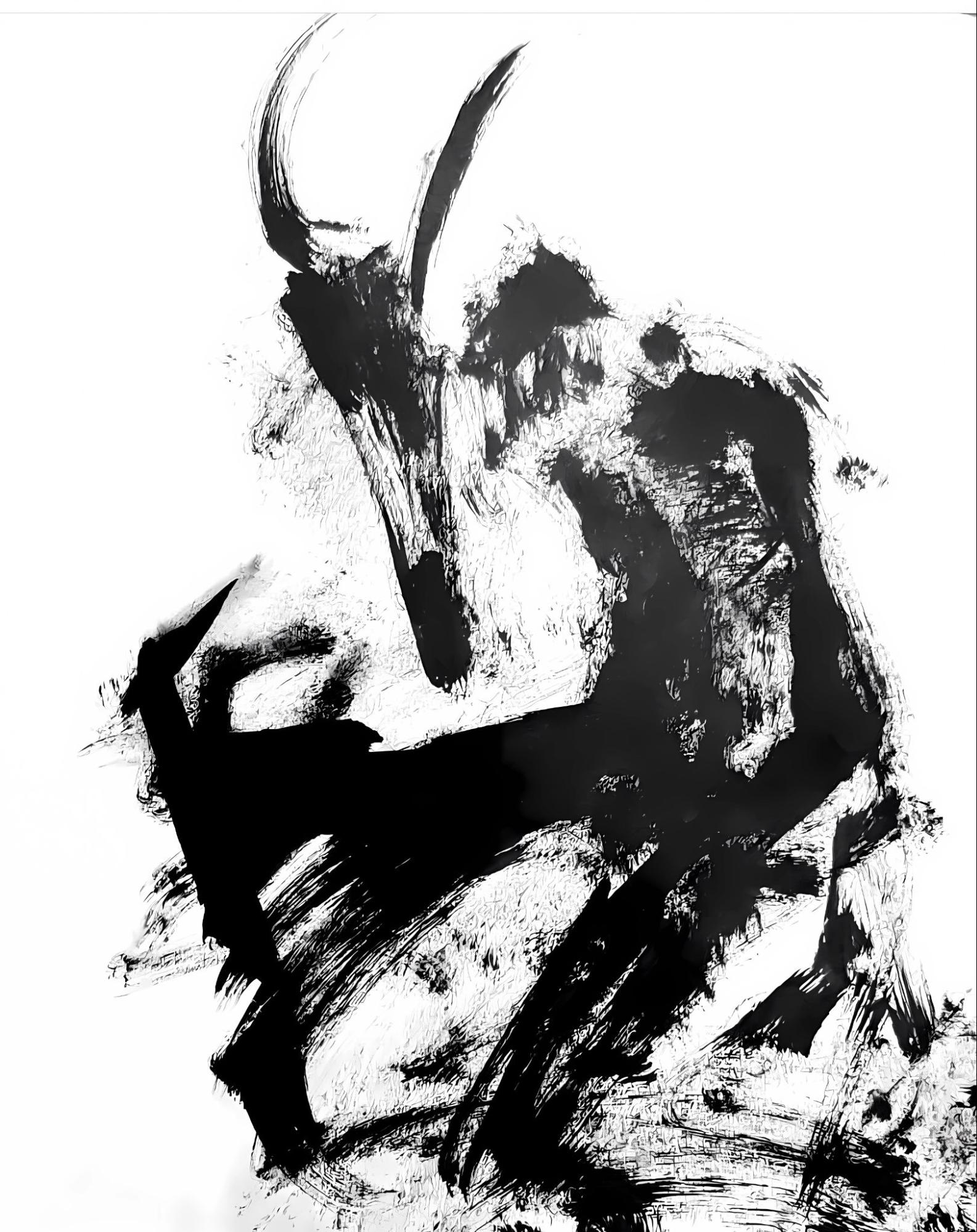
2019, ink, dry brush and digital, 32 × 32 cm
In Daemon, the darkness reaches a peak. It is where the lines come together to form a shape that is not strictly representationa l – the abstraction of a figure that is screaming in agony. The surface has a textured quality that is close to being abrasive. This is not an illustration of a creature, but a visualisation of inner conflict made external. The weight of the brushwork produces a sensation of compression, as if the image itself were struggling to breathe.
Throughout the series, the fact that black ink is used exclusively elevates the hellish and brutal connotations of the imagery to a phenomenal degree. The use of dry brushwork lends unpredictability to each line, so no line is passive and resolved. Even in instances where there is no movement, the drawings pulsate.

