

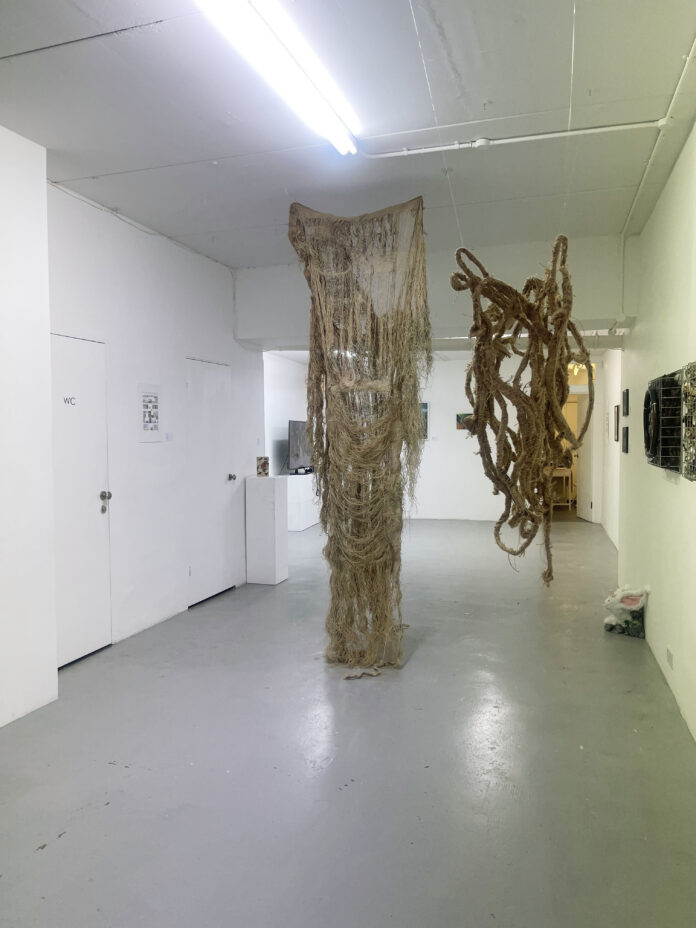
Entering the space of Kairós: Between Choice and Fate at Batsford Gallery has a very charged yet subtle quality. The gallery’s atmosphere seems more akin to a threshold than an empty box for exhibiting artworks. This feeling of being suspended is deliberate, and it makes perfect sense. The exhibition is based upon Kairós, the Ancient Greek term that refers to that critical juncture where chance, choice, and destiny are aligned. At first glance, the show sets itself up in that fragile space of uncertainty and choice as being experientially lived, as opposed to merely stated.
Kairós: Between Choice and Fate was organized by PA Art; PA Art is a long-standing supporter of contemporary visual art, curator experimentation, and the growth and development of artists. As such, PA Art functions within the changing landscape of London’s art community as a connective tissue between artists, ideas, and larger cultural conversations. That attitude is very apparent in this exhibition. The exhibition does not express one unified idea. Rather, it provides a platform for multiple voices to converge, intersect and sometimes contradict each other.
Hui Qi and Huan Zhou curated Kairós: Between Choice and Fate and have resisted the urge to represent freedom and fate as mutually exclusive. Instead, the exhibition treats freedom as an interdependent entity; as something that is often compromised and influenced by factors including our psychological habits, social structures, technology, and inherited stories. Therefore, the exhibition serves as a meditation on how choices emerge under constraints, and how the decisions we make are rarely as autonomous as we would prefer them to be.
Anatomy of a Belief by Yu Yu (Spencer) is perhaps the most psychologically engaging work in the exhibition. The work is exhibited as a diptych composed of mixed media and relates to the phenomenon of confirmation bias. An abstract behavioral concept is rendered in a tactile and unsettling way. The left side of the panel is compact and restricted. Red yarn is threaded throughout fractured material and creates a visual enclosure which illustrates how information-based environments can confine thought and identity alike. The sense of confinement experienced here is similar to the experience of being surrounded by an algorithmically-supported belief system.
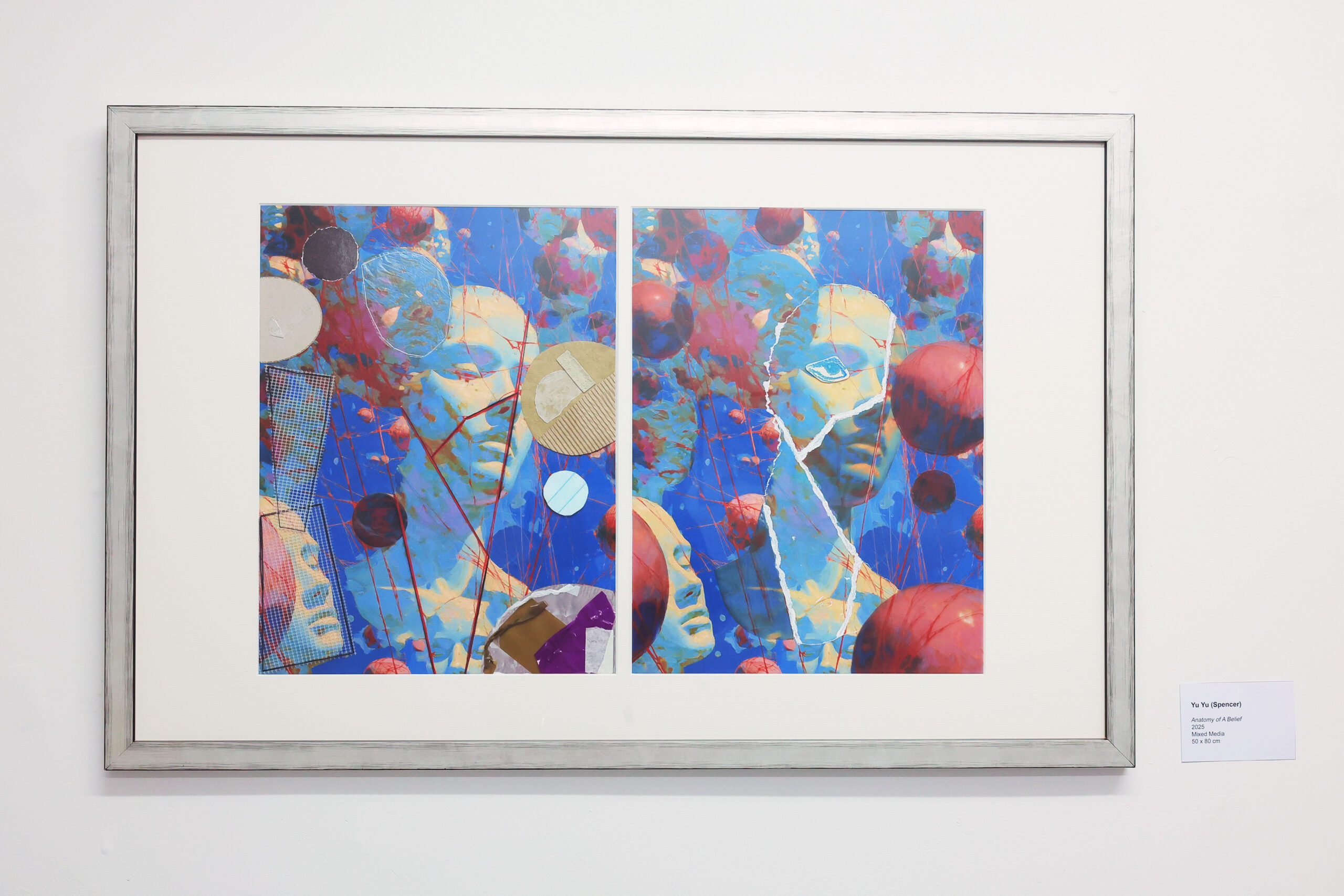
The right panel does not provide release, instead it creates disruption. The figure is broken apart and remade, with an additional eye symbolizing awareness rather than escape. Spencer portrays self-awareness as a laborious and disorientating process. To see is not to be free immediately, but to face the discomfort of realizing your cognitive boundaries. Within the exhibition’s overarching structure, the work represents the relationship between agency and inevitability. We perceive our beliefs as being selected by us, however they are frequently unconsciously constructed well prior to our recognition of them.
While Spencer examines the structural influences of belief, Manlin Zhang examines the origin of thought. Intelligence in Motion-Dreaming Butterfly is an oil-on-claybord painting that depicts intelligence before it develops into language or logical constructs. The surface is alive, and holds the forms of both intuition and computation in a state of ambiguity. Everything is fluid. Thought appears to be recursive, incomplete, and inconclusive.
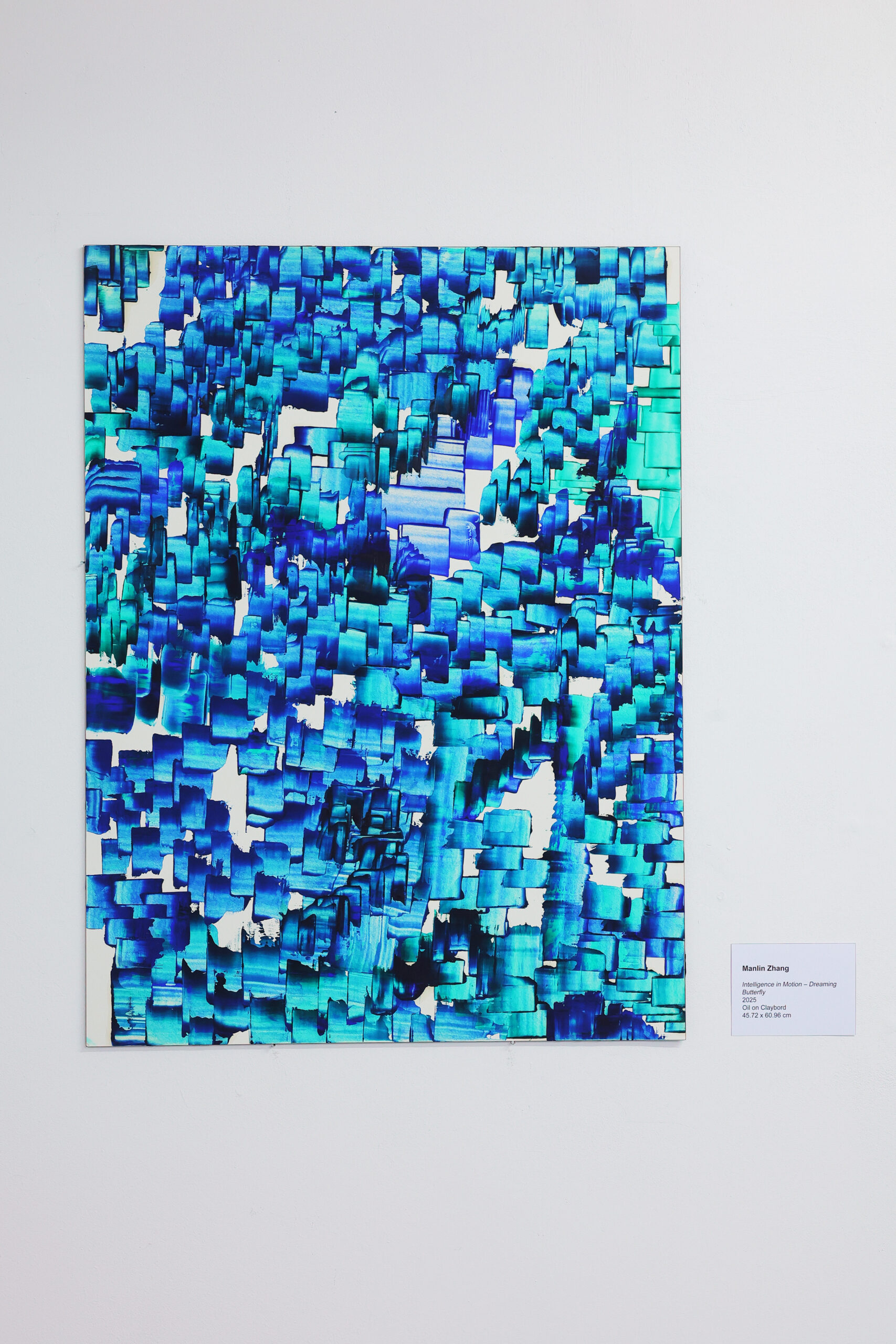
A fragile equilibrium exists in the work, and there is an indication that meaning is forming, but that it has not made a decision as to what form that meaning will take. In the context of Kairós, this is a pivotal moment. It is the point of transition before a decision is articulated, and before an action evolves into a consequence. Zhang’s painting reminds us that freedom may be most active in those pre-symbolic realms where intelligence remains in flux and results remain undefined.
Bob Holmes’ use of a more obvious symbolism is evident in Broken Continuum. Two female bodies are merged into a single fragmented body, eliminating the distinction between the self and others, memories and perceptions. Blindness and awareness are present in an uneasy balance, indicating that insight is never total, and that vision is always incomplete. Animals and botanical motifs appear throughout the composition, referencing ancestral memories, folkloric traditions, and myths.
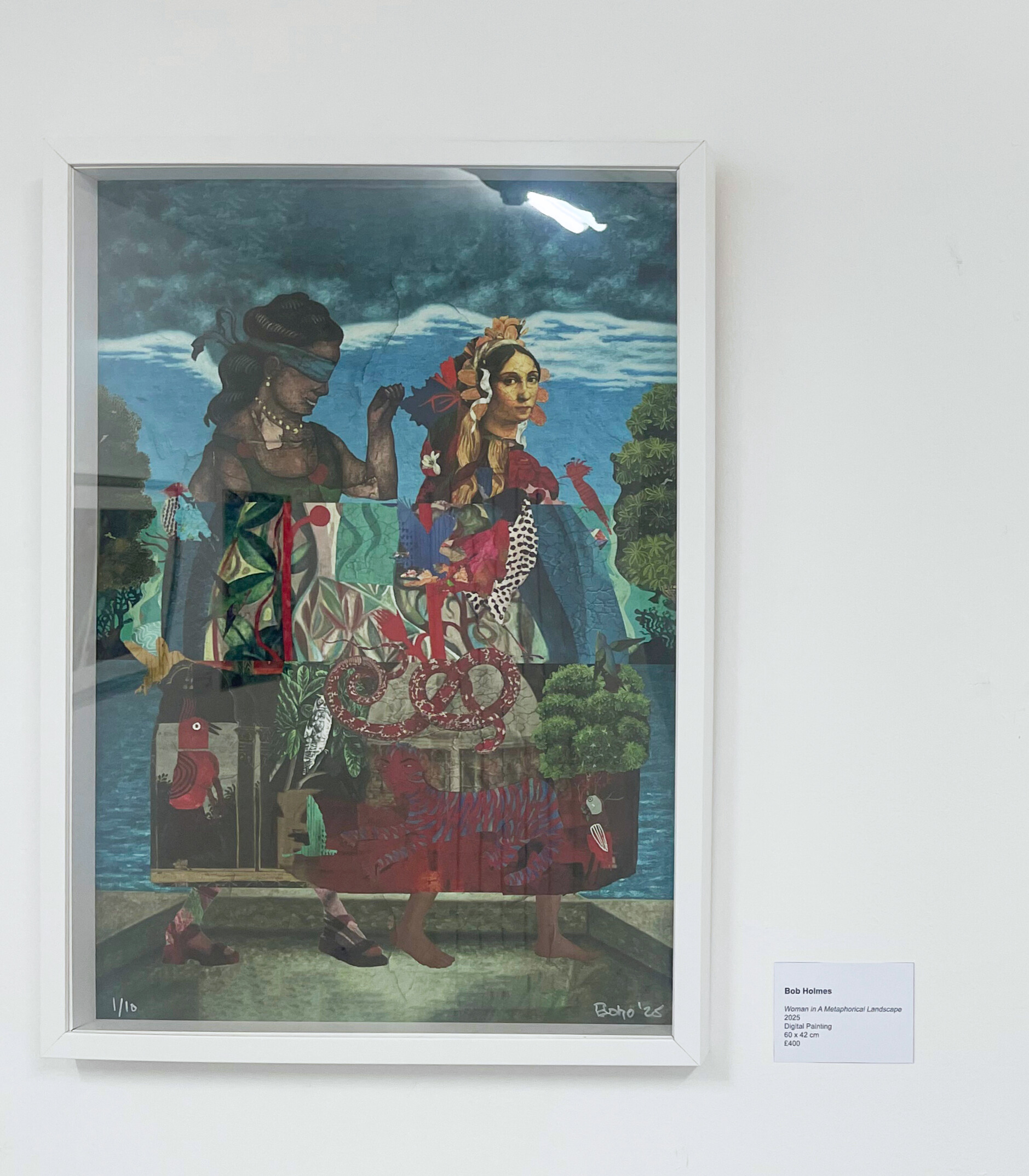
Holmes appropriates the visual elements of Classical Portraits; however, he disrupts them through their fragmentation, layering and disjointedness. As such, the portrait appears to be both solidified and at the same time disconcertingly unrecognizable. Justice, inner sight, and internal blindness to the divine emerge, but they do so without finality. In this way, the work occupies a state of ambiguity as opposed to one of moral clarity; thus, it is consistent with the exhibition’s reluctance to represent choice as being either positive or heroic. Ultimately, the work demonstrates that choice is intertwined with what we inherit, what we forget and what we fail to see.
The opposition between apparent control and structural constraint is made visually explicit in Direction Illusion by Henryk Terpilowski. Compressed seed pods are a powerful symbol of growth and possibility which are embedded in a steel lattice grid. On top of the seed pods lies a found steering wheel; while the steering wheel is a ubiquitous symbol of human agency and direction, it is stationary. Therefore, it has no ability to turn.
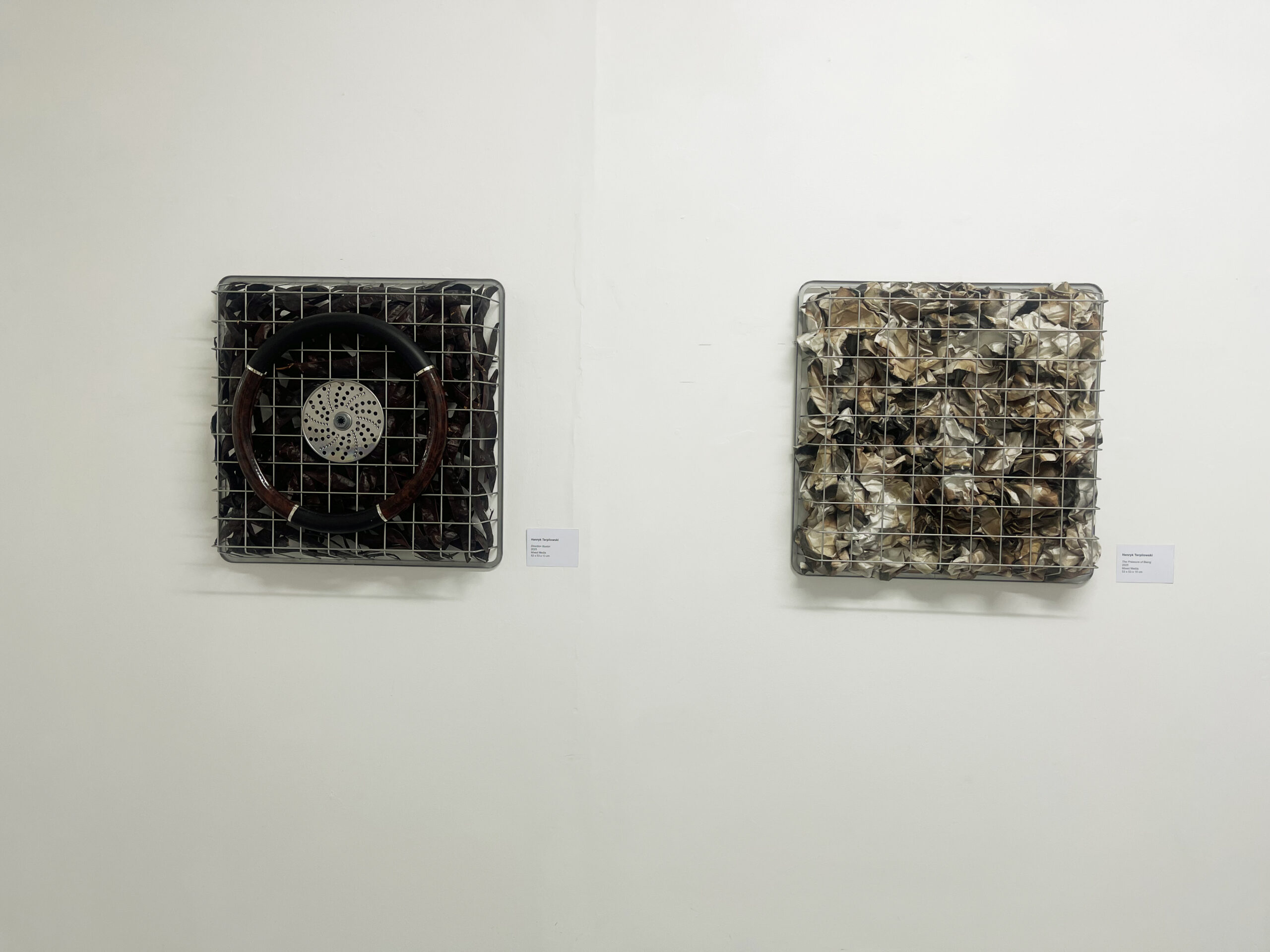
The visual impression is immediate and subtle yet disturbing. Within a single object exist natural capacity, human intent and structural constraint. The work posits that our gestures of control are merely ritualized motions that occur within systems that determine the parameters of all possible outcomes. While the steering wheel implies choice, it provides none. It serves as a stark illustration of how quickly symbols of agency can camouflage structural limitations on freedom.
The presence of multiple artists (Alice Boot, Anastasia Neff, Eskild Beck, Gera Dunachie, Luke Bacon, Marian Obando, Rachel Barlow, Xiaohan Sun, Xiaoxiao Chen, Xiwen Xu, Yao Feiyun, Yilun Liu and Jiawen Zin Zhang) adds additional dimensions to the exhibition as opposed to each artist vying for attention. Their contributions collectively create a multilayered context of viewpoints. The overall atmosphere of the exhibition is conversational as opposed to didactic with each artist adding a unique nuance to the central inquiry of how choice functions in today’s society.
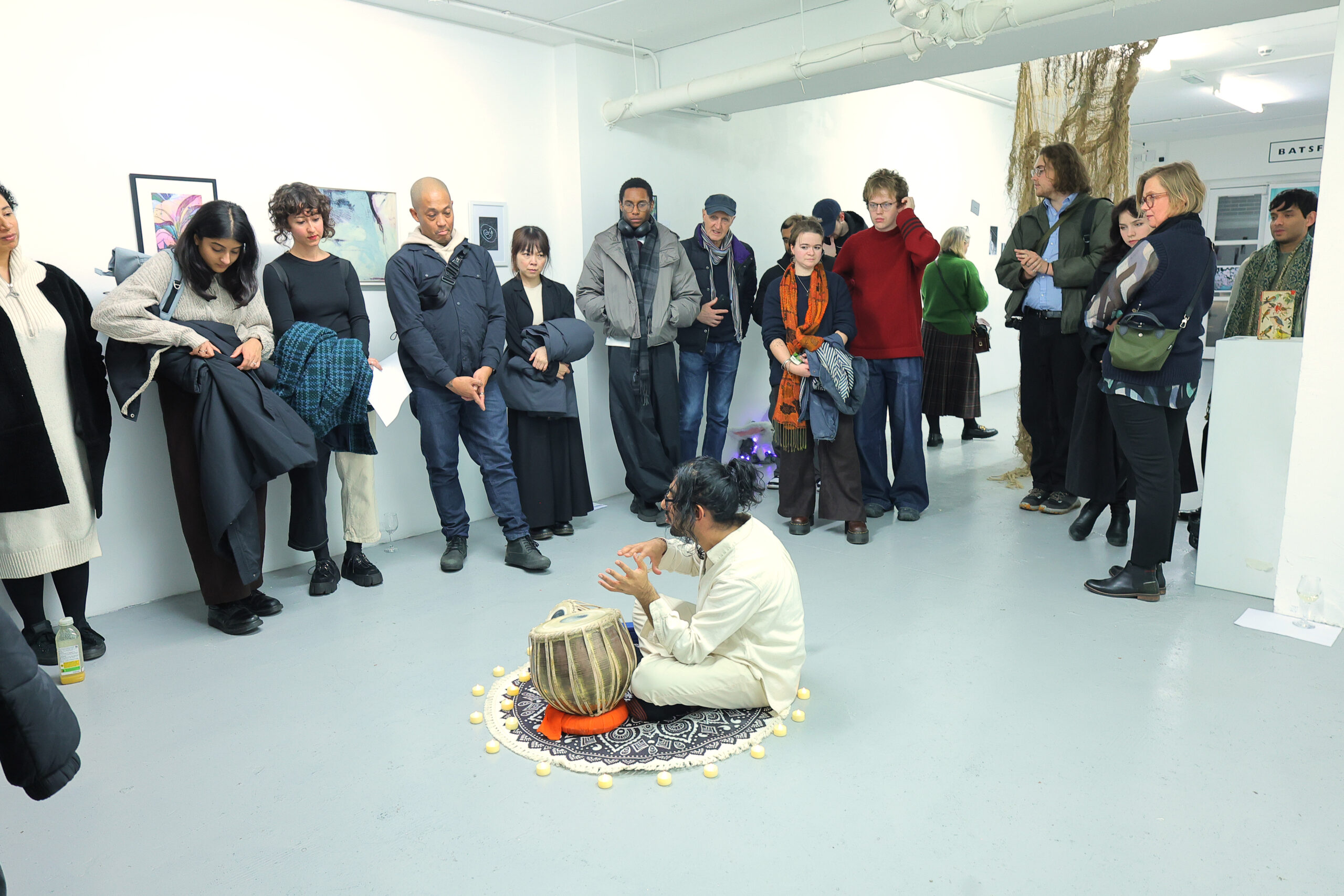
A live performance by Jay Mistry contributes to the temporal element of the exhibition. Performances take place solely in the present. They cannot be completely captured or replicated. The addition of performance reinforces the notion that certain types of agency are ephemeral, embodied and irreversible.
Ultimately, it is the exhibition’s willingness to leave questions unanswered and to avoid defining freedom and providing ways to regain lost freedom that distinguish Kairós: Between Choice and Fate. The exhibition creates a space in which ambiguity regarding freedom is both accepted and celebrated. Through the careful curation of Hui Qi and Huan Zhou, the exhibition develops into a space of reflection rather than conclusion.
Given the current cultural obsession with optimization, clarity and control, the refusal to provide answers or solutions to the dilemma of freedom seems relatively radical. The exhibition suggests that perhaps true freedom will not come about when individuals master systems, but rather when they recognize the points of intersection between decision and destiny. When choice does not cancel out fate, but instead comes close to it, there occurs a temporary shift.
Artists include Alice Boot, Anastasia Neff, Bob Holmes, Eskild Beck, Gera Dunachie, Henryk Terpilowski, Jiawen Zin Zhang, Luke Bacon, Manlin Zhang, Marian Obando, Rachel Barlow, Xiaohan Sun, Xiaoxiao Chen, Xiwen Xu, Yao Feiyun, Yilun Liu, and Yu Yu (Spencer).
The special performance is by Jay Mistry.
The exhibition is curated by Hui Qi and Huan Zhou.
Photography is by Jiaqing Chen.
Exhibition support is provided by Chün-Tse Chang and JiaJun Huang.

