

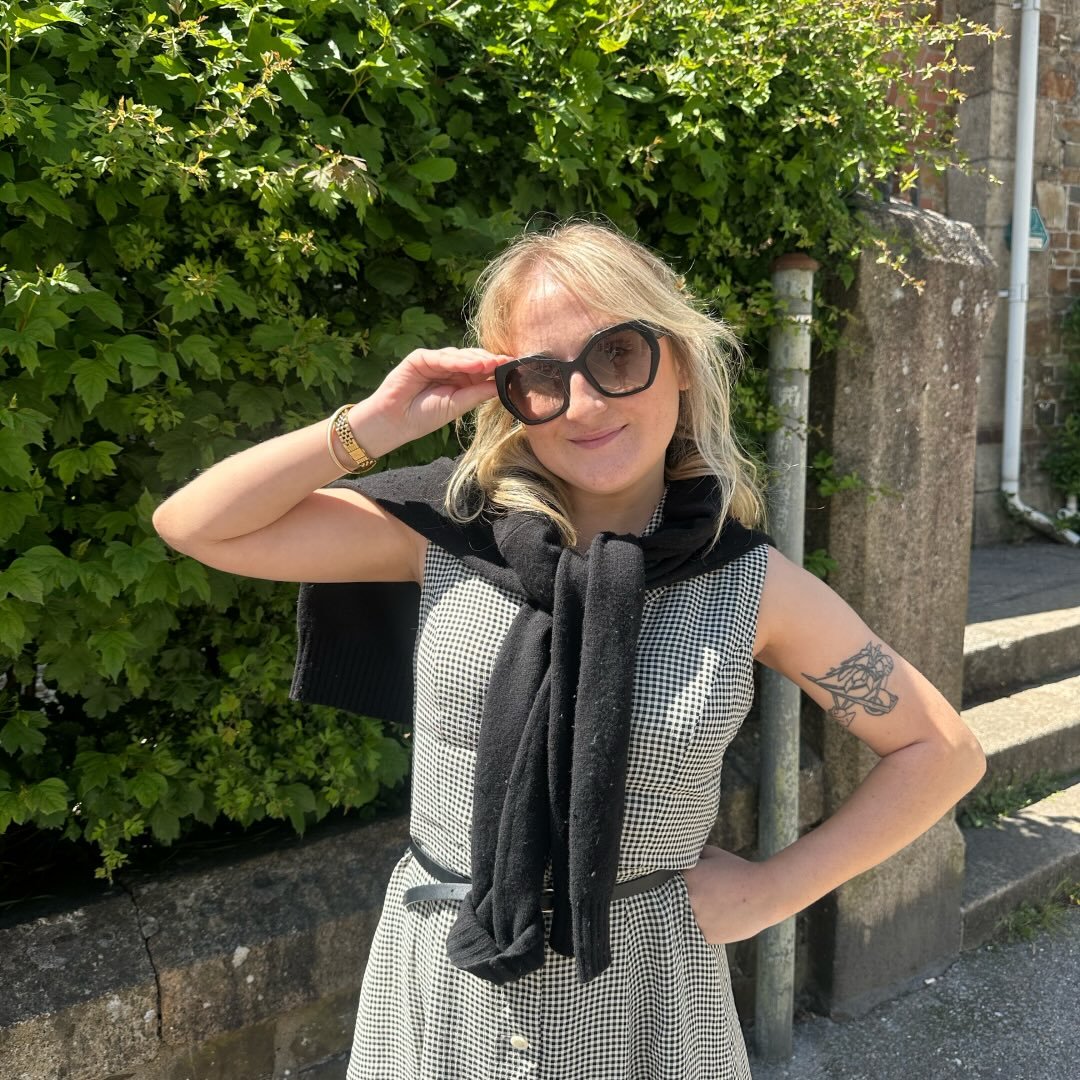
Emily Pink is a climate justice advocate with a particular focus on slow fashion and literature. Her platform The Conscious Press, active on Instagram, TikTok and Substack, seeks to empower and educate people to see themselves as so much more than consumers, and to recognise how climate action requires the action of us all to succeed. She frames her work through an intersectional lens, informed by her lived experience with Cystic Fibrosis, of which she raises awareness whenever she can. Her professional experience spans publishing, journalism, digital marketing and sustainability engagement, and she loves nothing more than walks in nature, good books and baking sourdough.
How did The Conscious Press come about, and what inspired you to focus specifically on the intersections of sustainability, fashion and literature?
It all happened a little serendipitously, but looking back, I do think it was only a matter of time before I created a platform to air my views. I spent a lot of my childhood and teenage years in the hospital, and it was my love of learning that helped me through the uncertainty. I was fortunate enough to benefit from the incredible Chelsea Community Hospital School, which provided me with invaluable support and routine in a period of my life that was undeniably frightening. It was here that my interests converged, where the brilliant Ben Lewis offered me a course on anything I wanted, and I chose Fashion Sustainability. Even in the non-glamorous environment of a hospital, fashion served as an outlet for me to experiment and develop my own confidence. And sustainability? I started to reckon with my own consumption as a teenager, realising that learning my own style and vibe also contributed to a fast-fashion mindset. I wanted to connect the dots between the clothes in my wardrobe, the people who made them and the planet whose resources they required.
This course planted a seed, and ever since, I have been a fierce sustainability advocate – in college and university, personally and professionally. I officially created The Conscious Press, then named The Little Wardrobe, in April 2023. My undergraduate and postgraduate studies in English and Publishing, respectively, led to the formation of The Conscious Press – a space that considers the intersections of literature, fashion and sustainability. What started as a collection of questions in my mind has blossomed into a multi-channel platform, and my passion and belief in a better world for us all only grows.
You’re a strong advocate for slow fashion. For someone who wants to transition to a more sustainable wardrobe in 2026, what would you say are the first few steps they should take?
I actually just posted a ‘no-bull’ guide to starting a slow fashion wardrobe, and the initial steps are incredibly easy. Just stop buying clothes, even for a little while. I often direct people to Remake’s #NoNewClothes challenge, which suggests people stop buying clothes for 90 days to break their consumption cycle. I find writing down everything that I get the urge to impulse buy, and I am always surprised by how disinterested I become in the item after the initial desire to buy has dulled. After you’ve reset your mindset about when and why you purchase fashion, head to your wardrobe – that’s where the magic happens. Audit your clothes, take stock of literally everything you own, and be mindful of what you wear the most and least – a process I’ve documented in a digital wardrobe-audit resource of my own. And perhaps the most significant step you can take, in my opinion, is to learn basic repairs! I’m talking about simple tasks like hemming, closing holes and replacing buttons, which can all be done without a sewing machine. These three steps are hugely impactful and relatively easy to do, but they have helped reframe exactly how I view fashion and my personal consumption habits.
Publishing might not be the first industry people associate with climate action. What are the most significant environmental impacts of the book industry that surprised you, and how can readers make more conscious choices?
My postgraduate dissertation, ‘Our (Publishing) House is Burning Down: A Radical New Book Industry’ looked at this question in detail. I think people have an issue with considering publishing’s environmental impact because of the product that it deals in. Books have long been removed from the conversation because they are protected by their position as harbingers of knowledge, culture and literacy. In other words, they provide a tangible value to the world around us, and that can make us less inclined to equate publishing with the dirty world of climate destruction.
Publishing has a monumental environmental impact, churning out 2.2 million titles every year (UNESCO), and the reality is that landfills welcome at least 320 million books every single year (Berendsen). If we think in really granular terms, books are made up of pulp, paper, ink and glue – each posing very real environmental impacts. One of the biggest impacts of publishing is, unsurprisingly, production. The WWF declares that 33-40% of industrial wood is traded for use in the paper and pulp industry, and it does not take much research to see the monumental amount of damage this can have on vulnerable habitats and indigenous populations across the world. The work of organisations such as the World Wildlife Fund (WWF) and the Forest Stewardship Council (FSC) are crucial in ensuring publishers and associated businesses take the required accountability. The Executive Director of the Tropical Forest Alliance, Jack Hurd, stated, ‘risks to nature are risks to business’, and nowhere is this more prevalent than in publishing. There are no books on a burning planet.
For me, there’s a clear way to reduce your impact when you consume literature – use your local library! Put your effort into supporting small-scale community hubs instead of blood-sucking conglomerates, and consume literature in an accessible and affordable way. Aside from this, choosing second-hand books or prioritising book purchases from small independents all help to support your local literary scene and reject Amazon’s monopoly of the industry.
What are your essential climate book recommendations — perhaps one for someone just starting their climate journey and one for someone ready to dig deeper?
My undergraduate dissertation looked a little more creatively at climate and literature, and one of my chapters focused entirely on It’s Not Just You by Tori Tsui. A climate justice activist herself, Tori eloquently explores feelings of eco-anxiety and how to use them for good. The concept of radical joy is one that I love learning about, and it’s a mindset that I try to return to as much as I can. It’s Not Just You does a really great job of balancing the obviously terrifying reality of climate breakdown with practical and hopeful moments of community care and resilience.
I also love to recommend Braiding Sweetgrass by Robin Wall Kimmerer. She is a truly beautiful storyteller, weaving together botanical expertise, climate change discourse and indigenous wisdom. We can learn so much from indigenous communities and their relationship with the land, and Kimmerer’s reflections on exploitative and extractive practice is incredibly profound – a must-read. I particularly love her quote: ‘What happens to one happens to us all. We can starve together or feast together’ (Kimmerer 15). It reminds me why I put in the work to make climate justice accessible, and highlights why community care is such a crucial tenet of an intersectionality just world.
How has your Master’s degree and experience working in publishing shaped your understanding of how the industry can — or should — be addressing climate issues?
I do think that my experience in the industry has reminded me how much people care. Not only do publishing professionals care deeply about the books they contribute to, but they feel similarly for a planet under threat. There is a huge amount of work underway at every level of the industry to mitigate its impact, from print-on-demand publishing to sustainable font development to community engagement. One of the most exciting efforts is Publishing Declares – a manifesto for climate responsibility currently signed by 224 publishing houses. Signatories, among other things, promise to achieve net zero by 2050 at the very latest, advocate for sustainability wherever possible and collaborate with players across the industry.
Ultimately, I think publishing houses need to be more radical in how they are approaching climate change. The mindset is still very much focused on quantity as a measure of success, and issues such as overproduction, returns and distribution loom large over publishing. There is still so much to be done, but I remain hopeful that the industry will continue to push for authentic climate action and challenge the status quo with more vigour.
In your post about rebuilding attention spans, you connect digital wellness with sustainability. Can you talk about how you see our consumption of content relating to our consumption of physical goods?
This connection is something I’ve been mulling over for the past few months. As someone who spends so much of their life online, I’m conscious that my screen time is not always supporting my wellbeing. As a disabled climate activist, online spaces have been crucial hubs for me to connect with others and champion causes I care about, helping me to recognise that I belong in the movement. But it’s also true that spending so much time online can be detrimental to our physical and mental well-being.
There’s an interesting shift happening on socials right now: the age of analogue. That is, people want to reject digital media in favour of returning to a slower, physical way of life. Think journaling, scrapbooking, puzzles, reading newspapers and magazines in print. I’m not immune to the pull of this new trend, having asked for a sunrise alarm for Christmas (I hate waking up to brutal iPhone alarms). What I worry about is how we perceive this analogue lifestyle – is it simply another way to overconsume, under the guise of slowing down and recalibrating with our physical world? I don’t doubt that adopting some analogue habits is a positive step towards slowing down, reconnecting and recognising our position in this chaotic world, but there’s a fine line between authentically practising a more offline life and performing a version of analogue living for an online audience. I would just say, think about what you’re consuming in consequence – do you need a journal for every aspect of your life? Do you need to buy absolutely everything for a new hobby that you might not enjoy?
In defence of the digital, I enjoy consuming content that challenges my own worldviews and educates me on topics that I was previously unfamiliar with. We all have so much to learn from one another, and curating your feed is a great way to reject many things, from an overconsumption mindset to AI slop. There’s power in recognising what fulfils you online, and what stifles your critical thinking and creativity. The digital world is a tool that I am constantly learning and unlearning, and I don’t think the work will ever be done in that regard.
What gives you hope when it comes to the future of climate-conscious living?
So many things! The people I have met and connected with since starting The Conscious Press continue to inspire and empower me every day. Community is perhaps the most fundamental tenet of climate justice and advocacy, and without it, I would be shouting (very loudly) into my own echo chamber. I am particularly passionate about grassroots work – small-scale projects run by passionate and brave changemakers. Without these movements, the cause would be disproportionately represented and, in turn, any progress would not be inclusive. I continue to champion grassroots work because I believe deeply in small, cumulative action and its power to mobilise others. All significant movements in history have relied upon the hard work from the bottom up, and I know that climate justice cannot be authentic or self-sustaining without it.
Watching people reject a world that is increasingly hostile and violent reminds me that ‘action is the antidote to despair’ (Joan Baez). Connecting with others, educating yourself and learning to slow down is a direct rebellion of a world that encourages us to see our productivity and consumption as a reflection of our worth. If you feel outraged – good. Channel it into something bigger, because our planet depends on it.

