

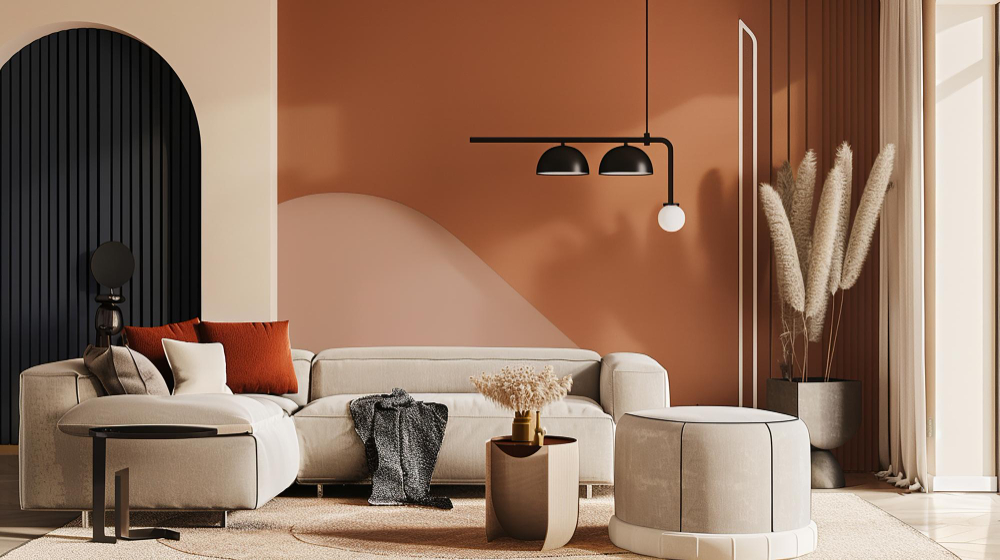
Design icons rarely begin as “icons.” They start as private obsessions: a coastline studied in silence; a word invented to capture a movement; or a sketch that keeps returning until it finds the right material in which to live. What we call a classic is often just the visible tip of a longer story made of cultural memory, technical experimentation, and a designer’s unique perspective on the world.
When it comes to designer furniture, it’s not like any chair you find at a discount store in the mall. Behind a Poltrona Frau wooden table or a De Sede leather armchair, there’s always a deeper story at work, a specific inspiration shaped by a designer’s interests, passions, or personal experience. In that sense, a living room can be read like a small gallery of creative artworks, where furniture is translated into storytelling, and geometry is turned into social space. Once you start following the thread of inspiration, these objects stop being just decorative pieces and start behaving like cultural documents.
A Sofa Born From Rock: Edra’s On the Rocks Sofa
While traveling in Puglia, Italy, Francesco Binfaré noticed how beachgoers easily adapted to hard rocks by shifting, folding, and leaning until the rocks felt almost accommodating. This “comfort” did not come from the surface, but from the body’s intelligence and instinct to find a comfortable position.
This observation led him to ask: Can a material accommodate any posture without forcing the body into a single “correct” way of sitting? For Binfaré and Edra, the answer became a research project disguised as a sofa, the development of Gellyfoam®, a special foam designed to provide both softness and structural support. Rather than treating comfort as a cushion problem, the On the Rocks sofa treats comfort as an adaptive landscape, something closer to geology than upholstery.
On the Rocks isn’t trying to look natural; it aims to behave like nature: supportive, irregular, permissive, and surprisingly logical once you surrender to it.
Naming the Shift: B&B Italia’s Camaleonda
Mario Bellini named his modular system sofa Camaleonda, a neologism that fuses camaleonte (chameleon) and onda (wave). It’s one of those names that not only labels an object but also describes its logic. A chameleon suggests change and adaptation, while a wave suggests flow and rhythm. The idea is that a shape can keep reforming without losing its identity.
That’s the essence of the Camaleonda: a seating system designed to be reconfigured and personalized for different rooms and phases of life. Rather than being inspired by a landscape or craft technique, the sofa is inspired by a cultural behavior: the way people gather, sprawl, host, retreat, and rearrange their domestic world. Bellini has built a sofa that’s less of a single statement and more of a toolkit for social life.
This kind of modularity feels iconic rather than utilitarian because it maintains a strong visual character while remaining open-ended. The system remains recognizable even when its shape changes, which is an important condition for anything that wants to become an icon.
In a culture that loves reinvention, the Camaleonda transforms reinvention into a stable identity. It is an object that anticipates motion rather than resisting it.
The Cloud as a Social Space: Cassina’s Moncloud
Patricia Urquiola’s Moncloud sofa is based on an emotional concept: a generous refuge designed for comfort and socializing. However, the inspiration is also technical and, importantly, culturally contemporary: the desire to rethink upholstered furniture with a more circular approach to design.
The name of the sofa cues the image of a cloud, but this cloud is engineered. A wooden structure lifts the upholstered pieces off the floor, making the entire composition appear to hover. This is one of those design choices that changes how a room feels: weight becomes buoyancy and mass becomes suspension. The piece doesn’t deny its softness; it showcases it.
Then there’s the upholstery itself. The fabric wrap creates a distinctive fold, a controlled gesture that sharpens the profile and renders the outline legible from across a room. It’s a reminder that “soft” doesn’t have to be vague. Softness can have edges, rhythm, and precision.
Geometry With an Artistic Reference: Poliform’s Mondrian
With Poliform’s Mondrian sofa, Jean-Marie Massaud draws inspiration from a different source: art history as a structural grammar. Rather than printing colors onto cushions, the sofa system nods to Neoplasticism and the paintings of Piet Mondrian by adopting a disciplined language of squared forms, strong geometry, and an architectural clarity that reads as graphic in space.
This matters because the most convincing art references in design are rarely literal. In this case, the rule is compositional rigor, a grid-like logic that can produce warmth when translated into upholstery. The result is a living room that feels organized yet not stiff, precise yet not sterile.
The Futuristic Armchair: Poltrona Frau’s Sanluca
The story of the Sanluca armchair begins with subtraction. Achille and Pier Giacomo Castiglioni set out to remove all the traditional padding until only the curves “strictly necessary” for support remained. This approach reduced the armchair to the minimal geometry required by the human body and helped make Sanluca one of the sharpest examples of Italian design during its heyday. It came from a network of relationships, production realities, shared tastes, and a willingness to create something unlike anything else on the market.
When it was introduced in 1960, the armchair caused a stir because of its aerodynamic and nearly futuristic design. Its double profile isn’t just a styling trick; it’s a structural feature that cradles the body with remarkable precision. Ergonomics is at the core of the project, shaping everything from the rigid structure and thin sections to the surprising comfort the chair provides. The Castiglioni brothers also ensured that the chair could be produced on an industrial scale without sacrificing harmony.
Inspiration as a Practice (Not a Myth)
The most interesting takeaway isn’t that designers “get inspired.” It’s how they train themselves to observe. Here, inspiration looks less like a lightning bolt and more like a discipline involving observation, naming, testing, and editing.

