

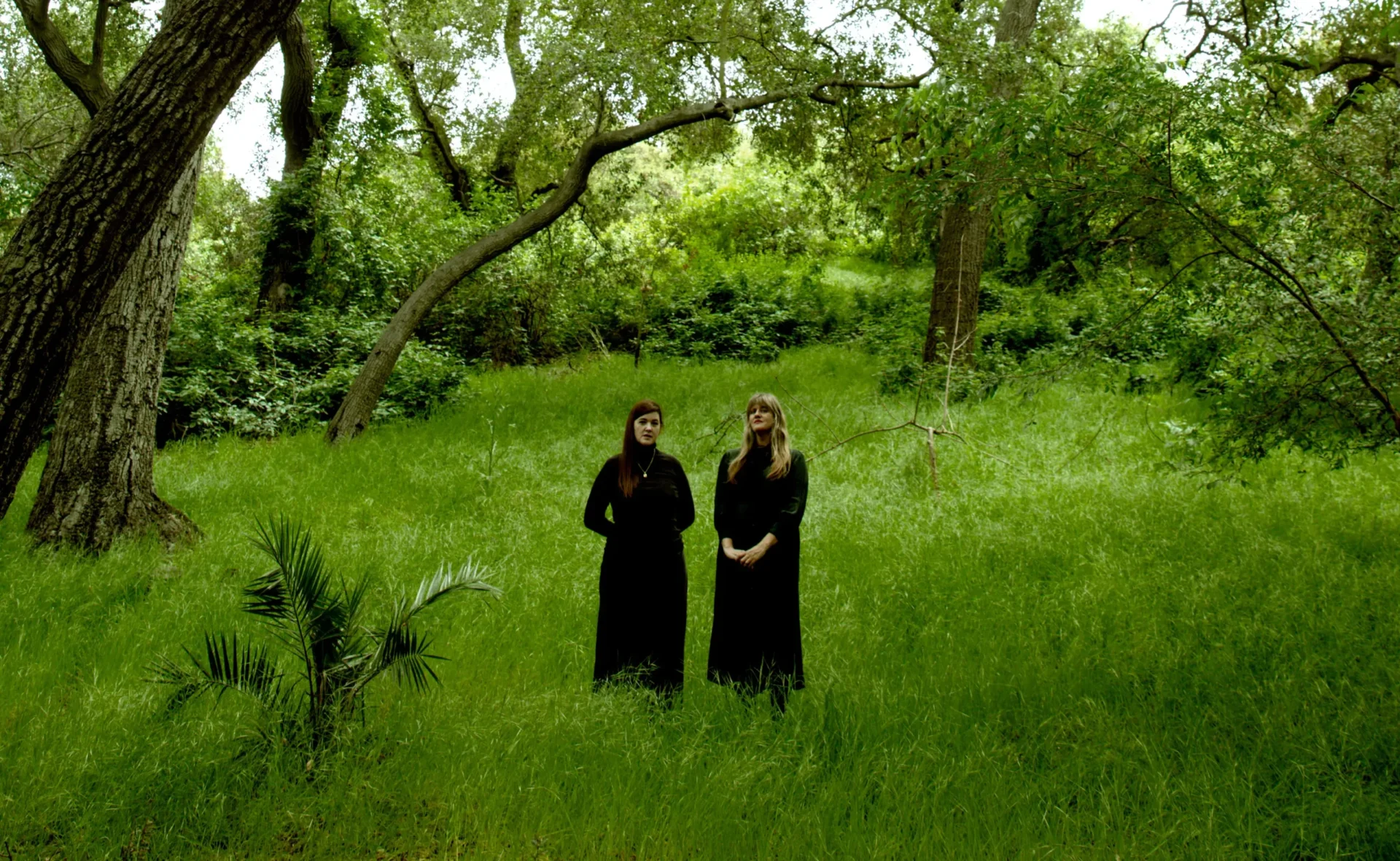
It’s remarkable that it took over a decade for Julianna Barwick and Mary Lattimore to make an album together. Two of the biggest figures in contemporary ambient music, the composers developed a friendship long before they shared a home base, moving to Los Angeles around the same time. They’d performed live together and collaborated on singles, but it wasn’t until they were invited to record an album in Paris, using the vast and historic collection of instruments at the Musée de la Musique, that a joint full-length finally materialized. Barwick and Lattimore have shown admiration for each other’s spiritual world-building, but, in the same way that they use technology and looping to elevate their respective instruments, their kinship heightens and bends the reality they mutually absorbed towards the cosmic—from the strange survivor’s guilt of leaving California in the midst of last year’s tragic wildfires to the reverie of a once-in-a-lifetime creative opportunity—towards the cosmic. “You may never go home again/ At least not the home you know,” Barwick sings, unfiltered, the way a friend who can see it in your eyes might hear it.
In the first installment of our In Conversation series, Julianna Barwick and Mary Lattimore talk about the origins of their friendship, their time in Paris, making Tragic Magic, and more.
Do you remember the first time you were inspired by each other’s music?
Mary Lattimore: I definitely listened to The Magic Place a lot. I wrote Juliana a fan mail through her website, and I was like, “I really love your music so much.” Listening to it felt like, “Wow, this is kind of what I am trying to do with the harp, but on another, more celestial level. This is so dreamy and so masterful.”
Julianna Barwick: Mary!
ML: Yeah, masterful looping.
JB: We met in person when I played in Philadelphia in early 2014 on tour and hung out. The first time I saw you play was at that little place in Bushwick. I think it was with Jeff [Zeigler].
ML: Was it called Body Actualized?
JB: It was Trans-Pecos. I was living in the neighborhood at the time and walked over there – it was a morning show or something.
ML: It was daytime.
JB: At that point, I was like, “This is my friend.” We hadn’t hung out very much at all. But I was feeling a kinship through another solo musician making “weird music” with lots of loops. In Mary’s case, obviously with the harp, which was so impressive on so many levels. She knows how to play this instrument in its traditional form, but through our own creativity and inspiration and expression, has figured out how to do it in a way that nobody else is doing. I feel like that’s what draws me into bands or musicians. It’s that inimitable quality that they have, their singularness, that really is exciting. And Mary obviously has that in spades.
ML: Thank you. Was my jaw wired shut during that performance?
JB: See, I didn’t know if you wanted to talk about it. [both laugh]
ML: I forgot about that. Yeah, I’d tripped and fallen and broken my jaw, and it was wired shut during that performance.
JB: I just remember I felt so bad because of that. But we’d only hung out in person one other time, I think, and I was like, “This is the funnest, most delightful person I’ve ever met.” And also felt that kinship – we’re tall ladies from the South making weirdo bedroom recordings with a loop pedal. I think that might have been early 2016, and not long after that, we played together at Trans-Pecos. We practiced together in the neighborhood…
ML: And the jaw was unwired by then.
JB: This was me playing on your record – these were your shows.
ML: Yeah, that was Hundreds of Days.
JB: Yeah, because then I went to Philly with you, and we played at – what’s it called?
ML: PhilaMOCA, yeah.
JB: That was ten years ago! That was super fun. I had a record [Will] come out in May 2016, and Mary opened several shows in September – 11 shows in 11 days. Did we do any playing on each other’s sets in those shows? I don’t think we did.
ML: A little jam at the end or something, maybe?
JB: I don’t think we did that until Australia [during a 2019 tour].
ML: And then we both moved to LA really shortly after that. Started playing together, DJing together.
JB: Guesting on each other’s records, doing remixes.
ML: Hanging out. Going to parties. Barbecues.
JB: Enjoying our LA crew. I guess it was probably a year and a half ago or so that Mary was asked about this opportunity for a Paris record.
ML: We started making demos a little bit over a year ago in one afternoon, and then went to record.
You’ve described Tragic Magic as “musical telepathy,” and I’m curious about the ways that was a new or a unique feeling for you, given your collaborative history.
ML: We were going to this very specific place, and we knew that we would never be able to play these instruments again. We knew we would never be asked to make a record in the basement of the Museum of Musical Instruments in Paris. We knew what a once-in-a-lifetime opportunity this was for these nine days. And I feel like that kind of heightened the musical telepathy a little bit, in that we both knew that we had this mission, and we knew each other’s styles, what we needed to do, what we needed to channel. There was more of a time constraint – constraints in general that enhanced the energy of those days. Kind of electrified everything.
JB: Our ability to make something together quickly really came in handy with this opportunity, because we actually had nine full days in the studio together. The first day was setting up and getting acquainted with these instruments, being brave enough to touch them and plug them in. Our history together and our similar approaches really came in handy for the time constraints that we had. We did jam for a couple days before we went over to Paris, so we had a few ideas, but everything else we made in the moment. We really wanted to be inspired by the novelty of the opportunity, the preciousness of the instruments, being in Paris, which is one of our very favorite cities. It was all something different – Mary and I usually make music by ourselves; we’ve done our fair share of collaborations, Mary a little bit more than me, but we’re pretty much used to just rolling on our own.
ML: We spent the weekend in between the two weeks of recording just exploring Paris, going to museums, absorbing the art, the culture, the music. We saw some concerts, we went to exhibitions, we had really good food, drank some wine, took long walks. That part was crucial to this music, too, just absorbing the vibe of the beautiful city.
JB: Yeah, that weekend was absolutely awe-inspiring. We stumbled upon a Mica Levi concert with some collaborators in an absolutely sick venue. We went to the Louvre one day, we went to see a James Turrell exhibit. It was just the craziest, most inspiring, beautiful weekend.
ML: They were also the only sunny days in the whole trip. The rest of the days were rainy and cold and wintry, and all of Paris was out and about in the parks.
JB: After that trip, people would ask me, “How was Paris?” And I was like, “It was perfect.” It was the perfect experience across the board, all the way from InFiné, our hosts – Mary and I really appreciated being treated so respectfully and lovingly by this label. They really took care of us, and we met up with them several times. Even just walking up to the Philharmonie every day, this sparkling silver structure, where we could go into it and record in the Museum of Instruments – it was dazzling. Our engineer, Trevor Spencer, had the greatest ideas and was so respectful. In my eyes, it could not have been more magical. We even loved our hotel! [laughs] We were obsessed with the breakfast there.
What kind of stuff would you talk about on those long walks?
JB: I mean, we covered everything under the sun with Trevor.
ML: Love life.
JB: Yeah, professional, music experiences and backgrounds, love lives, places we live in. It was cool because Mary and I are huge James Turrell fans. And Trevor had never experienced his art, which – it’s an experience. It’s not just an observation. You really experience his work, and it affects you, I want to say, spiritually. I feel very moved by his work, so it was really cool to watch someone else experience it for the first time. The very first night we were together was January 26, Sunday night, and Mary had said, “It’s so crazy that our hotel is so close to Sacre Coeur.” I said I’ve never been there, and she’s like, “Oh my gosh, it’s so gorgeous.”
ML: Our choice was to either stay at the hotel and be cozy and have dinner there or something, or go out into the cold, and I’m glad you guys were like, “Let’s do it now. Let’s go.”
JB: We were just gonna go look at it, and then go have dinner and go back to the hotel. But we went there, and it was open for business. They were having Sunday night Mass. We were able to walk through, and it was such a moving experience. Lots of times you go somewhere to make a record, and you have your experience, and you make your record, and you’re drawing from within more than anything. But in this case, there were just so many outside magical forces. That night, we walked through the church, and about three-quarters of the way around, the organs started playing these magnificent drones, and then this nun got up on the pulpit and started singing and waving her arms. It was absolutely gorgeous and had us all in tears. It felt very sacred. I almost felt like, “Is this for… This kind of feels like this is for us.” [laughs] Not really, but it just felt so…
ML: Meant to be, that we would walk in at that moment. Also, we were coming from LA, which had just experienced these crazy wildfires in the city, and two weeks later, we were in Paris making this record. We were very grateful to have a few days of being away from that pain of everyone where we lived, appreciating the break really acutely, and our antennae were up for a lot of magic. We were being very receptive to little signs and a sprinkling of beauty and destiny and light: What are we supposed to do? Why were we brought here? What are we gonna make here? This is a moment in time that we’re never gonna get back, and then we’re gonna go back to our city that is so heavy right now, so devastated. But we had this little twinkly moment to process this melancholy, this huge life event. It felt like a secret world.
JB: Cosmic winks, as you say. Universal pulls back through time. We experienced such a moving sonic experience at Sacre Coeur on night one, and then the next day was our first day in the museum, setting everything up to record, mic checking, Mary putting her fingers on these harps for the first time. In sound check mode, what we ended up making on the spot turned into ‘Perpetual Adoration’. I think we were still carrying that holy experience from the night before into the next day.
ML: And I wouldn’t say we’re religious-y people. We’re not going to church and stuff, but that musical sacredness transcended any kind of organized religion. Being able to hear that nun’s beautiful voice felt really human and part of the world – really terrestrial, but also really celestial at the same time, you know?
JB: It just felt like the timelessness of music making, which is as old as humanity. They’re kind of one and the same. Even tapping into what the city had to offer in that way, to have this record be an actual record of our time – not just in the Museum o Instruments, with these instruments, but also in the city.
You’re referring to it as your Paris record, but there’s also this mournful side of it, this spectre of grief over LA. Over time, have you talked about how you hear this record now as opposed to how it felt when you were making it?
JB: I feel nostalgic for both emotional experiences when I listen back to it. I feel nostalgic for the feeling after the fires in LA, and I feel nostalgic for the magic that we experienced in Paris. But I definitely feel like we were carrying a lot of sorrow. I would never say it was a sorrowful record, but we were definitely processing all of that and ended up writing a song specifically about it, which of course is ‘Melted Moon’. I wrote lyrics for that, and were we were all crying together.
ML: Yeah, it was a heavy day making that song, for sure. I remember you showed me this photo that someone had sent you from the fire in the Palisades, maybe, and you were like, “What does this look like, Mary?” And I said, “Volcano.”And you’re like, “Exactly. It looks just like a volcano.” And that was part of the lyrics you wrote.
JB: That was a picture of the Palos Verdes, and you could see…
ML: We saw nature that was unnatural those days – the color of the sky was olive green, sickening. It’s something I did not know in my childhood, the black hole sun – the way the sun comes through smoke., That song – we saw things that we can’t unsee. There is a loss of innocence every time something like this happens.
JB: At once, it felt incredible to get out of the country, to get away from all of it, but there was also a hanging – not that I knew what to do or how to help, but a feeling of, “I left my city, and all that stuff’s happening there.” A little bit like abandoning your home.
ML: Survivor’s guilt, yeah.
JB: So we came to Paris with so much heaviness, and I think that’s what made the beauty and the magic of the experience heightened even more. It was definitely cathartic. Even performing the songs live is cathartic, because you can’t not think about what you’re singing about or what you’re playing.
Is there anything you’ve been meaning to ask each other?
ML: Julianna made some cookies yesterday, and I would love to know how I find the recipe. [Julianna laughs] I’ve been eating them this morning, and I can’t stop! As you said, these cookies are addictive. Walnuts, oats, raisins, butter, butter, butter!
JB: Pecans, girl.
Ml: Oh, they’re pecans. Pecans.
JB: It’s a very Southern thing to say pecan. Very Louisiana thing. I don’t know where that latitude on the word is. It’s Pioneer Woman, girl. I just Googled “Pioneer Woman oatmeal raisin cookie.” She is a cooking show personality here in the States, and her show has really soothed me over the last few years. Her cookies are fabulous.
ML: Well, yours are too.
JB: That’s why I gave you, like, a dozen of them, because I was like, “I will literally eat all of these.” Are you preparing any food items today, Mary?
ML: I’m going grocery shopping.
JB: Oh, what are you gonna do?
ML: I’m buying Italian beer, I’m having a visitor come from Italy.
JB: Moretti?
ML: He loves Moretti beer.
JB: Did I guess that?!
ML: I thought I had told you that! No, you just guessed it? That’s so funny.
JB: Yeah, because when I worked at Mary’s Trattori – making that connection now…
ML: It’s all connected.
JB: We had beers, Moretti Beers. Full circle, baby! Get some spumoni too.
ML: There’s a very cute store in my neighborhood, Buccatini, and it has a lot of Italian groceries. This is my visitor’s first time in the United States, so I feel like I want to show him that it’s not all horrific. I’m gonna show him the beautiful sides of LA.
JB: And it is a beautiful city.
ML: It’s a wonderful day today. The sky is clear and blue. It’s rained a lot, so the hills are emerald colored, and it’s very lush and green. It feels like a good time to be here.
This interview has been edited and condensed for clarity and length.
Mary Lattimore and Julianna Barwick’s Tragic Magic is out now.

