

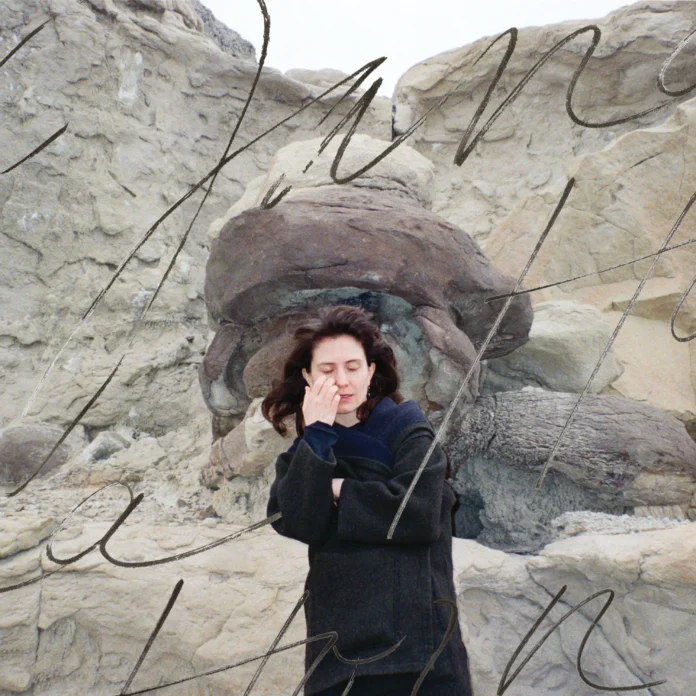
At the very end of her self-titled album, Jana Horn includes a moment of recorded uncertainty. “It was good until I messed up,” she says, and in the soft laughter that’s free from judgment, adds, “Should we just, like, try to do the end?” You can imagine the singer-songwriter listening back to this wholly authentic exchange and smiling at its unintended poetry. Patient and pensive, the follow-up to 2023’s The Window Is the Dream is marked by its open-endedness, recognizing that behind every loss and human sense of finality churns the cyclical nature of change. Documenting her first year of living in New York, where she moved after completing a creative writing MFA in Charlottesville, Horn and her band refuse to paint a portrait of an artist unstuck from the past, unmissing, or untroubled by a changeless future. It would be absurd to try to force it. They simply inch towards an answer to the album’s final question: “I don’t know, how do you feel about that?”
1. Go on, move your body
I’ve written about the way ‘Go on, move your body’ bounces off of Joseph Campbell’s quote about “follow[ing] your bliss,” aimlessly drifting through its untraceability. Now that the song is firmly planted in my memory, my ears are drawn to its minute details, particularly how Adelyn Strei’s clarinet creaks like a new door opening – or, as the opener to one of the first notable albums of the new year, a new apocalypse stirring. “Nothing prepares you for this” is a line Horn wrote way before many of the life changes her self-titled album captures; being in this doesn’t make it any easier to wrap your head around.
2. Don’t think
Horn’s claim that Jade Guterman has “a very melodic, almost lead guitar style of playing, and I tend to play guitar like a bass” is wonderfully evidenced in ‘Don’t think’. Strei nimbly weaves in her clarinet over the cloudy rustle of Adam Jones’ drums, as Horn’s object of surrender is not just perpetual motion, but the very state of being, persisting through uncertainty. “I don’t take it lightly/ That a thing set in stone/ Can begin to roll when/ The ground that you’re on is different,” she sings. There is a lightness, still, in the group’s every movement.
3. All in bet
In lieu of a chorus, ‘All in bet’ finds rapture in Miles Hewitt’s minimal piano, accompanied first by Horn’s choir of self before cascading alongside Guerman’s melodic bass the second time around. Lyrically, the song is about shots in the dark of an endless night, wherein our protagonist finds her own company: a phone call with a friend, a drink with an unnamed one. A sign that it is not over yet, bet still in play.
4. Come on
Sensual and nocturnal, the song drips with double entendres: “Make me think that you are worth moving for” (as in: cities, the body), “In the city I was on time/ Couldn’t get off my mind/ On pills, on trains, on praying.” Horn’s wording is as precise as her syntax is peculiar, translating the mush of consciousness that comes with traveling, or mentally occupying multiple places at the same time. More than wearisome, though, it is ultimately vivifying: “Seeing eternity as a quality of time/ Done with my dying/ I can breathe again/ In the heart of it.” ‘Come on’ sounds a lot like ‘Go on, move your body’, but takes its time breathing life into it.
5. Love
Slightly more straightforward, ‘Love’ briefly meditates on the changing and unchangeable nature of its titular subject. The tone is affirming, if not quite self-affirming, as Horn compares it to “the moon in the middle of the day.” But then it’s gone and leaves you standing there, resting on the nighttime memory of it.
6. It’s alright
After several strummed songs, this one’s fingerpicked swirl – though again that bass is just as high up in the mix – is hypnotic, especially when Horn’s ethereal voice and Hewitt’s piano drift atop it. It starts off in the same emotional vein as the previous track, but it’s not long until the feeling swells, turning assurance into rubble. “It is like my eyes to cry/ To die and die to feel/ The cycle repeat,” she sings, her voice almost breaking as she rhymes, “The pit is the seed.” The ensuing minute feels like digging your hands through the dirt.
7. Unused
Dissociation has a million faces, and here Horn showcases a range from surreal to banal that’s unique in its humanity. “I was more like a feeling for a while/ Not even mine, not even one of mine,” she sings, making the distinction by leaning on more of a hum – her voice, the clarinet – than a clear melody. She orchestrates an abrupt ending, as if telling herself it’s over is enough to stop missing.
8. Designer
Over a chugging rhythm that’s one pedal away from sludge, ‘Designer’ is also lyrically darker than even the most pensive songs on the album. Seemingly fixating on a kind of manic episode, Horn asks, “What does madness prove, Designer?” The piano softens the worry, but there’s no answer striking down from the sky, just an image burnt into your eyes as the cycle repeats.
9. Without
There’s no poetic pretense on ‘Without’, whose tapestry of sound rests mostly on Guerman’s impossibly gentle bass. The rest of the band is there to support them, but the song feels like a conversation between its wordless sentimentality and Horn’s own; when she lets out the words “How do you go without leaving me,” you don’t need to have heard her whole discography to know she has never sounded so fragile, so affecting. The bass sounds like an embrace when in major; the absence of a single note can make the whole song sound ready to fade. Softly, it holds its parts together.
10. Untitled (Cig)
The closing track does quite the opposite, taking liberties in the production – who’s the Designer now – to turn all its instruments into fragments, like smoke from a cigarette. The simple bass pattern is the one solid thing Horn holds between her fingers, and even slightly effected her voice is powerfully clear in its questioning: “Spirit, have you had enough of this body?” In her bio, Horn says her mother “was learning to live again after years of being passed from one hospital to the next, like a crime no one wanted to be responsible for.” When she addresses her directly here, mentioning her for the first time on the album, it’s in poetically reverent terms: “Tell me how you broke down to soil for my life.” The song murmurs and sizzles and sighs. It goes on for a while, then gives.

