

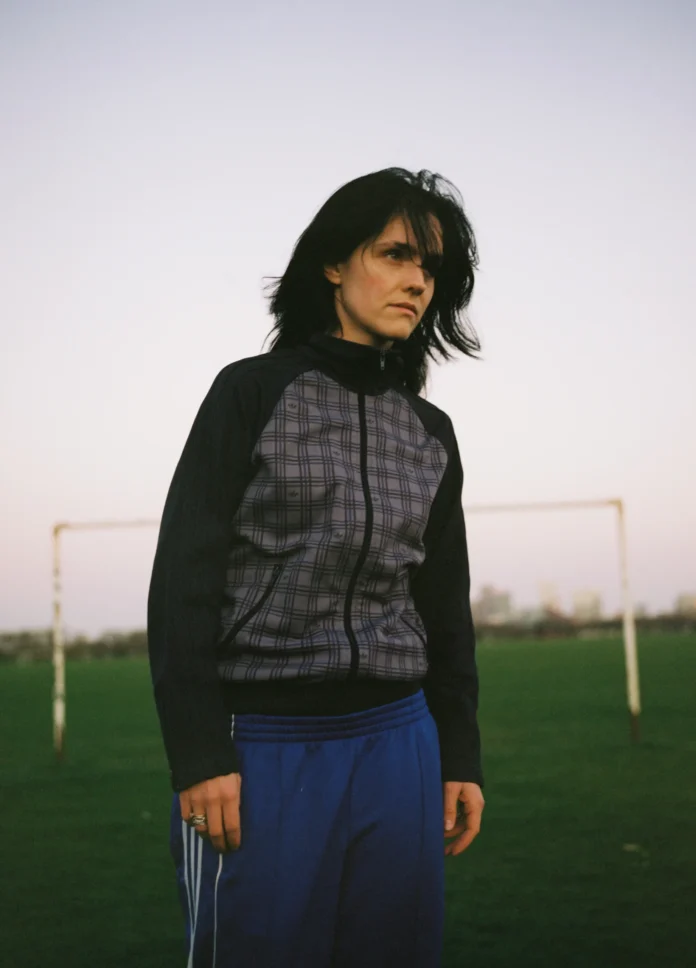
Sassy 009 is the project of Oslo-born artist Sunniva Lindgård, who grew up taking lessons in violin, cello, piano, and flute. Though she ended up quitting those instruments, a high school music production course, which she picked almost at random, convinced her to pursue music. After uploading tracks to SoundCloud, she enlisted two of her friends for the project’s first live performance and made plenty more music with them before returning Sassy 009 to its solo origins. Following a series of mixtapes, including 2019’s KILL SASSY 009 and 2021’s Heart Ego, she toiled away at her debut proper for years, struggling to funnel a fantastical narrative in which intrusive thoughts become reality into a digestible record; in essence, squaring the nightmarish with the catchy. But with notable assists from Blood Orange, yunè pinku, and BEA1991, Lindgård – playing a character described, better than by the album’s namesake, on the title track as an “in-betweener” – embodies the blurry, fluid qualities of Dreamer+ with undeniable kineticism. It’s the kind of dream more likely to haunt you down than fade from memory.
We caught up with Sassy 009 for the latest edition of our Artist Spotlight series to talk about her musical upbringing, self-producing Dreamer+, intrusive thoughts as a kind of daydreaming, and more.
I read that your parents were both string players who also made pop music. What are your memories of hearing them play or seeing that dynamic at work?
Such a core memory for me, in general, is to just hear a violin or a viola being played in a room with a closed door. At any time of the day, really – them rehearsing for a concert that is coming up, almost like a white noise thing while you’re home doing your own things. Especially on my dad’s side of the family, his siblings are also classical musicians, and a lot of my cousins are in jazz. In terms of gathering with the family, everyone just brought up their fucking instruments – that was our way of interacting. I feel like music has been almost like a default in my life, really. Since it’s been so normalized in my life, I didn’t really think too much of it growing up – that this is not usually what people are surrounded by.
Were you always comfortable in this kind of normality, or were there points of wanting to break away from it a little bit?
It was normal conditions, but I felt actually very uncomfortable – for example, when my family and everyone would pick up their instruments and start jamming, a very typical situation would be me just playing something on the piano by myself, and it took seriously two minutes before everyone’s like, “Let’s lock in here.” I would feel very uncomfortable, because I was classically trained, but never to the point where I was able to read sheet notes properly or just jam my way around whatever. I had my own way of playing and approach to that, so I would feel like I was, in a way, less of a musician than they were. I kept on resisting these instruments and the training that came with it. I felt like all of my cousins and my parents were able to overcome something that I wasn’t able to – they had the patience, or they dealt with the impatience I was trying to deal with.
Now, I’m looking back on it and realizing that – first of all, I might have just had the wrong teachers to begin with – and then also I was maybe more of an impatient person than they were. [laughs] I was not really singing – not really using my voice, even, until I started making my own music, which was in my late teens. So I felt like a weirdo in my musical family, yeah.
Were you also craving solitude? Did you think, I wish I could just play for two minutes without someone joining in?
Yeah, definitely. I felt like I was more meant to be in my own bubble. I was allowed to, but I didn’t fully understand, I think, what was my way. So when they would all just gather around me and try to follow my lead, I was just like, “What are you guys doing? Someone else needs to be in charge, and I can accompany whatever is happening.”
You took your first course in music production in high school, and when Sassy 009 was a trio, it was with your childhood friends. How did your relationship with music change when it became part of your social and school life?
Once I discovered music production during high school, I was still very much leaning into it in solitude and did my thing. How the trio came about was I was asked to do a gig for the first time in my life with my own music, and I was terrified. What does even live mean, in terms of having beats on SoundCloud? It was just overwhelming, really, to even imagine how I was gonna solve that. I wasn’t forced, but I felt like there was no way for me to do that by myself, and that’s how the trio came about. So I reached out to my friends who went to music school and were used to being on stage, and it just made sense to me to ask them to be a part of my live band. Then the bubble I was in opened up, obviously, because we also put out a record together, and the whole project was branded as trio at the very beginning of this career.
At that time, I was feeling like that made sense. But it was also the first time experiencing every level of being an artist or being a band. I hadn’t been in a proper studio ever until then and hadn’t really been on stage, hadn’t really sung anything. Everything was just new. When I think of it now, it’s a crazy, overwhelming experience to go from sitting, literally, in my home with headphones, to then do all of that – as if that is the most natural thing. Being a solo artist since 2018, I think I prefer the bubble, in a way. [laughs] I love collaboration, but I guess I am that kind of person who just needs to be in charge of most things.
When did you know you wanted to self-produce your debut album?
It was a decision or an ambition that I was naturally led to by having put out a few EPs, seeing myself more as, like, a competent producer. I felt like I was stepping into that role with a lot more integrity. That’s probably a thing for female producers, I can imagine: At what point do you feel qualified to call yourself something that a lot of men are calling themselves? I’ve worked with male co-producers, and I saw how I could also be having my own studio, having my own hardware, and being able to not rely on other people. And also, other things in my personal life were leading me to that ambition of, actually, I have to just rely on myself, so in order to do that, I need to prove to myself that I am myself I can almost hire for my project. To prove to myself where I’m at, or to even document it, at least – to be like, “If I do it myself, it’s gonna sound like this.”
The idea of hiring yourself as a producer makes me think of having the protagonist of Dreamer+ be a version of yourself. Do you feel like you’re creating a separation between yourself as a songwriter and a producer, in a similar way that you do between yourself and the character in your story?
It’s so strange when I think of what kind of roles I’m having in my own project, because at the very beginning, it was all just purely intuitive. I was naive, and I was like, “It’s just me making music.” I was having fun and exploring. And then the further in I got, I was kind of more aware of these different skills that there are actually names to. I’m much more aware now – whether it’s my work, or someone else’s work, or if I’m just talking about music – of what parts of me as a musician are speaking. I also enjoy categorizing things, and I find it helpful in terms of navigating this industry when it comes to collaborating with people. Being aware that I can step into this role, or I can lean back on this. Do I sit on the couch in the back, or do I sit on the front, staring at the faders? I’m really glad that I can tune into all of it together, or just be a little bit more fluid.
You spent a lot of time building the fictional world of the album. I’m curious how the shifting conceptual framework of the album affected the actual process of it.
It felt like everything. It felt like I had this idea that fell into my head, and I was just amazed. Before really working on the record, this fictional story kind of happened through conversations and trying to understand my own life at the time, and I was just immediately drawn to working on this fictional story without really knowing where or what it was gonna be separately from the music. It was such a great source of inspiration for me in terms of making music. I just made a lot of songs, and I had a very clear idea of what the music should sound like. But then the further in I got into that process, I never felt fulfilled with what the music really sounded like, or I was forcing songs together, forcing the sound to be more the same throughout all the songs. I felt like I lost something very crucial, which was just the music in itself.
I decided to work on those things separately, but using the story as a source of inspiration. Having the songs be more representations of the moods, rather than being this record that is somewhere in between being a sound book and a music record. I had to let go of some parts of what I was envisioning this record to be. And then to be now here on the other side, having a record that is based on a fictional story but doesn’t really necessarily sound like it when you’re listening to it – I’m trying to give myself the grace of: This was a method, and not necessarily the outcome. I feel like I’m on this bizarre place where, yes, it’s a conceptual record, but it’s conceptual in terms of the method I was applying to making it. The story in itself, I still have to figure out how to land that in its own way, and it’s something I’m working on.
It sounds like the blurring between reality and fantasy that’s at the core of the album ended up being reflected in the thread between the narrative and the lyrics. When you were working on lyrics specifically, was there that sense of surrender in letting them flow intuitively?
At the beginning, I was trying to write songs that were more telling of the story and the actual things in that story, and then the songs didn’t really make sense; I was finding that difficult. I then just decided to rewrite many of the songs, focus on one song at a time, and further process to make things more simple. Because I also really enjoy catchy music and simple lyrics that feel powerful in their simplest form. Speaking of letting go, I let go of many things while writing, I figured that allowed me to actually write more. I felt more free as a songwriter – I just had to free myself from my own methods.
What kind of freedom was there in playing this protagonist? What did that afford you?
On a personal level, it was so fun. When I started working on this story, I was in need of taking control over certain things in my life and myself. Working on this story, where I’m literally steering the narrative, I was just so drawn to this world I was creating for myself – which was just fantasy, but still, it gave me a certain confidence in my personal life as well. I was exploring what I was going through in a way that didn’t require me to necessarily interact with myself in reality. I just stepped into this fantasy world, where I would even catch myself – this is sounding fucking crazy, but there’s this character in this story that’s like a summary of many people I’ve had in my life, this person I’m feeling very drawn to romantically in the story. I was able to embody what that feeling was, and I was feeling almost like I was actually in love with this character, which is strange, because it was a fictional character. I would catch myself daydreaming of this person, almost stepping into that world of: there’s a possibility of a person appearing in my life that I will feel this way about. I was creating these pockets of magic for my own life.
On ‘Edges’, you sing, “It gets harder to sleep/ When minds turn the best of us into poison.” You mentioned daydreaming, but is the edge of sleep also a kind of creative space for you? I’m also thinking of the line “Can’t sleep without fear of missing out on luck” on ‘Tell Me’.
I’ve always been a very big dreamer, and I’m realizing by talking with other people that they don’t necessarily dream or remember their dreams that much. I can catch myself trying to sleep, and then thoughts just rush, a thousand thoughts at the same time. Eventually, when I fall asleep, dreams turn out to be very bizarre and surreal, and I wake up and feel disconnected from reality, and connected to the dream, trying to adjust myself. With this record, and for the past year, I’ve been more aware of the kind of stories my mind is creating; because there are stories, and they also have sort of the same texture often. There’s the same narrative often, and it’s a source of inspiration, but also such a source of mystery to me. And I think mystery is one of my great inspirations of all time.
Intrusive thoughts, which are a key part of the album’s narrative, are a lot like recurring dreams, in that you can harness them in a similar way to tap into the subconscious.
They’re also so interesting, and that’s something I played around with in the story. We’ve all had those moments of, for example, waiting on the metro, thinking, “What if someone pushed me over in front of the train?” Intrusive thoughts are so dramatic, but we’re just dealing with them in silence – to me, it’s a very quiet drama. I think intrusive thoughts are also a way of daydreaming in a bizarre way. There’s these layers of the conscious and the subconscious mind that are happening at the same time, and when I make music, I try to step into the role of being as unaware as possible, as free as possible, to not restrict myself from making anything. Once awareness comes in, it just adds so many questions.
How did it feel to invite other people into this dreamworld?
First of all, I was feeling very drained by working on this project, and I was also feeling confused by how to present it and how to explain it. When I decided to bring others in, there was no way for me to really explain what this record was, in a way. So I was just approaching them like it was a very simple thing: “I’m making records, here’s a song I was thinking of having you on if you’re down.” I also was hoping for that to be an approach I could have myself on my next project. I was just tired of working on these layers. Also, it’s refreshing to let people do what they intuitively wanna do, instead of being like, “There’s this story.” I figured that was the best way.
Though it isn’t a collaboration in the traditional sense, the final track, ‘Ruins of a Lost Memory’, samples a melody your parents wrote for a Eurovision Song Contest entry in the ‘90s. How did the idea dawn on you?
When I first heard the song, and also some other songs that they made at the time – which, surprisingly enough my mom just had them on MP3s; they made it on the cassette back then, so it was just this moment of, “Look what I just found.” My parents are classical musicians in terms of being instrumentalists, but then hearing my mom’s voice – which I’ve heard before, but she doesn’t really sing a lot – there’s also something about that to me. There are these pockets to my parents that I’m understanding myself better, hearing this pop music from themWhen I heard that song, where I was with my record was I had still had this very hardcore ambition of it being something like a film score, and I had this idea of having a song that would set the tone of, “You have now just listened to the record, and what you’re now hearing is the aftermath of it.” This is where the credits start rolling, kind of. Although I was changing a lot of the tracks on the record itself, and the project tooka different direction later on, I was like, “There are certain things I need to hold on to still.”
Has making or releasing the record stirred conversations between you around music?
My dad was very much more into pop and rock music growing up and stuff, so I’ve had a lot more conversations with him, chatting about music in general. My mom is such a hardcore classical musician – she barely knows any artists even from her generation. I’ve had many interesting conversations with her as well, but it’s very different conversations and different ways of understanding music, so her way of hearing my music is very different from my dad’s way of listening to it. He brings more of a historical context, while my mom is purely like, “Wow, what is this?” When I said to them that I wanted to put the song on my record, they were just laughing out of, like, “What?” Along the process, they were checking in, like, “How’s it going with the record? Is the song still there?” [laughs] They were both really excited about it.
How are you thinking of translating the fantastical realm of the album into a live context?
I have two thoughts in my mind at the same time. One thing is the technical aspect of it: How do you present a record musically that is in between being electronic and acoustic? It’s been such a brain fuck, really, all my career to figure out what the live element is. But now I’m leaning very much into letting things be as live as possible, whether that means removing certain things to add other elements, so that the song actually takes a new shape. It’s also a way for me to understand how to go about making music in the future as well. I would prefer my songs to be as simple or work for musicians to just play. I want to be free from the computer, basically. But then the other thought is the conceptual part of it. Live performance is such a playing field, where the story and the narrative can also exist in a new form. I can add stuff, I can say things, I can play around it, which is what I’m now working on before going on tour in February.
This interview has been edited and condensed for clarity and length.
Sassy 009’s Dreamer+ is out now via [PIAS] Électronique / HEAVEN-SENT.

