

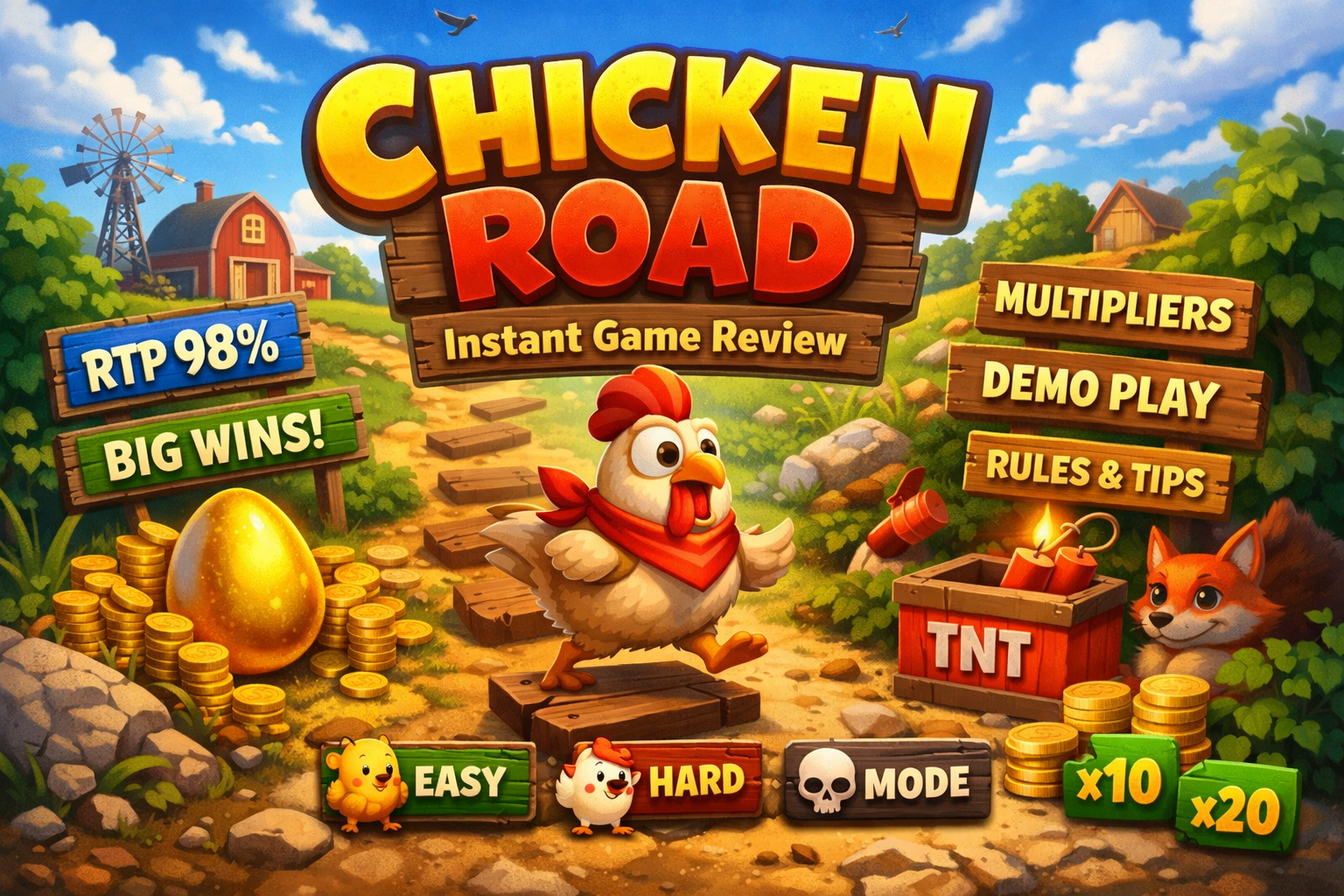
From InOut Games, Chicken Road is an instant casino title where one wrong step can end the round, so decisions matter. This chicken road guide explains the mechanics, the RTP number, and the payout math for players worldwide via Chicken road.
You will also learn how to start safely, how demo play helps, and what to check in a casino lobby before you stake real money.
Quick facts and specs you can verify fast
A fast snapshot helps you judge the game in seconds. The table below focuses on settings that change results or comfort.
| 🧩 Parameter | Value |
| 🐔 Game concept | Cartoon chicken moves toward a golden egg, avoiding hidden hazards |
| 👤 Players | Single-player |
| 🎯 Main decision | Choose a step, then decide to continue or cash out |
| 📈 Multiplier model | Multiplier grows after each safe step, then applies to your stake |
| 💥 Loss condition | A hazard ends the round and loses the active stake |
| 🧠 Difficulty modes | 4 modes Easy Medium Hard Hardcore |
| 📊 RTP | 98% |
| 🧮 House edge from RTP | 2% in the long run, based on 98% RTP |
| 🗓️ Release date | 4 April 2024 |
| 🕹️ Format | Instant game, not a reel slot, so there are no paylines |
| 🧪 Demo mode | Demo Play is available on the provider page |
| 📱 Device fit | Mobile-friendly because actions are single taps |
| 🌍 Region fit | Worldwide availability depends on each casino catalogue |
| 🔁 Session tempo | Short rounds, many decisions per minute |
| 🧾 Skill lever | Cashout timing and pace, not pattern hunting |
After the specs, the real topic is risk control. The interface is simple, but the pace can pull you into rushed clicks.
A quick check many players miss is round tempo, because the fastest losses are usually self-inflicted. When the pace feels too quick, the chicken road format benefits from planned pauses and smaller stakes. Those two adjustments travel well across regions and devices.
You may also notice the provider page uses the slug “chiken-road” without the second “c.” This kind of short slug is common in game URLs, and it does not change the game name in casino lobbies.
What the game is in plain terms
Many players group this with crash-style instant games, because you build a multiplier and choose when to stop.
For newcomers, chicken road works like a step ladder where each safe move increases the multiplier, and any hazard ends the round.
The goal is simple, so the learning curve is mostly about emotion control, not about menus. This structure makes the game easy to explain in any language. It also makes it easy to overplay, because the next click always feels close.
Why it feels different from classic slots
Classic slots hide decisions inside paylines and bonus triggers, so you react after the spin. In chicken road, the decision is direct, because you choose whether to take the next step or lock the return. That design reduces “mystery features,” but it increases responsibility.
The differences are clearer in a quick list.
- 🎰 No reels or paylines, so outcomes arrive per step rather than per spin
- ⏱️ Rounds can end in seconds, so tilt control matters
- 🧾 Payout math stays clear because payout equals stake times multiplier
- 🧠 Difficulty modes shift risk without extra side bets
- 🧪 Demo play teaches pacing without deposit pressure
Once you notice the speed, you can plan around it. Without a plan, speed becomes the main problem.
How to start playing worldwide
The start process is similar in most regions, even if payment methods differ. A typical chicken road session begins by choosing a risk mode, setting a stake, and pressing Start in the instant-games lobby. If your casino offers a demo, use it first to confirm the controls on your device.
Use a checklist before you deposit, especially when you play from a new country or while travelling.
- 🌍 Confirm the casino supports your location and preferred language
- 💳 Check deposit and withdrawal methods you actually use
- 📲 Test mobile performance on your current connection
- 🧪 Play demo rounds to learn the cashout button timing
- 🧾 Open the help panel to understand the round history display
After that, treat the first cash session as practice. Low stakes give you space to learn how you react after wins and losses.
Core mechanics explained step by step
Every round starts with a stake, then you interact with a path that hides hazards. During chicken road play, each safe step raises the current multiplier, and you can cash out after any safe result. A hazard ends the round immediately, so there is no partial payout for “almost.”
A clean mental model is “ladder with traps.” You climb, and you decide when to stop climbing.
Here is the loop you repeat.
- 🟢 Pick difficulty, then place your stake
- 🟢 Select the next step on the path
- 🟢 If safe, the multiplier increases and cashout stays available
- 🔴 If hazard, the round ends and the stake is lost
- 🏁 If you cash out, the return credits based on the current multiplier
The mechanic is simple, but the tempo can be intense. Slow play often produces better decisions than aggressive play.
Difficulty modes and what they change
Difficulty is the main dial for risk, so it should match your bankroll. With chicken road, higher modes usually offer higher potential multipliers for the same progress, while increasing the chance of hitting a hazard. That makes mode choice a budget decision, not a badge.
Many losses come from mixing high mode with high stake. Keep one of those low, especially early. A practical view of the modes helps.
- 🐣 Easy supports longer practice sessions and stable cashout habits
- 🐤 Medium adds swings while staying readable
- 🐔 Hard suits short bursts when you accept wider results
- 🔥 Hardcore fits tiny stakes or rare high-risk attempts
After picking a mode, decide what the session is for. “Entertainment” and “profit attempt” need different limits.
Rules to know before your first real-money round
Rules are mostly about what counts as a win and what ends the round. In chicken road, you win only when you cash out before a hazard appears, because the stake is otherwise lost for that round. Most casinos show a round history panel, but it is for review, not prediction.
Keep these basics in mind.
- 📌 Your stake locks once the round starts
- 📌 Safe steps raise the multiplier, but do not pay until cashout
- 📌 Cashout ends the round and credits the calculated return
- 📌 A hazard ends the round with a full loss of the round stake
- 📌 Changing difficulty applies only to the next round
One habit saves money: decide your cashout zone before the first click. A plan reduces “one more step” mistakes.
Multipliers and payouts without guesswork
The payout formula is simple, so you can check results without trusting feelings. Inside chicken road, your return equals stake multiplied by the multiplier shown at cashout, and the net profit is return minus stake. If you stake 2.00 and cash out at 1.60x, the return is 3.20 and the net profit is 1.20.
That math is the core of the game, so learn it once and use it forever. It also helps you avoid chasing impossible targets.
A small example is below.
- 🧮 Stake 5.00
- 📈 Cashout at 1.20x
- 💰 Return 6.00
- ✅ Net profit 1.00
Small multipliers can still build a session, if you repeat them with discipline. Big multipliers are rare, so treat them as optional.
RTP 98 percent and what it really means
RTP is a long-run average, not a promise for a session. For chicken road, the published RTP is 98%, so the implied long-run house edge is about 2% if the implementation matches the spec. Variance can still be high, because losing streaks cluster in fast games.
Use RTP as a comparison tool. It helps you pick between similar games, but it cannot protect you from short-term swings.
Two reminders help here.
- 🧠 RTP does not prevent losing streaks
- 📊 RTP needs a huge sample size to show up
If you want one lever you control, choose pace. Fewer rushed clicks often means fewer avoidable losses.
Demo mode and how to use it well
Demo play is useful because it removes money pressure, while keeping the rhythm intact. A smart chicken road demo session is a drill, where you practice stopping at a chosen zone instead of chasing. It also lets you test mobile comfort, because tap accuracy matters more than graphics.
Try a short routine before your first deposit.
- 🧪 Play 20 rounds on Easy with the same tiny stake setting
- ⏸️ Cash out at a fixed point, like after two safe steps
- 📝 Note when you feel the urge to “push it”
- 🔁 Repeat on Medium and compare how your emotions change
If demo makes you impatient, real money will amplify that. Use the signal to reduce stakes and take more breaks.
Bonuses and promotions that matter for instant games
Promotions are set by casinos, not by the provider, so terms vary by country. When you play chicken road with bonuses, the key question is whether the casino counts instant games toward wagering requirements. Cashback and reload bonuses often fit better than “free spins,” because there are no reels.
Scan these terms before opting in.
- 🎁 Whether instant games are eligible for wagering
- 🧾 Max-bet limits while a bonus is active
- ⏳ Time limits, because fast games burn time windows
- 💸 Withdrawal caps that reduce real bonus value
- 🧠 Opt-in rules, because some promos are not automatic
If the rules are unclear, play with cash until you get a written answer from support. That avoids surprise restrictions later.
Mobile and app reality for global players
Most operators deliver the game inside a browser, even when they also offer a casino app. In chicken road sessions on mobile, the main risk is misclicking a step or missing the cashout moment due to distraction. Connection delay can add stress, so test your setup before real stakes.
If you use an app, it is usually the casino app, not a separate provider download. That means performance depends on the operator platform.
Mobile habits that help worldwide are simple.
- 📶 Compare Wi-Fi and mobile data for delay
- 🔕 Silence notifications during rounds
- 🧩 Use landscape mode if buttons feel tight
- 🔋 Watch battery level, because long sessions sneak up
- ⏲️ Set a timer for breaks every 15–20 minutes
A small screen can still work well, if you slow down. Your goal is fewer rushed decisions, not more rounds.
Bankroll control that fits a fast step game
You do not wait for a bonus round here, so session structure matters. With chicken road, a practical approach is to split a session bankroll into 50 equal round-stakes, then cap the number of rounds. This keeps losses predictable and stops the “one more chance” loop.
If your session bankroll is 50 units, stake 1 unit per round on Easy or Medium. If you move to Hard, reduce the unit size.
Two guardrails work in any currency.
- 🧱 Loss limit that ends the session, not just the day
- 🧾 Win target that triggers cashout and a break
When you hit either limit, stop for at least 15 minutes. Fast games reward breaks because your decision quality improves.
Common mistakes and how to avoid them
Most expensive mistakes come from changing two variables at once. During chicken road play, raising stake after a loss while also choosing a higher mode compounds variance twice. Another common error is treating history as a predictor, because random outcomes do not “owe” you balance.
Watch for these habits.
- 🚫 Chasing losses with bigger stakes in the same session
- 🚫 Jumping into Hardcore after a short losing streak
- 🚫 Clicking faster when you feel annoyed
- 🚫 Assuming a bonus counts without checking eligibility
- 🚫 Playing on unstable internet
If you fix only one thing, fix speed. Slower rounds give you time to cash out on purpose instead of on impulse.
Pros and cons from a player’s view
Trade-offs are normal, so match the game to your style. For chicken road, the main advantage is clear control, because you always see the multiplier and choose when to stop. The main drawback is temptation, because the next step always feels small.
Pros are straightforward.
- ✅ Clear payout math and simple controls
- ✅ High published RTP compared with many slots
- ✅ Demo access makes onboarding quick
- ✅ Difficulty modes let you tune swings
- ✅ Short rounds suit limited time windows
Cons are also clear.
- ⚠️ Fast rhythm can trigger impulsive sessions
- ⚠️ Higher modes can drain bankroll quickly
⚠️ Not all casinos count it for bonus wagering
- ⚠️ Feature variety is limited if you prefer reels and bonus rounds
- ⚠️ Mobile misclicks can be costly
If the cons describe your past sessions, keep stakes small and keep sessions short. A strict plan can make the format workable.
A short field note on behavior and pacing
Fast games reveal your habits quickly, which can be useful. In chicken road, you may notice a surge of confidence after two quick wins, followed by an urge to “secure a big one.” That urge is the point where many players give back profit.
A small routine helps you interrupt the cycle.
- 🧘 Take two deep breaths before the first step
- 🧮 Decide your cashout zone before the round starts
- 🧊 After a loss, pause 10 seconds before the next stake
This routine is simple, but it creates friction. Friction is good here, because it slows decisions and reduces tilt.
Worldwide notes on payments and currency handling
Payments are handled by the casino cashier, not by the game, so country details vary. When chicken road is offered in multi-currency lobbies, watch conversion spreads, because hidden exchange costs can exceed the game edge. Withdrawal speed matters more than deposit speed, so prioritize methods known to pay reliably in your region.
Practical checks are worth a minute.
- 💳 Prefer methods with predictable fees in your country
- 🧾 Check minimum withdrawal amounts, which vary by market
- 🕒 Note weekend processing rules, because banks differ
- 🔐 Enable two-factor login on the casino account
- 📩 Confirm support works in your language and time zone
If support cannot explain withdrawals clearly, choose a different operator. A smooth exit is part of safe play. A good habit is to test one small withdrawal before you scale stakes, even if deposits were instant. For many people, chicken road stays fun only when exits are easy and limits are respected. That is a global rule, whether you play in euros, dollars, or local currency.
Final verdict for careful players
This title is easy to learn, but it is not a passive slot. For chicken road, the best results usually come from consistent cashouts and strict session limits, not from bravery. If you like quick rounds and you can follow a plan, the game fits short sessions across most markets.
Treat it like a sprint. A few measured rounds can be enough, and a break often improves the next decision more than a bigger stake.
FAQ
How does cashout timing change results in this step-based format?
Early cashouts lock smaller multipliers and reduce blowups. Late cashouts chase bigger returns and raise the chance of losing the whole stake.
What should global players check before depositing and starting a session?
Check withdrawal speed, fees, currency conversion, and whether instant games count for bonuses. Test mobile stability to avoid misclick losses.
Does the published RTP mean I will profit if I play long enough each week?
No. RTP is long-run theory, not a guarantee for your sessions. Variance and your cashout choices can dominate week to week.
Is demo play enough to build discipline or only to learn buttons and flow?
Demo helps with both, but discipline comes from rules you follow. Practice fixed cashout zones and slower pacing to build the habit.
Which difficulty mode suits beginners who want fewer swings and longer play?
Easy usually supports longer sessions with the same bankroll. Move up only after you can stop on schedule and keep stakes stable.

