

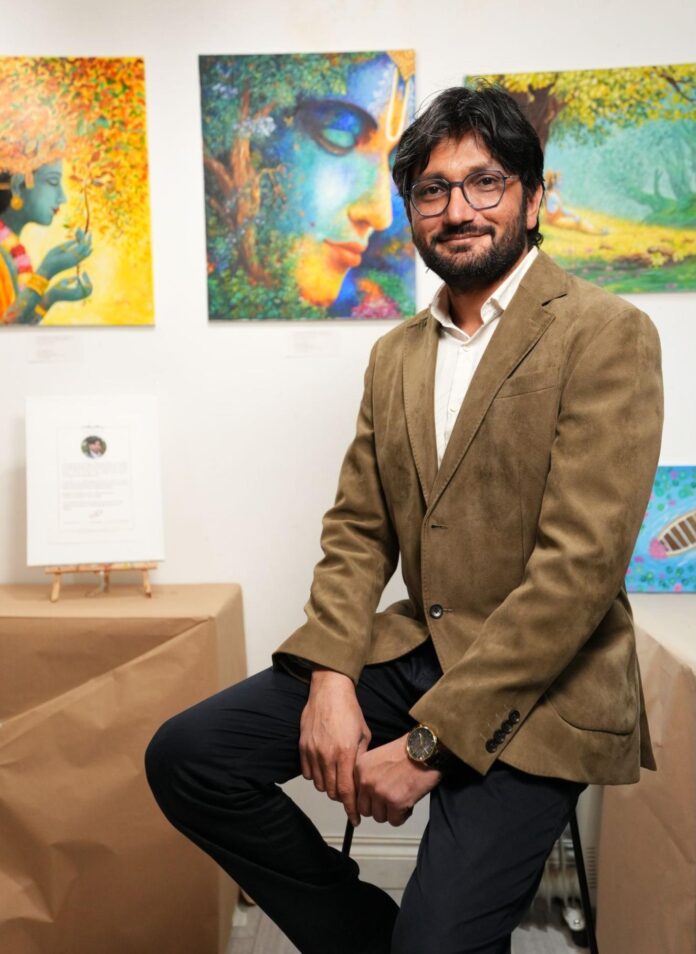
The sacred has always been a part of art history, taking us back to before the Renaissance and potentially to the Ice Age, with the Lion-man of Hohlenstein-Stadel sculpture, which may have been one of the earliest references to greater powers and deities.
While in Western art history, this often takes the form of the Gods of Ancient Rome and Greece, followed by representations of Christianity, the art of Pareshkumar Kakadiya offers a different perspective we don’t often see in the UK – that of the spiritual side of Hinduism.
When we see a swan, we think of the myth of Leda and the Swan, Zeus’ seduction of the Spartan Queen, depicted by many Renaissance artists, including Leonardo da Vinci and Michelangelo. However, in Kakadiya’s hands, he paints the Hindu mother goddess, Brahmani Maa, floating on a swan, blessing those below her with her divine light. Much as we might see in a 15th- or 16th-century depiction of the Virgin. While we can see similarities with Western art, the narrative is completely different. A narrative many UK audiences won’t be familiar with.
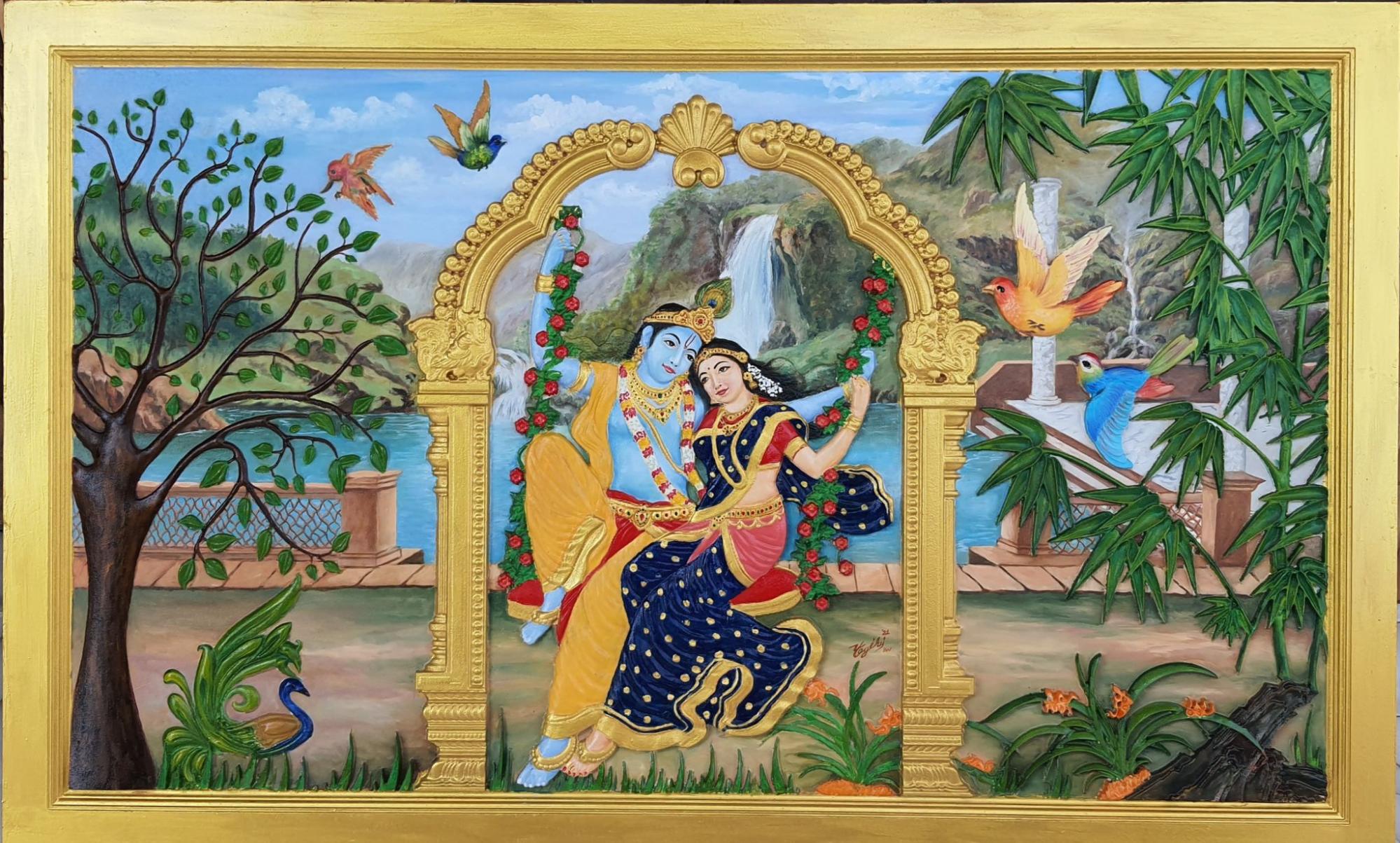
The artist also demonstrates technical skill in painting in relief, as seen in his depiction of Radha and Krishna, the great love story at the centre of Hinduism.
Beyond the spiritual, I’m also drawn to his scenes of India painted on murals and wood. Whether that be capturing the hubbub of Mumbai with an auto-rickshaw speeding between market stalls, or children engaging in an impromptu game of street cricket. Both are part of the authentic experience of visiting India, and should be on the list of any visitor to witness. Just as LS Lowry captured people walking to work in factories under grey skies, Kakadiya captures the dynamism and vibrancy of India.
His portraits capture the emotions of his sitters, whether through paintings or drawings. The coloured pencil drawings of spiritual leaders have a strong smokiness, similar to the sfumato effect made famous by Leonardo, and they also reminded me of the work of British artist Curtis Holder and the recognition that pencil artists are now receiving after being sidelined for decades.
He’s equally skilled at capturing a likeness in oil painting, and a sepia-toned self-portrait of his younger self shows a faraway look in his eyes, as if he’s daydreaming or recalling a moment from his past.
There’s no shortage of ambition in Kakadiya’s practice, and he’s always up for a challenge, as demonstrated by his awards across different mediums, and a world record for the largest bubble wrap painting.
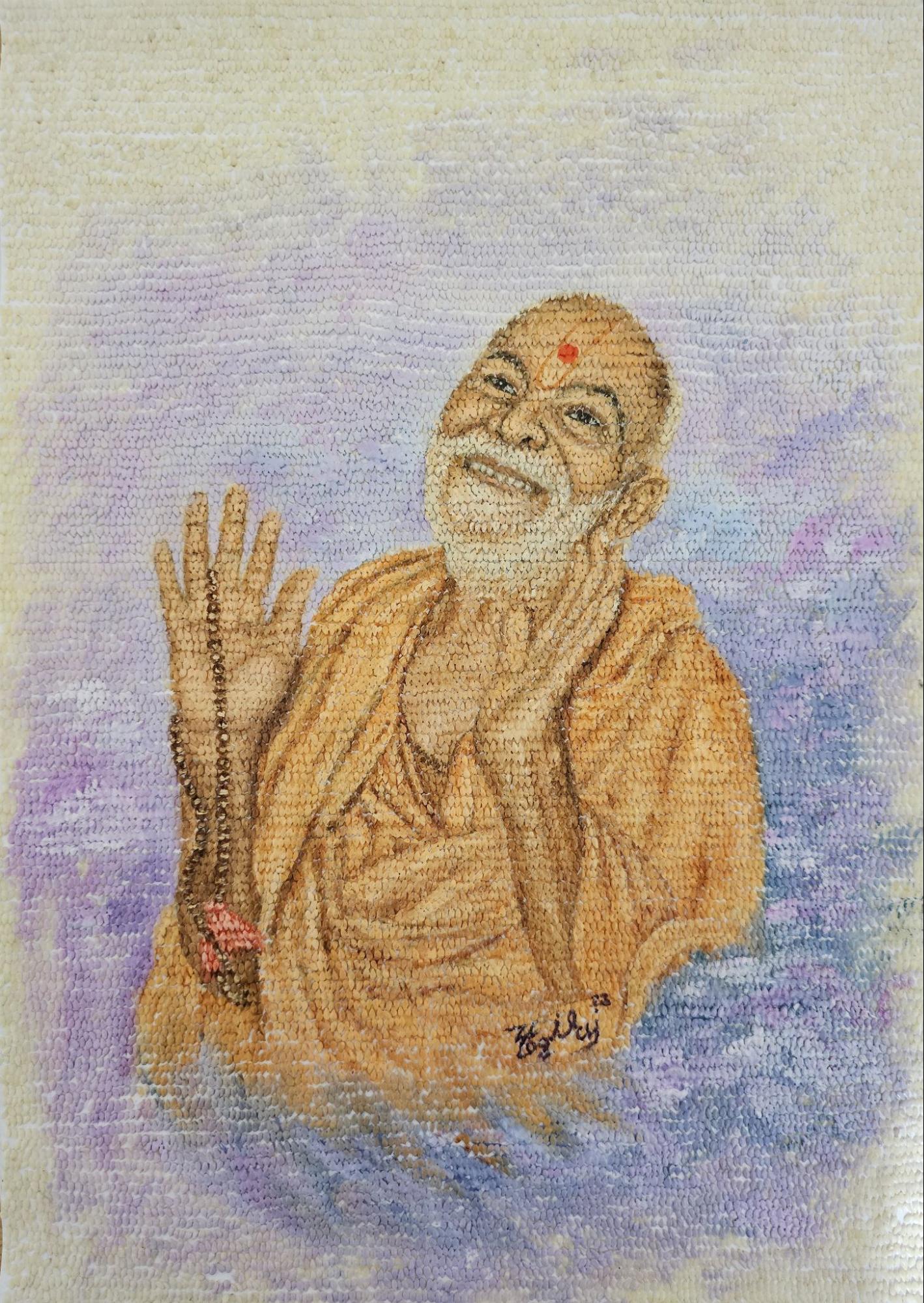
His ambition is evident in his portrait of Yogiji Maharaj, in which individual sesame seeds were painstakingly affixed to the surface to create a richly textured work. It makes you want to run your fingers across the surface, the way we feel when we look at the impasto painting of the likes of Vincent Van Gogh or Frank Auerbach. The sesame seeds also hold significance in Hinduism, symbolising immortality, purification, and ancestral connection. Displayed at the BAPS Shri Swaminarayan Mandir in Neasden, North London, it demonstrated both his commitments to creating unique artworks and imbuing them with spiritual reverence.
His strength lies in drawing on his Indian heritage and painting in both historical and contemporary styles. It allows him to incorporate Western techniques while remaining true to the spiritual and personal roots that tether him to his home country and to develop as an artist in the UK.
More information on Paresh Kakadiya may be found on his website and Instagram.

