

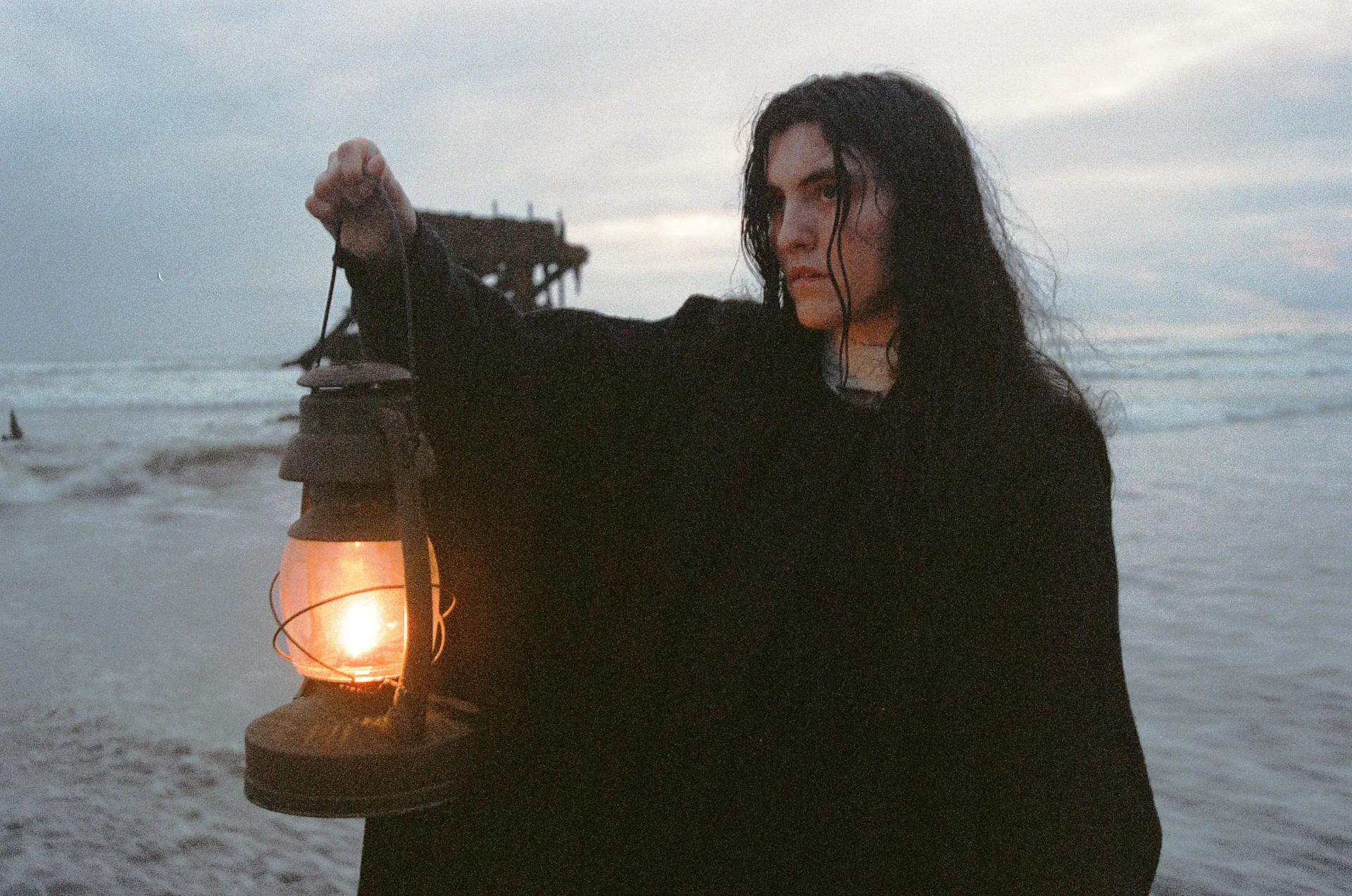
Alec Duckart, the Pacific Northwest singer-songwriter who records as Searows, was looking for a title for his new album when he stumbled on just the right passage from Herman Mellville’s Moby-Dick: “Yes, there is death in this business of whaling – a speechlessly quick chaotic bundling of a man into Eternity. But what then? Methinks we have hugely mistaken this matter of Life and Death…. Methinks my body is but the lees of my better being.” The forces in Searows’ music often feel vast and uncontrollable, mirrored in atmospheric layers of folky yet dense instrumentation, but his own presence is unshrouded and crushingly gentle. Abstract and cryptic as they are, it’s not hard to emotionally latch onto the songs on Death in the Business of Whaling, which follows Searows’ compelling debut Guard Dog as well as his 2023 EP, End of the World. Their resonance, too, stemmed from characters who find themselves on the edge of oblivion – he does release on a label called Last Recordings on Earth, launched by Matt Maltese – but Duckart keeps finding new ways to embody and eternalize them.
We caught up with Searows to talk about Chelsea Wolfe, Crater Lake, The Storm on the Sea of Galilee, and other inspirations behind his new album Death in the Business of Whaling.
Marked for Death by Emma Ruth Rundle
When it came out almost a decade ago, I remember being struck by how heavy, gothic, and stark it was at the same time.
I feel like I’ve been obsessed with it since I heard it, which was really only maybe a couple of years ago. And immediately, Emma Ruth Rundle was my top artist of that year. I was obsessed with her other projects too, but mostly Mark for Death. I hadn’t really heard that much music that felt heavy in the way that it is. It’s also very soft at times, and her other albums are either very soft folk-esque or full metal.
She Reaches Out to She Reaches Out to She by Chelsea Wolfe
What made you pick her most recent one as opposed to an earlier record, like you did with Emma Ruth Rundle?
I feel like that’s just the one that I was listening to before making the album. ‘Dusk’ is on that one, and it’s one of my favorite songs ever. It’s very satisfying, and I feel like I listened to so much music that was not necessarily what I know how to write. I don’t tend towards writing heavy music; I’m very comfortable in the quiet, folky songwriting type of music. And I feel like going fully on the other end was trying to get some other sound without completely switching it up.
Does it inspire you to see the trajectories of artists who maybe started out with this folkier sound before experimenting with different kinds of heaviness?
Yeah, I feel like that is so cool and definitely something that I want to explore more. With this record, I feel like I could explore a lot more, but I also didn’t want to go too far out of my comfort zone – I wanted to go out of it, but not somewhere else entirely.
Something Chelsea Wolfe said in an interview about that record that stuck with me was attempting to reconcile “darkness and coziness,” in the sense of embracing the darkness. Is that something that resonates with you?
That’s something I’ve always come back to, especially with music. I feel like there’s a comfort in it, almost, and it also makes sense being from the Pacific Northwest. It has a very dark, spooky essence about it, at least in the winter – the trees and the fog – but in a very comforting way, something that I find cozy. I’m definitely drawn towards darker themes and aesthetics. I feel like I’ve gradually become more comfortable writing about more material dark themes – like, not emotionally dark. It feels more comfortable, even if it’s still symbolic of emotions.
Alex G’s score for We’re All Going to the World’s Fair
It’s weirdly in line with the previous inspiration; one review called the score “both creepy and cozy.” What draws you to it?
Again, I was listening to it quite a lot while I was touring a couple years ago. I was working on the album, and I feel like that score, and the other one that Alex G did for I Saw the TV Glow, were both so influential. I just listen to them all the time. It’s someone who makes the type of music that Alex G makes, but going into a project with the purpose of cinema, making something feel a certain way. I love Alex G and I love scores, and I feel like it’sthe perfect combination. He just executed it so well – it doesn’t sound different from something I would expect him to make. My goal now is to make a project like that.
Annihilation by Jeff Vandermeer
Are you a fan of the whole trilogy?
I should read the rest of, but I’ve just read the first book. It stuck with me for so long. I read it when I was working on the album, and I feel like it was something I thought about a lot. It was one of those things that I didn’t consciously think about when writing, but when I think back to it, I can feel some of the influence that it had – the unreliable narrator, everything sort of becoming nature, in a way that disturbed me but also was so fascinating and well done.
Crater Lake
I imagine these songs unfolding against a very staggering natural backdrop, and this feels like a real-life inspiration.
It was one of those first inspirations for the feelings of the record, what I wanted it to come back to. It’s a beautiful place, obviously, and a gorgeous piece of nature, but there’s also so much myth and so many ghost stories and monster stories about it. It’s the deepest lake in the US, and deep bodies of water – I’m so viscerally disturbed by thinking about how deep that is, it makes me feel fascinated and afraid. I feel like I’m frequently inspired artistically by that feeling.
Did you go back to it later in the process?
I didn’t, actually. I wanna go back, but I think it’s gonna be closed to the public for a few years.
Rembrandt’s painting The Storm on the Sea of Galilee
I’m curious if it was mostly a visual reference for the artwork or if it also crept into the writing of the record.
I have the painting on my wall. I found it at a thrift store, or I think my partner did, and I put it on my wall because it’s very in line with other paintings that I love. Again, the vast ocean – it’s disturbing and beautiful, and I love art like that. But while I was recording all the demos and writing all the songs, I was staring at this painting. I feel like I didn’t know that the record would end up being so ship-heavy in theme. [laughs] It definitely was seeping into my subconscious.
You’ve toured quite a bit at this point, and I’m curious if there are other seascapes you’ve encountered that have stuck with you.
I think we stayed on the coast in Scotland for probably one night, but it was so foggy, and the road there was just so insanely beautiful. And then being on the ferry to Ireland, I felt the same way that I feel whenever I’m in an ocean in general. It’s so crazy to think about where I am and what’s underneath, that same feeling of being disturbed and fascinated. That’s probably why I’ve written songs about it, but it’s something that I am always looking for more ways to describe: that phobia of things that are too big, and especially when they’re too big underwater. When I see giant things, there’s a pit in my stomach, and maybe that’s just a really natural human response to a giant anything. But I also can’t stop looking at it. When we were on tour, we would pass by wind turbines, and they were so much bigger than I thought they were. And I was just like, “That is horrifying, but I can’t stop staring at them.”
Speaking of looking for the words, I know you were flipping through books in search of album titles, and it’s fitting that it comes from a Moby Dick quote. What other books were on your shelf?
That part of the process was after making the album and all of the visuals. I was looking books that I had not ever read – I had a copy of Frankenstein, and that was another one that I was like, “Why is this so exactly the theme that I was trying to capture?” I couldn’t say that it was an inspiration, because I didn’t even know that there were so many things to call back to. But I was looking through that book, and it was so specific to so many things that I wrote about, which is strange.
Preacher’s Daughter by Ethel Cain
Obviously, you’ve performed with Ethel Cain, who supported your work early on. She’s put out a couple of records since we last talked, and I’m curious what it is that’s kept Preacher’s Daughter dear to your heart.
I’m obsessed with every record she’s ever put out, but I feel like Preacher’s Daughter was one of those records that was so inspiring in how it was this story that she thought through from start to finish – the character’s parents and grandparents. It’s just so well thought out, and there’s so much detail and care and attention in everything about it. The idea of making a project that is fully a story, even if it’s mirroring experiences or feelings, is so inspiring. I wanted to make something that was far more fictionalized than I feel like my record ended up being, but it’s fictional and cinematic in parts.
Do you see yourself leaning more into that narrative side of your songwriting going forwards?
I feel like it’s very inspiring to me, but I think it depends on whether I feel capable of doing that. I do usually tend to come back to either very abstract or personal experience, mixed in with the rest of whatever is inspiring me.
The quiet sprawl of your record also reminds me of the follow-up to Preacher’s Daughter, Willoughby Tucker, I Will Always Love You, in that it finds ways other than distortion to give the songs density.
Yeah. I didn’t want it to be loud in an abrasive way, but I definitely wanted it to be a lot more layered. I feel like all of the albums that I referenced have these different elements o, like, banjo and cello and bass and also distorted guitars, crossing the boundaries of genre.
This interview has been edited and condensed for clarity and length.
Searows’ Death in the Business of Whaling is out now via Last Recordings on Earth.

