

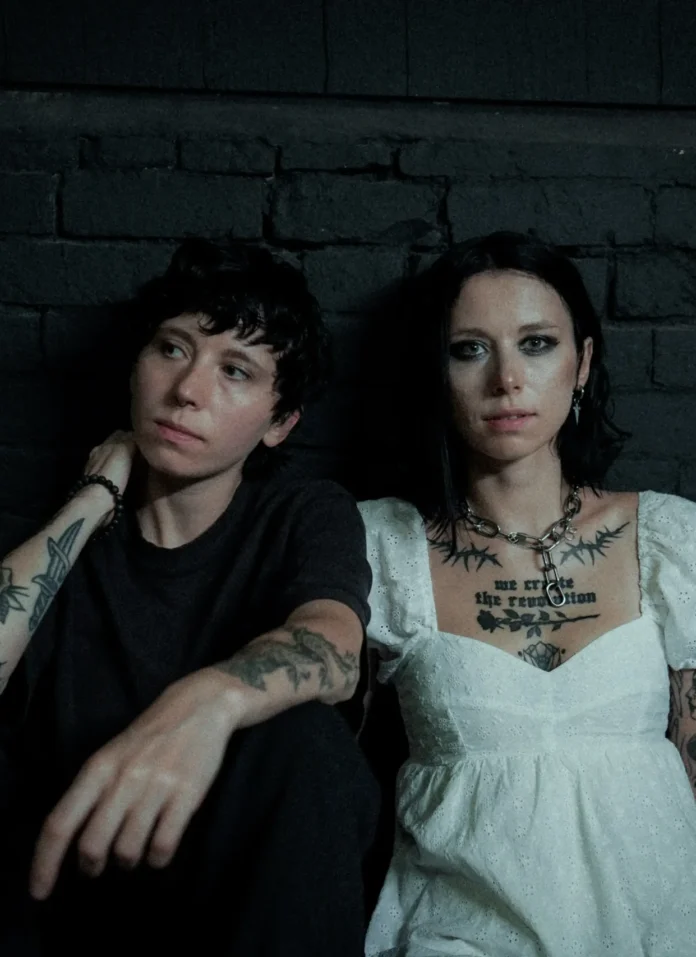
Softcult is the project of Ontario-based twins Mercedes and Phoenix Arn-Horn, who previously made music together as Courage My Love. Though they retained some of the pop-punk elements of their previous band, eventually embracing them more authentically as riot grrrl, they wanted to break away from the industry pressures of being a “Warped Tour band,” initially writing music with no particular goal in mind and fleshing out different pockets of their sound across a series of EPs. Beginning with 2021’s Year of the Rat, they developed an intimate blend of shoegaze, grunge, and indie rock while building their own community through the monthly zine SCripture. Softcult’s debut LP, When a Flower Doesn’t Grow, arrives on their own terms, self-produced and self-reclamatory, a journey of personal transformation that understands its power in becoming a lot more than personal. In a press release, Mercedes mentioned feeling “rootbound” as a form of dissociation, but the record doesn’t close without her naming what it is the roots yearn for: the unknown. “When a flower doesn’t grow/ Do we blame the dying rose/ Or the soil that it called home?”
We caught up with Softcult’s Phoenix Arn-Hor for the latest edition of our Artist Spotlight series to talk about releasing a debut album the second time, self-producing, twin factor, and more.
Having released a debut album before Softcult, how has putting out When a Flower Doesn’t Grow made you reflect on this time and how your circumstances have changed?
You might know we were in a different band for 10 years, and we did a similar thing where we released a lot of EPs before putting out a full-length record. The reason back then why it took us so long to put out an actual full-length was more because it just took us a long time to get our label on board with actually signing off on what they were willing for us to put out, basically, which was a not-so-great situation. But in this band, it’s definitely the polar opposite of that, where we’ve been a band now almost five years, and we’ve just been releasing music every year, non-stop. Getting to do an actual full-length now – you don’t always get the opportunity to start over. Cedes and I are both in our 30s now, we’re 32. It’s pretty rare that you get the chance to start a whole new project when you’re at that age and you’ve already done it for so long. Getting the opportunity to be like, “I’m gonna release a debut record at 32” is just really cool and exciting. It lights that spark again and makes everything feel new, even though we’ve been doing the band thing for a while now. It’s definitely nostalgic looking back and thinking about all the things that we’ve learned from our previous project.
What was the motivating factor that made you feel ready to make a full-length record this time around?
I think this time around with Softcult, it just seemed like the right time because it’s always something that we wanted. We’d released four EPs before we started working on this record, and I feel like it was enough time to really sit in on our sound and figure out where our strengths lie. Having 10 songs to mess around with as opposed to 4 or 5 lets you explore a bit more each corner of your sound, and we did try to do that. There’s definitely some gazier songs and dream-poppy songs that you might expect from our band, but since we had the opportunity, we tried to lean into more of the riot grrrl sound that we’ve touched on before, definitely lyrically, but maybe not so much sonically. It was a cool exercise.
Given that you self-produced the record, I’m curious if there was an element, too, of feeling settled in your abilities and communication in that respect.
To give a little bit of backstory on the start of the band to now – we finally completed the last singles that we had to do for our old band’s contract to expire in 2020. It was already the pandemic at that time, and where we live, it was in a lockdown. At the time, Cedes and I lived together, which was cool. We had really nothing but time to kind of sit down and make demos, so we just got really comfortable being in a home studio. We were lucky that we had got that set up before shut down. That’s how this band has always been, a bedroom recording type vibe, so that’s what we’re comfortable with. There’s definitely been times where we’re like, “Do you think would it sound better if we actually did it the proper way and go into a studio?” But at the same time, I think us self-producing maybe is a core aspect of our sound. At this point, I think we’re happy with it. In the future, it could be something we try to actually do a bit more on a grander scale, but right now it feels genuinely a part of our sound to do it ourselves.
In that part of the process, do you feel like you have similar philosophies when it comes to getting a song right, or do they sometimes diverge?
That’s a good question. I do think we’re pretty similar with it. We make a good team when it comes to songwriting. I’m really grateful that I have her sometimes to tell me when something’s done, because I feel like I’m the kind of person who will work away on something forever, and it doesn’t necessarily always make it better; sometimes, it maybe makes it just weirder or worse. I do feel like it’s good for our dynamic that she’s the one that’s like, “Alright, it’s good. You don’t need to keep tinkering with it.” But I think for the most part, we’re pretty on the same page. She showed me a bunch of bands that really influenced me, and I’ve shown her some records that we both really enjoy the sound and production of. I think we do align and meet in the middle that way. So far, it’s been mostly me engineering and editing the stuff music-wise, but she’s starting to get more into that, too. Down the line, I think it could be something where we’re both taking on that role more, and that’s just gonna be exciting.
Do you tend to talk through a lot of these reference points or ideas for a song, or is it mostly unspoken?
Now that we don’t live together anymore, we have to basically schedule times for us to meet up and record and write together. A lot of the time, Cedes will send me voice notes of songs or ideas that she has, and then when we get together, we’ll put them together in Logic, start recording them and filling in all the blanks. Sometimes I’ll bring an idea – a lot of the time it even just starts as writing lyrics in your Notes app and sending them to each other. Sometimes, and especially right now, there’s just so much going on in the world – there’ll be a world event, something insane that will happen, and obviously that’s top of mind for both of us, so we’ll get together and that’ll inspire something that we’ll start together. It can go either way, really. Cedes obviously plays guitar, and she’s really good at that, so she’ll often come with a structure and melodies. If I have a riff idea in my ahead – I have so many voice notes of me just humming into my phone, and she ends up having to translate that and decipher that into how you would actually play it on a guitar. If I get hit by a car, you have to delete all my voice notes, okay? [laughs] Delete every single one. I don’t want that to get out into the world.
Aside from exploring different sounds, the journey of the album as an LP feels very intentionally sequenced, and I wonder to what extent that reflects the order in which the songs were written.
It was intentionally sequenced in that way. We tried to make it so that it ends in a really empowered note, and maybe you feel a bit stronger than you did at the very start. When we were writing the songs, we definitely didn’t write them in that order, but what ended up happening was, we had a couple songs kicking around, ones that were written but just didn’t make it onto EPs. Cedes was going through, personally, a big point of self-discovery in her life, finding ways to deal with that, and she ended up sending me this song – I think it was at 3am or something – it was just a voice note that was her playing guitar in her living room. That ended up being ‘When a Flower Doesn’t Grow’, which is the title track. As soon as I heard that song, I immediately texted her back and was like, “Hey, I think this should be the title track of the album. I think we need to call the album When a Flower Doesn’t Grow.” And I said I think it should be the last track on the record, because to me, it just said a lot of things that I feel like were encapsulating what we wanted to say with the album.
Once we had that plan, we were able to kind of fill in the blanks with songs that get from point A to point B. It’s basically about someone that’s discovering that their environment isn’t suiting them anymore, and they need to change things in order to allow themselves to grow and become the best version of themselves. It’s not the people in the world that should feel like there’s something wrong with them and they need to change – it’s more like the environment right now isn’t conducive to everyone growing and thriving together, so that’s what needs to change.
After the two songs, it’s interesting how you dive into a couple of more narrative-driven tracks, ‘16/25’ and ‘She Said, He Said’. What was it like switching perspectives and now stepping into them in a live context?
I’m glad that you can tell that it’s supposed to shift from perspective to perspective, because I could see it getting confusing, like, “Wait, what now?” [laughs] But I think that’s a fun exercise in songwriting, finding different ways to say something and coming at it from a different perspective. ‘16/25’ is basically trying to show how absurd it is that someone in their 20s is not self-aware enough to know that it’s weird that they’re dating a teenager. Why they would think, “We have something in common,” when there’s no way that that could be true. That one was an interesting one to try to write and get into that mindset. But live, I think it’s just really exciting to play some new songs and see the way people react. That one tends to go off live, and it might be because the drums are fast-tempo.
Another pair of songs that are powerfully juxtaposed are ‘Hurt Me’ and ‘I Held You Like Glass’, which seem to trace the pain from the moment it’s buried to the numbness that grows in its place. It sounds like they came from different places lyrically, but they complement each other.
Sometimes when you’re writing a song, you don’t always necessarily even know fully where it’s coming from, but once you sit in it for a while, you realize, “Oh man, I feel like I maybe wrote this song about this.” It was the same with pairing those two next to each other. They couldn’t be more different as songs – one is obviously so kind of aggressive and full of rage, but it ends off where the lyrics are like, “I’ll carry this all of my life/ I’ll bury this thorn on my side.” When you bury those things deep down, you bury that rage deep down, eventually it does get replaced by numbness, which is dangerous, because you don’t ever deal with it. It just grows, and you end up holding on to things that are damaging to you, but you eventually just become numb to it. I’m glad that makes sense listening through, because it did to us, but we were a little bit worried that no one else would get it because it’s so up and down vibe-wise.
And what you described becomes a cycle, right? That’s where the record looping back into itself comes in as well.
Oh yeah, we’re big on cycles. [laughs] Any kind of metaphor we can use.
Was ‘Hurt Me’ split into these parts from the beginning, or did it progress that way?
That one was just a weird outlier for a long time, because I originally had written it as more of a poem. I had it in my Notes app for a long time, and then eventually I showed it to Cedes when we were just kicking around some ideas. I honestly never thought it would become a song; I wasn’t even totally sure if I wanted it on the album, but Cedes was really down for it. She convinced me that that one was important in the context of the record. Obviously, the beginning is pretty intense and rage-filled, and when it just flips vibe-wise, we just kdidn’t want the whole song to be one-note. Because I think that’s the thing with these feelings that people have – it’s not always just, “Oh, I’m angry.” There’s always a deeper root cause for why someone’s angry, something underneath that’s a little bit more nuanced and more complicated.
When you’re both at this early stage where it’s maybe just thoughtson your phone, do you sometimes tend to work through them as just that first, or does it quickly become about what they could turn into?
We’re siblings, so when we’re showing each other stuff like that, of course we’re gonna ask, “Where did that kind of come from? What’s going on?” [laughs] I think talking about that stuff together does help give a deeper understanding into the issue, and we’ll maybe get different perspectives on it. It just lets you understand things a bit more. It doesn’t always have to turn into a song or into anything; it can just be talking about it. But I think for us, that’s just how my sister and I tend to deal through things in our life, is we do turn to music a lot. We’re lucky that we have each other, because we can do that together, and it is cathartic.
‘Tired’ is a song where the lyrics are pretty self-explanatory, but it’s interesting that the first thing you list is self-deprecation. I think you’ve talked about preaching empowerment while also feeling like you’ve internalized a lot of shame. From your perspective, what role does self-deprecation play in normalizing and feeding into self-doubt?
Cedes and I aren’t perfect people, and there’s no way anyone could really talk about some of these issues in a perfect way. Sometimes it does feel a little bit like we try to come at it from an empowerment role, but it’s hard sometimes to always practice what you preach in your own personal life. I think that’s something that my sister was going through big time during the writing of this record – she felt like she’d be this strong person on stage, but in her private life, she wasn’t really always taking her own advice. If you put yourself out there in that way, people expect you to live by your own words. I think for both of us, when we do feel like we’re messing up in our own lives, or if we feel kind of like we’re not living up to everything that we’ve tried to say in our music, it feels self-deprecating to go and be on stage and sing songs about certain topics. You kind of feel a bit of imposter syndrome.
‘Tired’ is a good one for that, because for me, that’s the turning point in the record, where you’ve already gone through some of these really dark traumas – you’ve kind of figured out the root of them with ‘Hurt Me’, and you’re like, “That’s where this cycle started.” And you get to ‘Queen of Nothing’, where you realize this isn’t even just a me thing, this is a societal thing. And then ‘Tired’ comes in and you’re like, “I’m not gonna keep going this way.” The end lyric is what really got me: “I’m gonna stay awake, but I’m tired.” You are freaking tired of this, but you’re not gonna be jaded. You’re gonna keep fighting.
Last night, I watched Jim Jarmusch’s latest film, Father Mother Sister Brother. The final segment focuses on these twins who’ve come up with a useful shorthand for when something happens that they attribute to their connection, “twin factor.” I wanted to ask if anything recent comes to mind that you could attribute to something akin to that.
Honestly, it’s hard for me, because I feel like I’m so used to that happening just from being a twin. Definitely when we were younger we’d always hear about twin telepathy, but I don’t think it’s even twin telepathy. It’s more like we’ve been around each other for so long, and we are really close. We can read each other’s body language really well, and I can just get a vibe off Mercedes, and she can get a vibe off me in any situation. Sometimes it’ll just be a matter of looking at each other, and we know we’re gonna talk about this later when it’s safe. But the twin factor, it happens a lot, especially in band practices. That’s just what I’m thinking of right now, because that’s just been my life the past few days. We’ll be kind of communicating, but we’re not saying full sentences – I’m saying the beginning of a sentence and trailing off, and then Cedes will be like, “Oh yeah, for sure.” And then our two friends that are also in the band with us, they’ll be like, “Guys, can you translate, please? We don’t know what’s going on.” I think that might be a twin factor.
This interview has been edited and condensed for clarity and length.
Softcult’s When a Flower Doesn’t Grow is out now via Easy Life Records.

