

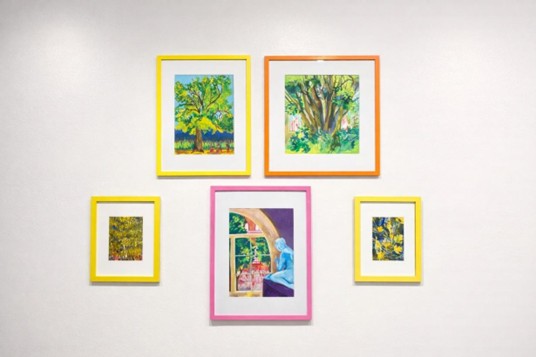
Art often steps in where time refuses to pause. That impulse runs through Echoes of Summer, Anna Iarchuk’s exhibition at Friendly Grounds in London, shown from 10 November to 10 December 2025. The exhibition positions itself as an attempt to treat summer not as a nostalgic image but as a fleeting psychological state shaped by attention and memory. This approach is convincing because the works resist closure. They do not try to hold on to summer but stay close to the act of noticing it as it passes.
Having recently moved to London, Iarchuk seems to have entered the city through its parks. Paths, trees, and passing figures recur throughout the exhibition, yet they are never fixed to specific locations. Her collages combine painted surfaces, hand-cut paper, and digital elements, a vocabulary familiar in contemporary painting. This combination could easily become decorative, yet here it largely avoids that risk. The restraint of the compositions keeps the works grounded in observation rather than visual effect.
Many of the works began as outdoor paintings made during the artist’s first months in the city. That origin remains visible, not as spontaneity for its own sake, but as a method of working. These are not studies moving toward a finished statement. They feel like returns to an initial encounter. Sketches made on site are later transformed into layered collages that still carry traces of changing light, weather, and time spent looking. Rather than romanticising plein air practice, the exhibition explores observation as a slow and uncertain process.
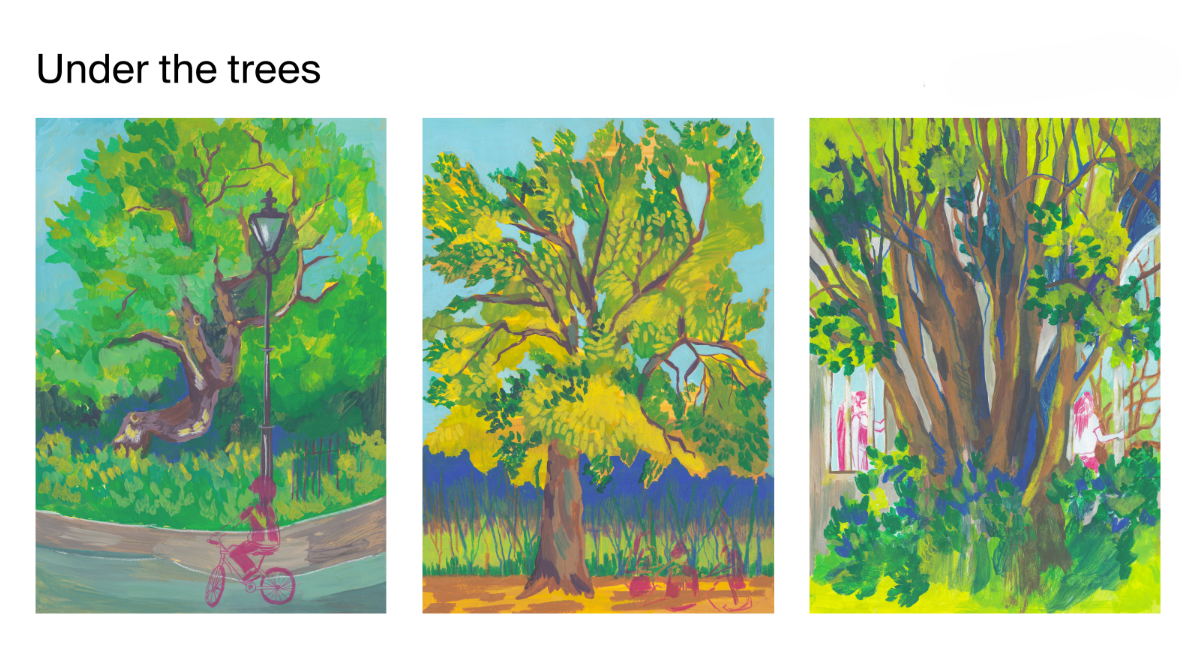
This approach is particularly clear in the Under the Trees series. Small scenes such as a child on a bicycle, a bend in a path, or the outline of a ruined church are handled with a light touch. Unlike many contemporary collage practices that use fragmentation to comment on urban or social conditions, Iarchuk’s work avoids overt narrative. Instead, it operates on a quieter, almost diaristic level. This restraint is a risk, but it is also where the exhibition finds its strength.
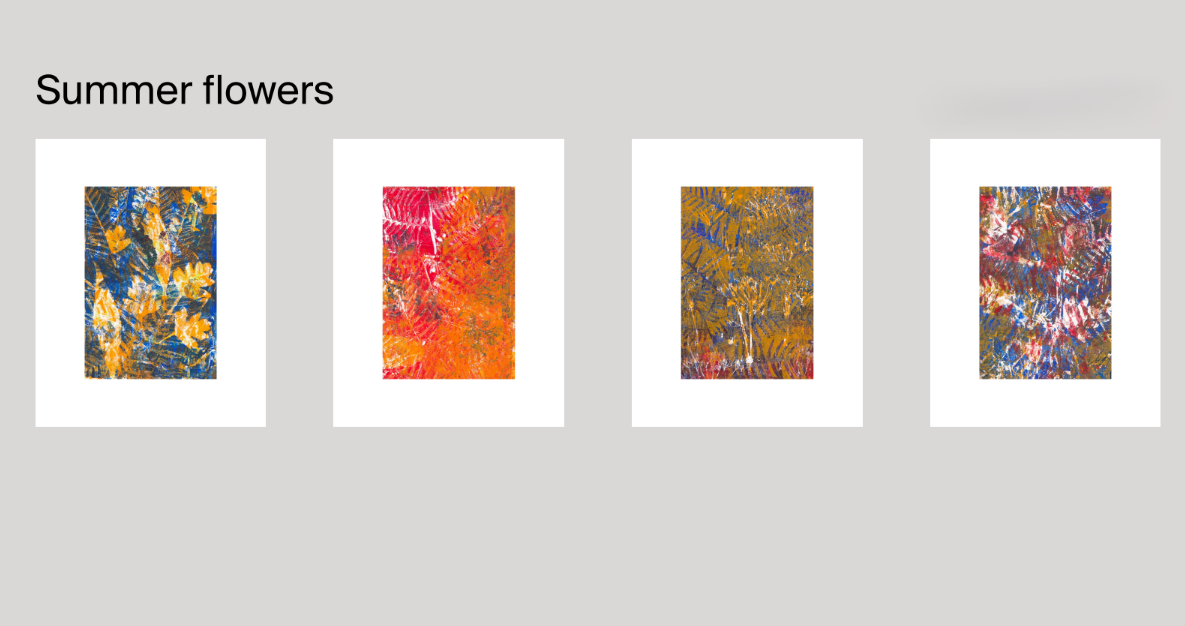
The Summer Flowers monotypes slow the pace further. Their small scale and unpredictability suit the subject, turning each image into a brief encounter rather than a depiction. At times, this lightness comes close to dissolving into pure mood, and some works risk fading too quickly. However, the consistency of the visual language prevents that fragility from becoming weakness.
The exhibition grew from a curatorial idea by Irina Andreeva, and her role is evident in more than atmosphere alone. The placement of works, the rhythm of spacing, and the way light falls across the surfaces are carefully considered. Rather than imposing a rigid conceptual framework, a choice that could have flattened the subtlety of the work, Andreeva allows the exhibition to unfold gradually. Brighter colours appear first, followed by softer greens and quieter tones. This progression supports the exhibition’s focus on perception and duration rather than statement.
Echoes of Summer does not rely on scale or spectacle. Its importance lies in precision and consistency. The exhibition holds together because it understands its own vulnerability and accepts it as part of its language. In doing so, it makes a quiet but convincing case for observation as a meaningful artistic position.

