

Author’s note: I wish to thank Ed Godziszewski, Erik Homenick, John DeSentis, and Matt Burkett for sharing information and/or perspective for this article.
In their seminal 1959 study The Japanese Film: Art and Industry, historians Joseph L. Anderson and Donald Richie offer a two-page commentary on the Japanese monster movie, at the time a “more recent development” in a national cinema stretching back to the late nineteenth century. As the authors recount, the genre erupted onto the scene with Ishiro Honda’s Godzilla (1954), “a film which the Japanese critics, though criticizing the picture’s exploitation of the atom-bomb scare, praised for an ‘intellectual content usually lacking in foreign pictures of the same genre.’”1 Honda’s movie ranked among the year’s major domestic hits, selling 9.6 million tickets2 and grossing ¥183 million.3 “The Japanese success of the picture,” write Anderson and Richie, “was such that a year later Toho [the studio behind it] brought out [Motoyoshi Oda’s Godzilla Raids Again], a quickie which […] spent much less time and ingenuity in the destruction of miniature sets. In the same year the Abominable Snowman […] made an appearance in [Half Human, also produced by Toho and directed by Honda].”4
Godzilla Raids Again wasn’t well-regarded within studio walls; special effects cameraman Sadamasa Arikawa felt “[s]omething was missing” and recalled fellow staffers “talking about the first movie” at a company preview.5 Nevertheless, it proved a worthy financial successor, becoming the year’s fourth biggest Toho release6 with an attendance of 8.34 million.7 And while box office stats for Half Human remain seemingly unavailable, Toho recognized there was still a market for Japanese monsters—especially when Godzilla migrated to the United States in the form of a 1956 re-edit called Godzilla, King of the Monsters! and grossed over $700,000.8 The year that Americans were being introduced to Godzilla, the studio unleashed—in Anderson and Richie’s words—“another prehistoric monster” via Honda’s Rodan and this time presented urban destruction in color.9
Japanese color photography was another recent development. While filmmakers in the Land of the Rising Sun had dallied with hand-painted frames and Kinemacolor (a technique of British origin that projected black-and-white footage through rapidly alternating tinted filters) since the early twentieth century,10 the studios were slow in developing authentic color celluloid. And when it did appear, it was regarded as an expensive gimmick. Fuji Photo Film Co., Ltd. unveiled its Fujicolor process in 1946, and it was initially used on newsreels, recorded stage performances, and select passages from features. (The earlier mentioned Motoyoshi Oda directed 1946’s Eleven Girl Students, which used Fujicolor in its opening title sequence.)11 Even when Shochiku invested $125,000 into making Japan’s first full-color movie—the Keisuke Kinoshita comedy Carmen Comes Home (1951)12—the results weren’t widely seen. Historian Hisashi Okajima writes in the October 2003 issue of Journal of Film Preservation that Shochiku’s front office wasn’t “confident of providing their chained film theaters […] with the prints to be produced from this new process,” and so Kinoshita shot two versions of his movie—one in color, the other in black-and-white—and only struck eleven prints of the former.13 Expenses likely factored into this decision, as well: processing Fujicolor cost twenty-five cents per foot versus the three cents required for black-and-white.14
All of this changed—in no small part—due to Japan’s snowballing interest in foreign exhibition. Despite Fujicolor’s status as an efficient film stock, it had drawbacks (“slightly heavy pink and orange tones”)15 as did similar processes like Sakuracolor, and exemplified a technical lag behind the West. Another major company, Daiei, thus imported Eastmancolor from the United States and used it on Teinosuke Kinugasa’s period drama Gate of Hell (1953).16 That picture subsequently went overseas, where it won prizes at film festivals and the American Academy Awards and earned considerable praise for what the New York Times labeled “color of a richness and harmony that matches that of any film we’ve ever seen.”17 Toho evidently took notice, for they used the same brand of stock the following year on Hiroshi Inagaki’s Samurai I: Musashi Miyamoto, which at $500,000 cost ten times the average Japanese feature18 and was similarly showered with praise overseas. The international appeal of Japanese color film might’ve factored into Daiei’s decision to use it on special effects for Koji Shima’s apocalyptic drama Warning from Space, released in January 1956. Toho followed suit with Shiro Toyoda’s Madame White Snake five months later before turning their attention to Rodan.
Having already created dinosaurian monsters and the manlike beast of Half Human, Honda convened with producer Tomoyuki Tanaka and special effects director Eiji Tsuburaya to determine what creature they’d turn loose next. Once the team tentatively settled on an animal resembling the birdlike reptile archaeopteryx,19 Tanaka approached author Ken Kuronuma to write a treatment. Kuronuma was well-known at the time for translating American mysteries and for his contributions to the Japanese edition of Amazing Stories magazine.20 He was also a name familiar to Toho, having been considered to write Godzilla’s foundational story before the studio contracted prolific science fiction author Shigeru Kayama.21
Tasked with a story about a flying monster, Kuronuma took inspiration from an incident in 1948 America. Thomas Mantell was a decorated war veteran employed by the Kentucky Air National Guard when he and three other pilots were ordered to investigate an unidentified flying object near the farming community of Maysville. Mantell separated from his squadron to get a better view, and the wreckage of his aircraft was subsequently found scattered across a half mile of farm terrain. Although the official report stated he’d lost consciousness due to ascending without oxygen equipment,22 the presence of a UFO understandably imbued his death with mystery. Kuronuma remembered this when writing his Rodan treatment,23 and the finished movie contains a marvelous scene wherein a Japanese pilot spots a mysterious object traveling at supersonic speed and is killed in the pursuit.
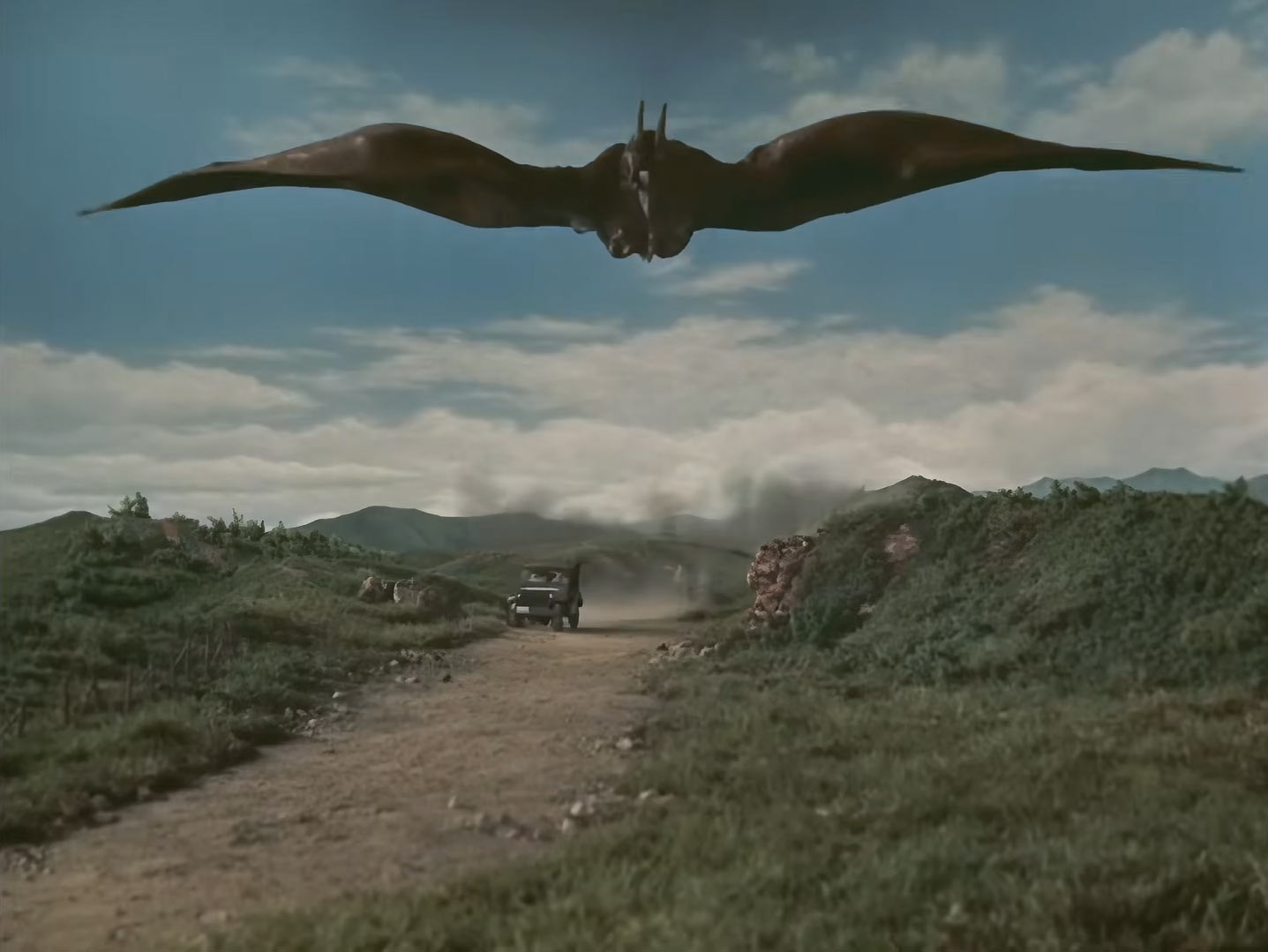
Fighter planes and trespassing aerial objects weren’t an unheard-of mix in Japan. Between 1952 and ‘53, up to thirty incidents of foreign planes violating Japanese airspace were reported in the country’s northernmost island of Hokkaido. The planes were of Russian origin, and on more than one occasion, American jets scrambled from nearby bases to give chase.24 Occasionally, Japanese jets were also called into action, such as in early 1953, when a squad took off with “shooting orders” in the aftermath of an American B29 being downed near Nemuro.25 All of this might’ve been on scenarists Takeo Murata and Takeshi Kimura’s minds when they converted Kuronuma’s treatment into a screenplay: military authorities in the film suggest a “foreign secret weapon” is responsible for their pilot’s death, and the first draft featured an Okinawa-set encounter between Rodan and American jets.26 While the latter scene didn’t survive script revisions, the finished movie contains several prolonged dogfights with the monster being chased across Kyushu by Japanese fighters. The model of jet used in these scenes (the F-86F Sabre) even has a connection to the age—specifically, the year—of Rodan’s making. The Japan Air Self-Defense Force had managed Sabres since the early ‘50s, but it was in 1956 that Mitsubishi factories began manufacturing one hundred and eighty models of American jet. First on the production list was the aforementioned F-86F.27
Also of historical note are the weapons that help seal Rodan’s fate. After planes prove insufficient, the monster’s volcanic lair is shelled by rockets colloquially known as Honest Johns. Contrary to what we see in the film, the Self-Defense Force didn’t have this missile in its arsenal,28 but it was nonetheless present on Japanese soil thanks to the American military—and was furthermore the cause of some controversy. First developed in 1950 and capable of carrying an explosive tip at speeds of Mach 2.3,29 the Honest John arrived at U.S. bases in Japan five years later and that August underwent its first local test. Right away, it provoked backlash, in part due to being launched near the venerated Mount Fuji, but mostly because of its association with atomic warfare.30 Even though the warhead used that day was filled with concrete,31 the Honest John was America’s first surface-to-surface missile system with nuclear capability.32 This, combined with the fact that the U.S. had 280mm cannons with atomic potential in Okinawa,33 led some to fear that Japan—the only nation to suffer atomic bombings, just a decade earlier!—was being used to stockpile American superweapons. When a second test was announced for November 1955 and Hokkaido Governor Toshibumi Tanaka failed to get it canceled, seventy university students protested by positioning themselves in front of the rocket’s launcher.34
Amusingly, the presence of Occidental machines in the film didn’t go unnoticed when Rodan reached the United States in 1957. “Some credit should really go to the weapons designers for the U.S. Army and Air Force,” wrote one syndicated reviewer. “It is not until the latest American weapons such as ‘Honest John’ missiles and air-to-air rockets […] are used against Rodan that the ungainly invader is destroyed.”35
As indicated, part of what makes Rodan retroactively fascinating is how the movie reflects or alludes to contemporaneous phenomena. The first-act drama revolves around a Kyushu mining community and the terror it experiences when large prehistoric insects emerge from the local colliery. A scientist played by Akihiko Hirata theorizes the creatures hatched from eggs that’d been dormant underground since the Mesozoic. To suggest how they could’ve gestated after so many millennia, he reminds his fellow man of a then-recent discovery. In 1951, paleobotanist Ichiro Oga uncovered ancient lotus seeds from an area near the Hamamigawa River; radiocarbon dating determined the seeds to be roughly two thousand years old, and yet, Oga was able to successfully germinate them the following summer.36 The reminder from Hirata’s character—together with topics brought up in the screenplay, such as global warming and environmental changes stimulated by atomic tests—yielded a possible explanation for how and why the movie’s prehistoric monsters came to life.
Japanese coal was first discovered in Kyushu around the turn of the nineteenth century and, following the arrival of modern machinery in 1868, it became the heart of a major national commerce. The government started tracking production in 1874, and by 1919, the annual excavated tonnage had increased from 200,000 to 31 million. Japan’s military expansionism in the early twentieth century led to an all-time high of 56.3 million tons in 1940 before plummeting to 22 million at the end of World War II. The industry never fully recovered (a plan made in 1957 to increase production to 72 million tons by 1975 yielded a mere 19 million), though two foreign conflicts, the Korean War (1950-1953) and the 1956 multinational battle over the Suez Canal, briefly revived it.37 With all this history came intense periods of unrest that biographers Steve Ryfle and Ed Godziszewski argue in their book Ishiro Honda: A Life in Film, from Godzilla to Kurosawa is reflected in early-movie conflict among the miners.
In April 1952, more than 400,000 colliery workers went on strike, protesting an anti-communism bill that, it was speculated, could be weaponized against labor unions.38 Another strike occurred that July across eight collieries as 170,000 pursued better summer bonuses.39 But the most noteworthy dispute began in October, when 250,000 demonstrated for a 12% wage increase and were joined by unionists from the electric power industry.40 The impact was such that Japan’s daily coal production lowered by 100,000 tons,41 factories closed,42 and the nation suffered a power shortage and was forced to ration manufactured gas.43 One of the many collieries to experience labor unrest became a model for the setting in Rodan: the movie’s fictitious coal mine was based on the Mitsui Miike colliery in western Kyushu, which became the site of a 25,000-person demonstration in 1953 (in this case against recent layoffs). Ryfle and Godziszewski note this in their book and likewise interpret first-act infighting as a reflection of “real-life tensions between labor and management.” The authors furthermore state that a cave-in that traps the picture’s young hero “foreshadows a deadly accident that would occur at the Miike mine in 1963.”44
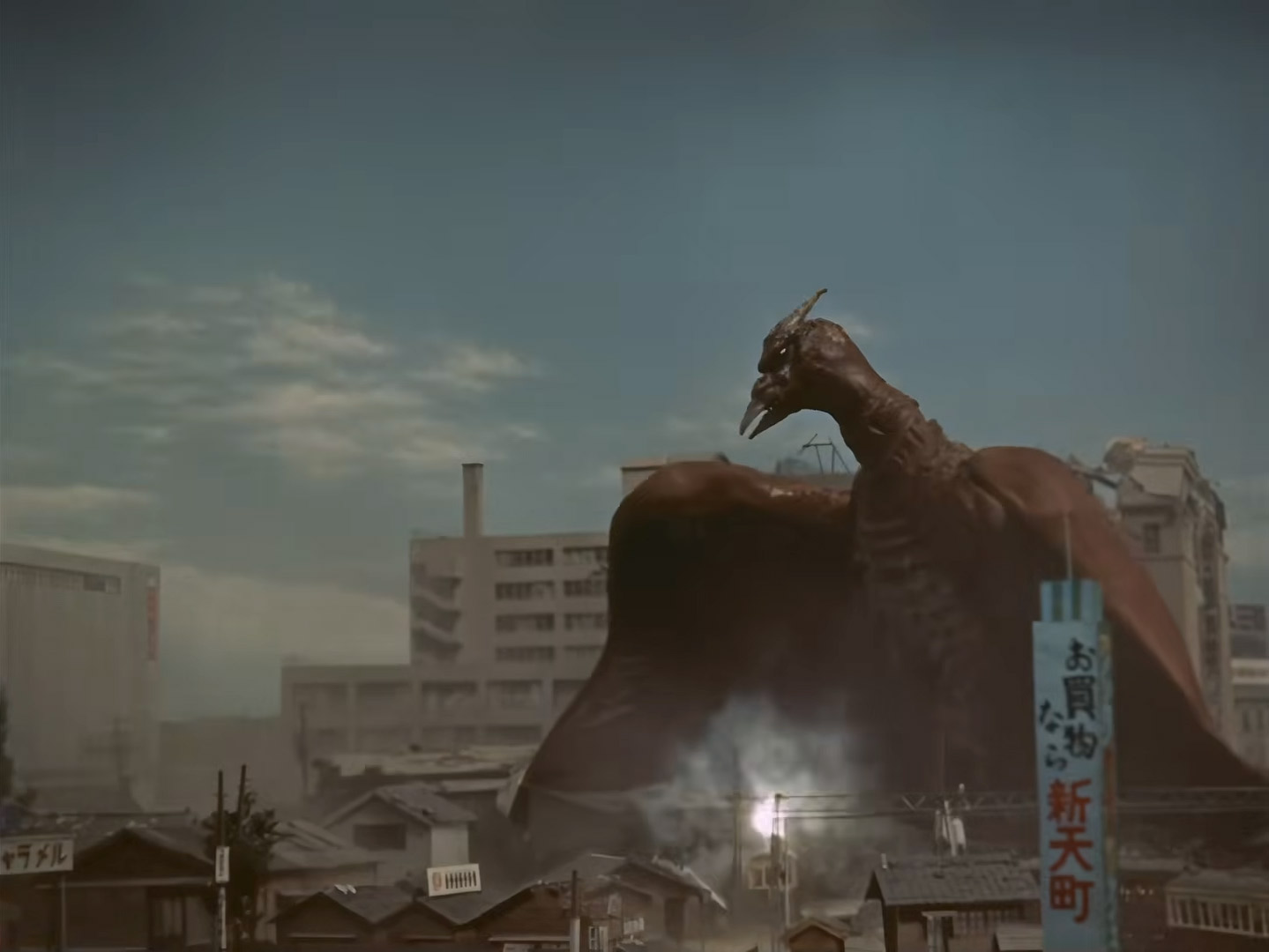
Although the action in Murata and Kimura’s first draft revolved around a single monster,45 the finished movie gives Rodan a mate that is foreshadowed via dialogue and comes suddenly to its partner’s aid during a raid on the city of Fukuoka. The first creature perches on the ground and is surrounded by tanks and missile launchers. After withstanding a barrage of projectiles, it flaps its enormous wings to generate powerful gusts and expels a concentrated blast of air from its mouth. Rodan’s mate subsequently appears, soaring over the military at supersonic speed and amplifying the damage. The action is extraordinary, and just as Godzilla famously modeled images of devastation after wartorn Japan, so too did the team behind Rodan reference real-life disaster: a crewman’s memories of the 1934 Muroto typhoon inspired shots of roofs being stripped of their tiles by wind.46 Director Honda remembered feeling “the technology of the miniatures department reached its peak” with this scene.47 “You can just feel the creators’ passion in the details. In special effects films like this, it’s all about destruction, how beautifully it all crumbles.”48
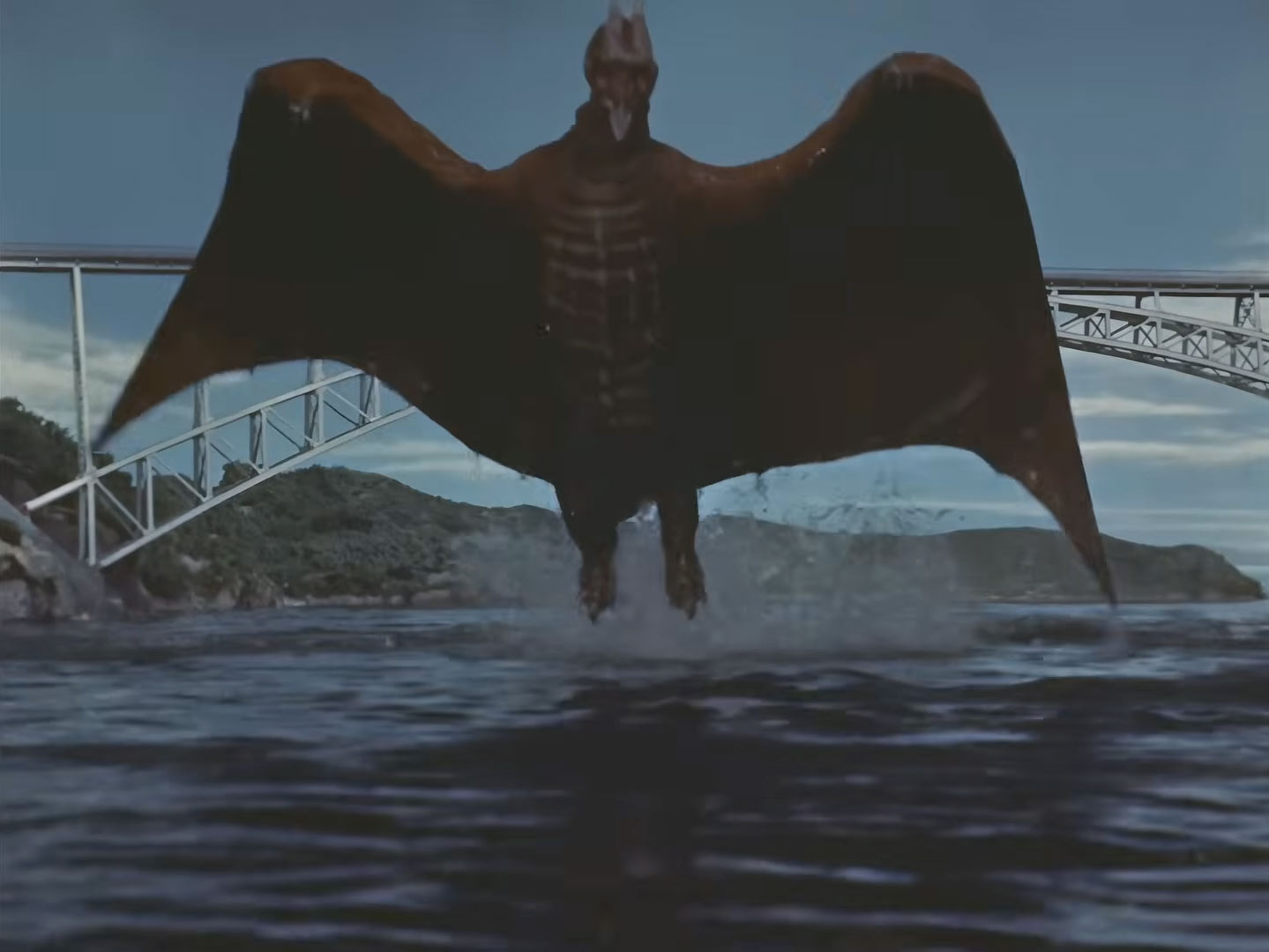
Approximately 60% of Rodan’s budget* went toward the special effects, which were lensed for the most part during overnight summer shoots. (Working nocturnally allowed the crew to escape seasonal heat that would’ve compounded the temperature generated by studio lights.)49 Rodan—depicted as a pterosaur rather than the feathered dinosaur that begat the concept—was realized via numerous props and marionettes, though certain scenes required a costume worn by stuntman Haruo Nakajima. Nakajima had played Godzilla in both of its appearances thus far and, like on those shoots, would be put through perilous situations. One scene called for Rodan, having been downed in the Hario Strait, to launch from the water and destroy Japan’s recently built Saikai Bridge. Nakajima donned the costume and was carried over the miniature set by piano wires—when the pulley suspending him suddenly broke! Still clad in the suit, he plummeted into the strait and was fortunately spared injury thanks to the water and the suit’s huge, spacious wings, which absorbed most of the impact.50
As mentioned above, the Saikai was a new addition to Japanese architecture, having been erected in 1955, and at the time was the largest arch bridge in Asia and the third largest in the world. It also spanned a passage of water known for its whirlpools51 (and part of me suspects the staff picked this location because a shot of spinning currents lent visual suspense to Rodan’s re-emergence). For its on-camera destruction, some of Tsuburaya’s wire operators maneuvered Rodan above a 1/20 replica of the Saikai while others tugged on cables hooked to the miniature.52 When timed perfectly, the impression was that of the infrastructure being snapped in half by Rodan’s supersonic flight—and was marvelously captured in three camera angles.
Composer Akira Ifukube had been one of the major artistic forces on Godzilla, responsible for not only the iconic score but also sound effects for the monster’s roar and footsteps.53 While he’d been absent for Godzilla Raids Again and Half Human (both scored by Masaru Sato), he made a triumphant return to science fiction with Rodan, delivering a moody masterwork that ranks among his finest genre efforts. The score was written for a full orchestra and two pianos, and incorporated specific playing techniques to achieve musical “sounds.” Ifukube’s main title, for instance, begins with a “crash” on the piano generated by the player slamming their forearms on the lowest white and black keys, and later moments are punctuated by smaller “crashes” created using one’s palm. Also innovative was a musical rumble that underscores a mid-movie earthquake. In his book Age of the Gods: A History of the Japanese Fantasy Film, Guy Mariner Tucker claims this cue was achieved by dropping coins of varying sizes onto the strings of a piano.54 But according to Ifukube biographer Erik Homenick and conductor John DeSentis, examination of the sheet music disproves this. In actuality, the musicians created the track by running a stick of rubber along the strings of one piano and a wooden stick along those of the other. The combined notes were accompanied by those of a timpani to produce an unpleasant, unworldly effect.55
Homenick, author of a forthcoming book on Ifukube and his Godzilla music, likewise notes that special performance techniques were dictated for the wind instruments. The Rodan manuscript contains the German word “Flatterzunge” at key points to signify where piccolos and trumpets were to be performed with tongue-fluttering. This involved the player rolling their tongue while blowing into their instrument, thus creating a “flapping” musical effect. Homenick told the author of this essay that he speculates Ifukube incorporated the flutter to musically “represent that Rodan is a winged monster.”
In what’s of no surprise to anyone familiar with the composer under discussion, Rodan occasionally cannibalizes Ifukube’s past work. Among the recycled material is the track “Get Rodan,” which derives from his film scoring debut Snow Trail (1947). What began as a lively piece accompanying an opening credits montage is reworked and repurposed for an extended air chase between Rodan and the F-86Fs. (The theme was recycled yet again for a similar situation in Kazuki Omori’s 1991 Godzilla vs. King Ghidorah.) Also present is a reworking of the composer’s 1948 ballet Salome, here played during attacks on Sasebo and Fukuoka.56
Rodan opened in Japan on December 26, 1956 and grossed ¥143 million, ultimately ranking twenty-fourth among Japanese pictures made that year. Kinema Junpo critic Masahiro Ara expressed reservations with the film, feeling it lacked social bite, but praised the horror aspects and Isamu Ashida’s color photography. “The overall color hue in Forbidden Planet [released in Japan three months earlier] is cheerful … whereas [Rodan’s] strong use of blues and blacks lends the impression that the creators are trying to give off a more gruesome feel.”57 Eiji Tsuburaya won a Japan Technical Award for his effects,58 and Honda discovered others shared his astonishment with the miniature work: “[P]eople who saw the last scene where tanks and missiles attacked Rodan in the crater thought that we had rented that equipment from the army.”59
In April 1957,60 the American trade press announced that King Brothers Productions was bringing Rodan to the international market.** Co-founder Herman King spoke enthusiastically about the “real ‘quality’ product” he’d acquired, stating it was the recipient of “several prizes at the South East Asia festival for special effects, production and photography. […] We purchased it and can show it anywhere except in the Orient and Spain.” But first, the movie needed revisions. “After we had the picture, there was a tremendous amount of work to be done. It had a couple of slow spots, and we cut it from 87 minutes down to 72.” Sixteen weeks went into assembling an alternate version61 that likewise dubbed dialogue into English and augmented Honda and Tsuburaya’s scenes with stock footage and a prologue emphasizing the culpability of atomic tests. Science fiction novelist and The Time Machine (1960) scribe David Duncan authored the dubbing script, which would be performed by a small cast—including Keye Luke and a young George Takei—hired through Oriental Casting Service.62
The King Brothers cut premiered in forty Texas theaters on November 7, 1957, augmented by a $120,000 radio and television campaign courtesy of Teleradio’s Terry Turner. So successful were the screenings that Turner’s advertising budget tripled ahead of Rodan’s Los Angeles debut the following week. By the month’s end, the movie ranked among the nation’s top six box office earners,62 and Variety reported a more than $1 million profit by April 1959.63 Especially pleased was Tomoyuki Tanaka, who boasted to the U.S. press that the movie made more money abroad than any other Japanese feature at that time.64 Rodan even garnered praise from Occidental critics, some of whom recognized in it one of the Japanese monster movie’s foundational characteristics. Helen Bower of the Detroit Free Press wrote, “As the country which felt the impact of the first atomic bomb, Japan may understandably be more acutely conscious than other countries of the perils of the atomic age. This awareness is implicit in the screenplay’s thesis that effects of atomic and hydrogen blasts may have penetrated to the depths of the earth with fantastic result [sic].” She also wrote positively of Tsuburaya’s work: “The very creation of the Rodan, from its hatching to its death, is a special effects achievement that has not been bettered by Hollywood.”65
Other reviewers saluted an appeal to the American subconscious in the age of the Cold War, the space race, and continued UFO sightings: “[e]specially timely in view of the dog-bearing Sputnik and the strange flying object seen in West Texas…”66 However, some lamented what they perceived as Japanese pandering to the western market. John Bustin of the Austin-American Statesman deemed Rodan a “tired old story” for “impressionable kiddies […] [I]t seems quite a waste of time to retell it—and certainly a waste of effort to go all the way to Japan to unearth it.”67 Canadian journalist Walter O’Hearn saluted the ingenuity behind the miniature sets but complained, “It shows none of the Japanese fascination with beautiful color or stately drama: it is another example of that cunning people manufacturing western toys for export.”68
For Ishiro Honda, Rodan was a personal favorite and the movie “that put me on my path.”69 The latter statement likely refers to him becoming Toho’s go-to science fiction director for the remainder of the 1950s and much of the ‘60s, during which he’d supervise Rodan’s return in 1964’s Ghidorah the Three-headed Monster. The character made subsequent appearances in two more Honda pictures (1965’s Godzilla vs. Monster Zero and 1968’s Destroy All Monsters), as well as multiple movies from both Japan and the United States. Ifukube’s score has likewise enjoyed extended life. A performance of the score was recorded circa 2014 for a CD series celebrating the composer’s centennial. And in 2019, monster movie fans crowdfunded the concert Kaiju Crescendo: An Evening of Japanese Monster Music, which was held that summer in Chicago. A suite from Rodan was performed that night under conductor John DeSentis, who spoke to Our Culture Magazine about the music and the challenges of performing it.
“Rodan is one of the great scores of Ifukube’s entire career. Much like Godzilla, it contains many elements of horror, evident in his classic style from the Toho Mark. It also afforded him the opportunity to continue experimenting with complex meters or time signatures.” For Kaiju Crescendo, DeSentis worked from Ifukube’s manuscript and described conducting selections as “no easy task. Particularly difficult was the piece ‘Rodan Flies to Sasebo.’ The time signatures for this piece are alternating measures of 4/8 (four eighth notes per measure) and 11/16 (eleven sixteenth notes per measure). The 11/16 was particularly challenging, as I’d personally never conducted a meter such as that. We had a bit of a time getting it together during rehearsal, but it was actually our bassoon player (and curator of fine craft beer) Jonathon Leik who helped me to figure out the best way to hit the downbeats on that one. A little more rehearsing and we were able to be ready by showtime.”
As far as the original movie is concerned, one can understand Honda’s enthusiasm. What begins as something of a Japanese take on Gordon Douglas’s giant ant thriller Them! (1953) cleverly segues into a grand-scale action picture, with the initial threat (giant insects) replaced by something much worse. But there’s also a touch of poetry to the whole affair. Rodan opens on a calm and peaceful shot of Mount Aso and ends on a special effects miniature of the same volcano spewing molten rock. One of the flying creatures collapses in the lava, and its mate joins it in death. The human cast looks on in sorrow, and Akira Ifukube applies a melancholy musical send-off to the monsters (which DeSentis labels “second only to Ifukube’s music for Godzilla’s death in 1995’s Godzilla vs. Destoroyah as far as that type of cue goes”) as they cry in pain. These final images epitomize Honda’s famous adage that “monsters are tragic beings […] born too tall, too strong, too heavy.”70 For all the mayhem they cause, the Rodans are, in a way, greater victims than the people they’ve killed. They were built for a prehistoric world that no longer exists and are guilty only of trying to survive in a time not meant for them. The director’s son Ryuji decades later recalled, “I was only a kid then, but I cried over it. I still feel pain with that scene. I cannot help having sympathy for Rodan and accusing the humans who killed them. I believe the scene contains a lot of things that my father really wanted to tell.”71
* In researching this essay, I encountered conflicting numbers as to how much Rodan cost to make. The 1983 book The Complete History of Toho Special Effects Movies, which producer Tomoyuki Tanaka supervised, lists the budget at ¥200 million. An April 1959 Variety report, however, claims the movie cost $277,777. (Per the 1956 exchange rate of ¥360 to every $1, this translates to just under ¥100 million.) While I cannot confirm, the latter figure seems more likely, as Toho would’ve made a profit off a ¥143 million gross. At ¥200 million, the studio would’ve lost nearly ¥60 million in Japan, and one would think such a letdown would’ve been discussed by the film’s creators.
Incidentally, Herman King, when asked at a press luncheon to list the budget of the movie he’d acquired, “did a little mental arithmetic […] and came up with the figure of 1,600,000, but he was a trifle vague about just what currency the figure referred to.” As the language of this reporting suggests, this is a number to be taken with a massive grain of salt.
** I also encountered conflicting numbers as to how much King Brothers Productions paid to license Rodan. The Los Angeles Times on September 20, 1957 reported, “King Bros. is spending $400,000 on exploitation.” The above-mentioned April 1959 report from Variety, however, claims the fee was $100,000.
References:
- Anderson, Joseph L. and Donald Richie. The Japanese Film: Art and Industry (Expanded Edition). Princeton: Princeton University Press, 1982, p. 262
- Ryfle, Steve. Japan’s Favorite Mon-Star: The Unauthorized Biography of “The Big G.” Toronto: ECW Press, 1998, p. 310
- Ryfle, Steve and Ed Godziszewski. Ishiro Honda: A Life in Film, from Godzilla to Kurosawa. Middletown: Wesleyan University Press, p. 105
- Anderson and Richie, p. 263
- Ryfle, p. 65
- Galbraith, Stuart, IV. The Toho Studios Story: A History and Complete Filmography. Lanham: Scarecrow Press, Inc., 2008, p. 110
- Ryfle, p. 310
- Jampel, Dave. “Japanese Arters Wow Critics, But Horror Films Get Coin.” Variety (April 1959), p. 46
- Anderson and Richie, p. 263
- Ibid, p. 33
- Desser, David and Early Jackson (eds). The Cinema of Kinoshita Keisuke: Films of Joy and Sorrow. Edinburgh: Edinburgh University Press, 2025, p. 15
- “Nip’s 1st Color Feature To Be Ready in 1951.” Variety (October 1950), p. 15
- Okajima Hisashi. “Color Film Restoration in Japan: Some Examples.” Journal of Film Preservation, Vol. 66 (October 2003), p. 33
- “Nip’s 1st Color Feature To Be Ready in 1951.”
- Ibid.
- Prince, Stephen. “Gate of Hell: A Colorful History.” The Current, 10 April 2023
- Crowther, Bosley. “The Screen in Review.” The New York Times, 14 December 1954
- “Top Budget Jap Film Took 130 Shooting Days.” Variety (April 1954), p. 14
- Ryfle and Godziszewski, p. 126
- Ragone, August. Eiji Tsuburaya: Master of Monsters. San Francisco: Chronicle Books, LLC, 2014, p. 50
- Ryfle and Godziszewski, p. 126
- Stilwell, Blake. “The First Air Force Pilot to Die Chasing a UFO Was Actually Chasing a Secret Balloon.” Accessed 30 December 2025
- Ryfle and Godziszewski, p. 126
- Poats, Rutherford. “Japan Warns the Russians About Air Violations.” The Record American, 13 January 1953, pp. 1-8
- “Japan’s Hokkaido, Near Russia, Is Becoming Asia’s Strongest Bastion.” Claremont Daily Progress, 2 December 1953, p. 6
- Ryfle and Godziszewski, p. 129
- “Japan Now Making F86F Sabre Jets.” The Patriot-News, 22 September 1956, p. 5
- Brothers, Peter H. Mushroom Clouds and Mushroom Men: The Fantastic Cinema of Ishiro Honda. Independently published, 2009, p. 110
- Seelinger, Matthew J. On Point, Vol. 15, No. 4 (Spring 2010), pp. 14-6
- “Army Will Fire Its Honest John Rocket on Fuji.” Chicago Tribune, 30 October 1955, p. 34
- “Honest John Rocket Test Nov. 29.” The Bay City Times, 21 November 1955, p. 27
- Seelinger, p. 15
- “News Trip Around the World.” Connecticut Post, 14 March 1956, p. 13
- “Army Fires Rocket Despite Jap Protests.” The Times, 29 November 1955, p. 23
- “Science-Fiction Movie at Tyler.” The Tyler Courier-Times, 10 November 1957, p. 21
- “Starting Out in Archaeology.” Mānoa, Vol. 28, No. 1, (2016), p. 9
- Shimazaki Katsundo. “The Rise and Fall of Japan’s Coal Industry.” Journal of Japanese Trade & Industry, No. 4, 1990, p. 25-6
- “Japan Miners Join Strike Protesting Security Proposal.” San Francisco Chronicle, 12 April 1952, p. 4
- “Japan Miners Strike.” The Tribune, 5 July 1952, p. 5
- “250,000 Japan Miners Strike For Two Days.” The Fresno Bee, 14 October 1952, p. 15
- “Japan Miners Strike.” Honolulu Star-Bulletin, 13 October 1952, p. 8
- “Cold Grips Japan as Miners Reject Strike Settlement.” Chicago Tribune, 11 December 1952, p. 3
- “Japan’s Miners Halt Long Strike.” The Saginaw News, 17 December 1952, p. 4
- Ryfle and Godziszewski, p. 127
- Ibid, p. 129
- Ibid, p. 128
- Brothers, p. 110
- Ryfle and Godziszewski, p. 128
- Ragone, p. 50
- Milner, David. Translated by Yoshihiko Shibata. “Haruo Nakajima Interview.” Accessed 28 December 2025
- “Saikai Bashi Bridge.” Discovery Nagasaki. Accessed 1 January 2026
- Ragone, p. 50
- Galvan, Patrick. “Interview: Erik Homenick.” Toho Kingdom. Accessed 1 January 2026
- Tucker, Guy Mariner. Age of the Gods: A History of the Japanese Fantasy Film. Daikaiju Publishing, 1996, p. 78
- Correspondence with Akira Ifukube biographer Erik Homenick and Kaiju Crescendo conductor John DeSentis.
- Correspondence with Erik Homineck.
- Ryfle and Godziszewski, p. 129
- Ragone, p. 52
- Brothers, p. 110
- McKay, Anthony. Little Shop of Horrors: Gorgo, No. 52 (November 2025), p. 55
- Knickerbocker, Paine. “The Lively Arts: Complex Beginnings Of the Movie ‘Rodan.’” San Francisco Chronicle, 16 December 1957, p. 33
- McKay, p. 57
- Ibid, pp. 57-8
- Jampel, “Japanese Arters Wow Critics, But Horror Films Get Coin,” p. 46
- Klaverkamp, Robert. “Japanese Are Proud Of Their Art Films.” The Florida Times-Union, 30 November 1958, p. 79
- Bower, Helen. “Science Fiction Has an Oriental Twist.” Detroit Free Press, 4 December 1957, p. 25
- “On S.A. Screens: Everything from Opera to Science Fiction.” San Antonio-Express News, 7 November 1957, p. 30
- Bustin, John. “Show World.” Austin American-Statesman, 8 November 1957, p. 20
- O’Hearn, Walter. “Walter O’Hearn Comments: Big Big Wrecks City.” The Montreal Star, 31 January 1958, p. 18
- Ryfle and Godziszewski, pp. 126-9
- Kalat, David. A Critical History and Filmography of Toho’s Godzilla Series (Second Edition). Jefferson: McFarland & Company, 2010, (eBook version)
- ‘Totorom.’ “Tokusatsu Studies Were My Playground: G-Fan Interviews Ryuji Honda.” G-Fan, No. 88 (Summer 2009)

