

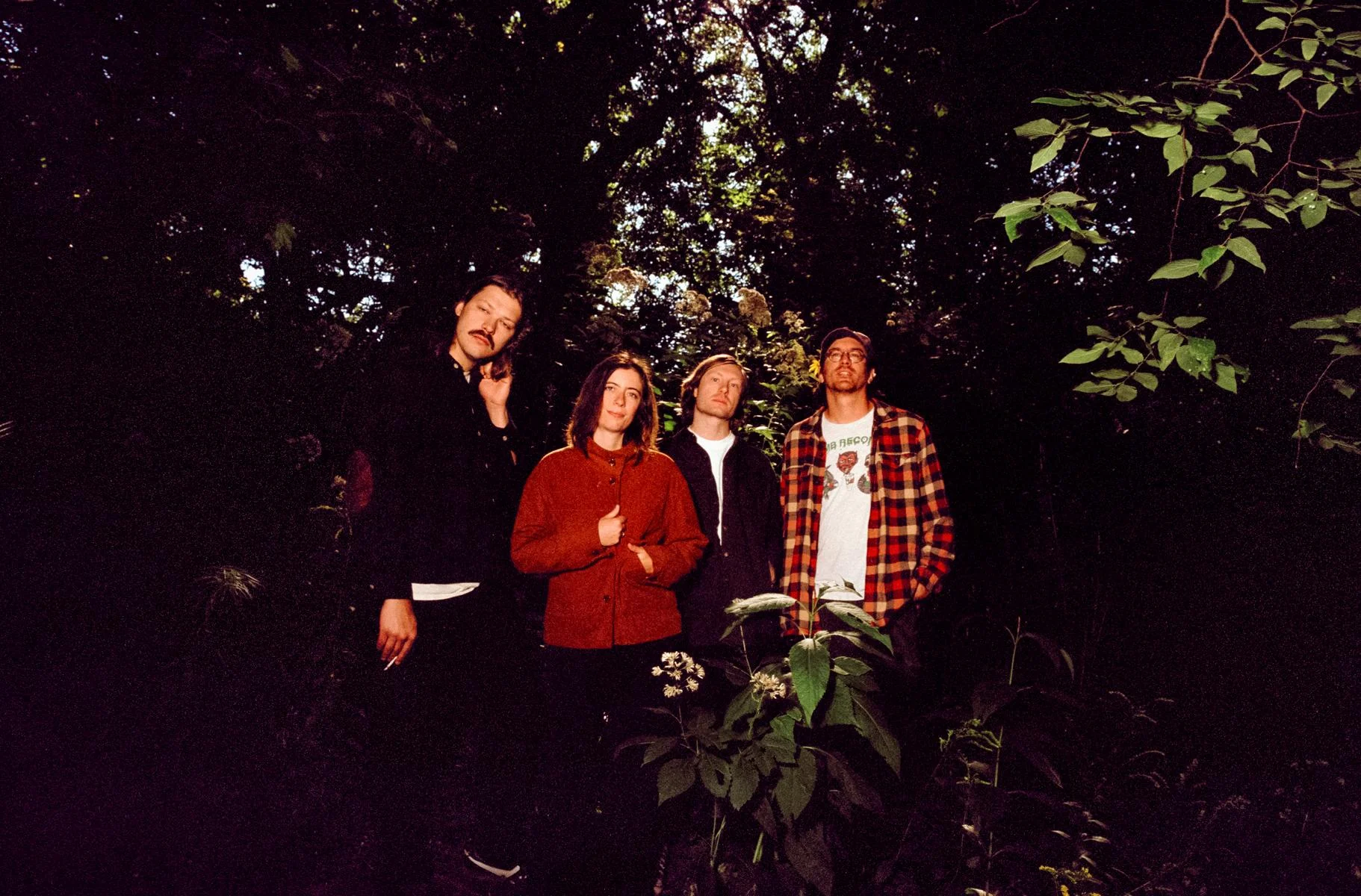
Have you actually tried it? In the lead-up to Ratboys’ new album, singer/guitarist Julia Steiner has outlined in one interview after another the therapeutic exercise that gives Singin’ to an Empty Chair its name: you sit across an empty chair that symbolizes an absent person and try to express whatever unpleasant emotions you may have bottled up. Listening to the follow-up to 2023’s The Window over and over, an empty chair was always in my periphery, and I would sometimes find myself staring at it while letting the songs do the talking: projecting, sure, but mostly getting lost in their sprawling journey, closing my eyes to appreciate their textures – homed in with producer Chris Walla – and spinning my head in pure joy. I was grateful for their lonely revelations but eager to put it on in the car, on a long drive surrounded by loved ones – real, not imagined. If you have listened to a Ratboys record before, you already know the new one is as tremendously open-hearted and emotionally piercing as it is ultra-catchy. The subject matter may seem heavier this time, but it feels less like pulling a blanket over the unvarnished truth than warming the room that could make it unravel, keeping the door open for anyone who’d like to enter.
We caught up with Ratboys’ Julia Steiner to talk about the Driftless Area, Juana Molina, a roll of gaffe tape, and other inspirations behind their new album Singin’ to an Empty Chair, which is out today.
The Driftless Area in Wisconsin
You went there to write and demo the new songs before returning months later to begin tracking. How did it feel different going in each time?
One exciting thing for us going into making this record was knowing that we were inviting Chris Walla, who produced the record with us – one of our lifetime heroes, and at this point, we’re lucky to call him a close friend – into our neck of the woods, our home turf of the Midwest in the US. He grew up on the West Coast in Seattle in the Pacific Northwest, which is just such a different part of the states geographically and culturally, and now he lives in Norway, on the whole other side of the world. This time around, it was his idea to want to approach the album firmly based here, where we live, and the surrounding areas, so it was exciting to get to show him around a little bit. We went back to this house where we had recorded before, so we had an idea of how we wanted to set up our gear – even the little things, like the DVD library that this house had. Because this cabin isn’t a recording studio, it’s literally just a vacation rental home that we found on one of those apps. So, knowing which DVDs they had, how the kitchen was set up – it was a very intimate, familiar feeling, going back there, already having had that experience of living in that house for a week when we wrote the songs.
The Driftless Area itself – I feel like I could talk about this for a while, because I find the geological history of the Midwest really interesting. But basically, in the Ice Age, 10,000 years ago, there were these huge glaciers that covered most of the area that we call home, and for whatever reason, those glaciers didn’t quite reach the southern southwest portion of Wisconsin and the neighboring states around there. What that produced was: Chicago, where we live, is really flat. There’s literally no hills, no topography to speak of, which is great for other reasons – getting around is quite easy. But it’s a pretty mundane landscape, I suppose, and in this specific part of Wisconsin, the glaciers didn’t flatten everything out, so there’s a ton of rolling hills and windy backroads and forests, just lots of nature that we don’t really have access to in Chicago. It was honestly pretty exotic and beautiful, only driving hours away by drive and still felt quite remote and different from our everyday. That first writing trip, we went on a pretty long drive just to clear our heads at the end of the week and listen to music together, and it was a beautiful experience. That’s one of my favorite ways to listen to music, on a long country backroads drive.
Looking at photos of this land did make me wonder if it inspired any part of ‘At Peace in the Hundred Acre Wood’.
That song is most firmly rooted in the cabin, for sure. I wrote the chords and lyrics here at home, but brought it to the guys up there, and the first time that we worked on it together was in that space up at the cabin. When we recorded it with Chris, we recorded 95% of it in the cabin. That’s the only one that has vocals that I tracked in that room. It felt very at home there, because this house we were in in Wisconsin was pretty isolated. It was on its own big plot of land, and you couldn’t see any neighbors at all. It was 75 acres of unoccupied, mostly forested land, so it definitely kind of felt like we were in our own little world out in nature. And that is one of the fantasies of those Winnie the Pooh stories that I love: being out in nature with your friends and not having to worry about the complexities of city living.
I know a lot of the songs took shape in the other studios that you worked at – and maybe it’s also the name that prompting me to ask – but I wonder if there was something precious about the aimlessness that marked this part of the process, where there wasn’t necessarily the pressure of completing the songs.
Yeah, that’s a good way to think of it. We wanted the stakes to feel low at the beginning. That was another idea that Chris Walla brought to the table: This cabin sounds great, and we’ll bring enough gear of our own that we can capture a great recording and use whatever we get. If we end up getting takes that feel amazing, they can live on the album. You don’t have to redo them later. And at the same time, if we don’t get takes that feel great, then that’s okay. We’ve spent a week working on the songs and re-acclimating to each other, bonding and cooking, and listening to music. It was a very open, free, playful environment. It’s all in the spirit of good fun and mutual support, and I think because that was the energy in the cabin that week, we did end up getting some takes that we were really excited about. ‘Penny in the Lake’ and ‘Strange Love’ and ‘At Peace’, and a lot of ‘Just Want You to Know the Truth’ came out of that time in the cabin, amongst some other little sprinkles of things that we ended up taking from that and overdubbing with everything else.
The authors Susanna Clarke and Miriam Toews
They’re the two main authors that I was reading consistently while we were working on this album. Starting with Susanna Clarke in 2024, the timeline just matched up perfectly, and her novels were very much a part of my day-to-day when we were working on writing the songs. We first went up to the cabin to do this demo writing trip in March of 2024, and during that week was when I read Piranesi for the first time. That novel, for anyone who hasn’t read it – the setting is just as much of a main character as the the two figures.
Right, the House.
Yeah, the endless series of rooms and what makes them unique. They feel very alive in this mystical, magical way. For whatever reason, I’m so grateful that I brought that book with me on that trip, and it felt very appropriate to be reading in this space that we were discovering for the first time, which felt similarly charged with this energy that was mysterious to us and we were discovering in real time. Just such a page-turner, and got me really excited about art and being creative. It felt like a real companion during that week that we were writing.
From there, I was really curious about Susanna Clarke as an author. I looked up her other work and saw Jonathan Strange & Mr Norrell was her debut novel, one that she had written over the course of decades, or at least 10 years. I was so fascinated by her story of working as a professional in a different industry. I don’t even know what her job was, but she was a writer on the side, and would essentially just kind of chip away at Jonathan Strange & Mr Norrell in her spare time over the course of many years. She eventually finished it and put it out, and it just became this huge success. I was really in awe of that story, of how she came to writing, the gradual approach and the fact that she wasn’t worried about rushing anything. I appreciate slow art. That novel’s really long, and I love long-form anything: songs, long movies, long books. If I can buy in, I want to be in it for the long haul.
The one I’ve read is Piranesi, which I remember being quite short, and I absorbed it in a few days.
Totally, same. I didn’t want it to end. I managed to stretch it out, so I read it over the entire week that we were working, but I wanted it to keep going. On the other hand, Jonathan Strange & Mr. Norell, which I highly recommend, is this magical realism – like if Jane Austen wrote a fantasy novel. It’s really long, so I read that over the course of our entire tour that spring and summer, and it was my constant companion on the road. I just felt very connected to her writing throughout that year as we were writing and workshopping the songs.
Miriam Toews is another one of my favorite writers. I’ve been aware of her work for a little bit longer. My sister, in 2020, sent me a care package of books right when the lockdown started, and a couple of those were Miriam Toews novels, including her book A Complicated Kindness, which is the first one I read. I was just immediately drawn in by her down-to-earth way of writing. It’s very funny and unique and has such a singular perspective. The community that she grew up in and that she’s writing about is very different from any that I have ever been a part of, and yet I felt very invited in. The way that she kind of writes about her own personal experiences in the context of fiction is something that I find really inspiring, and I aspire to do that. I love all of the novels I’ve read by her, and I read All My Puny Sorrows while we were recording the album. That novel’s extremely raw and emotional and vulnerable, and gave me confidence to lean into those aspects when we were making our record.
I love those titles – A Complicated Kindness reminded of the phrase that the narrator in Piranesi uses to describe the House, which is “infinite Kindness.”
Yeah, the House gives so much.
I was looking back at quotes in an attempt to relive the book, and there’s one about “the wisdom of birds resid[ing] not in the individual, but in the flock, the congregation.” That reminded me of of the verse about birds [“on a wire/ They fell asleep because they all forgot to sing”] on the final track.
I feel comforted by that, for sure. I think that’s one reason I feel so safe in putting out this music that is personal to me is – the power and kindness of the flock. It’s my bandmates. I’m not not out here alone, and I’m really grateful for that.
Trevor Horn
Chris Walla – I don’t know if it’s accurate to call him a disciple of Trevor Horn, but he is very keyed into Trevor Horn’s discography and his whole story. First as a member of Yes and then as a producer who’s done such a wide range of projects, from Grace Jones to – I mean, the thing that blew my mind was learning that he produced a couple of those songs for t.A.T.u., that Russian duo who I grew up with and blew my mind when I was a child. And then, Dear Catastrophe Waitress by Belle and Sebastian, he worked with them in the early aughts. He makes such bold, artistic choices and is such a master of knowing when to make big swings in production. Dave, Chris, and I would commute to and from the studio every day together, because Chris was crashing at our house, and we would listen to this oldies station. Fairly often a Trevor Horn production would come on, and it was always really exciting when that happened, because Chris would point it out and kind of dissect a lot of details and tell us about specific synths that were just being released at the time, the ways that they were utilized on these recordings. It just opened up a whole new world of music that I had never really learned about.
Do you tend to do that when you’re listening to music as a band more generally?
That’s something that the four of us do a lot, no matter what, which I think is one of the reasons why we get along with Chris so well. At the end of the day, we all love listening to music and and nerding out about our favorite artists and recordings. When we’re on tour, just the four of us, we’re more of a record band than a podcast band in the van. We don’t really listen to podcasts super often, it’s more so pressing play on full albums, usually. It’s quite a nice way to pass that time in the van, and there’s always something to talk about. There’s always a lot happening, so you can observe different things together and make connections. When we first met Chris, that was something that he was clearly very down with. I feel like most producers would be. [laughs] We haven’t worked with many, so it’s hard to say, but he definitely is.
Juana Molina
That one probably didn’t come up on the oldies radio station.
[laughs] No, definitely not. I wish there was a radio station here that played Juana Molina. Maybe there is, and I just don’t know about it. Juana is one of those artists who I’ve had on my radar – I’ve been listening to her music since 2012. It’s been a while, and I’m really grateful for that. A friend turned me on to her when I was still in university. When I first found out about Juana Molina, I listened to her extensively and kind of constantly, and then for a few years – I don’t want to say I forgot, but I was listening to other things and didn’t check in for a while. For whatever reason, a few months before we started recording the album, I rediscovered Juana Molina, and specifically one of her early records, which is called Son. I think it’s her third album, came out in 2006, but I became so obsessed with the acoustic guitar sounds on that album specifically. That was a big reference for me as far as acoustic guitar tones to chase.
When we were up in the cabin, when it was time to take a break and cook meals and make dinner, that would be a great time to listen to music together. I have a memory of putting on Juana Molina, specifically that album, and then blazing through some of her other records, choosing songs to pick. But Chris I don’t believe was familiar with her before, so it was really exciting to share her music with a friend for the first time. She is such a magical artist – I don’t really know how to describe what she does, but the way she builds her songs layer by layer is really pleasing and satisfying. I don’t know what she’s talking about – I don’t speak Spanish – but I don’t need to know. I just love all the different sounds that she makes.
When an acoustic guitar catches your ear, is it usually the tone you reach for, or the tuning, the chords? What are you most curious about?
Definitely curious about everything, as far as acoustic guitar goes. It’s my favorite instrument. I’m always excited when that’s sort of the featured instrument on a song. An acoustic guitar solo is always really exciting, especially in the context of indie rock. I feel like it doesn’t happen very often. I’m definitely not a guitar virtuoso, so I’m not always listening to the song with the investigative ear of: How did she play that? What shapes was she using? How could I replicate that? It’s more so the feeling that it creates, and a lot of that, I think, comes from the tone. Obviously there’s not one that I prefer. I love super bright, trebly, Tom Petty acoustic guitars, where it’s clear someone’s strumming with a pick. Or a really warm close, fingerpicked sound, maybe even a nylon string, is really beautiful.
The clarity that a close-mic’d acoustic guitar can provide in a mix is so important, I think. That record specifically, Swan, there’s something about it where the acoustic guitar just feels so close to the ear. I just wanna wrap myself up in it like a blanket, it’s so comforting. I couldn’t believe that I had never heard that record before, just never pressed play on it, so it was a very exciting discovery and came at a great time, because we definitely leaned into the acoustic guitars for ‘Strange Love’ and ‘At Peace’ when we were recording those up at the cabin.
The Canadian sketch show Kids in the Hall
This is one of my favorite types of inspirations, when you know it’s just something you got together to watch. The Simpsons is something that’s come up a couple of times in that vein. For you, it was Kids in the Hall.
For me, less so – for the boys, yes. I was there, but I go to bed earlier than everyone else – not super early, but I’m not much of a super night owl. We had a really nice routine. The first time that we were up at the cabin, every night, when we were sort of ready to wind down and put the instruments away, we would spend, for me, maybe an hour just sitting on the couch and relaxing and watching Kids in the Hall, which is a Canadian sketch series – the episodes that we were watching, I think, were from the mid-90s. I didn’t know about this show before we started watching it every night at the cabin, and it was so funny and irreverent. It’s five guys, and anytime there’s a woman character on the show, the guys are dressing in drag. It’s one of the silliest, mindless, fun things to finish the day and wind down.
So, I would often say goodnight and go to bed before Marcus and Sean and Dave. I would leave them, and they would still be watching Kids in the Hall, and I would sort of fall asleep to the sound of them laughing to that show through the walls. It was our ritual each night when we were working on the record. I don’t know if any of it really seeped into the music and lyrics necessarily, but it contributed to the positive vibes in a real way.
Richard and Linda Thompson’s 1974 album I Want to See the Bright Lights Tonight
I first heard this album when I was playing poker with some friends 10 years ago, right when I moved to Chicago. It immediately stuck out to me as being, again, really down-to-earth, and it felt like it was made by human beings in a room. Lots of warm textures and interesting instruments that you don’t always hear in music from the 70s – more folky stuff like the mandolin, I think here’s some accordion in there. Some pretty incredible band performances, very in the pocket, especially one that’s super slow, ‘Calvary Cross’. That had been a record that I have loved for a long time.
When we went on that country drive on the last day of that writing trip, when we were up in Wisconsin for the first time, it was a very beautiful rural, scenic setting, driving around the Driftless region – with no goal in mind. We were literally just aimlessly driving without a map or a destination. In that moment, I put that record on in the van, and it was just one of those magical needle-drop moments where the music and the setting just morphed, and it was perfect. That record really resonated with us at on that day, in that place, all together in the van, driving around. It became kind of a touchstone of how music can make you feel really inspired. We put that record on again when we were driving back to the cabin, when Chris was with us, to start recording.
How was it different the second time?
That time it was a little bit colder, and I remember the sun was setting. I guess the context for us was pretty different as far as the timing of where we were in the process. The first time we listened to it, it was our last day up in Wisconsin, and we were celebrating a job well done, a productive week of work. It was our way to blow off some steam at the end of the week. The second time we put it on was the very first day that we were with Chris, and we hadn’t recorded anything yet for the album. I was driving, and I put it on just sort of as a way to take us back to that feeling of motivation and remembering what we’re capable of, to get us excited about being back in this place again, this part of the country, this specific small town. It felt like a nice way to remember how much we love what we’re doing. I don’t think anyone was in danger of forgetting that, but yeah.
You still need those reminders of what a record can do at the right time.
Yeah, man. There’s something so hard to explain and so magical about a needle drop on a road trip that just hits at the perfect time. I have such a specific memory of listening to that Big Thief double album [Dragon New Warm Mountain I Believe in You]. We were driving through the Grand Tetons in Wyoming, and it was snowy and so sunny, just like another planet. And then we had this one time we were driving on a really long day through rural Utah, and it was the 4th of July, and all of a sudden we came around the bend and saw all these fireworks going off far in the distance – clearly there were a bunch of little towns in the valley, all lighting off fireworks at the same time, and we were listening to the second Now, Now record, Saved. It was just so epic. It was one of the most beautiful little snapshot memories. I highly recommend it: Just go on a road trip and listen to your favorite records, and it’s bound to happen before long – those two things will intersect in a way that just sticks with you forever.
Lucky roll of grey gaffe tape
One of the reasons that we were so excited to work with Chris Walla again is because we already had this sense of familiarity. We had made a record before, working on The Window, and one thing that I really enjoyed about working with Chris the first time around was how he was very committed to creating comfort in the vocal booth. Whether that was lighting candles, or, when we were recording The Window, he would bring all of these little tchotchkes over time and place them near me on a little table. At one point, he got out these fake plastic trees that Tegan and Sarah had used; they were set pieces for their album recording documentary for The Con. He just had those in the studio in Seattle, so he brought them out, and he knows I’m a huge Tegan and Sarah fan. Just doing whatever he could to make me feel confident and comfortable and at ease while I was recording vocals.
One thing that I realized when we were working on The Window, recording the vocals, is that I like to have something in my hands when I’m recording a vocal take, ideally something heavy. I don’t know what it is about having the counterweight; I don’t know if it brings my shoulders down, or if it’s something that helps me release my diagram. I don’t know if it’s physical, or if it’s mental, or just a comfort thing again. But it became something I was open about with him, and he clocked that and was very non-judgmental and ready to help me, get what I needed. I appreciated that. Going into recording together this time around, I felt like I was at an advantage, because I already knew that about myself, and Chris knew that too.
The first vocals that we did for this record were the last song, ‘At Peace’, and what did we have at the cabin for me to hold in my hands but a huge roll of silver gaff tape that Chris had brought with him, I believe, from Norway. It became my lucky charm recording the vocals, at least my vocal takes for the record – I don’t think Sean used it when he was doing the harmonies. But having this was a consistent little key to unlock my best performances, and Chris always had it close at hand and was ready to give it to me when it was time to sing.
I’m smiling because I’m looking at my notes here, and the next question was going to be: What parts of your singing voice do you feel like you unlocked with this record?
I know I said acoustic guitar is my favorite instrument, but really, at the end of the day, singing is the thing that I feel the most confident in as my main instrument. Just in knowing my voice, having gotten to know it over the years, and being empowered to push it in new directions. I feel like I approach making each record as an opportunity to try new things and pay even closer attention to what I’m doing. For this one, it was exciting, because I had the chance to, with a song like ‘Light Night Mountains All That’, get really into the song and give maybe a more dramatic, amped-up performance than I have done in the past, even kind of yelling at one point. [laughs] Also, learning more about what my voice does when I feel like I’m not in control of what’s happening. There’s some moments on ‘Open Up’ and ‘The World, So Madly’ where I’m singing really high in my head voice, and there’s a little lilt or a break that’s happening in my voice. I couldn’t necessarily do that if you asked me to, but it kept happening, so little happy accidents like that are always really exciting to discover. Honestly, they make me want to get a vocal coach and try to harness that, so that I could do it on purpose.
Sometimes I feel a little bit nervous going into recording vocals, because I’m a critic of myself, and I want it to be really good. At the same time, it’s exciting, because I love to sing, and having learned more about my voice over the years, I do feel like I have a better idea of what I need going into it. I’m just so grateful, because Chris is such an awesome vocal producer. He’s a great singer, but he was never the lead singer in his band, and he still has such a great ear for what makes a compelling vocal take – for comping, breath, and also for when diminishing returns are setting in and it’s time to stop. That’s probably personally my favorite part of working with him, doing the vocals together.
This interview has been edited and condensed for clarity and length.
Ratboys’ Singin’ to an Empty Chair is out now via New West Records.

