

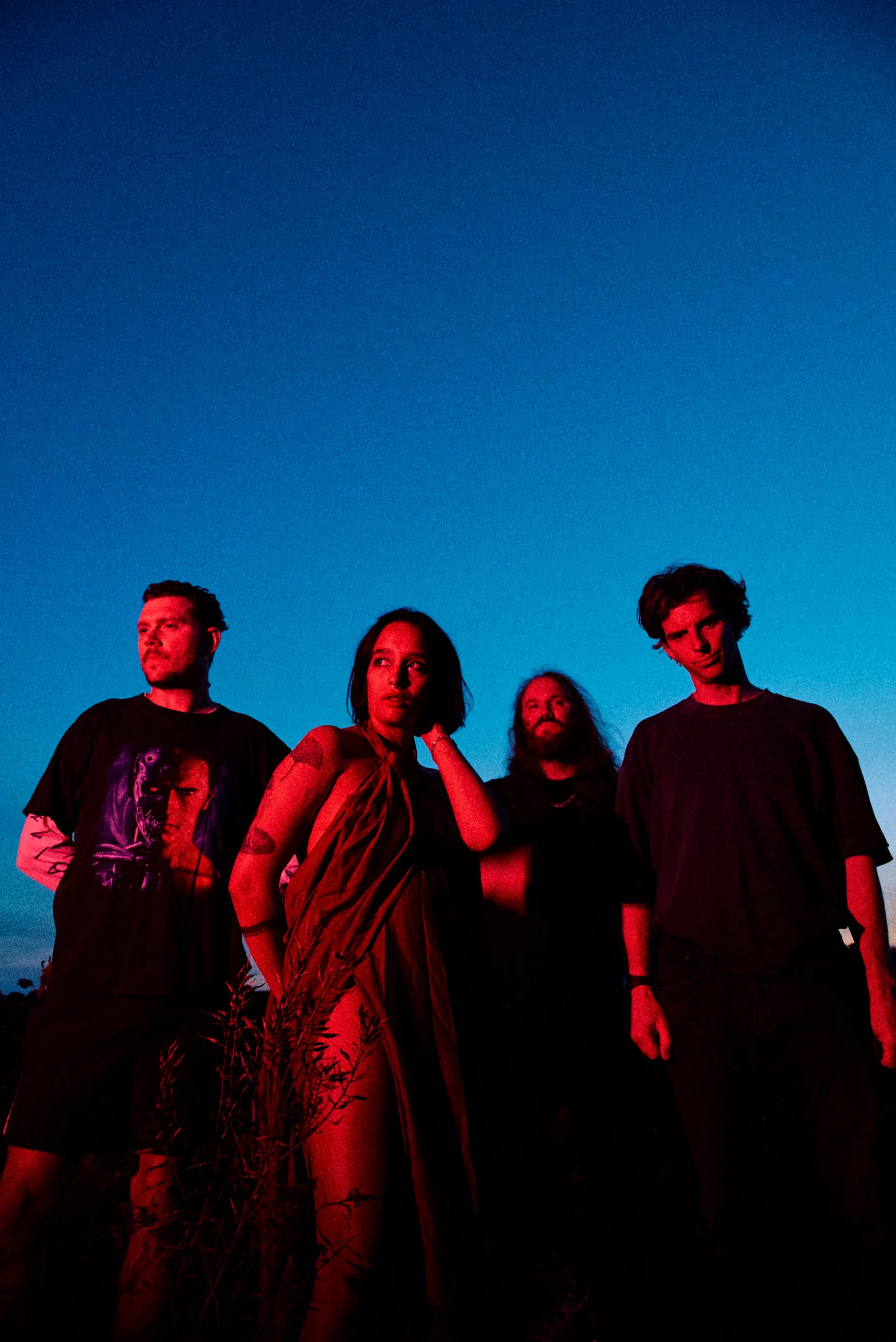
Towards the end of our 2023 Artist Spotlight interview, Mandy, Indiana guitarist and producer Scott Fair brought up an unlikely source of inspiration: Moana. “The Disney film,” he said, an important clarification in the context of a harrowingly chaotic noise rock LP recorded in caves, crypts, and shopping centers. (I guess there are caves in Moana, too. I did not interrupt Fair’s response at the time to admit this, but I have in fact watched the film.) The call at the start of the movie “influenced this kind of tribal call that happens while [vocalist Valentine Caulfield] is singing in the background,” referencing ‘Sensitivity Training’, the closing track on the band’s debut i’ve seen a way. For Mandy, Indiana, inspiration could come from anywhere, and their ears are as attuned to the sounds in their environment – whether close to (or in the literal walls of their) home or entirely foreign – as the ways they can be imagined into their piercing, uncanny body of work. And the body is precisely the animating force on URGH, their first album for Sacred Bones, which partly took shape during “an intense residency at an eerie studio house” near Leeds, but mostly, and painstakingly, over long distances. Buzzing, thrashing, and sloshing through unpindownable spaces that can only be defined by the coordinates of their own band name, the album similarly inspires countless reactions but can only really be captured by its own title.
We caught up with Mandy, Indiana’s Scott Fair and Alex Macdougall to talk about physicality, a wasp nest, video game atmospheres, and other inspirations behind their new album URGH.
Physicality
This major theme is mirrored in different aspects of the album, and the title is a good place to start. How did you land on it?
Scott Fair: I’ve seen it come up in a number of write-ups, that it is this aural encapsulation of the sound of the record, a collective verbalization or utterance. I suppose for the purposes of a record, it needs to be written down, but you could spell it in any number of ways, and in fact, that was the subject of weeks-long debates between the band members: How are we actually going to spell it? But it’s a physical response, I feel, that transcends language. It is something that feels more primal, but it could have lots of different meanings. We were discussing the definitions of that word, and there were synonyms that were floating around, but we had to pin it down to something. We’re always trying to operate within ambiguous areas, things that are hard to define, and using non-verbal language to communicate, so that felt like a very appropriate representation of what we’re trying to communicate as artists. We prefer not to have things spoon-fed, to leave things ill-defined or unresolved, closer to life.
Alex Macdougall: I was thinking about the difference between this album that’s coming out and the last one. The first record is much more escapist, creating these other atmospheres and worlds, and the name and the artwork lack the body, the physicality – it’s like a virtual world. Whereas this one is the opposite of that; the artwork is from these old anatomical drawings.
SF: Carnovsky interpreted these original works into the RGB.
AM: Our manager, Tasha, when we first put this idea forward as the artwork, she was like, “Oh, I remember these exact drawings from my textbook in university.” But yeah, the context around which this record has been made has felt much more stressful. The world around us is so fucked up and chaotic, and I think about how seeing the news and everything going on imprints on my nervous system, because I am addicted to my Instagram feed, seeing all this stuff roll in and having emotional reactions to it. It really gets under your skin, so I like how the artwork has the face, the skull, and underneath these nerves and the central nervous system, because it really reflects how I felt making this record as well.
These three-layered illustrations also made me wonder if you have a similarly anatomical view of the music in terms of structuring it.
SF: Yeah, I would argue that our music is somewhat reflective of the layers. We actually discovered in the early days of touring that we were neglecting whole massive frequency ranges, because we had this extremely low bass, and then these guitars and vocals in the high mid and high frequency range, and there was nothing there in the low mids. It’s almost like you have this low foundation, you have the vocals, and then you have these more ethereal, scratchier parts that sit on top. It is layered a bit like that, perhaps more so than other music, which tries to make use of the whole frequency range.
The 2024 film It’s What’s Inside
SF: The actual idea for the RGB artwork – if you haven’t seen the film, I consider this to be a minor spoiler. But it’s basically a body swap film, where some guy comes into a party, hasn’t seen his friends for years and years and years, and he brings a device. He doesn’t tell them what it is, but he’s gonna show them what it is, and then they all swap bodies. The filmmaker uses this ingenious device, a visual way of telling you who’s in whose body by changing the lighting. As a device, I found that to be really interesting and unique, and not something that I’d seen attempted in a film before, especially in such a well-realized way. That’s where the inspiration for the artwork came. I discovered Carnovsky, shared it with the others, and said this feels like a really good fit with the music. I really love that it’s something that you have to physically engage with in order to appreciate. I think there was some confusion, maybe at the start, when we first shared it with the label. They were like, “People might not understand what this is.” And it was like, “That’s kind of the point.” We want people to be confused by it and compelled to find out why it’s hard to see. I think that is an extension of how we make music as well.
Collective shared experiences
Before getting into collective shared experiences, I wanted to ask Alex something that lies in the intersection of physicality and performance, which then feeds into your live show. You’ve described the process of playing drums during the 10-hour work days when you were recording the album as being in “survival mode.” Do you feel like there’s a specific kind of intensity in the energy you’re able to exert when you’re pushing the limits of your body as opposed to relaxing it?
AM: It’s a really interesting question. That’s something that I think about quite a lot as a drummer, because learning the drums, you’re taught to relax as much as possible, because your muscles will work better if they’re in a relaxed state. But it’s just not the way I’ve ever been able to play. [laughs] The energy of the live situation always takes over me. I’m slowly changing that, but there’s something really interesting and different about playing at a physical limit, certainly live. I think it’s to do with seeing a real person in front of you, a human being really on the edge. That’s why I love drummers like Zach Hill, that kind of style.
Thinking back to the recording, we did the drums over the course of three days, and we were solely there to record the drums; we weren’t aiming to record any other instruments. It’s the first time I’ve done a recording session where that’s been the case. Previously, when you get a bit tired doing takes, you can hand over to the bassist or another musician to do some of their parts and rest. I was taking breaks, but it was all on me to get it completed in three days, which is all we had money for. That was off the back of some surgery I’d had earlier in the year, and I was feeling a bit like 70% battery anyway going into it. I really don’t want to glamorize all that, but I think that the sound of the drums and the urgency of it did stem from some of that context of really pushing through, because it’s not a walk in the park. Some of these drums are really intense to play, especially when you’re doing back-to-back takes. I think that has imprinted itself on the record.
You were also thinking about the different rhythms that cause the body to move in different ways, which ties into observing the audience in the live setting. Being at your Primavera gig in Barcelona a couple of years ago, I was struck by how there was a fine line between moshing and dancing at your show. I hadn’t really seen that specific combination before.
SF: That’s a really awesome observation to hear from you. A lot of these ways of moving to music originate somewhere – it’s not called moshing initially, somebody labels it that. I think if you can inspire a way of movement that is, at first, somewhat unrecognizable, there’s something really exciting about that. If you’re offering people music that they don’t know whether to dance or mosh or both, that’s really awesome. I hope that’s something that we can encourage people to explore at our shows, to move not necessarily in a practiced way, or in a way that feels like an imitation of something, but in response to the music and however that makes you feel. All of our self-described experimentation, however much you agree with that, is in pursuit of discovery. We’re trying to land on something that feels new and exciting to us, and only by regurgitating your influences in as interesting a way as you are able to do you have even a remote chance of landing on something that feels like it’s an experiment, like it might have some kernel of newness about it.
AM: I was thinking about how, throughout the record, there’s rhythms that are kind of rigid and on the grid, and then there’s rhythms that are weirder, kind of slushy. I’d basically go into a drum room and play around with these ideas and just record whilst improvising with these different images in mind. One example that comes to mind is, at the start of ‘Magazine’, there’s this cowbell rhythm that’s meant to sound slushy, a bit laid back. That was me going into the room and thinking about that band Liquid Liquid, the sort of mood they have, and what their music causes my body to do, trying to bring that out as well.
Wasp nest
AM: This was an idea I had to kind of chat about some of the less conventional samples that made it onto the record. Some wasps made a home out of the wall in the house I live in – actually, Val was staying here for a few weeks while that was going on, and she would go down into the bathroom in the middle of the night, and there would be five wasps in there. She was not happy at all. Just hearing the colony getting bigger and bigger was weird, and towards the end of their cycle, they got more aggressive, so I made a phone recording through the wall, sent it to Scott, and it’s somewhere on the album. Maybe I shouldn’t say where. There’s some other fun, interesting sounds. The subway in Budapest made it on. And then there’s your kids’ walkie-talkies feeding back as well.
SF: Yeah. We did some ASMR shit, hands rubbing together, packaging and things like that. If you get an idea for something textural – that’s what it usually is for me – and you’re like, “It needs this here,” it’s like, “How do I go about making that?” And sometimes it’ll be like, “Hey Alex, have you got anything that sounds like this?” And he’s like, “Well, I’ve got a recording of wasps right there inside my wall.” It’s like, “Oh yeah, we need a wasp-ish kind of sound.” [laughs] We’re not necessarily dropping things as little Easter eggs with that intention, it’s more just about broadening the sonic palette in that way. We’re not precious about what we should or shouldn’t include – if it works and it makes it more interesting, so be it.
AM: We’re lucky that we have two ways of incorporating that stuff into the live set as well. Simon’s got an SP404 sample pad, and I have an SPD pad by the kit.
SF: Oh, there’s the dogs from outside the White Hotel?
AM: Is that where they’re from?
SF: Yeah, in that car park. That’s literally me walking home from a show at the White Hotel, and them running over and trying to get me. [laughs]
AM: You couldn’t have been that scared if you whipped out your phone.
SF: I think it’s happened enough times that I was kind of prepared. I was like, “You guys are going on the album. You’ve harassed me enough.”
A song like ‘Cursive’ has so much in it, and I can appreciate the final product without knowing how you really got to those sounds. It’s almost like the starting point could be anything.
SF: That’s an interesting one, because that’s the one that has the Budapest subway sound on it. We played it live for the first time, we’ve been rehearsing it, and I can actually make very similar sounds to that subway and the kind of noises that it’s making on my guitar. That almost happened by accident, so it is weird how that happens.
Touring Europe and the US
I remember seeing both you and billy woods playing the same stage on different days at Primavera. Is that how you crossed paths?
Scott Fair: Actually, it wasn’t the Barcelona one, it was the Porto show. He was backstage being interviewed, and we were just sitting next to him. But I was such a big fan. I was like, “I’m not speaking to him.” And then it came to pass that we were also billed together at Club to Club, another festival in Turin, and his dressing room was right next to ours. I was talking about how I was listening to his music a lot at that time as well, so it was just a bit too raw for me to interact, but Val caught wind that I was a big fan and was just like, “Well, I don’t care, I’m gonna go in there.” [laughs] So she literally just walked into his dressing room unceremoniously, unannounced, just barged in and was like, “Hey, billy woods!” I feel like we need to sort of hold on to the rest of that story for a little longer, maybe, because it’s definitely a bit of a – what would you call it? You know when you hear these stories about music history, and nobody knows whether it’s true or not or whatever.
It’s not for the album campaign, it’s for the history books.
SF: We’ll talk in more detail about it one day, but maybe we’ll just leave that dangling for now.
AM: [laughs] I love how you’re talking as if we’re going in this history book in the sky eventually.
SF: I’ll tell you what, when we’re entered into the Rock and Roll Hall of Fame or whatever the equivalent is for a weird band like us, that’s when we’ll dish the dirt.
In what other ways did touring influence the record?
Scott Fair: That’s what I wanted to do when I was younger, just travel. I didn’t really get lots of opportunities to do that, and being in a band is a really amazing way of just getting to experience other cultures and meet interesting people, and that has to have an impact and an influence. There was one gig, which I still think about a lot, that was in Leipzig. They would broadcast the shows on this internet station – it was all ancient broadcasting equipment, but they would use these filters and effects, all this outboard stuff that they were doing in real time whilst we were playing the show. It was a really small room, everybody was smoking indoors, just living and breathing this very artistically stimulating atmosphere. That show was a real eye-opener for me. I was like, “I haven’t played a show like this for a long time.” We don’t play live that often, because we’re all so busy with our day jobs, our home lives, just everything else. So when we’re together, it’s really special, because other than three days in that house in Leeds, we didn’t really see each other while we were writing the record. I feel that’s really where the spirit of the band exists, when we’re together doing shows.
Creating long-distance
SF: There was much more involvement from the four members in terms of ideas where inspiration was coming from. The first record was a bit more myself and Valentine, ideas that we’d been working on as we assembled the band around us. The tastes and ideas of the four individual members have much more presence in this record. But otherwise, I would say it was probably even more of a remote, long-distance process than the first one, because a lot of the first one was written while Valentine was still in the UK. This time she was living in Berlin from the beginning of the process, and that meant that everything was done remotely, apart from the three days that we spent together, which were very productive.
It was super challenging, but we also knew we were doing something worthwhile, so it was worth the extra strain that it was putting on our personal lives, and that was pretty frequent. To be frank, it was pretty testing at times for us as a band, as individuals, given the other hardships that some of us were experiencing, surgeries and various kinds of health issues. It wasn’t as pleasant an experience as making the first album, I would say. It felt more like work at times. There were many times when it felt like it was finished, and then later we realized it wasn’t, and we had to tear things down and build them back up. And that’s all harder when you’re not occupying the same space, because communication can be fractured if it’s all via text message or voice note or an occasional sort of Zoom call. As Alex was saying before about pushing yourself to limitations, it’s like a football player out on the pitch, putting in absolutely everything they’ve got. I felt like that at times, like, “I’ve got nothing left to give this album now.” It’s all been wrung out, it’s all in there.
What was the most rewarding aspect of the process for you, Alex? Is it now, hearing the record, or maybe during those three days?
AM: I feel like now that it’s coming out, all the difficulty of it is receding into the background. But I just really enjoy hanging out with these guys, so the three-day thing was great for that. The other thing with that is that we were pretty cut off, there wasn’t much phone signal, we were just with each other there. It does make me feel sad that we don’t get to see each other as much now. The three of us guys do, because we live in Manchester and around Manchester, but seeing Val is a bit more challenging. So the times when I see these guys are the most rewarding because we do bounce off each other and just have a very interesting and silly time together.
Video game atmospheres
That’s definitely something that fed into your first record as well. I remember you mentioned BioShock.
SF: I guess this just alludes to a lot – it could be a film, it could be a video game. Music is the thing that comes most naturally to me, but I’m often motivated by visual stimulation, and often in combination with music. It could be any number of movies or games. In particular, the stuff that I was playing at the time: Alien: Isolation was a big one, and that was definitely a huge influence for a lot of the sounds that I was making with my guitar on the record. There was a game called Detention, which I was really transfixed by. It’s a side-scrolling puzzle horror game with a really creepy atmosphere. There’s not really anything that much deeper to any of these influences, but I’d always rather cite those visual things than list a bunch of records or artists, because I feel that that’s less interesting. Inside by Playdead was another one – also really loved Limbo by them but I remember specifically playing Inside really late at night and being like, “How does this game sound as a song?”
I don’t think it’s necessarily a super unique process, but that’s just the honest way that I went about starting off a lot of these ideas: How do you transfer the way that the atmosphere of this game, or of this film, into music? I imagine that’s fun to do for people who actually score those things, but in many ways, there’s much more freedom when you’re not doing that because it doesn’t have to work to picture; there’s no loop points or whatever. It’s just trying to find a tone, a feeling, and that can come from anywhere.
This interview has been edited and condensed for clarity and length.
Mandy, Indiana’s URGH is out now via Sacred Bones.

