

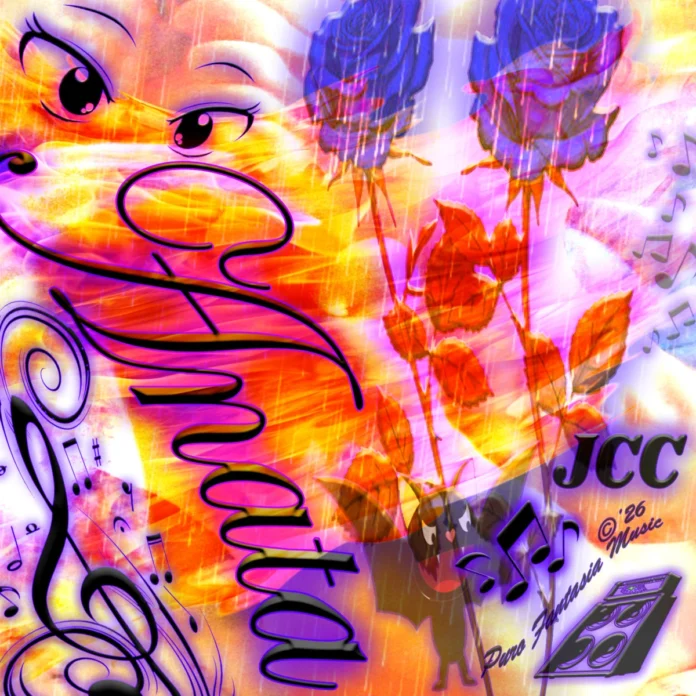
On a purely textural level, it’s easy to dismiss Joshua Chuquimia Crampton‘s music as harsh to the point of being overstimulating. But it doesn’t take more than a little context and emotional attunement for its spiritual, medicinal, and strikingly deconstructive properties to take hold. Inspired by the ceremonies of the Great Pakajaqi Nation of Aymara people and more specifically the idea of “activated ceremonial music,” the Los Thuthanaka guitarist’s fantastic new album, Anata, riffs on and blows apart its influences not as a means of distancing but approximating their ecstatic essence, the way a low-quality audiovisual can elicit a more visceral response than the best technology. Hot on the heels of his 2025 album with his sibling Chuquimamani-Condori, the 25-minute record might strike new listeners as less plentiful than Los Thuthanaka, but its slightness is deceptive: Crampton possesses a mysterious ability to let his refractive, impossibly layered guitar playing soar up into the galaxy while ensuring it all slips away in a flash. It just makes you want to hit play again.
1. Chakana Head-Bang!
Within seconds a muffled, pounding low-end gets scratched over by a heavy riff that keeps racking up speed and volume, so much so that when the higher frequency range also begins to fill up, it’s almost miraculous. Then the seemingly oppositional elements merge, as if meeting in the middle of the fretboard, tumbling like an avalanche before getting sucked back up into a ball.
2. Taqini (Juntxs)
Crampton condenses what could have been – and might as well be, in a live context – a much longer odyssey into a two-and-a-half-minute highlight that plays like a glimpse of heaven. Its melodic brightness is lightly distorted, while the rhythm is so simultaneously rowdy and subtle you’re not sure if it’s trying to barge in or simply trudge forward. Then the guitar just shrieks like a sun stirring millions of people awake, the underlying lick mirroring them going through the motions, as if its searing intensity – its very insistence – is nothing to marvel at. So it dissipates violently, circling back to the opening riff, slightly cleaner and somehow more pensive.
3. Ch’uwanchaña ~El Golpe Final~
With the guitar carrying the weight of rhythmic propulsion, ‘Ch’uwanchaña ~El Golpe Final~’ hews closer to something off Los Thuthanaka, making it a good entry point for those introduced to Crampton’s music through that album. (It makes sense as Anata’s lead single.) At first, the rhythm appears so unfathomably effected it could swallow up the whole composition, but in fact gives way to a streamlined pulse where all the instruments – shard-like, chugging, eruptive – feel far from at war with each other, especially with the addition of charango and ronroco. It’s intoxicating.
4. Convocación “Banger/Diffusion”
The title goes a long way in describing this track, divided as it is between stormy guitar swirls and an ambient second half; the rain quieting down and folding into stars. Rather than contrasting the crushing distortion of the previous tracks, it very much feels like a peaceful diffusion, a part of the same ceremony imbued with grace and self-reflection.
5. Mallku Diablón
More than just in conversation with the previous two tracks, ‘Mallku Diablón’ also feels like it’s fusing them in ecstatic fashion. Spiky guitar notes tease another freeform soundscape, a drum comes and goes, but when the huayno rhythm reestablishes itself, so does its celebratory current, rendering it the most easy-going track on Anata. Crampton is clearly gifted at making even the most unsuspecting listener feel at peace with styles, deconstructed as they are, that may be entirely new to them.
6. Jallu
It doesn’t take long for Crampton to disrupt the luminous tremolo ambience of ‘Jallu’ with noodly guitar that pierces right through it. When the track quiets down right in the middle, you realize how much of the tone is determined by the force and fluidity of his strumming, not just the effects. His impeccable sense of control and sensitivity shines through in those moments; he seems almost content with abruptly ending the piece at the three-minute mark, but it’s only a trick of the light: it gets the perfect little coda it deserves.
7. Anata
Crampton bangs open the closing title track with possibly the harshest noise on the album, scrubbing it over to build an imposing, dare I say cinematic, instrumental. High up in the mix, the charango’s single-chord persistence offers a tinge of hope over swirling guitars, a combination that obliterates any need for percussion. As the track keeps getting thicker, Crampton avoids the impression that its low and high ends are coming from different instruments, but colliding in his own hands; a consciously tactile expression of euphoria. When it collapses – again, ingeniously, at the three-minute mark – he leaves you with that initial feeling that an epic journey has been bottled up for our enjoyment. It’s hard to get to the bottom of it, which is why, for all its brevity, it keeps delivering.

