

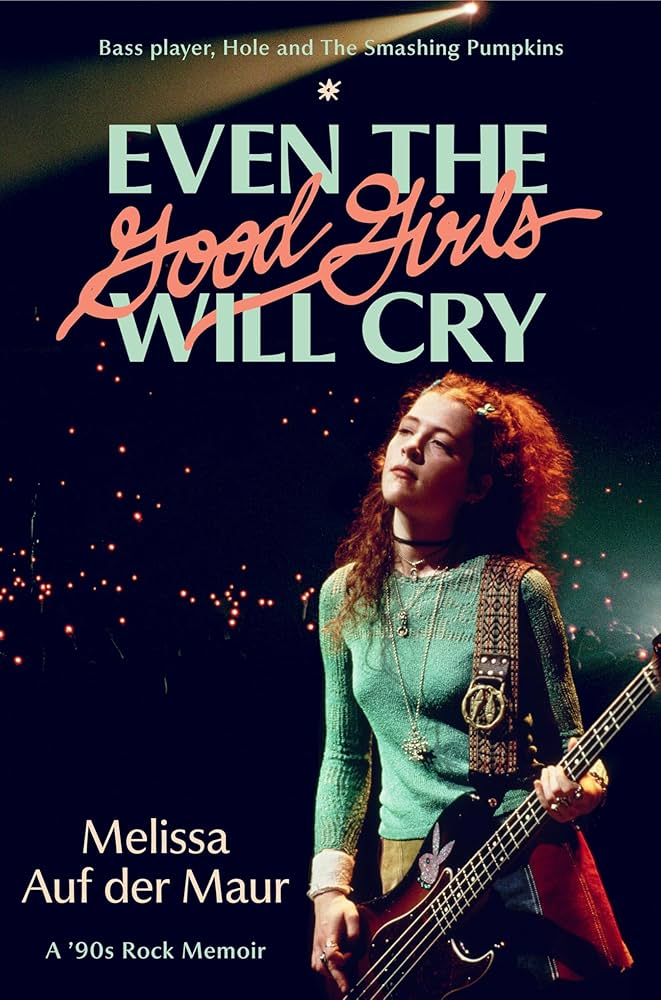
The week after bassist Melissa Auf Der Maur resigned from Hole, Courtney Love – her former band mate, boss and cosmic sister – sent her a fax (it was 1999) saying that she wished, as a songwriter and one quarter of the group, she had given “25%” of her creativity to the band. It’s a jab that’s not unfounded at least musically. Auf Der Maur’s preferred music tastes were heavier, more dissonant and male than Hole’s guttural pop- noise-rock. A 90s playlist that turns up early on in her memoir Even The Good Girls Will Cry includes Helmet and White Zombie. One of her named contributions to Hole is Use Once And Destroy, a heavy stoner rock number that owes more to Kyuss than Hole’s normal sound.
However, according to her book, Auf Der Maur gave it 100% but it was in the form of emotional support rather than musical. She is drafted into Hole just 4 months after the overdose of bassist Kristin Pfaff and five months after the suicide of Kurt Cobain, she brings levity into a situation reeling from darkness and death. In the 2011 documentary Hit So Hard, guitarist Eric Erlandson says: “Melissa bought some sunshine to the band.”
But, it turns out, it was more complicated.
At the top of the book, Auf Der Maur casts herself as a born empath, a Pisces, a fatalist and an ‘observer’ both metaphorically and literally: she is a photographer who describes her lens as “armour”. For her time in Hole her sturdy, assured bass playing becomes a metaphor for the supporting, grounding role she plays for others. It was a role she was groomed for, growing up in Montreal she was known as ‘Nick’s daughter’, her father being a local celebrity, a journalist, raconteur and man about town. She has a complicated relationship (older friend, mentor, caretaker) with him. At least twice in the book she compares her father to Love – both are gregarious, with an impenetrable public persona and a softer side only Auf Der Maur was privy to.
The first shows that she plays with Hole, in the wake of Cobain’s suicide, are legendary for their exhilarating, quasi-sacrificial nature: Love on the edge of public grief, communing with the spirit of her dead husband through lyrics that somehow predicted the situation. Teetering between brilliant and car-crash theatre, Love would often verbally confront the audience. Auf Der Maur describes these gigs as “gladiatorial” with the band holding the vulnerable, exposed Love through the music. Auf Der Maur sees that moment matter-of-factly: Love as a widow, a single parent acting out stages of her grief on stage. It’s in stark contrast to the world who saw Love’s refusal to play the “sad widow” archetype as proof she had a hand in her husband’s murder.
In Hole, Auf Der Maur is an empathetic balm to a band collapsing in on themselves. In parallel to her playing the ‘good daughter’ to Nick in Hole she is Horatio, the good sister to Love’s bad, the mysterious red head to Love’s blonde. It’s not long before Love herself tries to Henry Higgins her into some sort of rock queen dilettante.
But who was Melissa? Even The Good Girls Will Cry is in part a tragedy about the erasure of self for the ‘greater good’. Later when she goes against her instinct and joins The Smashing Pumpkins, she plays with the image of being captured in a bell-jar: a kept creature, observed by others. It seems appropriate.
Auf Der Maur’s heart’s desire is the lo-fi, DIY creative community she finds as a teenager in Montreal. Turned off by the corporatisation of alternative rock that she observes after she joins Hole, she leans into the emotional needs she intuits her bandmates need from her, placing the other parts of herself on hold. While her life as a celebrity is painted with duality: the eccentric parties full of James Dean-ish actors and strippers covered in whipped cream, paired with her lonely antiseptic home life as the band record the follow up to Live Through This, Celebrity Skin in 1997. Her closet ally, drummer Patty Schemel, had quit the band by this point, after their autocratic new producer Michael Beinhorn replaced her drum parts with a session player. And the passage about Auf Der Maur recording her bass and vocal parts alone, to the backing drum track played by this ‘ghost drummer’ makes for depressing reading, contrasting starkly with the codependent ‘band family’ who played the Live Through This shows.
The book frames itself in many dualities, not just between Love and Nick. From the 90s alternative scene which is caught between the cardinal sin of ‘selling out’ and getting big (Auf Der Maur notes Green Day’s Billie Joe Armstrong tell Love that Cobain killed himself because he realised he had killed punk rock. Love says Armstrong had ‘got it’) to boyfriend Dave Grohl who wants to settle down and start a family but also sees himself as a progressive rock star.
Auf Der Maur writes best when describing the quasi-religious ecstasy of music. “I grew accustomed to the underlying sadness and loneliness in the people who gathered there,” she writes incisively about rock crowds, “they seemed both lost and found at the same time”. Or the star-crossed relationship between her parents.
As she walks from one high intensity situation to another, Auf Der Maur’s strategy is to disassociate and mask her feelings with a very 90s stoicism. There are thoughtful passages where she questions why she always finds herself around such high drama and questions her own culpability in it all. When she finally realises she has to completely cut ties with her glossy former life and its incestuous scene to find herself again, you feel a sense of relief, glad she doesn’t become another casualty of the era.
Even The Good Girls Will Cry demythologises the fantasy of the 90s with a deflating honesty. It also makes you want to listen to certain records from that time again. But maybe not Celebrity Skin.

