

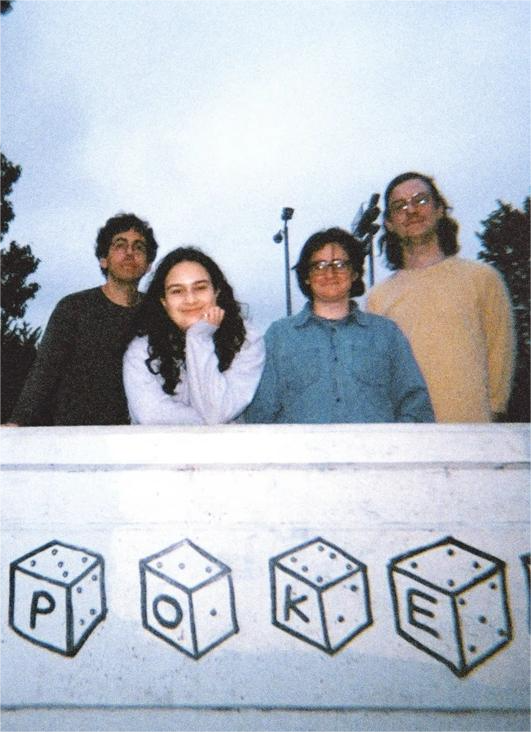
Remember Sports is an indie rock band that formed in 2012 when its members were attending Kenyon College in Gambier, Ohio. Having put out their first album (as Sports) on Bandcamp in 2014, they signed to Father/Daughter Records and released All of Something the following year. Their third LP, Slow Buzz, arrived in 2018, followed by Like a Stone in 2021. Bassist Catherine Dwye and guitarist Jack Washburn had played in other projects, but it wasn’t until last year that singer and guitarist Carmen Perry stepped out to release Eyes Like a Mirror, her debut solo album. Now, the group is back with a new album, The Refrigerator, their first for Get Better Records and first to feature drummer Julian Fader, who joined the live lineup a few years ago. Recorded at Chicago’s Electrical Audio, the album refashions the surreal collision of past and present selves – inspired by Perry’s job teaching at an elementary school through COVID – as a head-spinning emotional ride, from the guttural rawness of ‘Across the Line’ to the hypnotic recollections of the bagpipe-led ‘Ghost’. “The kitchen table split in two and I thought of you,” Perry sings on the latter, the whole band ensuring that train of thought – bending time and reason as it does – is a thrill to follow.
We caught up with Remember Sports’ Carmen Perry for the latest edition of our Artist Spotlight series to talk about teaching at an elementary school, the kitchen as a space where life happens, taking advice from songs, and more.
There’s a thread across the album of approaching your 30s while reconnecting with your childhood self, which I assume, for you, was inspired by taking a full-time job at an elementary school during COVID. What was it like shifting your focus in that way, and how did it seep into other parts of your life?
I’ve been part-time teaching since I moved to Philly after I graduated college. This opportunity to take a full-time position for a year at an elementary school near my house came up for me during COVID, at a time where it didn’t look like I was gonna get to tour ever again. I was very much in that mind space that my life as I know it is over, so why not try this for a while, save up some money, and see how I like it. I think there was a big part of me that was like, “This is not what I really want to be doing, but I am doing it, and I’m doing it every day, which is out of the ordinary for me.” I think I’ve always connected with kids; I babysat when I was younger. I felt like a big part of my role when I was working that year was just making kids feel like they were okay, both in relation to COVID and all the uncertainty that all the adults in their lives were facing at that time.
Kids have problems that adults don’t tend to think about anymore, so I would talk to so many kids every day and would see these little glimmers of things or quirks in them that I remembered from myself when I was young, or people I knew when I was younger. There’s this whole inner world that is sort of inaccessible to adults, and all the fears and anxiety that come with growing up – I think we tend to not think about how hard that is to deal with when we’re past it. That really put me in the headspace of something hard that I went through, and maybe haven’t processed fully. It felt like a big part of my job to just be a friend to them, be someone who could listen and understand, so that made me, in sort of a roundabout way, treat myself a little differently. I was just spending so much time thinking about younger me and the child that I was, and it did a number on my head, but in a way that made me think a lot more about taking care of myself and being kind to myself.
They’re often not afraid to be weird and funny, but also don’t suppress fear in the way that adults do. I feel like this sense of fear is something that you get in touch with in this record. Would you describe your childhood self differently after spending time with kids and seeing how they express emotions? In what ways do you remember yourself now?
I think adults have learned to navigate the world and feel through their emotions from behind several different layers of: How is this gonna make me look? How is this gonna make me appear to other people? Those layers just aren’t there yet when you’re a kid. To your question, when I think about myself as a child, I’m thinking about it through my eyes as a child, and I think about all the embarrassing things I did. All the ways I was cringe, and, I don’t know, funny? I think there’s a way that I talk about my younger self in a making-fun-of-her kind of way. In the process of writing this album and working at school and sitting with these thoughts, I have a much more protective sense of being a kid. Maybe I was embarrassing to my sensibilities now as an adult, but I also was going through a lot, and trying really hard to, like, be a person, have dreams, and figure out who I was. I feel like I have so much more tenderness now.
It’s very easy for us to be hard on ourselves, and I found that that was extending to the child part of me, too. I just decided I don’t want to be hard on child Carmen anymore, because she did what she could. We don’t think about it super often, but our child selves are very much with us, even in the present. Every time we talk to somebody, every time we make a move, our childhood is much more present than I think most adults think about on a daily basis. It was a process of reexamining who I thought I was and putting it in the light of what I would think, as an adult now, meeting a kid like I was: I would want to do everything I could to make her feel safe, that she was understood, and doing a good job.
You mentioned the word “tenderness.” When I heard that line in ‘Roadkill’, “Tenderness devastates me,” I had to write it down.
I’m sure you understand, but I feel like when you are really down on yourself., hating yourself, and somebody is nice to you, even a little bit, it’s like, “Ugh, this is the worst.” [laughs] I feel like that’s pretty universal.
Do you remember your high school yearbook quote, if you had one?
I don’t think that we had quotes in my yearbook, but I have thought from time to time what my quote would have been, and it probably would have been something ironic. Maybe a lyric from an emo song that I really liked. Realistically, what I would have thought at the time I was doing a really deep quote, and then it would probably be something that I would look back on now and be really embarrassed about. [laughs] But I always was envious of the people who had quotes in their yearbooks. It feels like such a big deal to stamp this time of your life with definitive words.
Hearing the drama of a song like ‘Selfish’, I’m curious if you were influenced by musical theater growing up.
Yeah, I feel like you got me, because I was a big musical theater person when I was a kid. I don’t bring it up a lot, because it’s seen as pretty embarrassing. I don’t want to say I’m embarrassed by it, because I’m not, and I still love musicals. The drama that I like about musical theater songs is something that still inspires me. I would say a song like ‘Selfish’, and probably even ‘Cut Fruit’, they feel very dramatic, and it’s me leaning into those parts of my emotions, in a way that is really fun because it feels over the top. Even when I was doing the vocals for ‘Cut Fruit’, there was a moment where I was just like, “This is so dramatic and serious.” And I stand by it, obviously, but it makes me a little bit embarrassed to go to those places. But it is so fun to just be totally melodramatic and sort of a drama queen, and that’s not where I’m writing every song from. It’s important for those two songs, because when you’re having feelings that won’t go away, you gotta just lean into them totally before you can even begin to move on or process.
With some of the songs, you get the sense that you’re revisiting feelings from relationships going as far back as your youth, and I wonder if you find yourself surprised in that process of going back in time.
Going back in time is something that’s been very integral to the whole experience of Remember Sports for a few years now. We’ve been a band since 2012, and at this point, we’ve got a pretty big catalog of stuff, going back to songs that I wrote when I was 18. Every time we play a show and play old songs, it’s always an experience of putting myself back in those emotions or that place from when I was 18, or 20, or 24, and that’s always tricky to do. It almost feels like going back and getting to play a character, or spend a little bit of time seeing things from my eyes at that age. That’s an experience that I have come to cherish, the last few years of being a band, because it is such a privilege to still be doing this, and to have been doing it for so long. I still can’t believe that people want to hear these songs that I wrote when I was 18.
I think this album is a good representation of how this project has been a vessel for me to experience things through past eyes, that head-spinning confusion of, like, “Am I 30 right now, or am I six?” Writing through these feelings, singing through these feelings, and playing through these feelings has been really huge for me in processing who I am and where I’ve been. But the longer that we have been a band and gotten to do this work, the more I’m like, “How can I apply this to other aspects of my life?” Maybe I was sort of using that logic when I was writing this album, because it’s like, “Okay, let’s go a little further back. What was I feeling when I was a child?” I guess it’s sort of a way for me to get to play with that experience at a different age now.
What’s interesting to me is how the album’s production reflects those shifts in perspective – that head-spinning confusion, as you said – between the bedroom intimacy of a song like ‘Fridge’ and the richness of ‘Ghost’.
Yeah, that totally makes sense. I think that this is a really dynamic album, and I think it speaks to what we’re trying to connect to, that it goes all over the place – from a bratty song like ‘Thumb’ to a softer song like ‘Fridge’. All these songs being together is just a tornado-like experience that is what growing up feels like, and it’s also what living through the pandemic felt like. All of it serves to bring parallels into sharper focus in my life.
Growing up was also a prominent theme on your debut solo album from last year. I’m curious how much overlap there was in the writing of these songs.
There’s definitely a lot of overlap. To your point, growing up has been a huge theme for me since I started this project when I was 18, and it honestly still feels like that is gonna always be what I’m writing about. Since we started working on The Refrigerator, I got officially diagnosed with autism, and that has put a lot of things about myself and about my life into sharper focus. In some ways, it feels like I’ll always have this process of feeling like I’m growing up and learning how to be a person. There’s a lot of things that, like, my partner will have to explain to me – just different aspects of being a person that I feel like I’m always learning. It sort of always feels like I’m growing up, or growing into something, and maybe that has to do with the fact that I know now I’m autistic.
For Eyes Like a Mirror, I wrote some of those songs more recently, but the oldest songs on that record I wrote 10 years ago, so I would say there’s a lot of overlap with that record and the entire Sports discography. I don’t want to say they’re B-sides or Sports rejects, but they’re songs that I wrote throughout the years that just had a different feel, that I wanted to record and produce in a different way than we do things for Sports. A lot of that was mining these old songs and lyrics that had been with me through the whole of the last three albums that we’ve put out as Sports, so I definitely think it’s a good companion record.
My entire music career has been with this band – Jack, Catherine, and Julian play in a bunch of different bands and have worked on a bunch of different projects, and I felt like I also wanted to do something else and experience working with new people. We did a tour last June, and it was the first tour I’d ever done without Catherine there; Jack from Remember Sports also played in my band, so that was familiar. It was something I hadn’t experienced before, so it very much goes with the theme of growing up and how stunted I’ve always felt, like, “I’m 32 now, and this is my first time doing a DIY tour with people I haven’t known since I was 19.” [laughs] I’ve always felt like a late bloomer compared to my peers. That just felt funny to me, because this is what my friends and people in my life do all the time.
Speaking of doing things differently, I wanted to get back to ‘Ghost’ and ask about the bagpipes and strings. More than just their inclusion, what struck me was how you go all in and let them be the backbone of the song. I’m curious if that was the vision from the start.
Yeah, I think that was probably the vision for the song from the beginning of when the rest of the band heard it. A lot of the songs I will write and finish and bring to everyone, but I think with ‘Ghost’, I brought them a partially finished song. That wasn’t where my mind was going, but I think as soon as Catherine, Jack, and Julian started working on it, it felt like there was a lot of room there for us to experiment and do something that sounds huge. We found a bagpiper, this guy named Reed who lives in Chicago, where we were recording the album. I think we found him on Twitter, and we got him to come with his friend to the studio and lay down some bagpipes. I’ve never been in a recording studio with bagpipes before, so that was really cool. There’s usually at least one song on every album where it’s like, “This is the song where we’re gonna do all our experimenting, throw everything at it and see what works and see what doesn’t work.” And I will say with ‘Ghost’, there was a lot of stuff we did that didn’t work. For as many different paths that the song, as a finished product, takes you down, there probably were twice as many ideas that we ended up not using.
A lot of the creative choices on the record feel really intuitive; I’m thinking of how the crunchiness on ‘Bug’ lines up with the feeling of the song, almost literally. It sounds like the kind of thing you don’t necessarily talk about.
I didn’t even think about that, but yeah, you’re right. I think just from us knowing each other and working with each other for so long, there is so much that is unspoken. A song like ‘Across the Line’, I wrote that very quickly. Sometimes you’ll labor over a song for months and overanalyze every little detail, but ‘Across the Line’ came to me pretty quickly. I brought it to the band, and everyone was like, “We know exactly what to do with this.” That’s a very straightforward song, and I love having both ends of the spectrum on one album; I feel like you need the more straightforward songs to anchor the more out-there songs. But yeah, we just always seem to know where we’re going, in a finishing-each-other’s-sentences kind of vibe, but musically.
Was there another song you over-analyzed from a lyrical standpoint?
‘Thumb’ was really hard for me to write at first. I think it was easier for me when I was younger to be fully honest in my lyrics, because I was doing everything from my bedroom and putting it on Bandcamp. On the other side of that, now that I’ve been doing this so long, everyone in my life knows what I do, and my family listens to my lyrics and whatnot. I find myself thinking a lot more about how stuff is gonna land, and that’s something I’ve really struggled with trying to not do over the past few albums that we’ve put out, because I think it does lead the lyrics to suffer. For ‘Thumb’, I think I was stuck in that limbo for a while. There came a point where I decided to just lean into not being nice and say what I wanted to say.
This is the song I’m most worried about my family hearing. Without saying too much about it, I think I really needed to put myself in the headspace of 15-year-old Carmen, who wouldn’t give a shit what anybody said, and put myself in the headspace of the Carmen who wrote ‘Clean Jeans’, which is also a really bratty song. That was the only way I knew how to do it, like, “I am gonna just pretend like I don’t care how this lands.” It came down to the wire, and I finally finished the song right before I had to sing it. The take you hear is the first time the band heard the lyrics or the melody, and the very end, I think we used the first take that I did there. That was a nice feeling, singing it for everyone for the first time and watching their reaction to it.
I love the relief in the exhale that you leave in at the end of that recording. How do you feel your relationship to your voice changed with this record?
This album especially was made in a time where I feel like I have gotten better at singing, technically. I’ve never been trained, but over the last few years, I’ve done a lot of thinking about using my head voice versus my chest voice, finding the mix between those. It takes a lot of people a long time to refine that part of their voice, and over the course of making this album, I feel like I’ve been focusing on that a lot. There are moments in this album where I’m singing from that place, or I’m making a conscious decision to sing from head voice or chest voice. To me, it feels like there’s more dynamic there, because a lot of our earlier records are just me shouting, because I think that’s what I needed at that time – I just needed to be as loud as possible. As we’ve gone on, it’s been more work to carve out these dynamics, because I do think it makes the yelling sound more powerful if there are moments where it doesn’t happen. At the same time, I’ve never been interested in having a technically good or pretty voice. That’s just very boring to me.
We touched on this self-consciousness, on ‘Thumb’, around how your words might come across. That’s a tension that I feel is present throughout the album, like, the contrast of sitting in silence and running your mouth between ‘Roadkill’ and ‘Cut Fruit’.
I think a lot of this goes back to finding out that I am autistic. I’ve always felt throughout my life that there is a part of my personality and my identity that is trapped in my head, and it’s just about getting the words right to make other people understand. That has been a constant battle in my life, finding my words. I’m not great at talking or articulating myself. Well, now that I’m old, I’m pretty good at it, but music still feels easier, singing still feels easier than talking. A lot of the battle of my life – and this goes back to talking about childhood and working with kids, has been – is about figuring out who I am and want to be, and being firm with my words about that, using my words to solidify that rather than swallowing things. I think a lot of my earlier work is definitely, like, “Why doesn’t anyone understand me?” And now it’s almost gone to the opposite end of the spectrum, like, a lot of people are listening to everything that I record, and that feels like a lot of pressure, that scares me and makes me want to retreat back into myself. But that’s the work, then: figuring out how to say what you’re gonna say, and stand behind it.
‘Thumb’ is about someone that I used to really love, and really hurt my feelings. There are parts of me that want to just scream that from the rooftops and have everybody know, and then there’s the more hurt parts of myself that are like, “But I still feel really tender about this.” It’s finding the right balance between those two parts: being loud and boisterous, and still being a caring, feeling person. A lot of times I feel I’ll misrepresent how I’m actually feeling and feel embarrassed about that, but then the alternative is not talking, which I did for a while when I was a kid. There were a few years where I was nonverbal, holding everything in, and that doesn’t feel good either. That’s been the big challenge in my life.
The title of the record homes in on the fact that you often write about household items as vessels for big emotions. There’s something nostalgic about not just the fridge as a treasure trove of memories, but the space around it.
I think the point about big appliances is very apt. I’ve done this already, we have a song called ‘The Washing Machine’. I think a lot of the ways that I write songs is I’m trying to put myself back in my head at whatever time I’m trying to write about, and I have to think about what I see, what I feel, what I hear, smell, touch. And a lot of these memories, I’m in the kitchen. I’m getting yelled at next to the fridge, or I’m hugging someone next to the fridge, or I’m dancing in front of the fridge. We become so connected to these things that literally loom over so many of the important moments or scenes in our life, and that is why we went with The Refrigerator as a title. In a lot of the songs, I’m singing about being in a kitchen, and it’s all these different kitchens that I’ve lived in throughout my life. I don’t know if there’s the same kitchen that I’m singing about twice.
On the final song, ‘Nevermind’, you sing about taking advice from the songs you like. Can you think of any songs you hold as beacons in that way? I know you’re a Rilo Kiley fan, so to me a song like that would be ‘A Better Son/Daughter’.
I’m glad you asked that. I think the song specifically that I was thinking about was a Rilo Kiley song when I was writing that. I was just thinking about all these songs I’ve loved for years – a song like ‘More Adventurous’, specifically the line that’s like, “I read with every broken heart/ We should become more adventurous.” I was thinking about songs that have lines that are like pieces of advice – I could sing that in my sleep, but am I really taking in what that means, and am I living my life to that principle? I think ‘A Better Son/Daughter’ is a good example of that, too. I did actually get to see them for the first time last year in September, so hearing that song live was a really crucial moment. I cried a lot.
This interview has been edited and condensed for clarity and length.
Remember Sports’ The Refrigerator is out February 13 via Get Better.

