

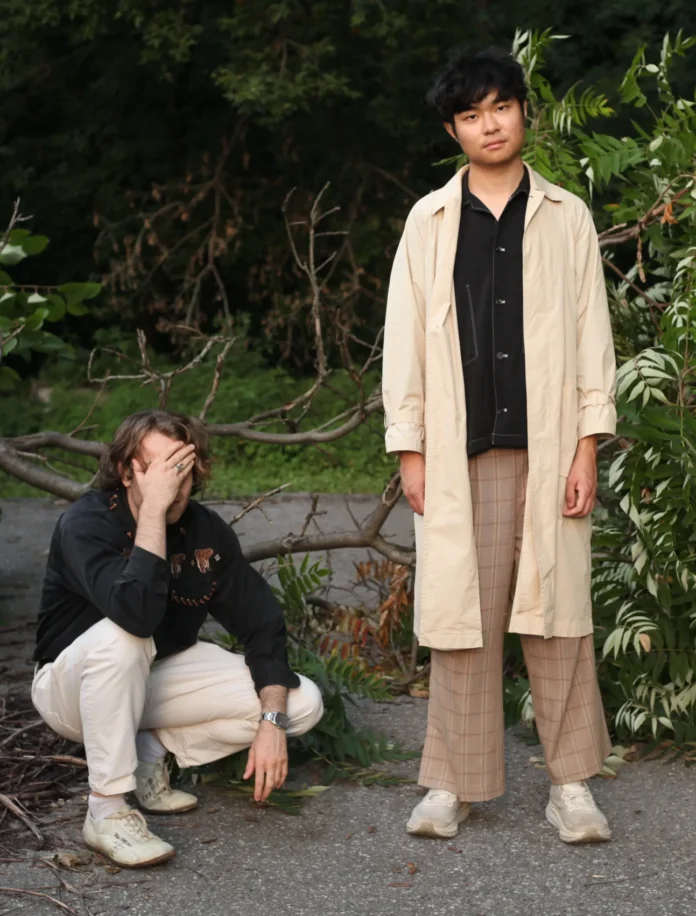
Ira Dot is the project of Canadian musicians Ryan Akler-Bishop and Eddy Wang. As artists, the duo have stretched their work across a wide canvas: Wang is a filmmaker, multidisciplinary artist, and PhD student at the University of Pennsylvania and Akler-Bishop (an occasional Our Culture contributor) is also a filmmaker, multidisciplinary artist, and co-editor-in-chief of Big Toe Magazine. Their artistic breadth is reflected in the elasticity of their music. Their music traverses genres such as electrocoustic rock, ambient techno, and pop. Since founding the band in 2019, the pair first cut their teeth playing in local venues in Toronto. For the last five years, Akler-Bishop and Wang have been recording their debut album In Blue Time, out Friday, in cities across the United States and Canada. The album brings together Wang’s ethereal vocals and Akler-Bishop’s eclectic production to produce a sonic palette of textures both harsh and serene.
We caught up with Ira Dot for the latest edition of our Artist Spotlight series to talk about their varied inspirations, philosophy, filmmaking, and more.
I’d like to begin with the album’s title, In Blue Time. The colour blue has a wide range of emotional associations, from melancholia to coolness to standing in for a sense of calmness. What was the title’s genesis and what does being in blue time mean to you two?
Ryan Akler-Bishop: In terms of genesis: when we were applying for grants, we needed a project title in order to submit. We didn’t have a clear concept of what the album would be yet, so I just put down In Blue Time. It felt like it encapsulated the melancholic tone of the music. Eddy was uncertain about the title at first, but I kept putting it down in the hopes that it would seep into his subconscious and become a natural shorthand for the album.
I have a poor sense of rhythm. When I think of the title, it sparks the mental image of someone calling me out and saying, “Ryan, you’re playing out of time”. I like to imagine I respond with the excuse, “No, I’m actually playing in blue time”, as if there’s some alternative temporality where you can play outside of rhythm, but sound still links together.
Eddy Wang: Melancholia is a big theme in the album. And I feel blueness is the most melancholic of colours. In fact, William Gass calls blue the colour most suited for interior life. Actually, if I could read William Gass for a moment, I think his book On Being Blue captures what we’re trying to get at with the blueness, as well as the blue timeliness of the album [grabs a book from his shelf]:
Of the colors, blue and green have the greatest emotional range. Sad reds and melancholy yellows are difficult to turn up. Among the ancient elements, blue occurs everywhere: in ice and water, in the flame as purely as in the flower, overhead and inside caves, covering fruit and oozing out of clay. Although green enlivens the earth and mixes in the ocean, and we find it, copperish, in fire; green air, green skies, are rare. Gray and brown are widely distributed, but there are no joyful swatches of either, or any of exuberant black, sullen pink, or acquiescent orange. Blue is therefore most suitable as the color of interior life. Whether slick light sharp high bright thin quick sour new and cool or low deep sweet dark soft slow smooth heavy old and warm: blue moves easily among them all, and all profoundly qualify our states of feeling. (Gass, On Being Blue, pg. 75)
Gass is gesturing at a kind of movement within blue. Though blue is melancholically tinged, it’s able to move between states like bright, high, smooth, heavy, etc. I feel that captures the formal dynamics of the album, which is invested in this kind of always moving-ness, interior movement that blue offers.
Do you think your research process worked in reverse of what you’d expect, where you actually created the title, and then that guided you to explore what the colour blue meant for you?
EW: David Bowie has talked about how many painters only title their piece after it’s done. I’m a true believer in theory, and so I wouldn’t say there is a binary opposition between the language of how we describe the record and the music itself. I would say that ideas put in language are intuitions of what existed before, just translated into a linguistic form. I also wouldn’t reduce the creation of this record into a kind of idea-then-work linearity. Anyways, I might add that the body itself has a theory that it expresses in the work. That body is informed by many things, and theory is one of them. Maybe you could say that instead of this linear research process that the theories informing the album are also in blue time.
Well, alongside these sorts of meanings and connotations of blueness, there’s also very much a collision of different sounds and musical genres such as pop, electroacoustic, and noise rock featured on the album. How would you classify In Blue Time’s genre?
RAB: I think the eclecticism of the album stemmed from this being the first time we approached creating music seriously. We had no sense of where our aptitudes lay or even what our inclinations were. We set our horizons very broad, so the final result is a hodgepodge of sounds. The next record will surely be more focused, but I like to think of this album as a body with all these disparate organs performing their own task, but they come together as one being.
EW: I think the eclectic form of the album, the way sounds shift and swerve into these different genres, reflects the aesthetics of movement and migration that coincided with the recording of the album. Ryan and I recorded In Blue Time in so many different cities and so many different places. I think that always-on-the-move-ness is reflected in the formal style of the album.
I’m sure this presented some challenges – writing and recording music while living in different countries. So what did your actual recording process look like? I believe some sessions were recorded in closets, cabins, as well as studios.
RAB: Eddy and I met in 2019 when we were in a research group. He would come to my dorm room and we’d record music. I would feed a USB mic into the closet where he’d sit and sing. As our recording process evolved, we wound up in more professional spaces: the Second Spring studio in Vancouver and The Music Gallery in Toronto, for instance. When we talk about this album being a meld of all the different experiences over the course of five years of our life, you also hear that in the sounds in the audio equipment that’s used from these trashy USB microphones to ones that are more expensive than my apartment.
Could you talk a little bit more about the process and the album’s evolution from five years ago to today? Did the project scope and shape change a lot over this time?
RAB: I think time is a huge factor when you think about its eclecticism as well, because when you make an album for five years, that’s half of your 20s right there. My aesthetic priorities changed drastically from the album’s inception to now. For instance, some of the earlier recordings (like ‘Blue Stucco’) are playing with the idea of pop artifice: something I gravitated towards in 2020. I wanted to test the synthetic possibilities of the voice, to see if digital manipulation could, counterintuitively, actually make it more human. I was listening to a lot of autotune-heavy pop records like Ecco2K’s E, but also more garish autotune tracks like Lil Wayne and Nicki Minaj’s ‘Knockout’ or that Farrah Abraham electropop record. I loved the idea of scraping off as much biological data as possible from the human voice. By the end of recording the album, we had shifted away from this, and the music sounded completely different from that starting point.
In addition to being musicians, you’re also filmmakers and you guys actually made films together. So do you view the music and the other art that you’re collaborating on as disparate, separate projects or are they part of the same conversation? Do they inform each other?
RAB: A major difference is: when Eddy makes a movie, he’s the writer and director, and I’ll produce it or be the DP. I adopt the role of trying to actualize Eddy’s ideas, and vice-versa when I’m directing a movie. But when we make music, it’s very much a collaborative process. It’s like a blood pact, where our blood commingles into some new DNA concoction.
EW: With films, because there’s so many moving parts, you need to be a bit of a big-brain puppeteer. While with music, even the band structure itself opens it up for more dialogical relationality. Arthur Schopenhauer says music “refers to the innermost being of the world and of our own self.” He writes that music doesn’t express a particular, definitive pleasure or affliction, but pleasure or affliction itself. In the philosophy of art, music is often held up as one of the most expressive mediums, something that speaks more closely to the language of life. Film, to me, is more critical, more intellectual. I mean that in a good way as someone who adores theory. But I’m definitely making films informed by a bunch of film theory.
RAB: Music has the capacity to be very instinctive. Some sections of In Blue Time are improvised; improvisation is the cornerstone of much modern music. At the same time, it’s hard to make a truly improvised film. Even in the case of improvised performances from actors (or live documentation), the principle of improvisation is then mediated and lost through the process of editing. Filmmaking is almost always a more considered, intellectual process. Music has a better chance at getting to the unrepressed emotional realm.
On the topic of Eddy’s melodies, I was very struck by the raw vocals and the lyrics on tracks such as ‘Bodies’ and ‘Goose Eggs’. Eddy, how do you approach writing and singing from this vulnerable, emotional place? I don’t know if the music has a therapeutic side, but there’s certainly a very raw, vulnerable side to the album.
EW: I approach art through an embrace of vulnerability and its nude affordances. It’s less therapeutic and more me saying, “These are the things I have to say at this moment, this is what I have to offer to you.” I think a lot about the figure of the amateur: Ryan and I talk a lot about the position of non-mastery in creating art. I try to write from a place of vulnerability, because otherwise what’s the point? Like, what are we doing here making art if we don’t think it’s important to us?
There’s something beautiful in vulnerability; it’s about acceptance. I find it very humbling, actually. Like I’m saying, “I’m giving you something, I’m unsure of how it’s going to be received, I’m maybe scared of how you will react, but I’m going to go ahead and say it anyways.” I don’t really think I have a great voice. I mean, I have a very particular voice, and that’s something I’m quite aware of. There are two main genres of early Chinese American vernacular music: the muk’yu or wood-fish songs and the Gam Saan (Gold Mountain) songs. These songs were popular with the peasants and the merchant class, and sung in a way that almost necessarily had to go against institutional forms of training. Combined with that, in the historical record we find that the early (white) critics of Chinese American singers often characterized their sound as nasally, guttural, sounding like dogs, etc. I think situating my own perceived imperfections in this larger racist history has helped me better understand the stakes of Ira Dot.
On the topic of following in the lineage of Chinese artists and musicians, this album also evokes Chinese traditional music and Beijing opera. I was wondering if you guys wanted to talk a little bit about incorporating elements from this tradition of music.
EW: Beijing opera is definitely the biggest. Three songs feature my mom, who grew up singing Beijing opera. In ‘Goose Eggs’, her voice grounds the interlude and on ‘Days’, it becomes literally the backbone. Then, in ‘Melancholia’, my mom’s voice closes the album. At one point, Ryan said he sees a lot of Ira Dot songs as country songs. That’s an interesting way to think about the album. What does it mean to write a country song when you’ve been historically cast as the alien – without a country or a sense of belonging – which has been the historical position of the Chinese Canadian subject?
I see a kind of negative genre of non-belonging being explored in In Blue Time. If Asian subjectivity is defined by the fact that it’s racially invisible in the black and white binary, what does it mean to make hyphenated music as a kind of operation of this non-belonging and negation? It might look like a kind of country music founded on the negation of the country, of the nation.
RAB: I don’t remember what I was blabbering about with the country music point. But a lot of country music has this perception of being a white American staple. Obviously, a cursory glance at today’s radio landscape of bro-country confirms this. But a lot of country’s origin comes from West African music. The banjo emerged from West African lutes. Much of the early songwriting borrows from Black spirituals and work songs. As country assimilated into pop culture, and even divorced itself from the white working-class connotation, these Black origins have been ignored, which is often the case when genre migrates into mass culture.
EW: Ryan is on point with this forgetting of country’s Black origins. And we can see that in the historical record. There’s incredible work out there archiving both Black and white American folk traditions. Harry Smith’s anthology of folk music is brilliant and wonderful. That said, it doesn’t archive the Asian American folk tradition. There’s that album from the 70s, A Grain of Sand, but otherwise, there’s a difficulty in speaking about what Chinese Canadian or Asian North American rock music might look like. It’s fairly easy to talk about what Chinese rock or pop music looks like, there’s a whole tradition of it. But I’m hesitant to subsume the aesthetics of the diaspora into the tradition of the mainland, Asian North American music I think has a more hybrid dimension to it.
I also wanted to bring up the album’s cover, which features a cat bleeding into this blue background. It’s very striking. I was wondering if you could talk a little bit about the album cover, maybe the influence of animals on the album.
RAB: Sometimes an instrument can sound more human than the human voice. There’s a great piece that Pharoah Sanders does with the Jazz Composer’s Orchestra called ‘Preview’. He’s screaming into his saxophone, making this abject wail. Somehow, an instrument sounds more human than an actual human voice. Sometimes the opposite can happen too: a human voice can evoke something non-human. Eddy’s voice feels like a soft meow to me. I mean that as an enormous compliment; the feline is one of the great species. Sometimes when I listen to Eddy sing, I close my eyes and picture a cat crooning to me. And so, it always made sense for the album cover to be a big, beautiful feline.
The album’s almost out in the wild. What’s next for Ira Dot? Any more live performances planned? And is there a new album in the planning stage as well? Are you guys gonna tackle any other colors on the colour spectrum ?
RAB: Live show in Toronto on March 17. It’s gonna be a rager.
EW: It’s gonna be in a church.
RAB: A church rager. In terms of LP2, that’s maybe coming out in 2036. My favourite colour is purple. Maybe we can make a great purple album.
EW: Yeah, we’ll be like Sufjan Stevens. We’ll just have to do a new colour every album.
This interview has been edited and condensed for clarity and length.
Ira Dot’s In Blue Time is out February 27 via Second Spring.

