

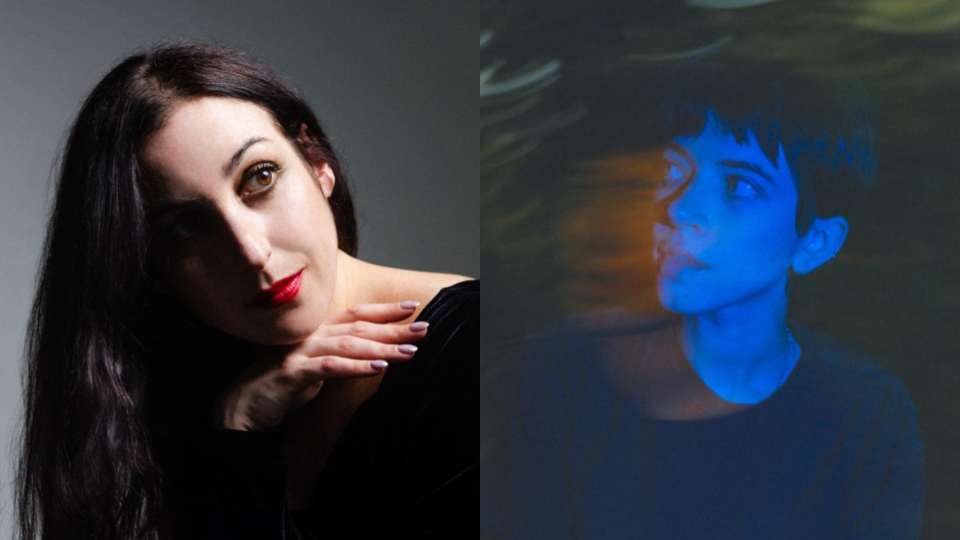
The Oakland-based artist who makes music as Maria BC remembers first encountering Marissa Nadler’s music about a decade ago, when Bury Your Name was released. In a newsletter post announcing their ongoing tour with Marissa Nadler, the Artist Spotlight alum describes being struck by the ghostly, skyward quality of her songs, singling out ‘Weightless Above the Water’, where Nadler sings, “I’m way out of range here but closer to the moon/ They forbade me for trying again and again.” It’s fascinating, then, how the cosmic and forbidden intersect in Maria BC’s creative process, which they liken to being in a spaceship lit by a bunch of candles. Marissa Nadler can relate. She sees Maria BC as a kindred spirit, a younger musician who also has one foot in the avant-garde but shows a love for classic songwriting – more than ever on their fantastic third album Marathon, which comes out on Friday via Sacred Bones, the same label Nadler has been on since they discovered her.
In the latest installment of our In Conversation series, Marissa Nadler and Maria BC talk about their relationship to performance, dreams, self-production, and more.
How are you both feeling with the tour so far? Marissa, I know that for your latest record, New Radiations, part of the intention was for it to be simpler to play live. And Rian, your new album Marathon isn’t out yet, but I’m curious how playing live has affected your relationship to the music.
Marissa Nadler: Just to clarify, I think I did say that in an interview, but it came out wrong. My creative process is definitely not linked to how I’ll present it to the world, but once I realized that the songs were sounding good stripped down, then it occurred to me, this isn’t necessarily such a bad thing. With the previous record [The Path of the Clouds], there’s so much production and musicians and guest stars that it was really difficult to bring those songs to life in a live setting. I was really never able to present the beauty of the layers in a live fashion, so the new record definitely was easier for that purpose. But one thing I find interesting about Rian and myself – Maria is producing their own records right now and always has, and that is something that I started to do later in my career, for the last two. I’m really curious about your production recording process, after we talk about this tour.
Maria BC: Translating things to the live setting is always tricky for me, because I really love having my vocals layered a lot. I think a certain effect of the music is lost if that’s not there. I’ve done trial and error, trying different ways of incorporating that into the live set, especially when I’m playing by myself. As tricky as that sometimes can be, it ultimately feels really good to take on that challenge, especially right now, when this album, Marathon, is about to come out but isn’t out yet. I’m at this place where I’ve heard the songs on the album so many times, especially from having recorded and produced it myself. You can overhear something and it destroys your relationship to it temporarily, but then putting the live set together can reconnect you emotionally to the music and rehabilitate some things. Also, performing the music and hearing it juxtaposed to and in conversation with Marissa’s music is really special, and I think brings out different aspects of the songs.
Marissa, to answer your question, performing my music live is something that came really late for me, and still feels really new to me. I think I was very early in high school when I got GarageBand and started recording at home, and home recording was co-constitutive with writing songs. One enabled the other, and it was, for a long time, this kind of forbidden thing that I would do in the spaces between other things that I had to do or felt like I should be doing or focusing on. The way that I feel when I go into the recording space that I’ve set up for myself, it’s like I’m in my spaceship [laughs], my fantasy world that’s forbidden and only I understand it. I’m in complete control, and it’s like a child play space. But also very dark, and I light a bunch of candles. How has that evolved for you?
MN: I find this tour particularly interesting because they’re such musical kindred spirits, and there’s a generational gap between us. What you were saying about putting our vocals, which are both often very layered on record, in a live setting – that has been a challenge for me as well, coming to terms with what I can and cannot do in a live setting, and accepting that it will be different, that it is not gonna have ten Marissas or all these background vocals. Trying to pick and choose the essence of the songs, and knowing that people, when they see live music, want to hear something a little different. “It’s okay to be raw” has been something that I’ve learned later in life.
You said that performing came later than recording for you – I wish, in some ways, that that was the case for me, because I’m still so shy, and I had such stage fright that some of my early years were really marred by that. The invention of so much of this recording technology that’s come throughout my career has emboldened and enabled me to really improve in a live setting. When I was in early high school, I had a four-track recorder with a tape cassette – it wasn’t that long ago, but you have to remember, the internet is a fairly new invention, so when I was in high school, we had an actual class on what a search engine was. I didn’t have a cell phone until the end of college. When I finally did get GarageBand, I sucked at it. But then the past eight years, I’ve learned Pro Tools, and it has changed my life. What you said – “I’m in my spaceship, I’m in my fantasy world” – it’s very similar for me, and to be able to finally have the tools to record myself and not have other influences marring my creative vision has been great.
I think it’s really cool that, in this day and age, people can grow up and, from a very young age, have access to this really amazing technology to make very high-quality recordings without having to pay a producer to tell you what you should or shouldn’t do, or to tell you to take less reverb off. I think we have a lot in common with that. The interesting thing about being vaguely ambient musicians for both of us is that without the verb, and without the dream zone additions, I think that your music still stands up very strongly, even if you were to play unplugged on the street. That’s, to me, the mark of a great songwriter.
MBC: Thank you!
MN: It was hard for me – I would never, in my early years, even play without eight seconds of verb in my voice. And then as I got older – I did that song with John Cale without any reverb at all, and people really responded to it. It taught me I can play with this, I can shock people a little by pulling the veil away. It’s been really cool to see the different iterations of your project, even on this tour so far. That’s a bunch of questions and answers all at once, but that’s a conversation, right?
MBC: Yeah. Aw, thank you, that makes it feel so good to hear. It does feel a bit like a pulling back of a veil, and it takes a certain leap of faith to trust that what people connect to in the music is the material, and also some other unnameable quality that comes from the body, rather than from the production. There’s such a powerful quality to your voice, and it’s inherently spiritual, even beyond adding reverb. The soul, the timbre of a person’s voice – that can’t be emulated or taken away by certain effects, or faked by effects, either.
MN: I know what you mean. Some of my favorite musicians, even some of my peers that I love to see play live, like Angel Olsen – she’s a friend of mine, but I’ve seen her play in tiny rooms with no verb, and then with her six seconds of verb. To me, it’s the same, because it’s that voice, it’s the songwriting. So, when you said forbidden earlier – I’m really interested in your upbringing, and I wanted to ask you a little bit about that. I know that you’re from Ohio. I know you took voice lessons as a child. I read your Wikipedia.
MBC: Oh no. [laughs]
MN: Because when we just met on this tour for the first time, we haven’t talked about our childhood. Was this music career something that was supported by your family?
MBC: I mean, it was unexpected, the path that I took, but music was always a big part of my life. My dad is a musician, my mom an actress, and I was brought up singing and performing in church a lot. I was raised primarily by my mom, and she really encouraged me to sing, but the songwriting thing was unexpected. And supported, now, for sure.
MN: That’s great.
MBC: I was the only child of a single parent, and I had a lot of time to myself to explore an insular world. I would just sing to myself all the time to sort of keep myself company and explore more deeply my inner world. I think that’s still where the music comes from. Yeah. For you, when you were a child in your home, where was music coming to you? What was your relationship to music like?
MN: My parents were real hippies, so they took us to tons of really great concerts. My first concert was Jethro Tull and Procol Harum. We went to see the Rolling Stones. I went to see Neil Young solo with them when I was in high school. They’re big music fans, and Mom wanted to be a singer in high school in a band, but I’ve never really heard her sing. She claims to have had a really beautiful soprano, but I don’t know, she never sings. But they were real hippies, so they had a great record collection. And then my brother played guitar in a jam band in high school.
I always loved to sing, but I never took any music lessons or any vocal lessons, because I was the artist – I painted, I was the kid in the art room, and a little too shy to be in choir. When I was about 13, I started to play guitar righty, even though I’m a lefty, just because that was what was in the house. I had a Bob Dylan songbook that had every one of his songs, and that’s how I started to play, based on reading songbooks and reading tablature, and started writing songs really quickly after that. I tried to take lessons. As an art educator now, I’ve realized a lot about the learning styles of certain creative people, and why music lessons didn’t work for me. But back then, I was like, “I don’t want to learn ‘Ode to Joy’, I’m already writing these crazy songs.” I was, like, 12.
My brother is an incredible writer, and he is really responsible for my real focus on lyrics in my writing. When I was a kid – I told you this last night – he would take record covers, the vinyl, and I distinctly remember him being like, “What do you see? What kind of world are you in?” And he would help me write short stories. You can get his books in the bookstore now, he’s a renowned novelist, but back then, I was just jealous of how good of a writer he was. I was like, “Man, if only I could write as good as that.” But of course, it’s because he worked on it, and a firm believer that the more you work on something, the better you get. I’m not a believer that people’s first record is their best ever.
MBC: Yeah.
MN: So, with new writing, especially the last two records, I’ve painstakingly interrogated every noun, every verb, every adjective. Stuart gave me advice when I was struggling with some of the meanings behind this sci-fi fantasy record that I made, and he was just like, “Go through every noun.” I really did, and it’s just fun to have that kind of craftsmanship, not just to a painting, but to the lyrics themselves. I have a lot of respect for all elements of the song, whether it’s the length of the verb, or the turn of the phrase, the hook, the bridge.
MBC: This is bringing up so much I want to ask you. Going off the last part, I think that’s so beautiful that you have a prose writer’s influence in your work. I’m also curious how your experience of writing lyrics compares to your experience of writing stories and text, because for me, I feel like they’re such distinctly different mediums. With lyrics, you have to think about where the syllables fit into things and in your voice. How much is the relationship between the words and the melody coming up for you when you’re writing a song?
MN: It is a real push-and-pull. The Path of the Clouds is my most story song record, where there’s a song about D.B. Cooper, there’s a song about the escapees from Alcatraz, there’s a song about Bessie Hyde. I wanted to fit in all those details, so I was really focused on the story. But then, to find the hook or the chorus, it is a push-and-pull where I don’t think that anybody would listen to the Alcatraz song and know that it’s about that. I think I’m probably the only person that knows that, because I like the way “Did you give up the ghost” [on ‘Well Sometimes You Just Can’t Stay] sounded. With this new record, I was more leaning towards the sound of the words. It’s always a happy battle, but most of the time, I’ll pick the musical over the analytical. If I like the way something sounds, even if it doesn’t make sense, I’ll say, “Well, it sounds great, so I’m gonna keep it.” That’s the creative license. I still have so much fun writing songs: that’s when you know you’ve picked the right path.
Marathon‘s your third official record that’s coming out on the 27th, and it’s your 27th year of living. When I made my first record, Ballads of Living and Dying, I was still in art school. I wrote it on a typewriter; I was a real Luddite. I was like, “Technology is gonna ruin the universe,” and I still kind of think that. But I didn’t think anybody was ever gonna hear that record. I thought I was gonna be a painter. I thought, no way in hell is this weird music, with me singing Pablo Neruda songs and sea ditties – there was just a lot of weird stuff on the album, and it just coincided with psychedelic folk having a moment. This was in 2003, 2002 even. When you made your first record, did you know that people were gonna hear it, or did you make it in that spaceship vortex where it was just your private balm? And were you surprised that people did hear it?
MBC: I put out an EP first, and the EP I put out was called Devil’s Rain. When I made that, I self-released it. I think I took three weeks to make it, and it was truly just me working in the forbidden space. It was just for myself, and I really did not think anyone was going to hear it. It got picked up, and I made the first album, Hyaline, thinking, “Some people I don’t know might hear this.” I didn’t think it would get much traction. I’ve been ceaselessly surprised and delighted by people’s interest in what I’ve been trying to do.
You also asked about how it feels now, three albums, and I’ll say, it never stops feeling good to make music, exciting, and also challenging. But new challenges crop up all the time, and having an audience is not not part of that. It’s made me fixate on certain details, maybe, that I wouldn’t otherwise, which is for the best, I think. But at this point, I’ve entered interesting new territory where I used to feel like every time I wrote a song at all, it was a miracle. I know that I can do it now, so I have to kind of create obstacles or something for myself. Cole Pulice, who plays saxophone on the new record, picked up the guitar a couple years ago, and they were telling me that it was so exciting to play around on guitar. They feel like they have so much muscle memory, and even “baggage” with the saxophone, just because it’s an instrument that they know so well, and they’ve written so much on. Having this new physical landscape with the guitar opens up new stuff for them. There’s something like that happening where, now I pick up the guitar, and it feels really familiar, so I have to try new things.
MN: Is that why you’re experimenting with open tunings, for instance?
MBC: Yeah, exactly. That helps so much.
MN: The same thing for me. I get so bored gravitating to the same things with the muscle memory. I’m already over DADFAD, open D minor, which is my favorite tuning. I’m not sure if you know this, but if you go to Joni Mitchell’s official website–
MBC: Yes, I remember you said that!
MN: You can see all the tunings, and they’re so crazy. It’s just hard to get into them live. You need, like, 8 guitars. Or, I don’t know, you seem to get them in pretty quick. But I think open tunings are a really great way to force yourself to find new ways into the song.
MBC: I want to jump into something I’ve been eager to ask you, which is your training and life as a painter. How has your music and your fine art co-evolved, if at all? Have they influenced each other?
MN: When I write lyrics, it’s all setting-based. For instance, in ‘Bessie, Did You Make It?’, my lyrics are really painterly, I think, just because when I look outside, I want to take a picture of everything I see. Painting and drawing was my first love. My mother’s a fine artist, an abstract painter, so my whole childhood was just drawing and painting. My music, as I’ve gotten more ethereal and ambient, some of my newest bleak landscape paintings are just degraded to the point of nothingness, which is funny to me. In high school, I would do these highly rendered, realistic charcoal portraits, and now it’s a wash of nothingness. It cracks me up that if you were to come over to my house, it’s all white and bleak, and there’s not a single bit of color in the entire house. It’s like my Zen monastery.
I’m leading that way musically – I’m not sure what direction my next record’s gonna be, but I know that to have longevity as a musician, you have to shake it up. The Path of the Clouds was a super psychedelic and very Pink Floyd record; unfortunately, it came out during the pandemic, so I wish more people had heard it. There’s still time. But I think this next one’s gonna go in the Harold Budd territory of nothingness – either super ambient or super jazzy. They’re like the same brain, to answer your question. There’s no separation between the two, and that’s very clear in my music videos, the five that I’ve made so far.
MBC: But do you feel like there are ideas or parts of yourself that you can explore in one medium, but not the other? Or do they both feel there’s infinite possibilities?
MN: That cliche, a picture is worth a thousand words, is really true. You can have a photograph that is so iconic that it captures the essence of everything you’ve ever wanted to say. Much like a poem, even a short poem, like an Emily Dickinson poem, can encompass so much. Part of the challenge with songwriting is that it doesn’t have to be a story, it can be just a short amount of words, so it’s like, “How do you take that one picture?” One of my favorite photographers is Francesca Woodman.
MBC: Oh, love her.
MN: I love her so much. We went to the same art school, and she took a lot of those pictures where I went to school. The ghostly quality of her photos – I don’t even know how to describe it. That’s why different art forms still all exist and have their place. Why do people still paint if you can take a photograph? I’m a painting teacher when I’m not on tour, so I talk about that a lot with my students: the challenge to leave realism behind, the challenge to not be tethered to representation. It’s the same thing in music, why avant-garde music – I think you and I both have our foot in the avant-garde worlds, a little bit of crossover, where my first tours were with Sun O))) and Earth and Boris, all these crazy bands. I obviously love classic songwriting, but I also really love weird stuff. I know we haven’t let you talk at all, but this is good, though, right?
It is. This is such a beautiful back-and-forth that I really feel no need to interject. One topic I wanted to mention, in case it doesn’t come up naturally, is dreams. Rian, in our last conversation, you said you love talking to people about their dreams, which seep into both of your latest records, thinking of the songs ‘Bad Dreams Summertime’ and ‘Night & day’. Is that something you’d like to discuss, even when it comes to affecting your day-to-day on tour?
MBC: For my part, with ‘Night & day’, something that’s been coming up for me for the past couple of years is that I haven’t been remembering my dreams, which to me feels like such a loss. I wake up early for my day job and immediately start my day, and I do think it’s true that to remember your dreams, you have to be in a practice of writing them down and sitting with them when you wake up in the morning. And I think it’s been true for all time that artists are really influenced by their dream life. It feels sad to me that I’ve been losing access to that, and the song is touching on that feeling. The lyric is, “And in the light, I try to remember” – the moment of sitting up in the morning and trying to remember the night, which is the divine time. It’s when you’re most in touch with hidden parts of yourself and the world.
But on this tour, I haven’t been popping up quite so early in the morning – now and then, but not every time – so I’ve been doing more of staying still at the moment of waking. And I’ve been finding that I’ve been retaining more of my dreams and feeling more like the feeling or timbre of them has been resonating through the day. That’s one of many things that I’ve really loved about being on the road. What about you, Marissa?
MN: Similarly, I don’t often remember my dreams anymore, which is a shame. Maybe this sounds like a little bit of a cop-out of an answer, but I feel like the waking world feels like a dream so often. I think the longer I live, the more places I go, the weirder the government gets here, everything feels very surreal. Oftentimes I do feel like I’m disassociating and proceeding through life in a dreamlike state. Like that first show we had in Asheville, where I had trouble because I didn’t have my music stand, and that’s my little security blanket. My partner, Milky, was like, “You don’t need this, you wrote these songs.” And I was like, “I do need this right now.” Because I start to wander, and during that show, I vividly felt my soul above my body. I try to stay tethered to the ground most of the time, but seeing the world in that way can be very creatively fun. But I do think that there’s a dreamlike quality to both of our musical worlds because of the love of ambience and atmosphere that can carry over.
MBC: You’ve mentioned feeling like there’s an arc to you over time finding your voice. I’m curious if there was a specific moment when you feel like you settled into that, and also, if you feel comfortable sharing how that feels in your body – where your voice lives.
MN: That’s a great question. Listening back to my work, it’s interesting, the first record sounds kind of like I do now, in a way. It sounds natural. But then the second record and the third record, Saga of Mayflower May and Song 3: Bird On the Water – that’s when other people started to hear me, and I got record reviews, and I started to listen to other people’s influence. Little Hells as well. Like all singers, I’ve got a little bit of affection on those three records. If you listen to somebody like Bob Dylan’s first record, he was obsessed with Woody Guthrie, and I could list a zillion examples of this. On the second record, I had just toured with Josephine Foster, and I was like, “I love her weird voice, and I want to be an opera singer, too.” I was 22 years old. I was so young when I made those that, listening back, the songs are still good, but all I can hear is affectation.
And then I wrote July, and that’s where I think I found my real voice. I’m such a staunch defender of late-career works, because some of my favorite Joni Mitchell records are late-career records. I’ve listened to her my whole life: I can trace the trajectory from her romantic idealism of her early work to this jaded misanthrope, to this drug-addled party girl, to some form of acceptance. It’s so interesting to listen to her grow up through these records, and I can hear that in myself, too. I am old enough, finally, to not cringe looking back on the early work.
In terms of where my voice sits in my body now, I’m singing a lot more from my chest voice. I had all head voice back then, but I’m pushing more from my diaphragm, so I have more power and more control. I can yodel now.
MBC: Oh, sick.
MN: Because there’s two voices, the chest voice and the head voice, and the concept of the yodel is throwing it from one to the other. Not until the second half of my career did I really find my voice, and my last four records, I like them better than my early ones. You have such an incredibly strong start, so it’ll be so interesting to watch your trajectory and where you’re gonna go next musically. I did have one last question for you, because this is your release week, and it’s a big deal. What is the biggest room that you would like to play if, like, this record blows up? Could you see yourself taking this project into a large room, or do you prefer the cozy ones?
MBC: I feel so drawn to intimate spaces. I’m trying a new thing – when I go back home to the West Coast, I’m putting a five-piece band together for my record release shows, and I’ve never done this before, so that might reveal something. I’m really excited for that, but the show I’m playing in San Francisco is at a 100-cap movie theater, a space I really love, and an intimate one. I chose it for that reason, and I don’t really see myself in a big space. [laughs] Another is I like to feel close to the audience.
MN: Me too.
MBC: Also, to feel a little shrouded, maybe. I like – I think we share this – when the lighting is more of a wash, and it’s hard to imagine getting an effect that I desire scaled up. I also think it’s a totally different medium. I haven’t really been to very many arena shows in my life – or I’ve been to one as an adult, and it was a Björk show. And I was just thinking the whole time, this is a completely different universe than thinking about the music.
MN: I do think it’s possible. I saw Neil Young in high school play acoustic with candlelight, with just him, a guitar, and three different pianos and organs. And the audience was pin-drop quiet. I saw Elliot Smith in high school; he has a huge influence on me. I think it’s possible to get that pin-drop quiet, intimate audience on a larger scale, but it’ll be interesting to see, because the concept of playing in front of a large group of people terrifies me. I’ve done a few opening slots for big bands, and it was too much for me.
This interview has been edited and condensed for clarity and length.
Marissa Nadler’s New Radiations is out now. Maria BC’s Marathon is out February 27.

