

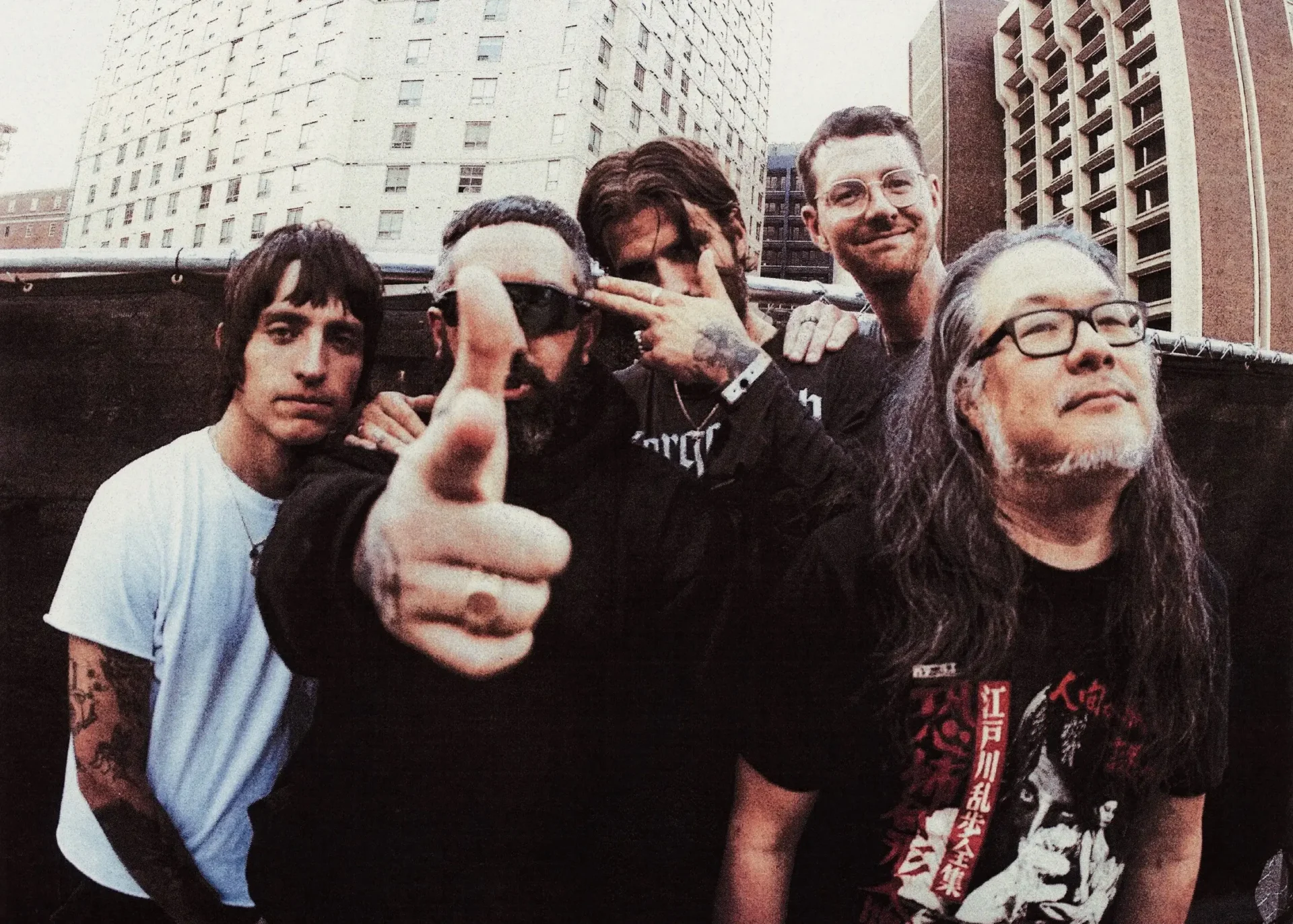
Nothing have been on a two-year album cycle since 2014’s Guilty of Everything, which came out a few years after the band’s inception as a Philly-based bedroom solo project. Frontman Domenic “Nicky” Palermo – joined by the current lineup of guitarist Doyle Martin, bassist Bobb Bruno, drummer Zachary Jones, and third guitarist Cam Smith – calls the time between 2020’s The Great Dismal and their fifth album and Run for Cover debut, a short history of decay, a “five-year layoff,” though I’m not sure releasing an impressive collaborative LP with Full of Hell and launching a definitive shoegaze festival counts as a full-on break. Still, it allowed Palermo the stillness to properly reflect on his pre-Nothing days – growing up with an abusive father, spending two years in prison – and the toll of keeping the band going, both on his body and his relationships from home. Named after a book by Romanian philosopher Emil Cioran, a short history of decay takes a step back to mirror the raw humanity that’s been responsible for the band’s survival, articulating, gently yet vigorously, traumas better shrouded on previous records. “When I was old/ Ain’t life terrible/ With beautiful things getting between,” Palermo sings on the opener. This may be Nothing’s final chapter, but they still traffic in that in-between.
We caught up with Nothing’s Domenic Palermo to talk about nostalgia, Williams H. Gass’ The Tunnel, The North Water, and other inspirations behind their new album, a short history of decay.
Nostalgia
Was rethinking your relationship to home something that was sparked by nostalgia?
In 2017, I moved from Philadelphia to New York, and I’ve been here ever since. That said, I frequent the city very often. I’m there almost once a week. My family’s still there – what’s left of my family. I lost a lot of relationships over the past 15 years, and some of that was due to just moving on in life; it naturally happens. But the fentanyl epidemic in Philadelphia had taken a lot of people that I was close with, friends and family. Where I come from in Philadelphia, I grew up in Kensington and Frankfurt – it’s kind of become polarized at this point, Kensington, Philadelphia, just because of how it looks down there. I was there in the ‘90s, it was a little different, but kind of the same thing: heroin had ravaged the neighborhood around the time where I was growing up there. That’s when it got the nickname the Badlands.
When I started doing the band, I started to ignore a lot it naturally. It was like, “Finally, I have an outlet to not be where I am, and not deal with the same neighborhood problems.” I finally felt like I got out, which is rare for Philly. There’s not a lot of people that were born where I was born that are repping the Philadelphia flag. In the midst of all that trauma and depression and bleakness, I fell back in love with the city and some of the history I had there. I brought myself into this place where I was thinking about things that I’d either reluctantly stuck in my subconscious or just simply had forgotten about. Looking through photographs of some of my family and friends really gave me this open space to speak about things that I don’t know if I was nervous to speak about before, or if I just didn’t feel like it was the right place to do this.
Speaking about my father and our home life is something I’ve really never done before, so that invoked a lot of this general nostalgia for the era where I grew up in the ‘90s in Philadelphia. The neighborhood, the seasons changing, how it felt being out in the street in the summer. I guess that was at that point when I realized maybe this record is the 360 moment, a tie-in for what I’ve done thus far.
The album begins on that note of, “When I was young, life was easy,” which is kind of nostalgia in a capsule. The sense of oneness that you grasp back to in that song, ‘never come never morning’, to me, almost ties back to a time you maybe don’t even have concrete memories of, before the world breaks you.
Yeah, absolutely. That was one of the first songs that I had written, with just an acoustic guitar and lyrics. I had things that I had written down and transformed them to fit into the realm of the song a bit. It was obviously wordier, but that’s the songwriting aspect of it. Having that song sitting around for a couple years and not knowing exactly what I was gonna do with it, and later on being able to throw caution to the wind a little bit more, when I realized that that’s what I was gonna do with this record – it made it a little bit easier. When we started laying all the tracks down, our guitarist, Cam [Smith], was like, “That’s gotta be the first song on the record. It sets the tempo right away for what you’re doing here.” And I was like, “Damn, you’re right.” I would have never thought that that would have been the song, but when I hear it now, it really makes perfect sense for me.
Time
The extra time and not being on that two-and-a-half-year cycle really did something different to my train of thought. The looking inward and this self-realization of how my body’s functioning physically and mentally, it all just became abundantly clear through the actions that I took the past 12 years or so, what the toll was. I just started to notice things, and that was my way of dealing with it. When we first started, the first three years really, no one really cared what we were doing. They were kind of annoyed by us, I think, in a lot of ways. We didn’t really have this identity; we didn’t really fit in anywhere. It was immediately a struggle that I didn’t expect because it went from recording these demos that I didn’t have any plans to do anything with to people telling me, “Yo, you should put this out, this is good.”
When we finally recorded Guilty of Everything, all of a sudden we had this thing building, and people wanted to see it, and it didn’t matter what our identity was. It was like, “Here’s someone who’s seemingly being honest enough,” and the music was a good fit for it. It spun us into this whirlwind, and I didn’t really know how to deal with it, so I just reacted off the energy that I had. We never had management or anything to keep me in line, so we were just a crazy train, no direction, and I didn’t take good care of myself. I get to the standpoint now where everything just immediately hits the emergency brake. We just halt fast, and just like you would if you were in a car hitting a wall, everything moves to the front, including yourself. So here I am, dealing with all this stuff, and I wouldn’t say I understood anything better, but things just started to seep out of me a little bit easier, and from a different perspective.
When, or how, did your perspective shift and things started pouring out?
I mean, it felt survival-ish, just like it always did. The prison sentence was something that was in front of me, and I for sure was not prepared for it, but I knew that it was something that I had to do. I got through it, and when I got through it, I just put it behind me, just like a lot of these things, and went 100 miles an hour to try to get away from it. But you’re not getting away from it, it’s there. It’s right behind you, no matter how fast you go. Same thing with family and overall trauma. I’ve never harped on it too much, what I’ve been through, because people have been through way worse, so nobody wants to hear what my problems are. I could write about it in a smooth way and touch on it, but I never really dealt with it.
I’m not saying that I truly have yet, but I do feel like I have a better understanding of it now, just purely from having to deal with myself more. And realizing some of this is abnormal, you know? Spending a couple years in prison isn’t normal. It’s definitely had its effects, and I deserve to at least look at it and deal with it and not just try to move on from it. In this record, it’s very much like, “Look at yourself in the mirror and tell yourself that you’ve done things that people haven’t, and that’s okay.”
Tell me about the decision to end the album with ‘essential tremors’. Was that something that was locked in as soon as you wrote it, or did you waver on it?
When I wrote it, I kind of thought this is a great ender just because of the content that I’m speaking of in it. But when we tracked it, it was a no-brainer for me. That song is very much about seeing the end in everything. It always feels like it’s too late, but since I’ve been a kid, I’ve always had this issue with not really enjoying the things I might have that are beneficial to me, that I’m lucky to have. Always dwelling on the fact of when they’d leave, which I’m sure is some deep-rooted psychological thing, probably to do with family. But that’s just always how it’s been, watching myself and my body going into this deterioration state. And my current home life, finally feeling a little bit content with how I feel, but not truly being able to let go of the fact that this is only temporary, just like everything is.
Agoraphobia and the current state of the world
I feel like the physical exhaustion that you were talking about with the previous inspiration is contrasted on the record with this pure sense of anxiety on songs like ‘cannibal world’ and ‘toothless coal’. That tension between restlessness and weariness is something that fascinates me about the record.
Absolutely. Those two songs, literally right on the nose, are very much about what we’re talking about right now. That restlessness and that anxiety, it’s all evident in what I’m feeling, but I’m doing it within this isolation. I’m dealing with everything we touched on before, and I’m just looking out the window and watching the world seemingly fall apart around me, and it’s just surreal. I don’t need to get into everything that’s going on, it’s all clearly evident, especially here in the States right now, with the ICE stuff, this secret army in the streets, social media, which I have been bestowed the job of being attached to. Watching land grabs from the US and Israel and China, war AI, Epstein – you name it, it’s this constant influx of this maniacal side of the world that has kind of been hidden from everybody.
We have social media now that puts us in everyone’s living room, watching how the world is dealing with it, and seeing how stupid the average person is. With all this time, it’s in my face every day, and while I’m on my own journey in this apartment, not leaving the house very often, it just feels hyper-realistic. I’m sure every generation thinks that they’re gonna be the last; I don’t know that this is the last, but it just feels like we’re moving in such an insane way that it’s really just a show of what this human race is capable of. ‘cannibal world’ was really the highlight of where I wanted to put myself in, that state of doom scrolling and utter chaos.
When you’re on social media, does your mind go, “I need to write about this,” or is it when it’s least in your face that the material seeps out?
I think it injects itself into you, and it’s there subconsciously all the time. Just like everything else, you’re absorbing it, it doesn’t go away. When I was putting that song together, me and my partner were driving around in New Jersey, trying to see all those UFOs that were in Jersey for a while. I do believe in UAPs, but I obviously look to the logic first, like, “Okay, this is governmental.” But driving around in Jersey watching these big things flying over army bases, it was just another realization: What is going on lately? I don’t know if it’s just me getting older and seeing things differently, or maybe focusing too much on what I’m seeing, or maybe it’s just because I had too much time on my hands. But it all does something to me that’s kind of new.
The TV series The North Water
I don’t know if you watched it when it came out, but I saw that it was in 2021, which would have been after The Great Dismal.
I didn’t watch it until maybe 2023, maybe? I had never even heard of its existence. It was an AMC show, and it just went under the radar for me. I don’t know why, because I love Colin Farrell. I watched the trailer, and I was like, “This feels like Journey to the End of the Night or something.” Turned it on, and within the first 15 seconds, there’s a Schopenhauer quote, which, at the time, Schopenhauer was a super big inspiration for The Great Dismal. They open up with this quote that says, “For the world is Hell, and men are on the one hand the tormented souls and on the other the devils in it.” I was like, “Holy shit.”
That show was crazy. There’s actually a book, too, which I haven’t got around to, I heard it’s even better. But it really scratches that itch of what I always loved in novels: obviously struggle, conflict, tension, and the fact that these things can be temporarily relieved in life, but they usually come back. And when they come back, it’s sometimes stronger, or usually is. It’s dealing with the human condition of endless craving. It’s basically about a surgeon who is trying to escape a traumatic past, and he goes on this whaling expedition with these complete savages, essentially. There’s this balance of civilization and savagery through this whole thing. Here you are on this boat filled with these godless sailors and whalers, and they’re out in the middle of the ocean, where humans probably shouldn’t really be in the first place anyway, and they’re just slaughtering whales in the most horrific ways. It’s the perfect base of a story to pull a philosophical thread out. I was all in on it.
Bill Fox’s 2025 album Resonance
This was the cult singer-songwriter’s first album in 13 years, and it flew under the radar a little bit. It’s the only musical item on the list, so I’m curious what made you include it.
I mean, purely the fact that I just beat it to death. My good friend Tony Molina, he’s one of the most talented people I’ve ever met. He’s a fucking weirdo. He’s very similar to Bill Fox and the way that he’s released music over the past 40 years. I never was super into the Mice – there’s a couple tracks that I thought were good, but I didn’t really know about Bill Fox’s solo career, and my friend Tony Molina put me onto the record. Tony sends me a lot of stuff, he’s always in the crates. He’s like, “I think about you when I hear this record. It just reminds me of you.” And when I heard it, I was like, “What the fuck? What do you think of me?”
But after reading about Bill Fox and learning a little bit more about him, I was like, “Man, this fucking dude reminds me of you, actually.” I just beat that record to death. That song, ‘Meat Factory’, is so perfect to me. The way he encapsulates this run-of-the-mill hamster wheel of a life, in this, I assume, small town, where everyone’s working in the same factory, trying to get through the day, being around dismembered corpses and puddled floors of blood. It really did something to me. What I really love about it is the imperfections that are left in the recordings that he does. There’s this weird spin-out delay thing. On some of our records, I worked with certain producers and even certain members that we had in the past that were like, “The G string’s out of tune,” or, “I cleaned that up in post.” I feel like it really lends a hand to the recording, again, being more honest.
Was a short history of decay done when you were listening to this record? Or were you knee-deep into the process of mixing?
We were just getting to the studio, I think, but it was along with me for the ride. We mixed this record for three months. It was painstaking. I write consistently; I’ve never written anything as long as I did for the notes for these mixes, because we just really analyzed everything. It was kind of punishing, honestly. I wasn’t sure if I was ever going to be able to listen to this record again because of how much I punished myself by mixing it, and Nick – I still feel bad for Nick. But I had full control of it this time, and it was good to be able to use this as an inspiration to be like, “That snare feels a little bit off the grid a little bit, but I just like the way it sounds.”
Even my vocals – I mentioned the essential tremors thing that I’ve been dealing with. Hearing that shake in my voice – the first thing to think is: Do we tune that to straighten it out and reverb it up? I was like, “No, let’s do some dry vocals on this thing.” I don’t love my voice, and a lot of the time, it gets smoothed out in past records with reverb. But I wanted it to be heard the way it is. A lot of that had to do with this record, I think, too.
It’s interesting, learning how to square the appreciation for imperfections with this analytical mind that you maybe apply more to your own music.
The way we chose to do this record with me and Nick Bassett and Sonny DiPerry, we eliminated the big producer vibe, which meant that a lot of the responsibilities were gonna fall directly on us. In that analytical sense, it’s very easy to just fall into your repetition of how to get things done the way that you think that they’re supposed to be done. And that easily could have happened, especially when it’s on your shoulders – you don’t want to make any mistakes, so you want to go back to your game plan. But hearing this record invoked this bit of freedom, in a sense, to throw caution to the wind a little bit. That’s a fine line, for sure, but letting the record breathe a little bit more naturally in places was something that I had to force into existence myself, and then deal with the repercussions later.
Williams H. Gass’ 1995 novel The Tunnel
It’s not often that I pick up a book that is not fucking 100 years old for some reason. I’m obsessed with a lot of the old philosophy and poetry that’s usually from the ‘60s, ‘70s. It was a strange book to grab, but a friend recommended it, and I couldn’t put it down. The character in this book is a professor, and he’s writing about World War II and Nazi Germany and Hitler, and this book that he’s writing turns into more of a biography on his life. As he’s writing, it becomes more and more increasingly clear that his life is built around things not to be super proud or happy about, to the point where it’s so devastating for him to read himself. It’s about his wife and his home life, and he hides it because he doesn’t want his wife to see what he’s writing about. It very much just came really close to home here about me feeling inadequate or ashamed of what I’m writing about along this process.
He basically built a tunnel where he can hide his work in the house. It felt eerily similar to what the process is writing here. My partner I’ve been with for quite some time, I hear her occasionally, embarrassingly, singing one of our songs across the house, and I’m just like, “You gotta stop doing that. Please, don’t do that.” But also, hearing her singing these songs – a lot of this stuff was about her. It’s really about me and life, but it’s another sense where I’m like, “Man, I don’t even think that she knows what I’m writing about here.” And it’s not always great things. Obviously, he’s writing about Hitler, too, which is a little different.
But pertinent, in a way.
Yeah. It’s funny when you are on the path to do something, and you realize that usually it winds up revolving more around you anyway. But that book opens with a really good quote, too: “Anaxagoras said to a man who was grieving because he lay dying in a foreign land, ‘The descent to hell is the same from every place.’” Again, when I saw that, I was like, “Oh god, what am I getting myself into here?” Once again, it wound up feeling like I was staring at myself in the mirror. I think it gave me a little bit more strength to stay on the path that I was on when we were making this record.
Not to get too heady with it, but you used the word embarrassing, and shame, and I think there’s a world of regret in this album. I wonder if you’ve thought about the line between those things – not necessarily the words themselves, but the weight they may carry for you in the context of this record.
I’d be a liar if I say I didn’t. But I try to move forward knowing that this is what I’m supposed to be doing. Life is about struggle and strife, and in traversing that, we’re supposed to make bad decisions. We’re supposed to regret, we’re supposed to feel ashamed, and there’s brief moments of happiness mixed into that. I just didn’t want to hide in that, and I wanted to actually bask in it a little bit. This is how I tie everything up: to learn to be comfortable with the fact that life is literally about being shamed, to an extent. And that’s how you get to move on to the next step, for whatever that may be, if there is a reason for any of it. But this is the first time in a while where I feel more at home with myself than I have been in a long time. For the longest time, Nothing has always preached this philosophy of walking through the fire, enamored with the absurdity of everything. But I think this record is past that point – it’s not just about being able to walk through the fire, it’s about being able to live with whatever burns were collected along the way.
This interview has been edited and condensed for clarity and length.
Nothing’s a short history of decay is out February 27 via Run for Cover.

