

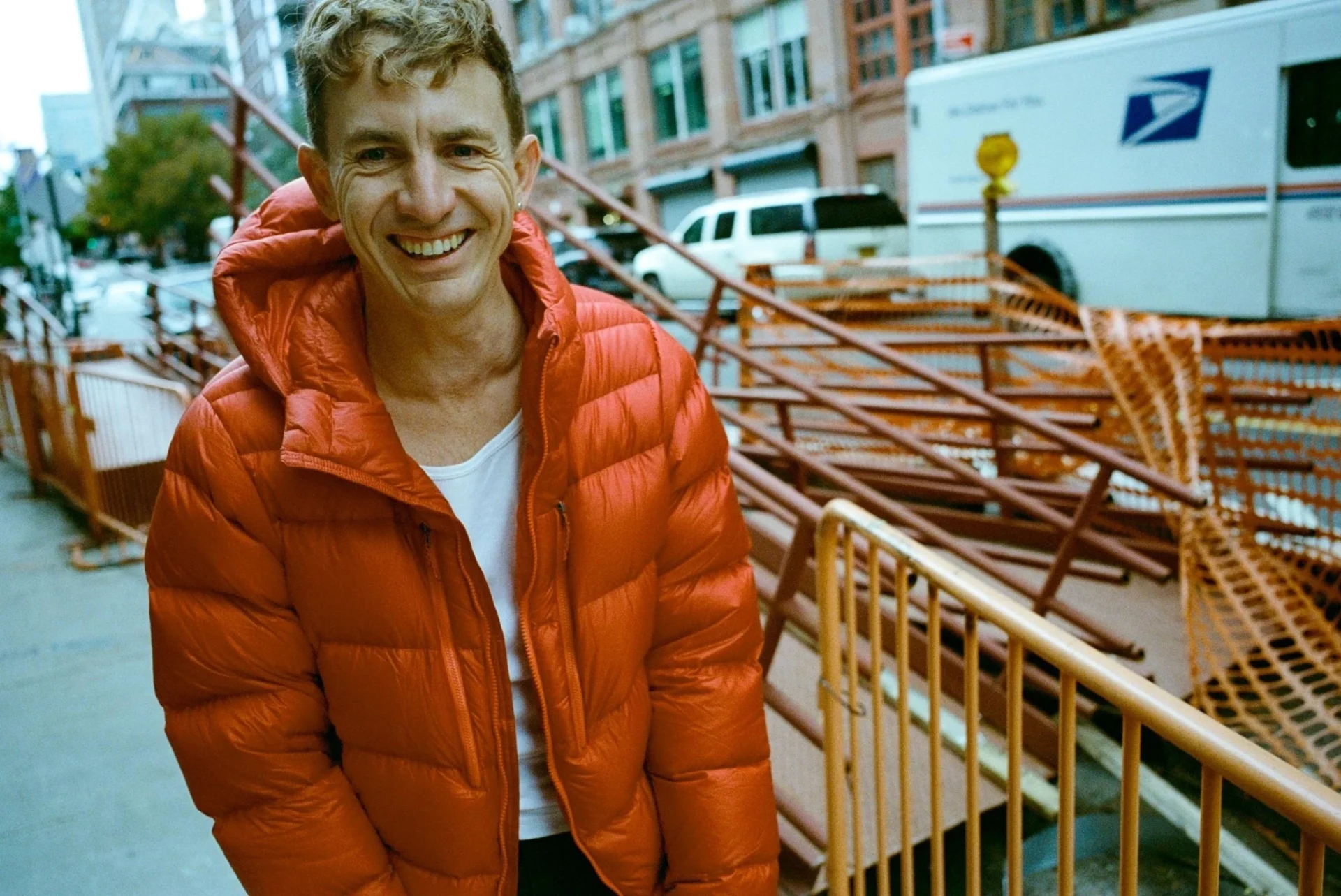
The camera catches Buck Meek hanging onto a fence, illuminating the boundary between him and total darkness, which even his black suit seems to be blending into. On the cover of his new album The Mirror, the Big Thief guitarist is glancing back as if meeting his reflection in the lens, his shoulder obscuring his expression just enough: it’s not clear whether he’s startled, running away from something, or trying to break on through. Perhaps he’s heading to the “the tunnel underneath the road” that he finds on ‘Demon’, “a place I go to sing with echo, echo, echo” – a natural magic further filtered by the voices that tune into it throughout the record, a choir that includes Adrianne Lenker, Germaine Dunes, Staci Foster, and Jolie Holland, and bordering the electronic world fashioned by his Big Thief bandmate and producer James Krivchenia. But just like he sings of trying to write a song that is not for others on ‘Heart in the Mirror’, he’s aware of the dark side of his soul being exposed while learning to foster something good and even divine out of it rather than projecting it outward. “My demon is my darkness, and my darkness is my angel,” he professes, “I taught him how to read, now I’m teaching him to write.” The Mirror bears the fruit.
We caught up with Buck Meek to talk about kissing, fast cars, natural disasters, and other inspirations behind his new album, The Mirror.
Death
This sounds like a heavy place to start, but I think it’s worth noting that the first time you allude to it on The Mirror, it’s in this joyfully spiritual way on ‘Gasoline’. It does take different forms later on the record, but that lightheartedness feels intentional as a starting place.
That resonates for sure. I’m just starting to experience real death in my life, with people that are close to me. My grandmother passed away a couple of years ago. The first song I wrote for the album was ‘Outta Body’, which was processing the grief of her passing away. She was a really brilliant woman. She was a professor, and I had a lot of conversations with her about books, and also about my songs. She had read, like, every book in the world. I was really missing conversations with her, and I wrote that song as this fantasy world that I’d built around being able to communicate with her after death. The thing I love about songs is you can create a world that defies physical reality, and you can live inside of that world – and almost believe it, for a moment, especially while you’re writing it. Hopefully that translates to the listener, but to me, the most valuable thing is just living in that space as I write the song. I almost believed it: I was talking with her, and she was winking at me through the screen, through Ingrid Bergman.
I think that set me off in a direction with this album, creating my own relationship with death a little bit. The whole industrial complex of religion is, to some degree, built around this idea of security in the afterlife. It’s one of the only things that we really don’t know and understand, so in a way, it’s this idea of magic that ties it all together, too. The ways that we all deal with that is really beautiful. I’m just trying to deal with it my own way throughout the record.
For you, do songs come out of that relationship that don’t immediately live in a fantastical realm? Do you feel the urge to write from a raw, non-magical place before twisting it in that direction?
I love songs that do both. Often those are my favorite songs to sing, the ones that start from a place of brutal honesty or confession, or do something that’s really simple but objectively true. In the writing process, whenever I feel myself limited by that, I allow myself to bend reality. That can be really exciting, and it often loops back to truth. Truth isn’t limited to objective truth, necessarily – emotional truth can be much more abstract than reality. But I think the combination is my fav.
Poison
I think that speaks to the latest single, ‘Can I Mend It?’, and the track that precedes it on the record, ‘Pretty Flowers’, which starts from a raw emotional place where the poison is a kind of meanness or anger, and then you bend reality to look at it through the lens of metaphor.
It’s so easy to forget that line between life and death and become numb to it, until you have a near-death experience or a death in your family – whatever reminder snaps you back into the awareness that the line is so thin. Our survival is so precious, and everything we’ve built in society is just there to attempt to protect us from death. Being aware of it makes me feel more alive, and in the songwriting process, that feels inspiring. It helps me prioritize what really matters in a song, weirdly. I like to approach a song as fighting for your life a little bit. Every word counts to the point of survival, at least in this abstract creative space.
My dog Ringo, she’s a little husky dog. We were in the mountains where we were living, and she had found this rattlesnake head. We found her crying like crazy; she was whelping, and there was this rattlesnake head that had been severed, with its huge fangs, this rattlesnake blood. We grabbed her and put her in the car, but she had grabbed this rattlesnake, because she was so obsessed with it, but also so disturbed by it. She’d brought the rattlesnake into the car, and the rattlesnake went under the car chair. She couldn’t get to it, and she started going crazy. She was making sounds I’d never heard before; it was really scary. I thought she had been bitten by this rattlesnake, or it was dead and she bit it but the poison was still active. I’d looked it up on my phone, and it said if a dog bites a dead rattlesnake – if it hasn’t been dead for long, the poison’s still active.
It turned out she was fine. The rattlesnake poison had completely dried up. Nonetheless, little moments like these wake me up to what really matters. And also the absurdity [laughs] of this idea that we’re secure – that feeds back into the process and the songs.
In the mountains up there, the spring has so many wild flowers, and there’s this one called the Datura. It looks like a beautiful white wedding gown. It’s super poisonous if your dog eats it. Where I was writing, there was a big Datura in the yard I was looking at, and that’s when I wrote the line for ‘Pretty Flowers’. But I did change the name of it to Jimson, which is another poisonous flower, because it worked better in the melodic rhythm. I guess that’s an example of starting with – Ringo didn’t actually eat the poison flower; she ate a rattlesnake. But there was a poison flower in my yard, which was a Datura, but I changed it to Jimson.
I did want to lean into that line about poison, because I feel like it also reflects the demons that you confront through the record. Over the years, have you found yourself more or less cautious of things like madness, darkness, and spite seeping into your songs? Is it sometimes necessary to lock them out?
I think locking them out creates a stigma, and then they grow and rear their head in other ways. For me, songs are a good way to practice letting them out, and it’s a very forgiving environment because it’s just my own head. But it’s also an externalization of whatever demons it allows me to look at and let them go. I think as a younger songwriter, I would avoid it for whatever reasons. With this record especially, I really tried to let it fly.
“Teaching him to write,” which is a really lovely way that you put it on ‘Demon’.
Thank you. Just trying to get to the bottom of it, because usually beneath those fears, there’s something very sweet or vulnerable. Vocalizing or expressing it often will get beneath to the root of those fears.
Do you feel like there’s a risk of romanticizing the darkness as a muse?
Definitely. It’s a huge problem in the world. I don’t mean to romanticize it, just trying to find the middle ground with it – to not romanticize it, but also to not suppress it, which creates other problems. Giving it a voice and listening to it, but not following it into the darkness, necessarily.
Kissing
There’s the obvious fact that your new band opening your solo tour is called Kisser, although kissing is also a motif throughout The Mirror, from ‘Gasoline’ to ‘Heart in the Mirror’ to ‘Outta Body’. Looking at those songs, it’s almost like the thread is that the kissing becomes increasiblysurreal.
I didn’t really think of that. What lines are you referring to with it becoming more abstract? That’s cool.
There’s kissing a person, and then inanimate objects, and finally that line you alluded to: “Ingrid Bergman kissing on the silver screen/ Am I crazy or did shе just wink at me?”
Oh, yeah. Kissing is the best. We all love kissing. It’s such an important form of communication without words. I realized as I was writing that there’s a lot of themes of communication in these songs. There are a lot of love songs on the album, but they also trace different phases of relationships, different types of relationships, romantic and familial and friendships. Communication is such an essential part of a relationship, and words are such powerful tools, but there are limitations to them. When we’re in love or we feel really close to someone, there’s a lot more communication happening beyond our words. And kissing is such a funny one because it looks like we’re talking, in a way, just very close to the point where we can’t even talk. It’s such a hilarious, unanimous example of how, when words fail us, we can kiss each other. [laughs]
In regards to what you said before, it showing up in different ways on the album, both literally kissing my wife and also kissing fruit, that sense of longing to the point where you can’t contain yourself any longer, to kiss something – ‘Kiss the Mirror’, which is another song that isn’t on this record. I used to kiss my mirror as a kid, we probably all did, whether we’re willing to admit it or not. With every song, I tried to push into the things I was afraid to say, the things that were scary or vulnerable to say. A lot of those lines are examples of that – it’s a little scary to say, “I’m gonna kiss fruit bread, and kiss bread, and kiss the carpet.” In a song, it feels kinda dumb. But also, as soon as I said it, it felt really empowering. And then that reenergizes the whole process.
Do you feel like part of tackling that fear has to do with reconnecting with your child self? Is that something that came up for you?
Yeah, definitely. Which is kind of the inverse of some of those fears and demons I’m talking about on these songs. Trying to relinquish the programming of self-consciousness that’s forced upon us as adults. Especially as a songwriter and musician, which is this competitive environment, like a sport to some degree, even with the press. Even within the music community itself, there is this form of competition and judgment that really has nothing to do with music at all. And that creates stigma and fears, and to counterbalance that, connecting with the child is an intuitive, instinctual process. It’s kind of the antidote for that.
Fast cars
The cabin where we were living when I was writing these songs and recording them is in the mountains, surrounded by all these twisty roads everywhere. But a lot of the mountain range is also alongside the San Fernando Valley of Los Angeles – you’ve probably heard the term “valley girl.” It’s basically this endless suburb of immigrant communities and mechanic shops for every possible type of car you can imagine – every hot rod, every subtle variety of specialty car shop. There’s this incredible culture of valley teenagers with these crazy hot rod race cars in the suburbs. On the weekends – and late at night, at three in the morning – they take the race cars up into the mountains and they race and drive around. There’s all these beautiful vistas up there that look out over the city, and they park their cars and make out, to bring it back to kissing. Often, as you’re going home, you’ll come around the corner and your headlights will flash on this beautiful Camaro with two teenagers making out on the side of it. Every single day, you’re seeing these scenes of American romance, just like the movies. But it’s real – it’s just these 19-year-old kids trying to find a sense of freedom, literally rising above the city. And you hear it constantly, too. These cars are really loud. It’s a weird juxtaposition: this peaceful place with birds and stuff, and then race cars all the time.
I just find that kind of thing inspiring, and it has nothing to do with the songs directly, but I put it in this list because the songs themselves and the album and the recording – all of these constructs we build around our ideas are just little analogues for our lives as a whole. Of course, I could determine specific inspirations for songs and life experience that is being reflected in the songs literally, but really, what it all is is just a filter for my life, the day-to-day. Even the players that are on the album are just a small part of a much bigger community of musicians around the world that have influenced me over the years, that I’ve played directly and indirectly. It’s all being fed into the music. We have a decisive moment where we choose a word, a melody, a chord, a player, a band, a microphone, a level in the mix, a song title, an album title, but these are all just little symbols in a construct we’re building around something that’s so much bigger and impossible to capture. The kids in their cars were just part of that fabric, I guess.
The way you talked about the noise piercing through the quiet of the landscape also made me think of the experimentation on the album and how it counteracts its organic elements.
I love that. I love the balance of extremes in general, and we definitely put a lot of intention into creating this balance of organic recording of a rock and roll band in a room playing instruments, with this parallel world of electronic instruments that was more ambient and less defined; more of a texture, an unpredictable synthetic world that was running parallel to the band – and also, to a huge extent, being triggered by the band. James Krivchenia was using the band as sources for his modular synthesizers and his programs. We weren’t even hearing it happening, so we were just playing our songs, and unbeknownst to us, there’s all this electronic music being created in parallel.
Natural disasters
They say the four seasons in California are floods, earthquakes, fires, and landslides. The Santa Ana winds come every year, which are these super fast, 100mph winds, and if a single match goes down, the whole mountain range goes on fire. That strips away all the root systems, so as soon as it rains, there’s all these floods in the spring. There’s no roots to hold the mud, so there’s mudslides everywhere. There was a big mudslide a couple of years ago, right around the time my grandmother passed away. There’s only three roads that go into the canyon, and all three of them had mudslides, so the whole canyon was shut down. We were all trapped in there. Suddenly, it was the most peaceful day I’d ever seen in the canyon. There were no cars, and there were these huge mudslides everywhere. School was cancelled, and all these little kids were playing in the mud, sliding around their butts in the mud. It was super fun. It slowed everybody down, I guess.
The fires were happening as we were recording the album. Just over the hill, there was this giant fire in Malibu. And shortly after this album, Topanga burned in the Palisades burns. That fire came just a hundred yards to the house where we recorded. It’s terrible when these disasters happen, of course; it uproots families and destroys homes. But at the same time, I definitely saw it bring a community together in a way I’d never seen before. There was literally a gang of surfers that banded together to help the firefighters put out spotfires. The relief that comes after from people coming together is really beautiful.
It’s also a healthy reminder that we’re not meant to live there in the first place. These mountains are young and pretty chaotic; the people that lived here before us, the Chumash people, were nomadic, so they could move around the fires, pick up camp and scoot up there, get out of the way. But building these permanent structures makes no sense. It’s just a matter of time they’re gonna go down. All of these things are inspirations to me when writing, again, just to remind me of the thin line, this idea of security and stability, and the truth of how fragile it all really is.
Boundaries
If there’s a line that sums up the whole album, it’s “The line between us all is thin.”
This is a big one. The wide concept of boundaries was something I was thinking about a lot while writing the album, and also in my life, regardless of songwriting. The inherent boundary of our body and our own consciousness being isolated, and all of the ways in which we try to reach out beyond that boundary to communicate with others. That line is very static in one way – we have a body – but also it’s really fluid in other ways. There’s a lot of relativity there. Even with sound, for instance, we can produce sound which leaves the boundary and suddenly is reflecting off of all the surfaces in the space and literally combining with other sounds. That’s just one example of how these boundaries are being bent constantly.
The mirror is this strange aspect of that, too. It’s a physical boundary, an extremely reflective dense surface, but it also reflects us back to ourselves. There’s objectivity there, but there’s also so much relativity, because there’s perception, and our perception is so biased. All of the ways we’re seeing ourselves through filters of whatever we’ve been taught to see ourselves. There’s so many contradictions in the idea of a mirror. Also, the mirror of a relationship, having yourself reflected back to you through their perception. Their ability to see you in ways you can’t see yourself, just like a mirror, and how that can be really challenging – but also, we’re somehow incentivized to look into that mirror. Maybe love is in some way a reward system for that, this form of incentive to continue to look at yourself in the mirror through another. Maybe because otherwise we’ll die, or we’ll completely lose touch with ourselves and any kind of objective reality.
In regards to my own relationship with boundaries, I think socially, as a younger person, I would often compromise my own boundaries to please others a lot. In the moment, I would see that as a way to make other people happy. I was pleasing others because I didn’t want to inconvenience them or hurt them, but in the long run, it’s actually more damaging. To not be fully honest with my own truth in the long run is not serving anyone. That’s been a big lesson for me over the years, to try to set healthy boundaries for myself and show up for my relationships with total honesty about my own truth. That’s a lifelong process, but I was thinking about that, and songs like ‘God Knows Why’ are a more direct exploration of that.
How do you experience the tension between how you’re perceived and how you see yourself when it comes to releasing music?
It’s something that you’re hyperaware of as someone who’s going on stage and sings songs. The whole nature of that medium is being perceived. You’re putting artifacts into the world that, as soon as you release them into the world, are suddenly beyond your control. They’re in the minds of others. It’s like your kids are sneaking out at night, getting up to things you have no idea about. That’s scary at first, but I think that’s also one of the things I love about making music. It’s definitely been a process to really embody my own confidence and decisiveness in creating something for myself. As I say in the song ‘Heart in the Mirror’, writing a song for me, really for me, which is a question I have to ask myself with every word of a song: Am I writing this for me or am I writing this for others? Am I writing this for the critics, for my friends? Am I writing this out of fear for others, or am I writing it for myself?
Not that there’s a hard rule – sometimes I write a song for others, but at least I want to be aware of it. Maybe I’m getting better at that. The truth is that if I’m writing something really for myself, that comes from a real confidence, then I really don’t care at all what other people think about it. I have no problem. Everybody is going to feel differently about it, and as long as I feel clear about it, that’s enough. That’s one of my primary filters, at this point, for when a song is done.
Outside of music, is the difference between mere perception and being seen something that’s become tangible to you?
Our lives are defined by that to a huge degree. Every time we leave the house, it’s this balance of being seen and your own self-perception. As I get older, I think I’m learning to really embody my own truth and offer that to the world, even just socially, when I go to the grocery store or whatever. Accepting the discrepancies – trying to accept myself for who I really am, because actually just being that is more generous. It gives people the ability to respond to who I really am instead of this whole ruse.
One more question on boundaries: Is there a point where, maybe you know who’s singing or playing a part in the recording, but that boundary between the sound and its origin sort of dissipates?
Yes. Part of the magic of making music is that those boundaries disappear through sound. You’re literally combining people’s voices and instruments, and then it’s this alchemical process that adds up to something greater than the sum of its parts. It becomes something completely new. I think our survival instinct has tuned our ears to have hyperawareness of frequency – it provides this environment to really hear how the overtones of everyone’s voices and instruments, the way they’re manipulated in a mix, is creating new resonances and EQ curves, all kinds of sympathetic frequencies that weren’t there before. I love how the human ear has developed to the point to actually perceive all of that, to a huge degree at least.
Do you mind sharing one memory of this kind of alchemical reaction happening on the new record?
Totally. Let me think. [pauses] Whenever we recorded background vocals with Adrianne Lenker and Germaine Dunes and Staci Foster – they recorded on a bunch of songs, but I think it was on the song ‘Gasoline’ that they each take a verse. In the room, of course, when they were recording, I could hear all their voices independently, and they sound like themselves. But then somehow, because they were blending with each other and blending with me, finding this little pocket within my voice, it’s often hard for me to determine which is which when I listen back. I can’t tell if it’s Adrianne or Germaine or Staci; all of their voices kind of became one. Maybe because even though they were taking turns singing, it was this moment of unity where they were all singing with me and so tuned into my voice that they were kind of adapting their own vocal cords to that.
It almost sounds like one person sang the part, which often happens – some of my best friends are identical twins: Adam and David Moss, they have a band called the Brother Brothers where they sing in harmony. It’s crazy because their voices are almost identical. Of course, they do have their own character, but especially when they sing, it’s impossible to tell the difference. It sounds like one person singing with two voices. I think there’s a lot of examples of that on the record.
Durak (Fool) card game
This is just a game that we played every night, almost, at the session while we were recording. It was a way to blow off steam at the end of working really hard all day long. Durak is a Russian game where there’s only one loser per round, and that loser is the fool. It’s a game of attack and defense that goes in a circle. The object of the game is to basically get rid of all your cards and the last person with any cards on the table is the fool. There’s a lot of disadvantages for the fool, like they get attacked first. The only right they have is that they’re the ones to decide if you play another round. If you lose the game, it’s your choice if you keep playing another round and have the chance to relinquish your title, because the rounds move pretty quickly.
You end up playing really late into the night, because nobody wants to go to bed as the Durak. You could be the Durak for years until you play another game, so you end up playing till four in the morning. It was just a way to create some adrenaline in the evening. I feel like games like that are analogues for war, to some degree, for all the little dynamics of human nature playing out: strategy, cunningness, building spontaneous allegiances to team up against other people. It’s a very safe space where you can practice all these survival instincts. Bringing it back to that idea of survival and the line between life and death, in the very safe space of a card game, is always an inspiration.
Did it mess with your sleep schedule at all?
It was a bit self-regulating. Because we had two weeks booked straight, everyone was somewhat aware of needing to get some sleep, so even the Durak would call it for the night, knowing that they could relinquish their title the next day. But the last night, when we were done with the record, we played until really late into the night.
This interview has been edited and condensed for clarity and length.
Buck Meek’s The Mirror is out now via 4AD.

