

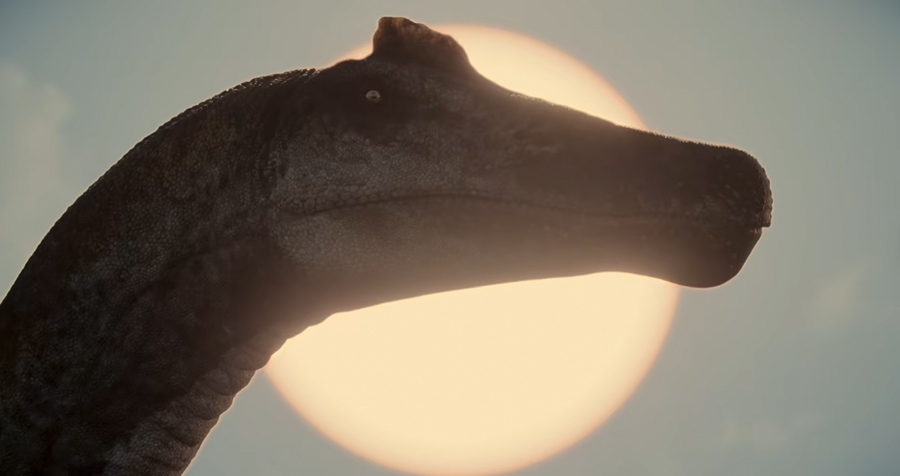
As someone who grew up enthused with dinosaurs in the 1990s and early aughts, nature documentaries about prehistoric life were an integral part of my childhood. I couldn’t even guess how many times my younger self watched BBC’s justly famous Walking With Dinosaurs (1999) or Pierre de Lespinois’s When Dinosaurs Roamed America (2001), both of which enchanted me with their insertion of computer-generated (and sometimes handcrafted) beasts into real-world locations, making it seem as though camera crews had traversed to ancient times. Intervening years saw me drifting from the genre, for a number of reasons: shifting interests, shows hampered by vexatious voiceover (e.g., Dinosaur Planet, narrated by an overperformative Christian Slater), and—I freely admit—my preference for anachronistic dinosaurs. On this last front I pin no blame on the science shows; their task is to depict ancient organisms according to the latest theories and research. It’s a personal bias, but I’ve always liked dinosaurs that have few to no feathers, protruding fangs, and cranial openings visible through their skin.
All that to say: I haven’t exactly kept up on the genre. However, a cold front this past Saturday left me sequestered indoors, and I found myself wandering over to Netflix to check out the new miniseries The Dinosaurs, from Amblin Documentaries and Silverback Films and executive-produced by Steven Spielberg. A decent amount of buzz has preceded this four-episode program, which follows the dinosaurs from their emergence to their extinction, and word of mouth seemed stronger than that for the Walking With Dinosaurs reboot that no one liked very much. I went in with a degree of optimism—and came out both mildly entertained and disappointed.
In what’s surely a delight for paleontology enthusiasts, The Dinosaurs shines the proverbial light on a variety of prehistoric species. Besides the usual suspects (Tyrannosaurus, Stegosaurus, etc.), the dramatis personae is populated by lesser-known taxa such as Volcanodon, Liliensternus, and Heterodontosaurus (the latter of which is amusingly portrayed as the squirrel’s spiritual ancestor: zipping around for pinecones and cramming them into pouch-like cheeks). There are also standout dramatic moments. Two heartbreaking scenes focus on herbivores struggling to feed on plants that have evolved to make foraging impossible. There’s a terrific hunting bit wherein a white-feathered tyrannosaurid uses its plumage to hide in a snowstorm. And the extinction finale is both cleverly foreshadowed and dramatically executed. Alas, these sequences, grand as they are, boil down to a few nice moments—in a series that otherwise settles for “good enough” and seems in too great a hurry to end.
Each episode is (expectedly) fifty minutes, and each (unexpectedly) attempts to cram multiple stories—set millions of years apart—into a single slot. Consequently, few stories receive sufficient breathing space, feeling more like clip shows to showcase prehistoric animals than an actual presentation of life in the ancient world, and the dinosaurs rarely develop into characters we can follow or care about. In many cases, they function like acts in a variety show: showing up to perform a trick or two and then disappearing to make room for the next attraction. Of no help is the show’s unfortunate habit of falling back on the same patterns. At least four times, a dinosaur manages to outrun or fend off a predator, only to be fatally ambushed seconds later. Twice we endure a beast “singing” to attract mates. (Morgan Freeman, as the narrator, receives the unenviable task of explaining, “It’s not bloodlust. It’s just plain lust.”) The filmmakers even insist on multiple iterations of close-ups and shadows teasing a monstrosity—only to arrive at something small, cute, and awkward. What’s familiar yet acceptable the first time around completely wears out its welcome by Round Three.
And cinematically, there’s not enough to make up for what’s missing. Some of the settings are quite picturesque—e.g., the shallows where a Spinosaurus fishes for sharks—while others are relentlessly drab and gray. Add to that: competent but never persuasive CGI models and Lorne Balfe’s score, which consistently fails to transcend adequacy. There’s nothing fatally wrong with The Dinosaurs; it’s a watchable enough program whose four parts can be digested in one sitting. At the same time, nothing about it makes for exemplary viewing. Paleontology fans will probably walk out pleased; casual viewers will discover something with which to pass a few hours. And that, I imagine, will be the extent of this show’s legacy. I knew in advance the charmingly outdated beasts that’d entertained me in youth would be absent, but I’d hoped for something with a grander sense of narrative and showmanship. A modern equivalent of Walking With Dinosaurs this is not.

