

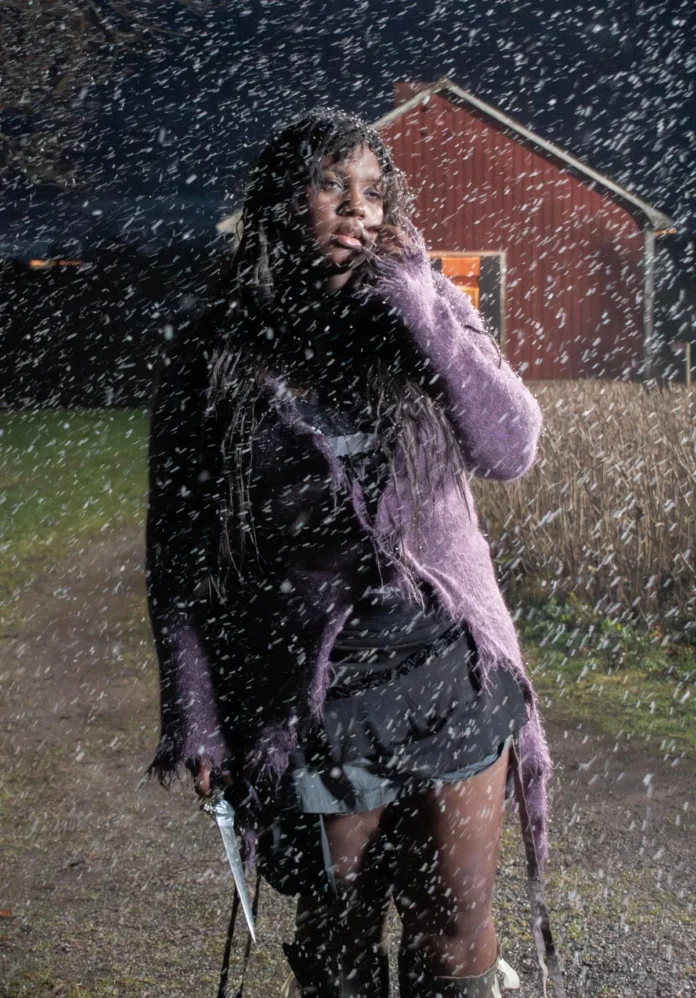
Music runs in waterbaby‘s family: the Stockholm-born singer-songwriter’s mother sang in gospel choirs while she was growing up, her great-grandad was a jazz pianist, and her uncle was a concert promoter who brought acts from Latin America and Africa to Sweden. Her brother, who’s had his own musical project for years, appears on waterbaby’s debut album for Sub Pop, Memory Be a Blade, which follows the 2023 EP Foam. Working with her primary collaborator Marcus White – who also arranged the lush contributions from violinist Oliva Lundberg, cellists Filip Lundberg and Kristina Winiarski, saxophonist Sebastian Mattebo, trombonist Hannes Falk Junestav, and flutist Pelle Westlin – waterbaby retains a preciously intimate and intuitive approach, even going as far as to improvise a lot of the lyrics on the record. “Steady waters asking me to leave again” are the first words that come out of her mouth as she embraces this flow, illustrating that steadiness is an illusion, a trick of lonely shadows and lights. Still, we’re left with no choice but to paddle on.
We caught up with waterbaby for the latest edition of our Artist Spotlight series to talk about early music discoveries, freestyling, making Memory Be a Blade, and more.
I read that one gateway to indie music for you was Pro Evolution Soccer, which your brother was playing growing up. I relate to that – that’s where I first heard, like, Vampire Weekend and the xx – so I wanted to start from there, and I’m curious how your journeys of musical discovery intersected more broadly.
That’s Theo, who’s the feature on ‘Beck n Call’ and ‘Clay’. He would just be playing all the time, and we would always have the same favorite songs. I don’t know if it’s PES or FIFA, but you could highlight your favorites so that they would come more often. I remember there was Passion Pit, Metric. I would not have known to go look for that music at that point, it was truly just because it was playing all day in our household. It just went on for so many years, and he’s still my music plug. When it comes to finding new or more underground artists, he’s way more tapped in than I am, so it’s really nice having that. The other stuff that was playing at home was neo-soul and hip-hop, but also Ghanaian folk music, and a lot of garage in Dad’s car – always garage.
Do you feel like that incentivized you to form your own musical identity early on, one that was maybe distinct from those influences?
I didn’t think of it in that way, and when it comes to music, I very rarely think about things in terms of good and bad. If I like it, I like it. If I don’t, I don’t. The quality can vary so much when it comes to what I like. To me, it was just a golden pot of, like, “Oh my god, there’s more music.” And that means that there’s more where this came from as well, so it was just widening my range when it came to listening. I also didn’t have any plans on writing music when I was younger. I always knew I wanted to be an artist and a singer, and I was into theater, so thinking about creating my own music in that way was not something that I ever took into the equation. I think it’s just been something that’s stuck with me, and subconsciously, of course, informed my sound.
Did your relationship to music listening change when you started making music as you were entering adulthood?
It’s hard to tell, because I went to a songwriting school a couple years ago, and people were like, “Oh, watch out so you don’t get pop death,” because that’s what it was a lot of. They would have classes, and they would talk about really famous songwriters, and I would be like, “Who’s that?” And my classmate was like, “Shut up, never say that again.” And they were talking about Shellback and Max Martin. I just didn’t know and think of things in that way, and in some ways, I’m still like that, because I don’t really analyze music or songwriting that much. Of course, I listen to stuff in a different way now. But if I was a producer, I can just see it being even harder to be able to enjoy and appreciate music when you listen to it, instead of hearing all the things that you would do differently, just hearing the technicalities of it. I listen to music very much just for pure enjoyment, not for anything else, and I want to keep it that way for as long as possible.
Do you think it prevents you from overthinking your own music, or do you still do that sometimes?
I probably still do that, but then imagine if I was to try to listen to it with outside ears. [laughs] I don’t want to find out.
I know you went to choir school, where you learned a lot about singing and harmonizing. But I’m curious if you have strong memories of the first times you sang into a mic, whether in a room by yourself or to an audience.
Yeah, I remember, because I was just reminded of it. I sang ‘I Just Called to Say I Love’ to my grandma on her 50th birthday 20 years ago, so I must have been 8. It was at this Chinese restaurant, and they had a karaoke thing, and the microphone was one of those microphones. I don’t think it was even plugged in, it was just an echo built into the microphone, but it also worked really so it filled the room. I was just so scared and nervous, because it was a big party, with all the adults and the grown-ups. But I also really wanted to do it, and I really wanted to sing to her, because I had never done that before. When you’re in a choir, obviously, it’s not as jarring, because there’s so many of you on stage, and the goal is to melt into each other. But that’s my first memory of doing it by myself.
Are you a fan of karaoke now?
No, I hate it. One of those things that keeps me up at night is when I was celebrating my best friend’s friend’s birthday, and it was at a karaoke bar, and I did three songs. Like, why? I just see it happen, I replay it. I don’t like it. But I like it when other people do it.
On your debut album, a lot of the songs begin with you clearing your throat or muttering into the mic, in a way that feels very authentic and natural. What other tactics or rituals have you developed to make yourself comfortable in a studio?
That is definitely one of those things – making sure that I have a voice. It’s like a tick, I do it every single time. If I don’t, it feels like I’m floating out around in outer space, and I have no idea what’s gonna happen when I do try, so I just need to make sure. I think it’s just those little things that I do – at least that I know of, because I did not know that I did them until I’m sitting there and listening, playing back the takes. It also obviously becomes extremely clear when Marcus leaves them in. It’s funny, but I’m sure I have other stuff I do that I don’t even know about.
How intentional were you about leaving them in? Did you feel strongly about it?
Marcus, the executive producer, left some in, and he did that with Foam as well. I think at first, I was like, “Oh, you missed one.” He was like, “No, I didn’t. It’s fine, just leave it.” What I did know, and that was intentional, was that I wanted it to feel intimate, and the vocals to feel like I’m singing them and you’re in the same room as me. But sometimes it also adds something rhythmically, the way Marcus has used them in this one, and it makes sense sonically. I really do do that all the time, so might as well let some of it through.
Another thing he kind of encouraged you to do was to improvise, especially when it came to lyrics. How much of what came out of that surprised you?
I’m always a little scared to be like, “Yeah, I freestyled this,” because I’m like, what if I didn’t? Because very rarely do I write alone, but I do have some specifics I remember. Like ‘Clay’, the first verse was freestyled in one go very early on and just stayed with us. “Pain in the morning, comfortable bed/ I’m like clay how you mold me/ I twist and I bend.” That’s the cool thing about freestyling, you don’t have time to evaluate or put it through any kind of process. When I was listening back, I was like, “Period. I said that, and I meant it, too, so let’s use that.” That was one of the first times as well. I’m so bad with time, but I think it’s the oldest song out of all the songs on the album. That’s the one we’ve carried with us the longest.
Was there a song where all the lyrics were entirely set in stone?
No, I don’t think so. What was new for making a lot of these songs was the freestyling of the lyrical part. I always do freestyle, or we do melodies, and then you pick up on stuff that sounds good or sings well. It might be three words, and then the rest is gibberish, or it might be just the vowels, and then we try to work with that.
You mentioned ‘Clay’ being the oldest song. At what point during the process did you feel like you were working toward a full-length record rather than an EP?
If you would have asked me two years ago, I would not have thought that the next thing would be my debut album. So I fought the idea of that a little bit, when we realized that we had more music than we thought, and so many songs that we felt like belonged in the same body of work. I struggled with accepting that, but when listening to it as a whole, I was like, “Maybe this is my debut album, because it kind of sounds like my debut album.” And now, it’s as clear as day, that that’s what it’s supposed to be. Walking into the studio, when writing ‘Clay’, an album was not on the table.
You recorded it in Stockholm, the south of Sweden, and even Los Angeles. I don’t know how long you spent in LA, but I wonder if there was something different about being there.
We didn’t do a lot there. It was mostly here in Stockholm. But first, we were in an amazing house, and then we moved to an awful, awful Airbnb. I just hated it, it was so low vibrational and disgusting. Marcus was playing piano, and he shouted for me to come do something. I walked there, and that’s when we started ‘Srs Ice’. We finished it back at home, but the feeling I was in carried on, because I just wanted to go. I didn’t want to do anything, because I hated coming back home, and everything was just subpar. I was just rambling things. I don’t know if you can hear an LA vibe in the music, I don’t think, but being away and traveling definitely leaves some marks here and there.
Going back to ‘Clay’, I think it’s one of the songs where the additional instrumentation, the cello and the flute, do a lot of the emotional heavy lifting. What effect did that have on you, either when you were hearing them being recorded or later on in the process?
I had lived with it as this pitched-up guitar, and even banjo for a while, so I had done my bits when the flute and the cello came on. When I got to hear it, I was just floating, and I was like, “That flute is just singing. It’s so soulful.” Marcus arranged all that, and he just did such a good job, because it’s so illustrative. Specifically in that song, and same with ‘Amiss’, it just adds so much and widens the world even more to me.
‘Amiss’ is another song I wanted to bring up. You’ve described yourself as “extremely nostalgic,” and that song is interesting because it’s less about being stuck in the past than missing a version of it that never really existed, or a place you’ve never visited, which is a very specific brand of nostalgia. When you think of the “simpler life” that you sing about in the song, does it live in the past tense, or is it about the future that you dream of?
I think it’s more that “ignorance is bliss” kind of thing. The simpler time, it never truly was, but I didn’t know any better at that point. But I’m also not yet ready to let go of it, so then the hope is still there. It’s the futuristic part, but it doesn’t have to be real in any sense at all. It doesn’t have to be anchored in reality, but purely in hoping and wishing.
I don’t know if that part was freestyled or not, but one phrase that struck me in the opening of the album is “steady waters.” Do you have a memory of coming up with that?
When we started writing it, I think it was the first line. Did not, however, know that it was going to be the opener of the whole project. I didn’t have that in mind. I try not to chase too clear of an idea and keep it open as much as I can, but I do think that was one of the first lines that came out on the mic.
Why do you think that is?
I don’t know. Again, knowing that you’ve been there before, but still – thinking for one second that steady waters is actually steady waters, even though I’ve been there several times. Like, I should know by now that it doesn’t mean anything and that it’s just for now. It does say something, I just don’t know what yet, I think, to me, personally. That one means a lot to me, because it’s also one of the more abstract songs. I remember when we wrote it, I was like, “I’m writing about this,” and halfway through the song, they were like, “What?” [laughs] Because they were hearing something else. Which I like — I like having it open.
‘Clay’ and ‘Beck n Call’ feature your brother, ttoh, and one song that doesn’t but mentions him is the closer that you mentioned, ‘Srs Ice’. Assuming he’s heard it, what was his reaction?
Yeah, I played it while we were waiting on this train. He just said, “Aww,” and hugged me and said that he loved me. That was it. And that was before he had added his verses, I think. He was not part of the album in any other way at that point.
Did you have an idea of him being involved?
I don’t think so, because ‘Srs Ice’ was also one of the earlier songs that we had written, so not at that point. We were working on both ‘Clay’ and ‘Beck n Call’, but something was missing, especially for ‘Beck n Call’, and we had been working on it for a really long time, tried so many different things. Marcus was like, “What about your brother?” I was like, “Oh, of course.” Then he came in and just lifted it, and I was like, “Why not check out ‘Clay’ as well?” And we did that, and he ate again. It’s also the first time we’ve worked together in that way. He’s had a music project for longer than I have, but I’ve only ever added some harmonies to his music. That was the first time we were sitting in the studio together so watching him work and write was really fun and sweet.
Given how much of the record is improvised and orchestrated, how has it been preparing the live show?
First of all, I’m so excited to get to play live and sing these songs live, but also know that I’m not at a place where I will be able to replicate the instrumentation that’s on the actual album. Economically, it doesn’t make sense for me yet. But I want to do the music justice and find a nice way to still channel the feel as well as I think we’ve been able to do on the record, fill the rooms with that, even if it’s not the same setup or anything. It’s a fun challenge to figure out how to do it the best way with what I’ve got.
This interview has been edited and condensed for clarity and length.
waterbaby’s Memory Be a Blade is out now via Sub Pop.

