

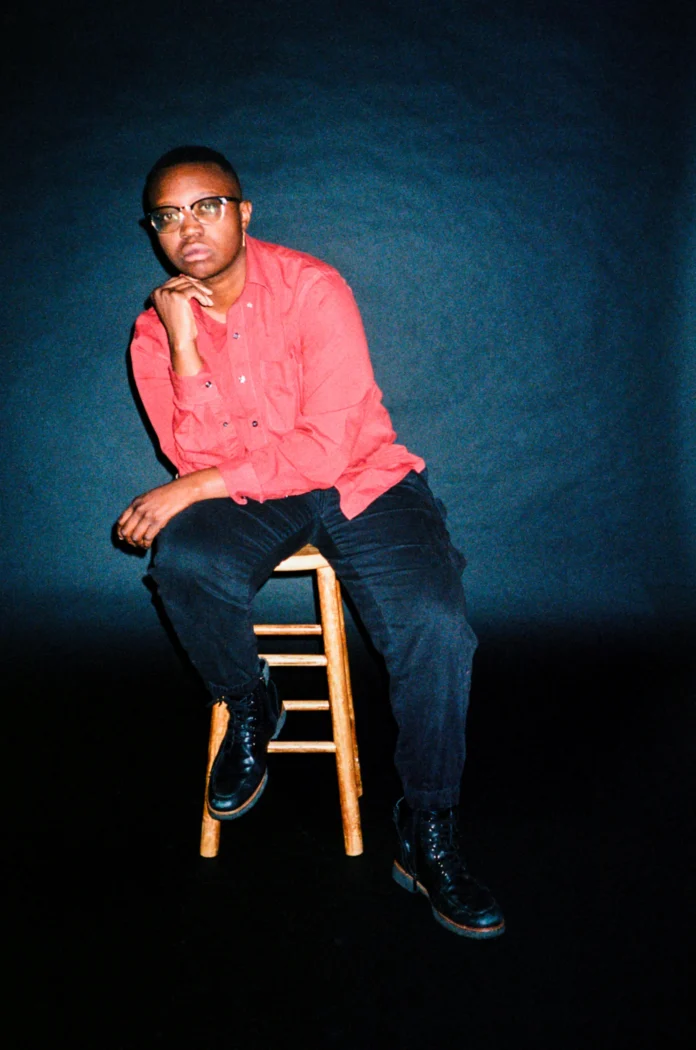
Anjimile Chithambo, who writes and performs music under his first name, was raised by Malawian immigrant parents in the suburbs of Dallas, Texas. He moved to Boston to attend Northeastern University before relocating to Durham, North Carolina, where his management company, as well as the producer of his new album, You’re Free to Go, are based. After working with Shawn Everett on 2023’s starkly dramatic, grief-stricken The King, his 4AD debut following 2020’s critically acclaimed Giver Taker, Anjimile linked up with Brad Cook (Bon Iver, Waxahatchee, Hurray for the Riff Raff) to help craft the airier, relaxed, and quietly cathartic songs that emerged from a period of renewed freedom. “It comes in waves/ Memory and empathy/ It stays and waits with me,” he sings on ‘Waits for Me’, patiently letting them ripple across and crash into his music, often retreating into a question instead of resolving. Whether for something as abstract as freedom and embodiment or palpably simple like kissing a partner, you want the desire to wash over you, and Anjimile makes it sound easy.
We caught up with Anjimile for the latest edition of our Artist Spotlight series to talk about settling into his songwriting, working with Brad Cook, collaborating with Iron & Wine, and more.
What is your relationship to the new songs like as we’re nearing the album’s release?
I was talking to my partner, who I wrote a lot of the songs on the album about, last night, and I was like, “Rust & Wire’ is coming out tomorrow.” That song was written in the summer, and it just brings us both back to when we fell in love, summer heat, warmth, and sunshine. Something about a spring album is really doing it for me.
I’m curious how that warmth is reflective of your process as much as the themes of the album. Do you feel like you’re easing into your songwriting more with each release, or is it more about where you were in your life when you were making it?
I definitely feel like I’m at a point in my artistic career where I feel confident about my songwriting. But also, I’m really interested in expanding it and doing things I’ve never done before. Even structurally, I have a goal of writing a song with a refrain instead of a chorus, or having a song that has literally only two chords in it. I would love to write a two-chord banger. These songs are about my feelings about very specific situations that have occurred in the last three years, but those specific situations engender such big feelings, and those feelings ripple across my life, my relationships, my conversations. These big emotional moments don’t exist in a vacuum, and I feel like that’s what’s cool about songs, is that you can put that big emotional experience in a little bit of a vacuum. Just be like, “Here is pure emotion. Here you go.”
I also don’t consider myself much of a narrative songwriter. I’m not like, “I was at the beach on Tuesday.” I don’t want people to know where I was at or with whom. [laughs] I don’t need the government to know my whereabouts constantly just because I sing about them. But I like to get down to the feeling. Maybe meeting my partner who inspired a lot of the songs on this album has helped me lean into the emotionality of just who I am as a person, which has let me feel more confident about expressing that sonically.
You’ve said that songwriting, for you, feels like “a prayer, a plea, or a question.” ‘Exquisite Skeleton’, for example, is a song that turns into a plea halfway through. I wonder if you feel like a song needs to approximate one of those things in order to feel complete.
It’s definitely an unconscious process. However, I do find, and I have found that there are a lot of questions in my songs. Ending songs with a question, or just having that be the bridge, or having it be an important component, it’s something that I tend to do, for sure. I have so many questions for my higher power and for the universe that I know I’m not necessarily gonna be getting the answers to. And also, I have questions for the subjects of these songs that I’m not necessarily gonna be getting the answers to. But something just feels right about using songwriting as a conduit, an opportunity to present these spiritual or existential questions.
When revisiting your previous record, the line “In my stillness, I am safety” felt like a prayer that stretches out to the nakedness and the stillness of the new record. Despite the musical shifts between the two albums, do you feel like there’s a thread there?
I haven’t thought about that at all. [laughs] But it does resonate extremely. In the aftermath of making my second album, The King, I was pretty emotionally spent, post-tour, post-everything. Songs are painful and meaningful to me, and I love them, but I didn’t expect the emotional weight of singing these songs every night to accumulate, literally, on my body. After the tour, I was like, “I need a break. I need to not think about this music, or maybe my music career at all, and just restabilize.” The distance between recording The King and this new album, I had some breathing room, and that’s what I needed to clear my mind and get back to putting pen to paper, feeling like I would even want to make another record. Making an album and then releasing it, it’s an awesome, exciting, wonderful, beautiful, mysterious, crazy process. And it’s also a lot.
I had this space to breathe, and it was in that space that I was able to meet the producer of the album, Brad. Honestly, I think Brad had a lot more to do with this album’s existence than I give him credit for. Obviously, he was a producer and he was there recording it every step of the way. But he inspired my songwriting as well by just showing me cool music and encouraging me. I would send him songs, and he would be like, “Hey, this is awesome.” He became a sounding board for my process in a supportive and non-judgmental way. It was just purely for the love of art. When it was time to record this album, me and Brad had linked up, we were buddies. I’m trusting Brad, I’ve written a song with him that’s on this album. By the time we’re recording, I’ve fallen in love with this new partner. I’ve written all these songs about her, I’ve ended a previous relationship, there’s just a lot of life changes happening. But I think my relationship with Brad and that trust provided a sense of stability that helped me approach this recording process with a clear heart and mind.
What are some things that made you feel comfortable and kind of spiritually aligned in the studio, that maybe surprised you, even though you and Brad had become friends by that point?
I already knew that he was just a chiller. He’s just easy to spend time with. He’s a kind individual with a great sense of humor. He smokes so much weed, more weed than I’ve ever seen anybody smoke in my life. He has such an incredible, silly, and sharp mind. I already knew that he had great feng shui. He’s got salt lamps all over his house; this guy’s got fantastic lighting. So nice, so smooth. He’s got delicious candles. He introduced me to a candle called Pasta Water. I’m not kidding: delicious, incredible, artisanal. He’s a man of the senses. But getting into this studio and seeing how simultaneously focused, completely locked in, and also objectively ridiculous he is as a person – it’s really hard to describe. Brad has an indescribable je ne sais quoi that exudes through every pore into the studio.
I’ll tell you one moment on the record where I can visualize that. When you say the words “Fucks sake” on ‘Exquisite Skeleton’, I feel like that’s an example of him allowing that ridiculousness and humour to permeate an otherwise dark song.
When I wrote that, I wasn’t trying to be funny, but I was like, “That’s funny.” And Brad got that too. We were listening to the playback, and he’s like, “I can’t believe you started this song with the lyrics, ‘I don’t want to be a son of a bitch,’ that’s hilarious.” And I was like, “It’s funny, because it’s true.” I think that’s also why it works.
Having had that breathing room, when did you feel like you were re-entering the flow of a new album as you were writing new songs?
A lot of it just had to do with the fact that I’m signed to a label. Commercially speaking, it’s in my best interest to release an album at least every three years, ideally less. But that’s just been my goal. So when I saw that I was coming up on that mark, I was like, “Okay, what have we got?” Whenever I write, I’m like, “Three years from now, this is gonna be probably an album.” But it was only through meeting with Brad, and with my managers, showing them all of the songs that I had accumulated over the past couple of years, that it became clear that there was a collection of songs that worked together. It’s a weird process to put all your songs in a playlist and then be like, “Yup, yup, no, no, yup, no, sucks, good.” [laughs] But that was more or less the process. It’s hard to describe, because I feel like thematically these songs fit a certain narrative. But I feel like music, in the same way that the songs kind of write themselves, I feel like the album kind of has a will of its own, almost. The songs are magnetically attracted to each other in a way.
Do you remember what kind of music Brad Cook introduced you to?
Yeah, Brad introduced me to Cameron Winter. Heavy Metal came out right after we finished recording, and he was like, “Dude, check this out.” He introduced me to this band called Good Morning. I think they’re from New Zealand. I don’t know if there’s anybody whose music tastes I just unequivocally trust as much as Brad. He showed me this record called Peanut by the artist Otto Benson. I don’t even know how to describe it. It’s indie, but there’s electro, and there’s also some Midwest emo going on. Brad introduced me to Cate LeBon, the record Reward.
How were you affected when Sam Beam entered the studio, given how Iron & Wine has inspired your songwriting?
That was surreal. Brad is just buddies with him, he knows him. Sam Beam lives 25 minutes away from us, and it quickly went from, “Oh man, I love Iron & Wine,” to Brad being like, “We’ll get him in the studio,” to Sam Beam just being there. I guess Brad had sent him some tunes, because I would not expect Sam Beam to know what my music is. Just to have him be like, “Brad showed me the songs, and they’re beautiful,” I was like, “Is this a joke? Am I alive or dead?” It was awesome. And then, he has just the most beautiful voice. It was a pleasure, and honestly a huge, unforgettable learning experience just to watch him sing. I was like, “This man’s voice is completely unreal.”
Do you have a favorite of the three collaborations? It’s really striking to hear his voice on ‘Ready or Not’, especially, given the weight of that song.
I think it probably is ‘Ready or Not’. He just went in there, and he was auditioning crazy harmonies that I would never even think to try. Again, I was like, “Is this a dream? Is this reality?” In addition to the beautiful harmonies, for the last 20 seconds of the track, it’s him breathing rhythmically, and when he laid that shit down, I was like, “It’s so good!” It’s just intuitively perfect. And then you listen to it and it’s cerebrally perfect.
One production detail that ties into the vocals is the modular synth on ‘Waits for Me’, which stood out to me because your voice isn’t really heavily effected elsewhere.
The inspiration of that tone came from the demo, which I just made in my room. I ran the vocals through an amp plugin on Ableton and just thought it sounded cool. But Matt McCaughan, who did a bunch of drums on this record, came in with a modular synth, and that distortion created the most sonically thick and satisfying version of that little lick. And you’re right, there’s not a ton of effected vocals at all, certainly not a ton of distorted-sounding stuff in my work on this record. I imagine that point in the song is a little victory lap, and I feel like that modular synth supports that feeling.
What other parts on the record stand out as victory laps to you?
Definitely the ending of ‘Like You Really Mean It’. Nate Stoker, who played guitar, he rips the last chorus with this tapping riff that’s just totally insane. I don’t know if victory lap is the right word to describe it, but towards the end of the record, there’s a song called ‘Afarin’, which is kind of a sad love song. The outro builds with drums entering in the last 20 seconds of the song. I’m hesitant to say victory lap because that song is sad, it’s yearning. But something about the drums in the outro just felt perfect, and maybe that feeling of perfection is victory to me. The perfect way to expand on and honor this emotional moment in the song.
Are you more of a perfectionist when it comes to endings? Do you usually put a lot of stock in the ending of a song?
Not really. [laughs] I wouldn’t say that I’m a perfectionist, but as a songwriter, I do ascribe to the school of thought where my song should have an end, instead of just it being assumed that it will fade out. A fade-out is beautiful and awesome, but I think it’s important to end a song sometimes. I think sometimes a song needs to be over. For my songs that have endings, which I feel like is most of them, I like for there to be a definitive end.
One song where that feels especially pronounced, maybe because it’s a short song, is ‘Point of View’, which has one of my favorite vocal moments on the record, the repetition of “But you know.” How does the memory of singing these songs in the studio sit in your mind?
‘Point of View’, from an emotional standpoint, I wouldn’t say was fun to sing. But from a technical standpoint, it was fun to sing because the mood for that song feels unique to me. A bit of controlled hysteria, or like something’s about to fall over. There was definitely a joy and an ease to recording and singing these songs on the album, but it can also be challenging to get out of your head enough to sing the song, the way that it is, without worrying about anybody around you or who’s gonna listen to it – or who isn’t, or who it’s about, or who it’s not about. In that sense, it was simultaneously so easy and so hard. But one of the standout singing moments for me was ‘Ready or Not’. Me and Brad wrote it together, and the melody came about super spontaneously, and the lyrics came about pretty quickly, a stream of consciousness. I remember feeling a sense of catharsis, the freedom of saying something true and having it feel right. For a lot of these songs, Brad was auditioning backing vocals behind me while singing, being like, “How about this? This could be sick.” So I felt supported. I wasn’t singing alone; I wasn’t experiencing some of these tough emotional moments alone.
Something that comes up on this record a couple of times is the relationship between time and songs. On ‘Like You Really Mean It’, you sing about how “time became a song that carries on without me,” and on ‘Ready or Not’, you sing “I wait too long/ I make no time for my song.” I’d love for you to talk about that feeling of songs existing outside of you, and I’m also curious what making time for songs looks like for you at the moment.
I’ll answer the second one first and say that making time for songs for me is not just a physical thing of, like, “I need to sit down, put my body here next to a guitar” – that definitely needs to happen, but I also need to be somewhat emotionally clear in order to express whatever needs to come out. If I don’t know how I feel, then I can’t write a song. If the feeling is I don’t know how I feel, then that’s a feeling. That counts. That’s a song. But if I feel like I have to live with a certain degree of emotional awareness and practice that in order to write music at all.
In terms of songs existing outside of time – love that. The producer for The King, Shawn Everett, once described music to me as decorations of time. I just think that’s so beautiful. Songs have a runtime, but at the same time, music exists around you, and you can feel it moving inside you. Literally, when there’s bass, when you’re at a live show; metaphorically, when that chorus hits and you start crying. For a phenomenon that doesn’t technically have a body, music is a pretty physical experience. For a phenomenon that exists in the air, in sound waves, and exists somewhere in our nebulous concept of time, it has the power to grip you, just like anybody’s hand. Bob Marley said when it hits you, you feel no pain. And I don’t know about that, for me personally, in terms of the feel-no-pain part, but it definitely hits. It’s just cool that music can exist around you, you can be completely surrounded by it, and have that surroundingness feels like a completely timeless moment. When you’re at an amazing show, and everybody’s sweaty, and the sound is everywhere, it’s this magic moment in time that is forever captured and you’ll never experience again.
You talked about The King‘s songs being painful to sing. Do you think a part of older songs becoming timeless has to do with them not hurting as much? You’re carrying them, but is there a point where they feel separate from you in that way?
I wouldn’t say that the hurt goes away. I’d say the point at which it feels like the songs exist without me is release day. That’s when the songs aren’t mine anymore. It’s not that the emotions in these songs don’t still resonate with me, but once you give your art away, it’s something that everybody can put their heart into. I value my life experiences and I care about them, and I’m grateful they’ve inspired this music, but I don’t need anybody who listens to this music to know anything about me for it to resonate with them, and honestly, I’d prefer that they didn’t.
I’ve played a song I wrote for an ex years and years and years ago, and it doesn’t have the same meaning. It’s like looking at an old photograph of an ex: there’s love and experience here, but not this now-ness. It’s the graciousness of the past, not necessarily diluting the feelings, but letting me look at it from farther away and see: I was hurt, and she was hurt, and we were hurt, and this isn’t about me. The passage of time helps me zoom out from these songs. The meaning of these songs evolves over time, which has been the weirdest experience about writing and performing them over the years.
This interview has been edited and condensed for clarity and length.
Anjimile’s You’re Free to Go is out now via 4AD.

