

It’s the summer of 1992, and Japanese Giants editor Ed Godziszewski is being led toward the rafters of Toho Studios’s Stage 9 in Tokyo. The friend escorting him previously explained they could visit Koichi Kawakita’s special effects set for Godzilla vs. Mothra, but probably wouldn’t see much—maybe a few shots of Mothra and a new creature called Battra flying around. “Okay by me,” Godziszewski said at the time. “I’m happy to see anything.”
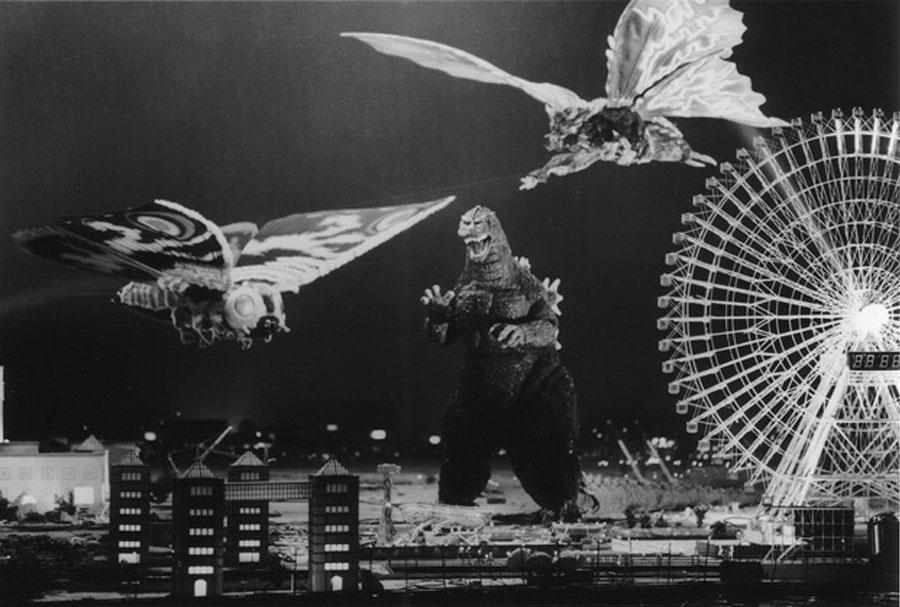
But as was discovered upon entering the sound stage—and as was reinforced tenfold from the rafters—something had surely been lost in communication. Godziszewski’s new vantage point offers a first-class view of a miniature set depicting Yokohama’s Minato Mirai district. “Everything was constructed on a platform about two feet high. They had the InterContinental Hotel and the Cosmo Clock 21 Ferris wheel, but only the bottom half of the Landmark Tower was standing; the rest was a pile of rubble. For the ocean, they’d custom-built a tank two or three inches deep. There was a curved backdrop with two-dimensional building cutouts to create a sense of distance.” And Mothra and Battra, hardly fluttering above the horizon, are locked in battle with Godzilla.
Godziszewski has watched Kawakita’s team rehearse the shot and its various components. Part of the day was spent on assistant director Makoto Kamiya coordinating Godzilla’s movements with stuntman Kenpachiro Satsuma: holding out a fist and shouting to the man inside the monster costume, “Look here! This is where Mothra will be coming!” The Mothra puppet has been rigged to a crane and undergone semicircular practice swoops. A subsequent dry run put them together, with Kamiya yelling “Dat-dat-dat-dat!” to simulate explosions that’ll be caused when Mothra fires animated beams at Godzilla. (Battra, meantime, lies prone on the ground, stunned by injuries captured in an earlier shot.)
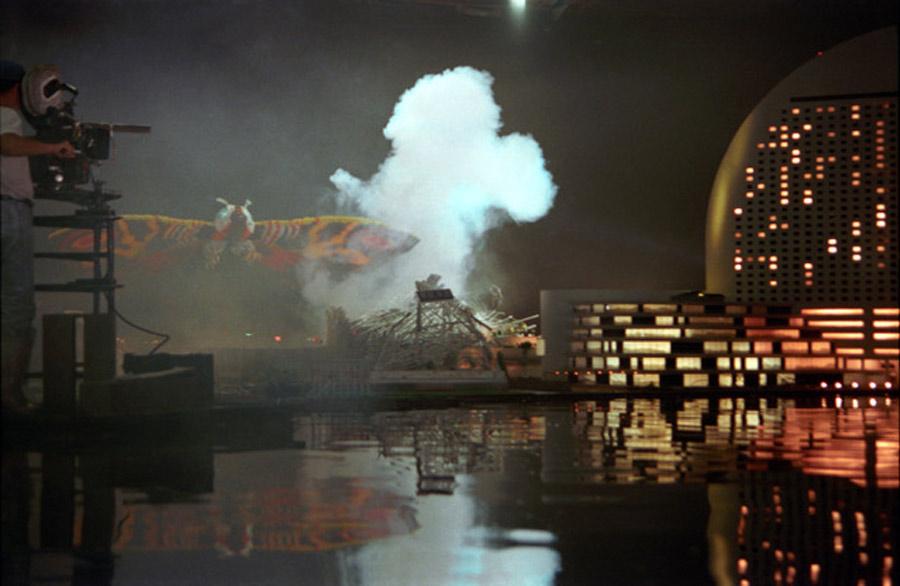
At last, Godzilla is coated with squibs. The actual take is coming. Perched in the rafters, Godziszewski aims his camcorder; he’s been shooting video throughout the day and is eager to capture the moment that’s taken hours to prepare. He hears Kawakita holler from below, “Ready!”
Then comes a heart-stopping click.
“The battery died.” The dismay lingers in Godziszewski’s voice as he tells the story decades later. “I was sad not to get the actual take on video. But it was still cool to watch the scene unfolding. To see Mothra curving in and to watch giant explosions burst on Godzilla as he staggers back.”
Being on set was also something of a personal fulfillment for the historian. By this point, Godziszewski had been to Japan several times and even paid a few visits to Toho. But never before had he observed the making of a Godzilla movie in real time. Nor did he truly know what went into a shot on these films whose images have dazzled him since childhood. Norman England’s Behind the Kaiju Curtain: A Journey Onto Japan’s Biggest Film Sets was decades into the future; there was, at the time, no English-language resource documenting the daily goings-on inside Stage 9. But now he was watching Godzilla tangle with one of his most famous opponents—after being told there was probably ‘not much to see.’ “I was, as you can imagine, shocked and delighted!”
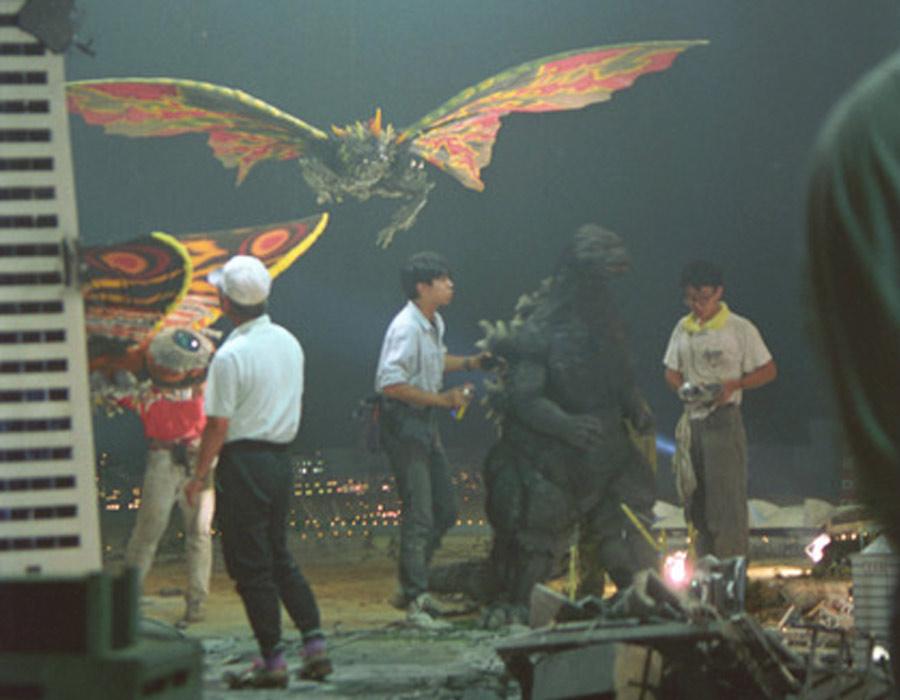
Godziszewski’s journey to the set began in spring 1992. “I’d recently joined a company that was headquartered in Japan, and my wife and I were overseas on my first business trip. Since we were there for a couple of weeks, we dropped in on Kawakita and learned about the movie they were getting ready to shoot.” As it happened, this particular visit took place mere weeks after international headlines declared that a Godzilla suit used on the previous year’s Godzilla vs. King Ghidorah had been plundered from the Toho lot. “In fact, we got there the day after they found it and brought it back to the studio. Kawakita turned us over to Kamiya for a tour, and I still remember him complaining, ‘We really wanted to make a new suit and were happy when somebody stole the old one. And then they had to find the damn thing!’”
In the end, though, the staff got their wish: the theft had led to an okay to build a new costume. “When Kamiya showed us around, they were just starting to cast new fins and body parts. Before the trip ended, we got an invitation. ‘If you have time later this year, why don’t you come back?’ And so, I took a week’s vacation that summer and returned with my friend Bill Gudmundson—specifically to watch them filming.”
Godziszewski knew little about Godzilla vs. Mothra ahead of time—just that it featured the eponymous monsters and something called Battra. He likewise had no insight into what’d transpire in the Yokohama battle he wandered into. Once Mothra’s charge at Godzilla was complete, Kawakita’s team lensed inserts of the winged monster coursing through the air. From here, another couple of hours went into setting up a scene wherein Mothra lands before Battra and the two monsters start communicating. “My Japanese friend who came with us described it as Mothra cheering up Battra,” Godziszewski recalls with a chuckle.
Preparation was nearly done when the staff broke for dinner around six. The visitors sat near Toho’s legendary Big Pool, “eating a little something we’d brought with us. Just when everyone was getting ready to go back inside, Kawakita sat down and asked if we were enjoying ourselves. That made me feel good; he didn’t think of us as annoying interlopers.” The day had likewise been punctuated by fun moments that included a meet-up with Satsuma and discovering monster props that weren’t in use. Mothra’s caterpillar form—along with a Godzilla puppet used for close-ups—was found in a storage area separated from the set by a partition. “And at one point, my friend showed us a huge blue tarp covering something near the Big Pool. Mind you, he’s not a staff member, but he just lifted the tarp, and there was the larva Battra! It was attached to a motorized wheeled platform used to carry it through water for swimming scenes.”
Mothra ‘cheering up’ Battra required numerous lights “going on and off” beneath the creature puppets and finally wrapped around ten p.m. “They were going to shoot something else, but we didn’t want to miss the last train. We thanked Kawakita for having us, and then he said—and maybe he was just joking—‘Come again!’” Godziszewski remembers exchanging glances with Gudmundson on their way back to the hotel before agreeing to take up Kawakita on his “very loose invitation.” And so, following a day of exploring the real Yokohama—seeing the location that was currently being razed in Stage 9—the two were en route back to Toho.
“My Japanese friend wasn’t able to come with us this time, so it was up to us to find our way and get in. I’d taken pretty good notes on how to get to Toho, and when we reached the front gate, I tried—through my terrible, broken Japanese—to tell the guard, ‘We’re Kawakita’s guests.’ It looked like he got on the phone and actually called him on the set. We stood there, wondering if we’d be told to leave.” Eventually, however, the gate opened, and they were ushered in.
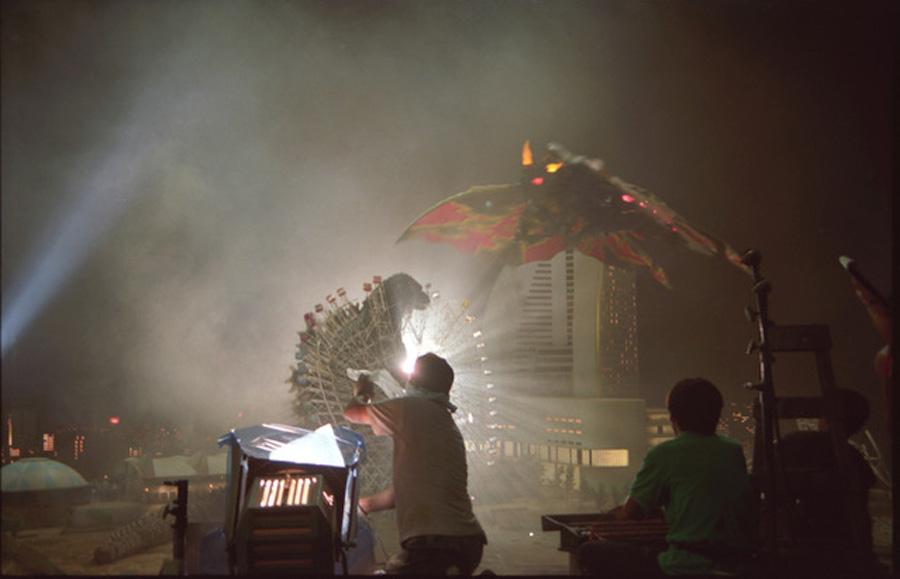
“We walked into Stage 9 just after they’d set up a shot of Battra carrying the Ferris wheel toward Godzilla.” Although the scene called for Battra to use the wheel as a battering instrument, the shot in question consisted of him just flying at his opponent with the infrastructure in his claws; the close-up of Godzilla being bludgeoned would be lensed another time. Godziszewski and Gudmundson remained on the studio floor and off to the side, doing their best “not to be in anyone’s way,” as the shot was finished. The Ferris wheel was then detached, fractured, and rigged to Godzilla’s body. When Kawakita called for action again, Battra flew past while Godzilla simultaneously hurled himself onto a building, making it appear as though he’d been knocked off his feet.
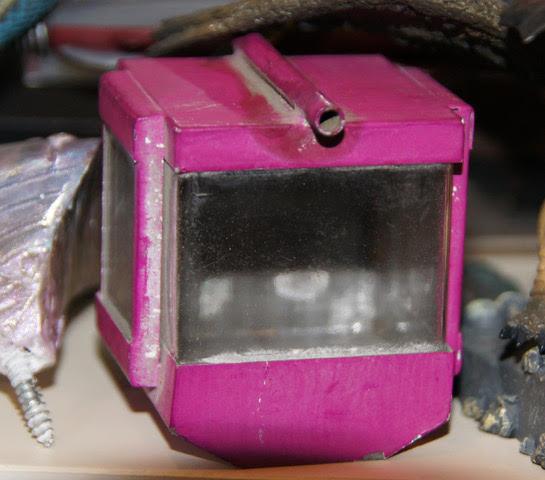
At times, the Toho staff treated their guests to a surprise. “After the scene of Godzilla falling over was done,” Godziszewski recalls, “Bill and I watched them help Satsuma out of the suit, which was left on the floor with all the debris still attached. One of the staffers walked up to the broken Ferris wheel, grabbed two of the miniature carriage cars, and—making a gesture to be quiet—gave them to us. So we got to leave with souvenirs from the set!” Another kind moment came from the man who Godziszewski learned years later was the son of modelmaker Keizo Murase. “He waved us over to show us the smaller flying props for Mothra and Battra and let us hold them. We couldn’t speak much Japanese, and he couldn’t speak any English, but we still managed to communicate. I wish this had been the age of digital cameras, because I would’ve taken a thousand pictures. Back then, you had a roll of film. Thirty-six sacred pictures was what you got.”
The rest of the day featured more exciting action—including a high-angle vista of Mothra and Battra crossing paths while Godzilla thrashed beneath the Cosmo Clock 21’s ruins—but the high point remained the first thing Godziszewski saw on Day One of his visit: Godzilla stomping toward a grounded Battra and strafing him with his atomic breath. For this scene, explosives were wired beneath the Battra puppet, and every staffer in Stage 9 clambered onto the set’s platform. Godziszewski realized at this point he had a chance to join them—to get closer to the camera and the monsters during an actual take. “I wasn’t going to be presumptuous and assume I could do anything. But for this particular shot, nobody was on the floor. Bill and I looked at each other. ‘What do you think? They won’t even notice us.’ Quietly, we jumped onto the set and stood behind everyone as they got ready.”
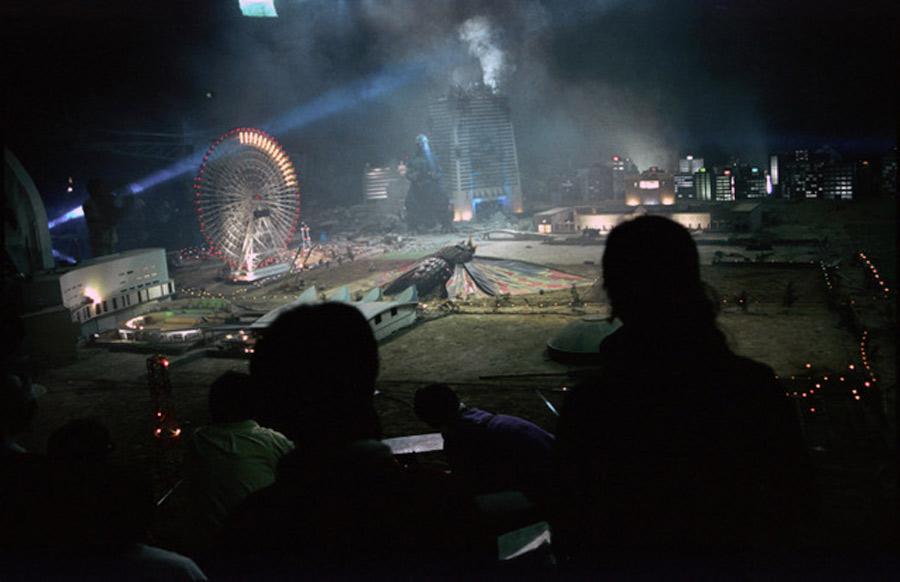
Once more, there was a rehearsal. Satsuma, clad in the Godzilla suit, lumbered toward Battra, and the crew used controls to open the costume’s mouth, where an animated ray would be added later. “Battra was still hooked up to wires, and they jolted him upward as though he were being hit by Godzilla’s breath. And then, the real take…. We knew it was happening, because they started up fans that blew smoke and fog across the set.” Satsuma went through his motions again; the mouth swung open.
Then came the explosion.
“It was a sound like I never expected,” says Godziszewski. “I was expecting the equivalent of firecrackers, but this was like M-80s! An enormous, loud sound! Really shocked the hell out of me and took away my hearing for a moment. The explosion itself lifted Battra off the floor a bit; they probably didn’t need to use wires. But it was so impressive to watch. Even now, seeing the scene all these years later, it looks every bit as great as it did in person. I still think to myself: ‘I was right there! Right by the camera!’”
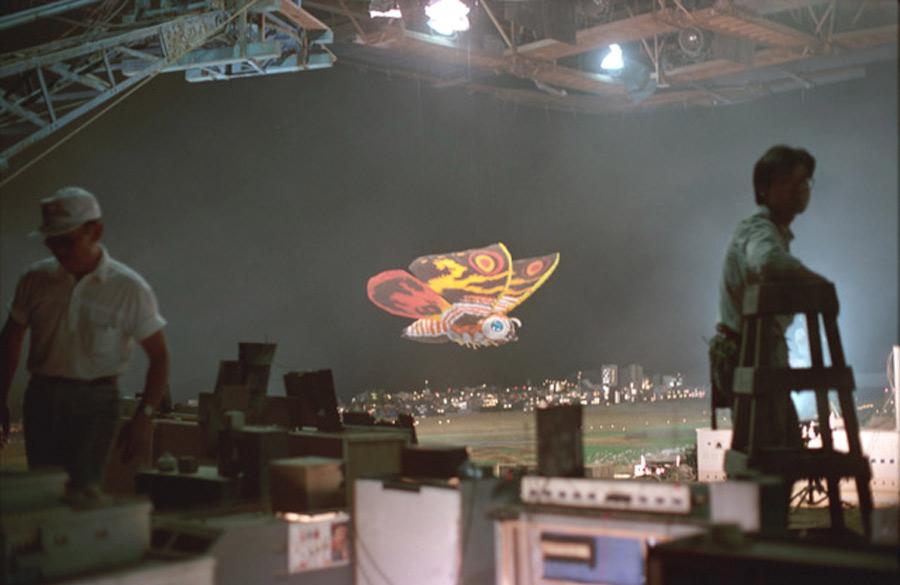
Ed Godziszewski’s two days on Godzilla vs. Mothra came after years of studying Japanese texts and behind-the-scenes photographs. And the experience taught him just how much there was to special effects that no verbiage or picture could adequately convey. “Most photos show maybe a handful of guys on set, but in reality, there are thirty-plus staffers constantly doing something. I’d say at least two hours pass between shots, and during that time, everyone has a job and is busy setting up and fixing things.”
Being an onlooker also allowed him to study the props and their intricacies. How, for instance, Mothra and Battra underwent battery tests to verify their luminescent eyes would turn on for a scene. How someone activated the batteries with switches located behind Battra’s neck and in the center of Mothra’s chest. Regarding Mothra, Godziszewski notes that the prop’s six legs—seemingly immobile through much of the movie—were capable of movement, as they awkwardly wriggled during a test he saw. “My guess is they didn’t really show this on camera because the movement was so unnatural.”
Another lesson learned was the truly dangerous nature of the set. “There’s a labyrinth of big, thick electric cables strewn everywhere—around transformers and canisters of compressed air and methane gas. The staff also lights these kerosene-soaked rags inside empty film cans and sets them in the background to make it look like the city’s burning. There’s always something flammable or on fire near these cables that, again, must have a good charge going through them. And everyone’s working in the midst of this! I found myself thinking, ‘I can’t believe nobody’s been blown up!’”
He also got a surprise concerning air quality inside the stage. “For effects scenes, they often use fog machines, because fog and smoke makes the air denser and gives the images more scale. The machines use paraffin, which makes the set smell like burning candles. And when they broke for dinner that first day, I walked out of the studio, blew my nose, and when I looked at my tissue, the whole thing was black! ‘Holy shit, we’ve been breathing that in?!’” From this came another degree of awe for the Toho effects team. “I’m just imagining these guys…. They’re all smoking to begin with, and then they’re sucking in smoke and paraffin and burning rags…all day…every damn day…. I’m surprised any of them live past fifty.”

