

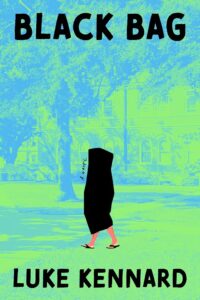
When an unnamed, out of work actor gets offered a job to walk around a campus in a black bag, he shrugs and accepts. It’s not the most humiliating thing he’s done, the pay is good, and it would be good to get out of dinner theater after a while—but he doesn’t expect that the anonymity of the bag grants him a new relationship with a woman who prefers his powerless, a friend who clamors to obtain a way to monetize the “art project,” and a renewed sense of self. Irreverent and honest, Black Bag is an answer to the ‘masculinity crisis’ that suggests the solution is a lot easier than it appears.
Luke Kennard sat down with Our Culture to talk about the real black bag study, sublimation and self-help.
Tell me about the real black bag psychological study, which took place in 1967, and why you gravitated toward it.
I chanced upon it as a study; I was looking for various theories around attraction, social psychology. I came across the mere exposure effect, which is partly used in advertising and politics, but originally it was about why we come to like each other—we just get used to each other. The black bag experiment took place at the University of Oregon, by a professor named Goetzinger. The black bag would sit in silence in a lecture theater in classes and not say anything, not interact with anyone, not respond when anyone spoke to him. At first the students found his presence unpleasant, really abject, they didn’t like this ominous, unresponsive figure. They reacted with hostility and complained about it. But as the weeks went by, they became defensive of the black bag. If anyone criticized him, they’d stick up for him: “Leave him alone, let him do what he wants to do.” And became quite affectionate towards him, invited him for a drink at the end of the term. And he never said a thing. Very visible, but a semi-erased figure. To Goetzinger, this proved the mere exposure effect. I’m more interested in the person who was the black bag. I liked the idea of him being a struggling actor—for this to be a role, but one they find they like, and want to carry on wearing the black bag.
The juxtaposition between this person who lives to be on stage accepting a role in which he’s anonymous is so funny. Why does he feel like he’s closer to his true self in the bag?
Actors are sort of a canary in a coalmine for the arts, in a way. If things are going badly for actors, then they’re about to be really bad for anyone who does anything creative. They’re out there all day every day, auditioning, whereas a lot of the other arts are much slower. There’s maybe something in that sense of egolessness. You want people to enjoy your work, want to be known for it, have people say nice things about it—that’s not a good impulse or instinct. The narrator is in his late thirties, he’s been trying and failing to make much of a living, he’s jaded and embittered, yet still believes in his talent. There’s not that much time left for him to prove himself. That, for me, is quite close to writing. A lot of the writers I love maybe had a modest high point in their careers and then just carried on doing it in obscurity for the rest of their life. I was obsessed with Gilbert Sorrentino, the Brooklyn novelist, a couple years ago, and collected all of his books. They’re not even printed in the UK, so I was ordering copies online, arriving from the Wyoming Public Library or something. I devoured everything he’d written; a lot of his work is about being an angry, slightly failed writer. But he was a genius, and did deserve a reputation.
At the same time, the narrator feels the need to conceal the black bag from his parents. Is there a hidden shame he’s not letting us in on?
He also refuses to describe his parents—he just says they’re two stone columns. Writers are awful, and the moment a writer describes somebody, they come across as horrendous. So he didn’t want to subject them to that. I think this was around the time the discourse was all around ‘likable characters.’ If you describe someone for the length of a novel, that’s gonna include their flaws. Sometimes there’s an arrogance that goes with writing and narration. You’re just trying to make yourself look as good as possible and everyone else is kind of a jerk. I think that’s one of the worst impulses in writing, especially in the age of autofiction. There’s such a profound responsibility to do right by the people you’re writing about, so you won’t mention them at all. And it is a shame! The narrator doesn’t want his parents to know what he’s doing, which may be like publishing as well. You work on it so privately, then it turns into this life separate from. You don’t necessarily want your family involved.
He is quite a cheeky guy, upfront about being a narrator in a novel.
Yeah, he knows he’s the narrator, but he’s also quite real. It’s a book he’s writing in his head. He’s quite pedantic, and snobbish about a lot of things, but he’s also honest about how much of a person he feels like, or how weird his attitude toward his own maleness is. Part of it’s how he tries to deal with being a certain kind of man, and the discomfort he feels about that, which comes into his desire to disappear into the black bag. He says to his friend, ‘Maybe this is the only way of being a man,’ like, trying to apologize for it.
His friend, Claudio, is desperate to monetize the study, whether it’s through crypto, art, or gesturing at some commentary. Do you think the narrator goes along with it because he’s unsure of what the black bag means himself?
I think he just likes Claudio, who is sort of a Twitch streamer. I have a lot of respect for that form, I think it’s quite difficult and punishing. I wanted it to be a contrast with someone who wants to be an old-school stage actor, wants to be in Chekhov. There’s the line of thinking of, well, turn your skills to what is actually available in your age. He has a conversation with a tech bro later who says, “If Dostoyevsky were alive now, what would he be doing? He wouldn’t be writing novels.” The narrator’s desperate, and wants to make money as well. If Claudio can make something out of this, then fine; he’s cynical enough to see where it goes.
He gets into a strange but fulfilling relationship with another professor, Justine, whose kink involves his anonymity and powerlessness. Why does this situation work?
He’s had a string of mutually unsatisfying relationships. He feels he’s been doing something wrong his entire life. But this is something completely different—this anonymity and submissiveness is something he really likes, and he enjoys her telling him stories about her escapades, her being sexually and domestically dominant. Towards the end, he tries to break up with her, and she refuses—it can’t go the other way. He finds a kind of pleasure and meaning in that. It takes any pressure off him to be any particular kind of man in the relationship. I don’t think he knows why he likes it, but he enjoys the passivity, and relinquishing his responsibilities.
In your fiction, you seem to offer solutions for a way out for helpless people. In Black Bag, it’s a new identity, and in The Transition, it’s a housing experiment. What do you think interests you about these themes?
We’re just so replete with that as a culture. There’s so many people who will tell you why you’re unhappy, what you can do to change that, and for the most part, it’s snake oil. But there’s always going to be a massive market for that. We’re always going to feel insecure about how we’re doing and what we’re doing wrong. It’s part of the contemporary mode of being spoken or sold to. “You’re fucking up, but here’s how to do better.” My knee-jerk reaction to that is, “Absolutely shut the hell up. How dare you!” [laughs] What the focus-on-the-self stuff does is deny the potential for community and collective action—it turns the focus purely onto the individual. It makes us self-absorbed. In Black Bag, there’s a crisis of meaning. There’s not a crisis of masculinity, there’s a horrible, regressive version of masculinity that’s in its death throes, and is particularly violent and visible at the moment. But it’s more about the ancient question of how to live a meaningful life. The solutions we’re offered are either bogus or self-serving.
Finally, what are you working on next?
I’m going to do a selected poems collection, which is the opposite of writing, sort of like a palette cleanser. It’s twenty years of work, and there’s a lot to get rid of, but it’s nice to go back to things from 2005 and ask what I want to keep. I’m working on a novel that’s vaguely about that Robert W. Chambers [story], “The King in Yellow,” where there’s a cursed play script and everyone reads it and loses their mind and it ruins their lives. I love the idea of a cursed manuscript. I’m making it into a PhD thesis, and when you try to examine it, it gets destroyed.
I’m working on a new novel, it’s early-stages, but I have it outlined and it’s gonna be different. I’m trying to create a continuity between the works. I’ve written like four other manuscripts that I have no intention of publishing, so I now have a pretty good sense of how to approach writing books in a professional way. I don’t want to say too much, because I get more freedom out of it when I don’t tell you much, but yes, I am going to write more novels.
Black Bag is out now.

