

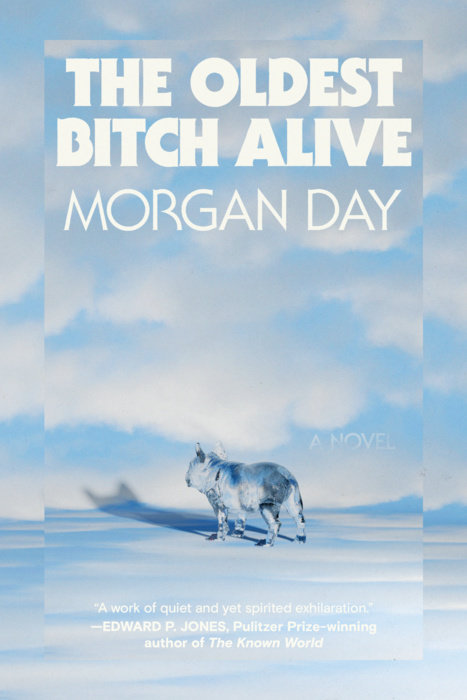
Gelsomina is a French Bulldog riddled with worms she got by lapping at pond water, living out her days in a glass house. In her shockingly scholarly voice, she begins to ponder the creatures around her—John and Wendy, her owners, Zampanò, the puppy they added to the house to provide Gelsomina a playmate, and the outside world, which she has little access to, despite the house’s transparency. With a range of perspectives—from the triad of worms inhabiting her, each fretting over their place in the group, and an omniscient, worldly consciousness—Gelsomina attempts to fill her last days getting to the heart of the unknown.
Eloquent and playful in its exploration of the divine within the mundane, The Oldest Bitch Alive breaks apart traditional novelistic conventions to create something bizarrely new. Morgan Day sat down with Our Culture to chat about skill issues, crafting voices, and Russian dolls.
I feel like this book is so ambitious, yet sticks the landing. You explore the perspectives of dogs, humans, tapeworms, as well as an uncanny omniscience. What made you want to go for everything at once?
It actually was born out of a slight skill issue. I’m starting to realize now, as I’m working on other projects, that I write a lot and cut down a lot. My editor, Tara, very kindly calls it ‘sculptural.’ It’s just a mess on the page that gets broken down and thrown away at some parts. It was frustration with having to choose a perspective. It originally was a fully omniscient POV, but I felt it wasn’t doing Gelsomina, the French Bulldog, justice. I really wanted to understand her experience. And over time, the words made an entrance in the novel, and I thought, ‘Well, it’s not fair to the worms if they don’t get a shot…’
Which is a normal thought process.
I started to build in that way. And there was a lot of nonfiction I wanted to be in the book, but I wanted it to stand on its own, side-by-side with the fiction. It just became this… I don’t know what to describe it.

I love when I read a book that clearly took a lot of research. You tackle science, philosophy, architecture—what drew you to these themes?
I’m not an architect, but I’ve worked for architecture firms for a number of years. And I’ve always been, as a writer, really fascinated by their capabilities for this act of worldbuilding, which is so ambitious and impressive. Science, to be honest, I don’t know, I’m not one who’s studied a lot of science, but as I was researching things about parasites, I’d come across these surreal and revolting facts of life that would draw me in. It was tumbling from there. And I would read philosophy books and have no idea what’s going on, but it’s this beautiful, artistic act on the page that I’m engaging with. I feel like something’s happening in my brain.
Tell me about crafting Gelsomina’s voice and perspective. For a French Bulldog, she’s surprisingly erudite.
She is an interesting voice. When I was done, I realized it might be the voice that feels most natural to myself in writing. It’s obviously a projection of a human voice onto a dog. But what I wanted to get at was the texture of language, and the ability of the language to refract, in a way. One sentence could take multiple meanings, or it could just be more of a sensorial experience than a literal one. A lot of times, I would sit there and open a book, choose a word and start with it, then look it up along with an etymology. Another word would come up, and it would piece together in that way.
I was just glad it didn’t have the tone of those 2016-era dog Instagram accounts, where everything’s misspelled and they take on the voice of a toddler. It’s marketed as a book from a dog’s perspective, so you never know…
[Laughs] Yeah, something we talked about a lot was how to position and talk about the book. I think so far we’re starting to find that people are very surprised, whether it’s good or bad, for a dog book.
You write about ({i}), the standard representation of life, which is made up of the physical form, cosmic matter, and the self. It’s so vague when usually, novels try their best to position the reader within the world. What made you write about this?
I wanted to get at this feeling of being in the world that’s very abstract, and there’s different philosophies in the book I pull in about our interconnectedness. I felt like I needed something that could encapsulate that, but at the same time, it comes up later that the Urban Dictionary definition of the symbol is “online clitoris.” That’s what you’d type, back in the day, before emojis. That was a way to both have this lofty, elevated explanation of being in the world for everyone that was brought down by this crass and juvenile symbol. I wanted to have both in one thing.
I noticed a parallel between that formation and the worms inside Gelsomina inside the glass house.
Exactly. Maybe it goes back to architecture, and being around architects, but I was really interested in scale, and that Russian doll effect. For us, what it means for us to be in our room, within our apartment, within our house, within our city… it’s porous but not.
Over time, the words made an entrance in the novel, and I thought, ‘Well, it’s not fair to the worms if they don’t get a shot…’
I read that the novel might have been inspired by your real life French Bulldog.
Yeah, my family had two. I started writing the book after they passed away a few years ago. I guess it was a way of grieving, but I was just reflecting on their life, especially their end years. When it was over, I started wondering about what they saw and how many people they interacted with. They weren’t friendly dogs. They weren’t out and about. How many spaces were they in across their life? How many creatures did they interact with? What was their sense of the world? Was it just their individual perimeter sites that we plopped them in, and they don’t know anything else? It was fascinating to me.
What did the writing process reveal about your relationship with her?
It sounds obvious, but I couldn’t remove myself in trying to write her experience. I was always present, and that’s how I was interacting with her. Inevitably, there’d be a projection of human emotion or dynamic onto her. I also started reflecting on her as a being that can be sexual and can reproduce, but never did. She had this sterile existence, literally. I started thinking about whether she was cognizant of that.
Finally, what are you working on next?
I’m working on a novel about furniture. [Laughs]
I would expect nothing less.
I forgot how hard it is to start a project. You finish one, then say, ‘Let’s start a new one, that sounds fun.’ I’ve been banging my head against the wall for months. But it’s going.
The Oldest Bitch Alive is out now.

