

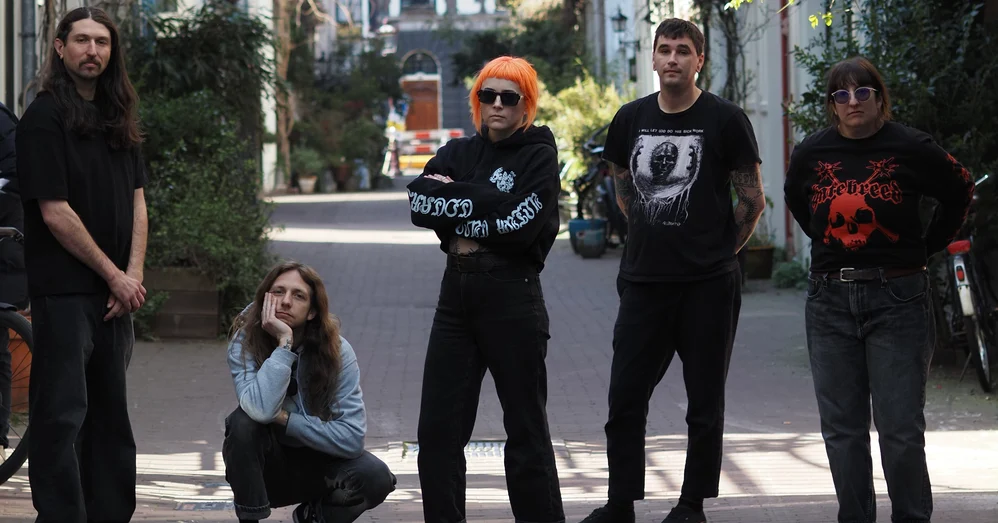
“TIRED OF BEING SCARED! EXHAUSTED BY THEIR HATE! NO LONGER LIVING TO APPEASE OR TO PLACATE!” sings a lone voice – in a tone of broken glass, open flames, and agony. It’s ‘The Chop’, the opening track from Portland punks Dry Socket’s second album, Self Defence Techniques. The quintet of Dani Allen, Geoff Hohn, Casey Nolan, Matt Taylor, and Jose Encheverria, their new album is an urgent hardcore purge against the downward pressure from systems of power to control us.
But Self Defence Techniques is powerful on another level. Riding on a wave of muscular riffs, Allen’s voice – a clenched fist of controlled hysteria – articulates a lifetime’s worth of being othered. “I grew up queer in a family where I was told that if I was gay, I would be disowned,” she says over Zoom as dawn is breaking. Allen describes her childhood as “questionable at best” and one where she felt silenced. “I had a home where I couldn’t express myself,” she explains. “That my feelings were not valid, that it was better to be quiet. I was really angry.”
Discovering her local hardcore punk scene when she was a teenager was a moment of self-recognition. “It was the first time I felt accepted in having feelings,” Allen says. “With the childhood I had, without punk and hardcore I would maybe not be here.”
She remembers being powerfully captivated by seeing Californian hardcore punks Look Back and Laugh, fronted by Tobia Minkler. “I was very young and it was the first time I had seen a female person fronting a punk or hardcore band,” she recalls. “She was hanging off some rafters, going wild. It was not socially acceptable! She was purely angry and not trying to imitate masculinity. It felt like permission.”
Hearing the socially charged lyrics and between-song banter was also important for the young Allen. “Coming from a pretty conservative family where people didn’t say things like that, I resonated with the political side of things.” Further education came from a bookseller who would have a table full of books at shows. “I would buy a book at every show, like I bought a book about the Rwandan genocide which I would have never learned about at school. It introduced me to a world bigger than my own and taught me about having compassion for other people.”
Allen fibbed about being able to play bass to get into a band and began her musical career. Formed with friends from the scene, Dry Socket began just before the pandemic, but Allen’s medical conditions meant they were hesitant to start playing venues again post pandemic. “I have POTS (a nervous system disorder), EDS (a condition which affects the skin, joints and blood), and MCAS (an immune disorder) so I am high risk,” says Allen. “We waited a long time (before playing again). We had our first show booked and then my dad died of Covid. And I was like, ‘I’m not playing shows anytime soon.’”
After a series of one-off singles, EPs, and split singles, the band’s debut album, 2024’s heavy Sorry For Your Loss, was a swirling cauldron of emotions. “I wasn’t ok at that time,” says Allen. “I had been diagnosed and I was grieving my dad who I had a complicated relationship with. A lot of those lyrics were me crying on voice notes.”
Allen’s high-risk health conditions mean that touring is dangerous. “I wear a back brace because my EDS means that my joints slip out of place.” She also wears a hand brace and has an “assisted thing” on her microphone because too much gripping leads to hand immobility. “Also because of POTS I don’t get enough blood flow to my brain, so I don’t remember a lot of our sets.” She admits she has to lie to her doctor “a bit,” saying, “Honestly, I shouldn’t be doing what I do.” At the same time, she is a rare and vital figurehead for her community. “I’m showing up for other people who have chronic illness. That’s why representation is so important. So many people don’t get that. Especially with the disabled community where (your disability) is not necessarily visible.”
These very real life or death high stakes give another dimension to the urgency of Dry Socket’s music – a death-defying rawness that cuts through when you’re listening to Self Defence Techniques. “I wanted to write an emotionally angry album about everything that’s going on now,” says Allen. “It feels really uncontrolled for most of us, like we don’t have choice in how we interact in the world right now.”
The lyrics on the ‘Ace of Spades’-ish ‘Clenched Fist’ (“Their budget is our obituary when death costs less than dignity/ Math disguised as mercy as we vanish statistically”) touches on Allen’s own health struggles. “That song is about being disabled in America,” she says, “we are being reduced to numbers on a page by CEOs and politicians, who are making a butt ton of money. They act like your life is not worth saving.” While ‘Rigged Survival’, which goes from Black Sabbath riffs to a Black Flag-ish swirl, with its end of days lyrics (“Hands of greed, mouth of lies”) tackles wealth inequality and systemic greed. “That’s probably the most straightforward song, in terms of being extremely angry at billionaires like Elon Musk who own all the wealth. While things have been getting progressively more expensive everywhere.”
Allen’s Cassandra in the coal mine lyrics makes Self Defence Techniques a vital but shocking album, a snapshot of the darkness of the world today. It also makes Dry Socket one of the most important bands around right now.
Dry Socket’s Self Defence Techniques is out March 27 via Get Better.

