

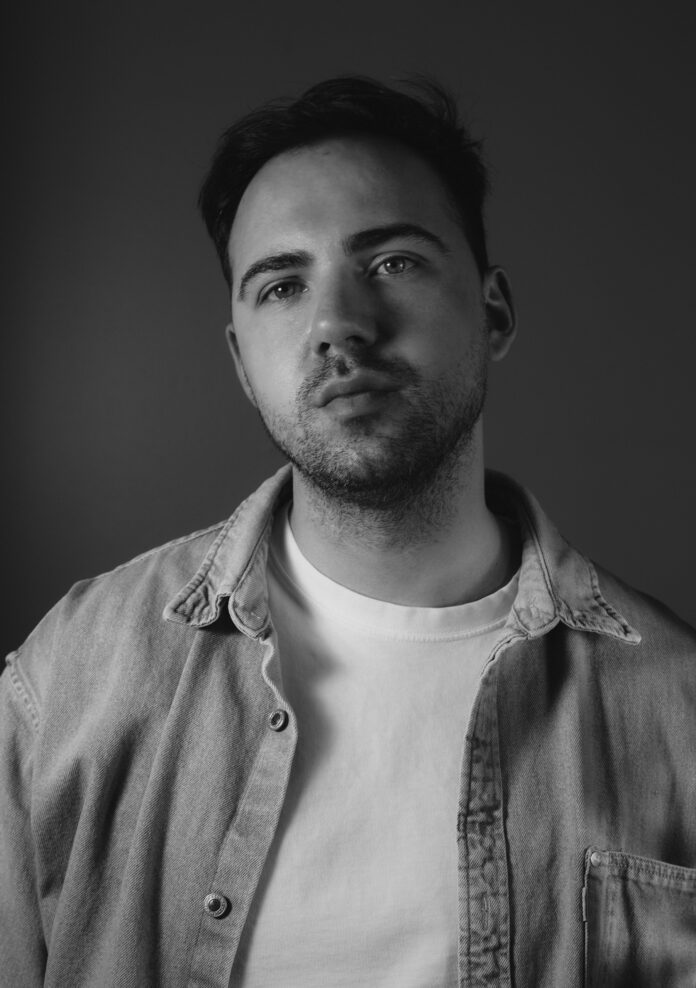
Ivan Chebotar works between two lived coordinates: he builds his daily practice in Pittsburgh, and he edits with the memory of Ukrainian streets that shaped his visual language. This interview starts from that concrete split, because his strongest images are not abstract statements about time—they come from repeated walks, careful sequencing, and close attention to how public space records pressure.
His recent international milestones are measurable and specific: the International Breath of Time Award in Photography (2024), the ARTENO International Art Awards 2026, jury service in Serbia and Italy, and exhibitions at A.L.L. Gallery and Deep Reverie Gallery. Those contexts widened the audience for his work, but they also raised the standard he applies during editing and presentation.
Across Streets and Emotional Echoes, Chebotar keeps returning to the same working questions: what can a photograph verify, what can it carry without exaggeration, and how should an artist balance commissioned production with long-form inquiry. In the conversation below, he answers those questions in practical terms—through process, sequencing, and responsibility to subjects.
You now work from Pittsburgh, yet your pictures often feel connected to a longer Ukrainian timeline; how does place function in your daily practice?
Ivan Chebotar: Pittsburgh gives me a working ground where change stays visible. Neighborhoods shift, light behaves in hard seasonal rhythms, and the social texture of the street remains legible when you spend real time inside it. I photograph here with patience, then I review contact sheets with a second layer of attention that comes from Ukrainian memory. A wall, a bus stop, or a crossing can carry visual pressure far beyond its local context.
I do not force direct parallels. I work through observation, sequence, and return. Over months, certain motifs keep reappearing: pauses before movement, faces in transit, architecture that seems to hold previous lives. That repetition is where place becomes method. Pittsburgh is the immediate field, while Ukraine remains an internal compass that shapes how I read time, fragility, and civic endurance.
Your International Breath of Time Award in Photography in 2024 brought strong attention to your treatment of temporality; what changed after that recognition?
Ivan Chebotar: The award did not change my core intention, yet it sharpened responsibility. Once a project receives international visibility, each next decision enters a wider critical space. I became stricter during editing and less interested in single-image impact. I wanted each frame to justify its place inside a sequence that could hold up over years, not only during a brief cycle of visibility.
Recognition also expanded dialogue with curators and peers who read time as structure rather than theme. Those conversations helped me refine pacing in both still and moving image work. I now build projects with clearer internal rhythm: where to open, where to hold tension, where to leave silence. The result is a calmer surface with deeper pressure inside the work.
At ARTENO International Art Awards 2026, your photography was praised for emotional precision; how do you build intensity without slipping into sentiment?
Ivan Chebotar: Emotional precision begins in distance. I avoid telling the viewer what to feel. Instead, I focus on framing, duration, and material detail so feeling emerges through encounter. If a photograph leans too heavily on symbolic shortcuts, it loses dignity. I prefer images where meaning arrives through texture, gesture, and interval, because that path leaves room for the viewer’s own memory.
During post-production, I remove frames that perform emotion rather than carry it. This step can be severe, yet it protects the project from overstatement. Precision means choosing images that remain active after repeated viewing. A strong picture should keep opening, with emotional force growing through structure instead of rhetorical emphasis.
You served on the jury in Serbia in 2024; what did that role reveal about current international photography?
Ivan Chebotar: Jury service in Serbia exposed a wide range of visual languages from different regions, and the strongest works shared one quality: they had a clear position toward reality. Technical confidence was common. What separated memorable projects was ethical orientation, the sense that the author understood where they stood in relation to the subject and the public sphere.
The jury process also clarified my own standards. I started asking sharper questions during my edits: Does this frame advance thought? Does it carry witness, or only style? Can it survive outside its immediate context? That discipline stayed with me after the event and shaped how I build portfolios for exhibitions and publications.
In Italy, as a juror for the Time Vector International Cultural Art Event in 2025, did you encounter a different visual discourse?
Ivan Chebotar: Italy brought a strong awareness of visual history into the room. Many submissions engaged with lineage, craft, and formal memory in explicit ways. Discussions frequently moved between contemporary urgency and historical vocabulary. I appreciated that depth, since it pushed judgment beyond immediate reaction and into longer evaluation of coherence, sequence, and conceptual durability.
That environment influenced my own working rhythm. I began reviewing projects in stages that mimic jury thinking: first visual impact, then structural consistency, then historical relevance. The method slows decision making in a productive way. It prevents premature closure and keeps the project open to necessary revision.
Your exhibitions at A.L.L. Gallery in Italy and Deep Reverie Gallery in Serbia placed similar themes in distinct contexts; how did audience response differ?
Ivan Chebotar: In Italy, viewers often entered through formal questions: color temperature, interval between frames, and compositional rhythm across the wall. Conversations were detailed and analytical, with close attention to how sequencing produced argument. That mode of reception was valuable because it tested the architecture of the work at a very high level.
In Serbia, discussions more often moved toward biography, historical memory, and civic tension. People read emotional stakes quickly and connected the images to lived social experience. I value both responses. Formal reading protects craft integrity, while lived reading confirms that witness remains active beyond institutional language.
Streets has become central to your public profile; what question drives that series today?
Ivan Chebotar: Streets asks how a city records pressure in ordinary time. I am interested in moments where people move through shared space while carrying private weather that remains visible for one brief second. The series avoids postcard urbanism. I search for civic texture: uncertainty, adaptation, fatigue, and persistence mapped onto sidewalks, facades, and transient gestures.
Practically, the project depends on repetition and return. I walk the same routes across seasons and different hours, then build sequences that reveal slow transformation rather than single dramatic events. Over time, the city becomes an archive of traces. That archive tells a sharper truth than any isolated iconic image.
Emotional Echoes feels quieter and more interior than Streets; what shift in method produced that tone?
Ivan Chebotar: Emotional Echoes required a slower aperture of attention. I reduced visual noise and moved closer to intervals where memory enters the present through small signs: a glance, a pause, a surface marked by wear. The project grew from the need to record afterimage rather than event, with each frame holding a delayed emotional charge.
Methodologically, I edited for resonance across distance. Images that looked modest on first pass often became essential once I viewed them in sequence. They carried the low-frequency signal of the work. This taught me to trust quiet evidence and to allow silence to do part of the narrative labor.
How does Ukrainian memory enter your images without reducing them to biography?
Ivan Chebotar: Ukrainian memory enters through orientation, not through display. It shapes what I consider significant: thresholds, interrupted routines, civic surfaces marked by endurance. I avoid direct illustration of trauma when it risks flattening complexity. Instead, I work with exact observations that carry historical weight through structure and relation.
Biography can open context for a viewer, yet the image must stand on its own formal and ethical logic. My task is to build photographs where memory is active in composition, timing, and sequencing. When that happens, the work remains specific and still travels across cultures.
You often speak about witness; what does witness require from a photographer in practical terms?
Ivan Chebotar: Witness requires accountability to place, time, and intention. I need to know where I stood, why I framed in that direction, and what relation I had to the subject at that moment. This is a working ethic, not a slogan. It influences shooting distance, editing choices, and the order in which images are presented to the public.
In practical terms, witness also means resisting visual overproduction. I would rather publish fewer frames with strong evidentiary clarity than release large sets that dilute meaning. Accuracy in context and sequence matters as much as visual strength. Without that discipline, witness collapses into style.
You are a photographer and videographer; how does motion work influence your still-image sequencing?
Ivan Chebotar: Video trained me to think in temporal units, so I build still-image sequences with attention to pace and transition. A photograph can function like a cut, a hold, or a bridge depending on what surrounds it. I use that logic when ordering a body of work for print, exhibition walls, or digital publication.
Motion work also sharpens discipline around continuity. Even when a still frame is autonomous, it belongs to a larger current of perception. I evaluate each image for directional energy, gaze flow, and emotional temperature. This process creates a sequence that breathes with controlled variation rather than random alternation.
Your certified 60 Second Photographer training in 2025 suggests speed under pressure; how has that informed long-form projects?
Ivan Chebotar: The training developed fast decision architecture: identify priority, lock framing, control exposure, and commit. In documentary conditions, those skills reduce hesitation and preserve authenticity of fleeting moments. Speed in capture can coexist with depth in project design when each phase has a clear purpose.
For long-form work, the benefit appears during editing. Rapid capture teaches respect for clarity. I no longer confuse delay with seriousness. Instead, I spend effort where it matters most: sequence structure, narrative interval, and contextual notes that protect witness value of the final body of work.
How do you handle the tension between commercial assignments and artistic inquiry?
Ivan Chebotar: I treat the two domains as distinct contracts. Commercial work asks for precise communication under external constraints: brand language, schedule, deliverables, and audience objective. Artistic work asks open questions and accepts uncertainty as part of discovery. Keeping this boundary explicit protects integrity in both directions.
At the same time, each domain contributes useful discipline to the other. Commissioned projects strengthen production reliability and technical agility. Personal projects protect risk tolerance and conceptual depth. The tension remains real, yet it becomes productive when intention, context, and evaluation criteria stay clear from the beginning.
Many artists romanticize that divide; you describe it in operational terms. Where did that pragmatic approach come from?
Ivan Chebotar: It came from lived schedule pressure. When deadlines, budgets, and collaborators are involved, romantic narratives provide little guidance. I built a workflow that separates project intent, technical plan, and review checkpoints. This structure allows me to deliver professional results while preserving space for artistic research.
Pragmatism also supports emotional sustainability. Clear process lowers friction and leaves mental energy for perception, which is where artistic value is created. I believe discipline is a creative tool. It creates conditions where intuition can operate with greater precision.
Pittsburgh appears in your work as a city of transition; what does this landscape reveal to you over time?
Ivan Chebotar: Pittsburgh reveals layered transition: industrial memory, current adaptation, and uncertain future occupying the same visual field. Bridges, inclines, river corridors, and neighborhood edges become markers of social tempo. I am drawn to moments when infrastructure and human gesture intersect in ways that expose civic psychology.
Over time, the city teaches observational patience. Repeated visits to the same site show how light, weather, and public movement reconfigure meaning without dramatic events. That slow change aligns with my larger interest in time as lived pressure rather than decorative concept.
Your projects frequently return to displacement; how do you avoid reducing displacement to a single narrative?
Ivan Chebotar: Displacement has many registers: legal, linguistic, emotional, spatial, and temporal. I resist single-story framing by gathering scenes that show variation in adaptation and memory. Some images carry rupture, others carry routine rebuilt under new conditions. Together they form a more accurate map of lived experience.
I also pay attention to scale. A project needs public scenes and intimate evidence, architecture and gesture, movement and pause. This plurality protects complexity and prevents simplification. Displacement then appears as a dynamic condition rather than a fixed label.
When you edit a full sequence, what makes a frame essential rather than attractive?
Ivan Chebotar: An essential frame changes the reading of adjacent images. It introduces necessary tension, context, or transition that strengthens the whole argument. An attractive frame may look strong alone while adding little to sequence intelligence. I choose the first category, even when it appears visually quieter.
My editing passes move from broad structure toward fine calibration. Early rounds remove redundancy. Later rounds test rhythm, emotional gradient, and evidentiary clarity. I leave the sequence for a short interval, return, and read it again as a viewer would. If logic remains clear under distance, the selection is ready.
How has jury service affected your sense of risk in your own photographic decisions?
Ivan Chebotar: Jury service exposed recurring safety patterns in contemporary submissions: visual polish without conceptual commitment, trend alignment without personal stake. Seeing this repeatedly encouraged me to take clearer risks in my own work, especially during sequencing and project framing.

