

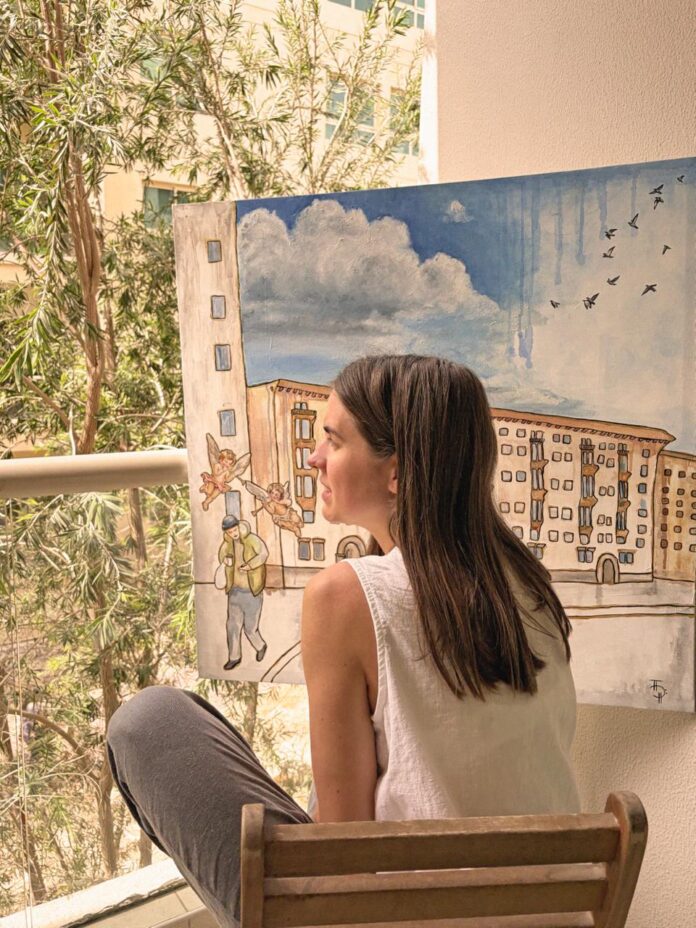
By Maria Bregman, a London-based art critic, writer, and curator. She has curated solo exhibitions for Zurab Tsereteli, president of a leading national academy of arts, and her criticism has been published in outlets such as ArtCulture.UK, Creativity’s UK, and international editions of ELLE, Cosmopolitan and Esquire. A member of several professional writers’ and journalists’ unions, her own literary work has been recognised with multiple international awards.
Blending the boundaries of visual and literary art, Olga Puzikova designs spaces of art where the mundane realities of life intersect with the hidden magic of life.
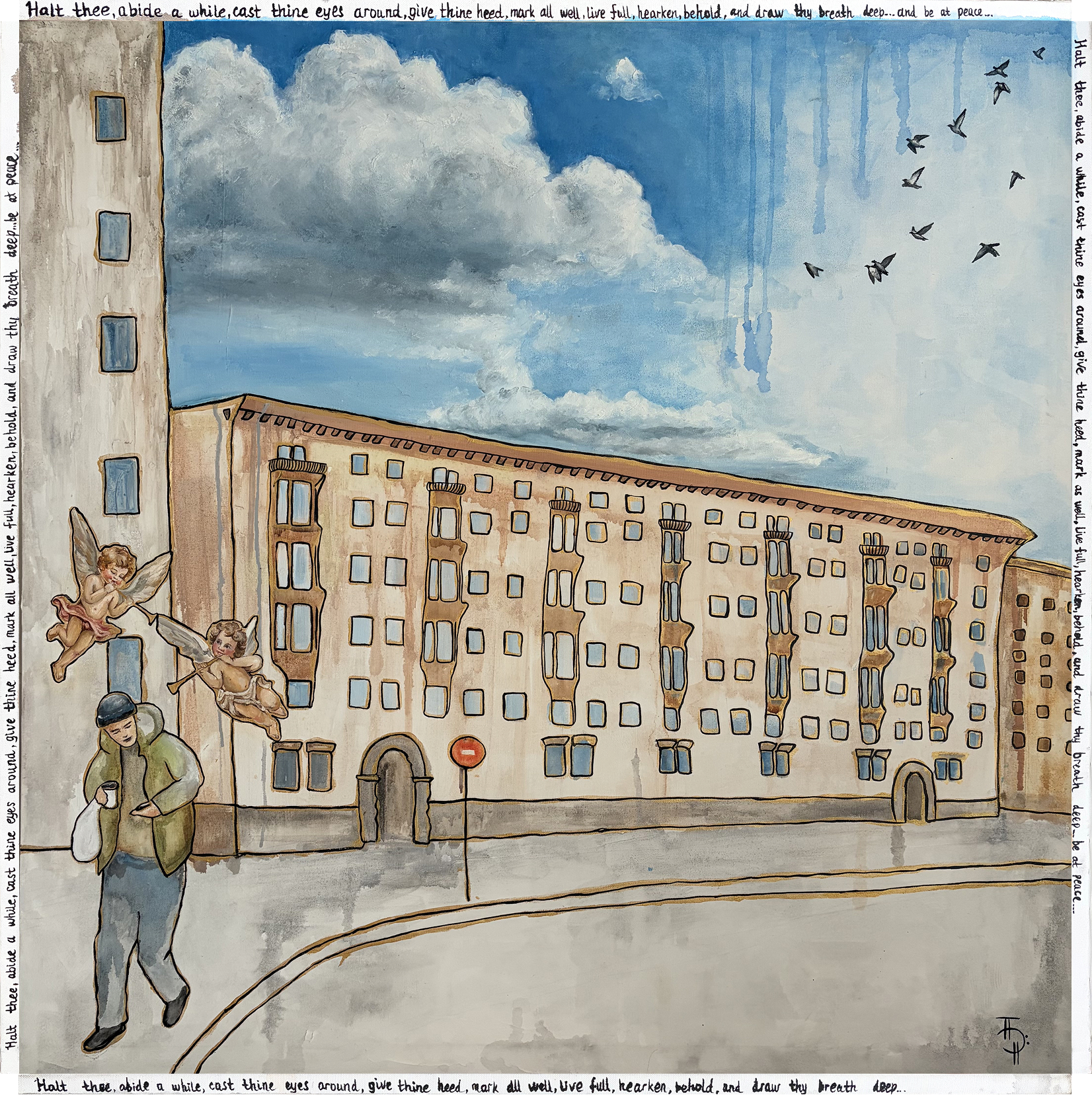
In the scene depicted in Olga Puzikova’s “The sky is blue.” (2026), a man is seen in haste walking past a stark and recognizable apartment block. He holds a coffee cup and is bent over in his haste to face whatever unseen burden awaits him in his morning commute. Yet floating above the pavement, unseen by the man in his haste, two cherubs blow trumpets into the cold air. To understand the scene properly, however, one must step to the side of the canvas. There, in archaic script along the side of the canvas itself, is written: “Halt thee, abide a while, cast thine eyes around… behold, and draw thy breath deep.” This is not only a demand upon the viewer but is itself emblematic of Puzikova’s journey as an artist. Born in Samara and currently residing in Dubai, Puzikova’s work is marked by the tremendous displacement of immigration and the personal displacement of motherhood. These kinds of tectonic shifts in life often serve to cleave an artist’s work in two. For Puzikova, however, it seems to have distilled it into something more essential. Having moved away from more broadly hopeful work, Puzikova’s more current work is marked by melancholy.
While moving away from earlier, perhaps more broadly optimistic imagery, she has created a space of melancholic reflection. Her classical training is the scaffolding for what has become a deeply conceptual, almost literary exploration of human fragility.
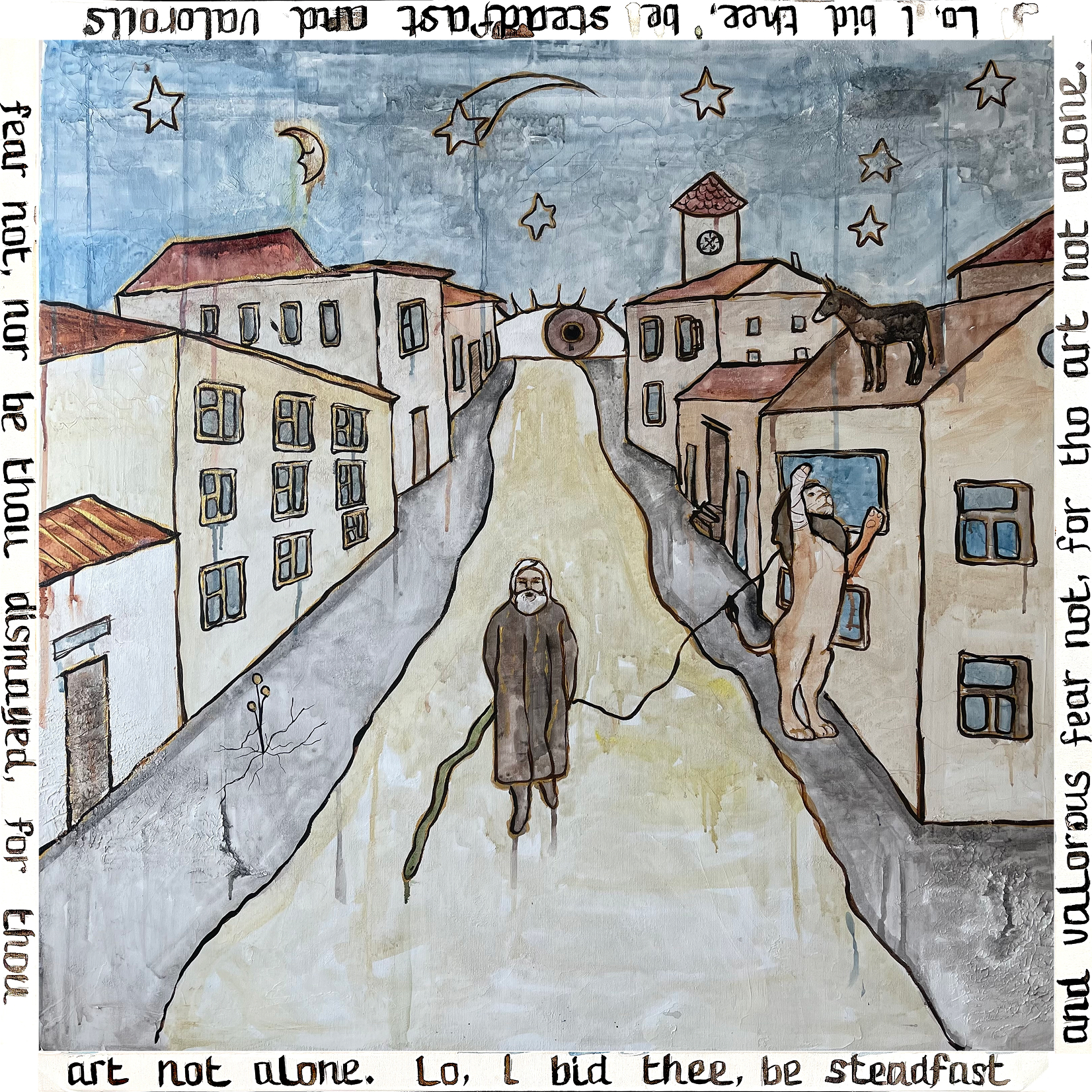
This narrative layering is taken to new depths in “Enigmatic City” (2025). Here, the story of Saint Gerasimos and the lion is enacted on a cotton stage. The imagery is subdued, slightly surreal, and theatrical, perhaps reminiscent of an artist such as Marcel Dzama, while the use of text is reminiscent of Moscow Conceptualism. Puzikova’s use of archaic English is part of her strategy of estrangement. By wrapping her images in phrases such as “fear not, nor be thou dismayed, for thou art not alone,” she creates a space between herself and our casual, throwaway use of language. The words have the weight of incantation, and we are forced into a slow and considered consumption of the image.
There is a similar resonance here to the use of text over traditional form as deployed by Grayson Perry to examine modern morality, although there is a sense in which Puzikova’s work is more existentially concerned than sociologically.
Her series “Questions and Answers” grapples with the moral and spiritual weight of modern life. In “Once at the Museum,” the writing around the edges of the piece discusses the constant process of “’twixt truth and falsehood, ’twixt faith and forsaking.” It is a heavy subject matter, but it is presented in a surprisingly gentle way.
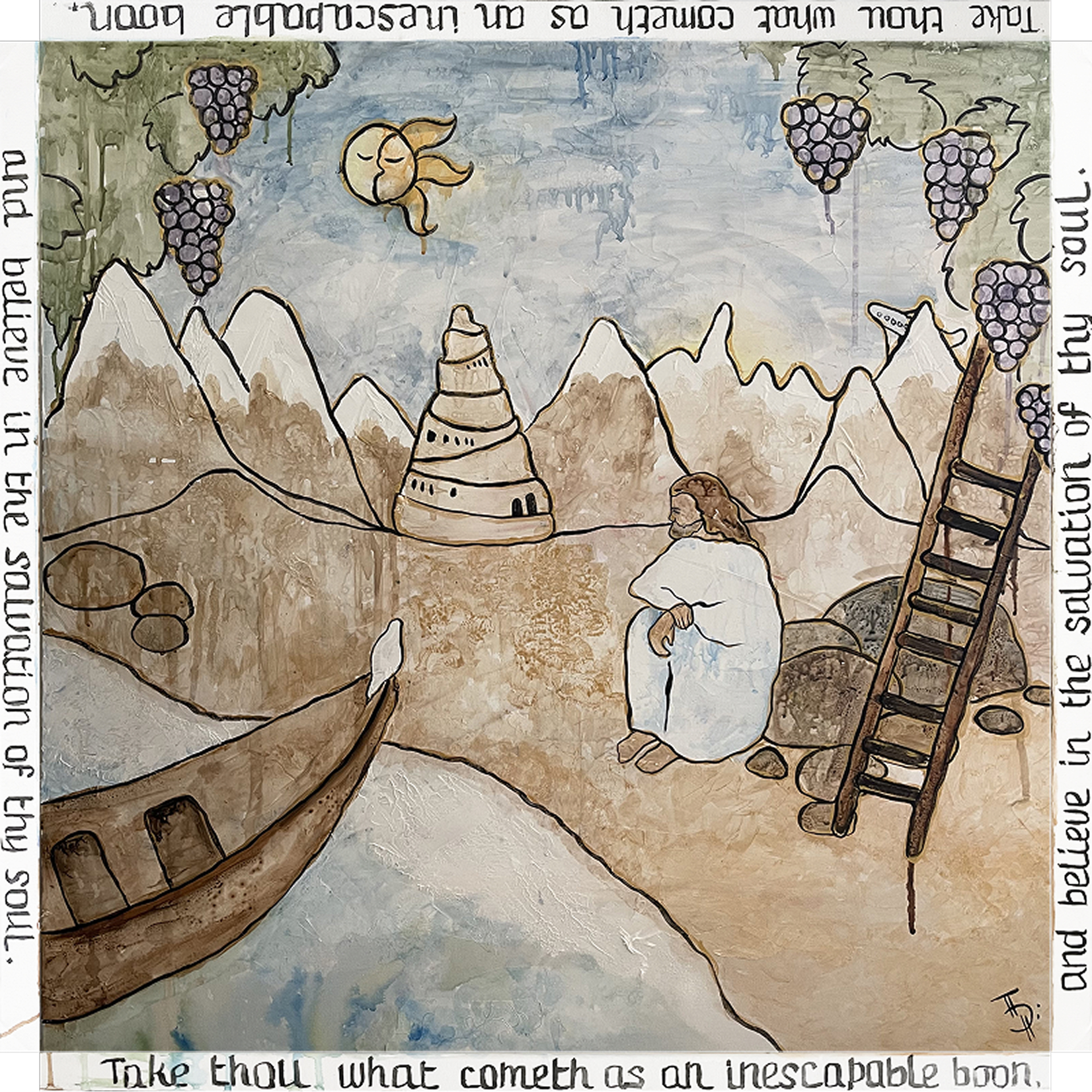
In her more representational work, such as “Catcher. (May the seeker be heard).” or “Between Hope and Despair,” there is a stillness and magic to her depictions of landscapes and solitary figures that reminds one of the work of Peter Doig in his more ethereal moments. A lone boat, a ladder leaning against a mysterious terrain; it is archetypal subject matter stripped of its grandeur and left with only its longing.
Puzikova’s current series of work may not scream for attention in a crowded room. It waits instead for those willing to look at it obliquely, to follow the writing around the edges of the canvases, and to see the hidden angels with their trumpets in the margins of our busy world.
By Maria Bregman, a London-based art critic, writer, and curator. She has curated solo exhibitions for Zurab Tsereteli, president of a leading national academy of arts, and her criticism has been published in outlets such as ArtCulture.UK, Creativity’s UK, and international editions of ELLE, Cosmopolitan and Esquire. A member of several professional writers’ and journalists’ unions, her own literary work has been recognised with multiple international awards.

