

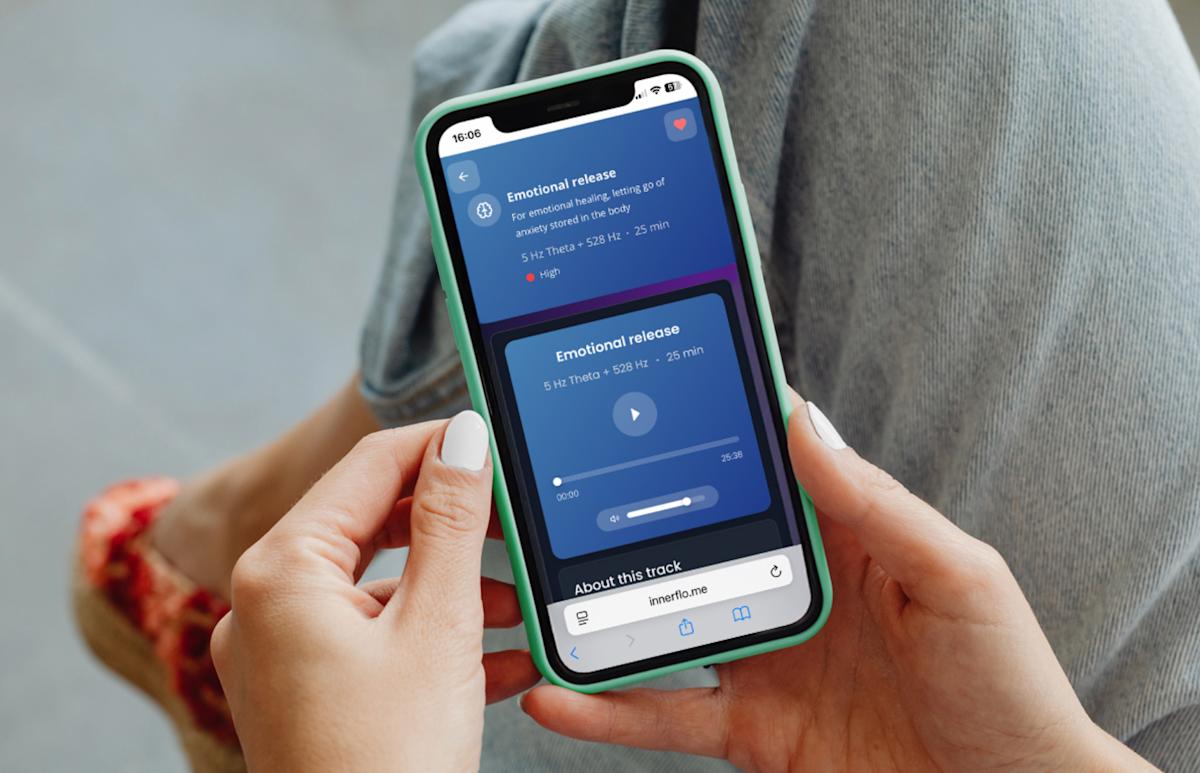
I have been hacking my own body for the better part of the last decade, as my stress levels, like many of you, are usually some combination of overwhelmed and on-the-verge-of-meltdown. I am a science nerd, so I know in my head exactly what cortisol is doing to my body.
That has little comfort when I am at 3 a.m. wide awake, replaying a conversation from three years ago as my brain refuses to power down. I wanted a more high-tech, passive fix, so I decided to give InnerFlo a shot.
I approached the platform with skeptical optimism. There are many digital drugs and apps out there that promise to solve your life problems via a set of headphones. But this one caught my eye because it did not simply offer the same old white noise. Instead, it promised a personalized frequency plan and support from experts in the field of neurocognitive musicology.
In this InnerFlo review, I will walk you through my experience with the tool over the past 3 months to see if the hype is real or if it is just another subscription to forget about.
InnerFlo at a Glance
InnerFlo is a sound therapy tool that claims to enable you to adjust to a new reality, where stress and sleepless nights have not become your new normal, with scientifically calibrated sound that places you in the exact mental state you require.
In simple terms, it works using a technique called brainwave entrainment. The specific form of entrainment InnerFlo uses is binaural beats, which attempt to alter your brainwave patterns to a target range such as Alpha for relaxation or Beta for focus.
What’s unique about InnerFlo, at least in theory, is the individualized plans; you’re not given a random track to listen to, you get a plan that is designed based on a comprehensive assessment of your mood, lifestyle, and objectives.
In this review, my aim is to cut through the marketing and offer you a no-nonsense, straight-talking assessment of this platform as it works in practice.
I’ll be taking an in-depth look at the features, the science behind how they claim to work, and the InnerFlo reviews from users around the web.
Why I Tried InnerFlo
I felt like I’d reached a stage where my revenge bedtime procrastination was triumphing and that I was too dependent on caffeine to just get through my morning rounds. I was looking for something that had a passive system of relief, something that I could play while I finished my charts, while I decompressed, and that didn’t have me having to actively meditate.
I also wanted to see if these claims of fewer cortisol-fueled days were just hype or if there was some quantifiable change to my level of anxiety.
I had read through some InnerFlo binaural beats reviews, which had left me somewhat curious as to what drove the chasm between those who reported transformational results and those who had trouble getting through the billing cycle.
I decided the only way to find out for certain was to strap on a good pair of noise-cancelling headphones and let the frequencies speak for a full three months.
First Steps With InnerFlo
Signing up felt less impersonal than other mindfulness apps I’ve tried that usually start with generic “how are you feeling?” questions. The onboarding process sent me to a 10-minute survey with specific questions about my stress levels, work environment, and even how many times I wake up at night.
It felt like the algorithm was attempting to chart my brain’s current baseline rather than just putting me in a “stressed user” bucket.
The platform then created a personalized plan based on my answers, breaking down my needs into five brainwave categories: Delta, Theta, Alpha, Beta, and Gamma. The sign-up process was quick and had nice visuals, but there were a few “one-time offer” screens that were pushy.
After the payment went through (I used PayPal for that added layer of security), I immediately received access to my daily routines and dashboard with my ideal session times.
Top Features of InnerFlo
The technical architecture of InnerFlo is where it justifies its existence in a crowded market of free alternatives.
Feature #1: Adaptive Frequency Selection
This is the magic of the platform in that it is performing what the developers refer to as progressive entrainment to prevent your brain from getting bored.
It has been demonstrated in research that the brain can habituate to a steady tone. So InnerFlo will slowly change the frequency during your 15-30 minute session to help maintain the entrainment in effect.
I discovered that I did not experience that drone fatigue that normally overtakes me when I listen to crappy binaural beats on YouTube for more than 10 minutes.
Feature #2: Personalized Soundscapes
I love that the oscillating hums aren’t the only thing I’m listening to. I can layer beats over top of high fidelity recordings of a fireplace crackling or rain on a tin roof.
The sound quality is so crisp. The platform even lets you control the volume of the fireplace separately from the amplitude of the beats.
Customizing this is important. If your ears disagree with the sound, it means your autonomic nervous system will remain in a state of hyperarousal. This would defeat the purpose.
Feature #3: ADHD and High-Focus Sessions
If you, like me, have the attention span of a distracted goldfish, the Beta and Gamma sessions are lifesavers.
InnerFlo creates these specific focus tracks to help you enter a heightened state of flow by keeping your brainwaves in the 14 to 30 Hz range.
I listened to these while doing my most intense research work, and noticed that I was scrolling my phone WAY less than normal during dedicated deep-work sessions.
What InnerFlo Gets Right
It’s clear that from a pure audio experience standpoint, the InnerFlo team has a solid grasp on neuroscience. But beyond the technical acumen that they’ve put into making this audio so effective, it’s the accessibility of the tool that stands out most.
I didn’t need to schedule a specific time to sit cross-legged or attempt to empty my mind. I could just pop the headphones on when washing the dishes or in bed. After 10 minutes or so, I would begin to feel my body relax.
It’s scientifically proven that listening to 10 Hz Alpha beats can measurably increase alpha power in the brain (the signature of a state of relaxed alertness).
In a very real and physical way, I also discovered that I was sleeping better; in other words, I was waking up less in the middle of the night, which the developers have tracked to Delta wave entrainment. This emphasis on utility also makes the platform feel less like a meditation tool and more like a life tool.
Where InnerFlo Could Improve
No software is perfect, and InnerFlo has few pain points that need to be addressed if it wants to maintain a happy user base. The first major oversight, which also happens to be the most obvious, is the subscription model which has prompted negative reviews across different platforms.
I also ran into some technical issues that disrupted the experience. A few times, the platform brought up a ‘no internet connection’ error even though I was connected to Wi-Fi, and it was working perfectly on all other devices.
Lastly, the checkout process is a little off-putting. The hard sell can make the brand feel disingenuous to new customers who just want a tool that works. Although, I understand the need to upsell, and at the end of the day it was not something that would make me change my mind about the platform.
InnerFlo vs. Competitors
It would be misleading to suggest that InnerFlo doesn’t face stiff competition, because it absolutely does. But when you put it up against something like Calm, the differences couldn’t be more obvious. Calm is very story- and visual-centric, while InnerFlo is all about the music and, more importantly, the raw frequency entrainment.
Headspace is a fantastic option if you like guided meditation, but if you find yourself easily distracted by the voiceovers, you will probably be better served with the extended focus on non-verbal soundscapes that InnerFlo provides.
Brain.fm is probably the one it is competing with most head-to-head, as the two apps are in many ways quite similar, both employing AI-curated music to help you focus. But InnerFlo’s quiz is more involved, and your resulting session will generally feel more finely personalized.
BetterSleep is an infinitely more capable all-in-one sleep hub, if that’s what you’re after, complete with sound mixing, story narrations, and more, but InnerFlo has more of the vibe of a focused clinical instrument.
Finally, we have Hemi-Sync, which is binaural royalty with a massive scientific pedigree and over 30 years of research behind it. The problem is that their mobile app experience is basically a time capsule from the 90s.
InnerFlo is a thoroughly modern tech product that allows these higher-tier brainwave entrainment tools to become much more approachable to a mainstream audience.
What Other People Say: InnerFlo Reviews Online
User reviews about InnerFlo are split between a premium product offering and questionable business practices. As expected, the audio technology used in InnerFlo has been well received. The complaints have generally been made about recurring charges.
Positive comments about the efficacy of InnerFlo focus on its functionality. Ivana Bubanja has pointed out that “The sound quality of InnerFlo audio is thousands of times better than the free binaural beats on other streaming services.”
Dorina Miclaus has made a similar observation: “The sounds are a lullaby for the mind…turning the mental speech off is the real miracle.” It is easy to see that such user testimonials are being delivered on the product’s central value proposition of neurocognitive musicology.
Negative reviews on sites like Trustpilot, however, present a stark contrast of unexpected and unexplained charges. One specific objection has been a lack of transparency about renewals.
Cancellation issues are also frequently raised. When Debra Dabbs deleted her account and emailed support three days before her trial period ended, she was still charged $34.99. She had to submit email before being granted a refund. She finally received a refund from the company.
Refunds, Support, and Transparency
Fixing billing problems or getting technical support is only possible by emailing support@InnerFlo.me.
Some users say that it is quick and that they received great support, but for others, it has taken several weeks before they received any kind of answer, and some have even had their support requests disregarded. The unreliability of the support channel is risky to use in a financial dispute.
The provider is very strict when it comes to refunds.
When it comes to deleting the account, the provider is contractually allowed to make you wait for a month. The reason they give is that it is a cooling-off period that allows you to have a change of heart.
If you live in the European Economic Area, take notice of the small print when it comes to your rights as a consumer. Some of the protections might be much more difficult to act upon if the provider, in their legal papers, does not identify themselves as a traditional trader.
Thoroughly read the TOS before you attach your primary credit card to the service. It is not unheard of that people end up charged hundreds of dollars with no way of recourse, and with so many people reporting issues with billing, it might be safer to test the waters with a virtual card.
FAQs: InnerFlo Explained
What is InnerFlo?
InnerFlo is a guided sound therapy platform that uses binaural beats to transport your brain to the exact mental state you want to achieve. It’s much more than your typical white noise tool, with a comprehensive onboarding survey used to generate a frequency plan that is personalized to your current level of stress and your goals.
By sending slightly different frequencies to each ear, the platform gets your brain to match its electrical output to that of the target state, be that laser focus for research or deep relaxation before sleep.
Does it really help with stress and sleep?
The science of auditory entrainment has shown that frequencies within the Alpha and Delta ranges can help to optimally balance the nervous system. Alpha waves are 8-13 Hz brainwaves typically associated with a state of relaxed alertness.
Delta waves (0.5-4 Hz) are the foundation of deep, restorative sleep. By listening to these beats, you can nudge the nervous system out of a high-cortisol stress state and into a much more balanced one. In addition, as this entrainment is passive, it is often easier to ‘sit’ with than active meditation, as it requires no effort on your part.
Is it safe to use?
It is a safe and non-invasive tool for most people. However, since it uses repetitive auditory stimulation to induce brain activity, it may not be suitable for all users.
If you have a history of epilepsy or are prone to seizures, it is essential to consult with a medical professional before using the platform. It is also recommended that individuals with pacemakers or who are pregnant consult a doctor before use
Final Verdict: InnerFlo in a Nutshell
I’ve now gone through the entire 90-day cycle and can confirm that the brain hacking aspect of InnerFlo is real.
The personalization did impact my day-to-day brain fog levels, and the sleep sessions were among the few things that kept me going during my intensive hospital rotations. For long work days and the chronic cognitive strain of hospital life, having a passive way to downregulate my nervous system was a real lifesaver.
It is a nice product if you are looking for a science-based, passive way to downregulate. It is a nice gap filler for folks that don’t have the time/patience for meditation practices but still want to have a way to keep cortisol under control.

