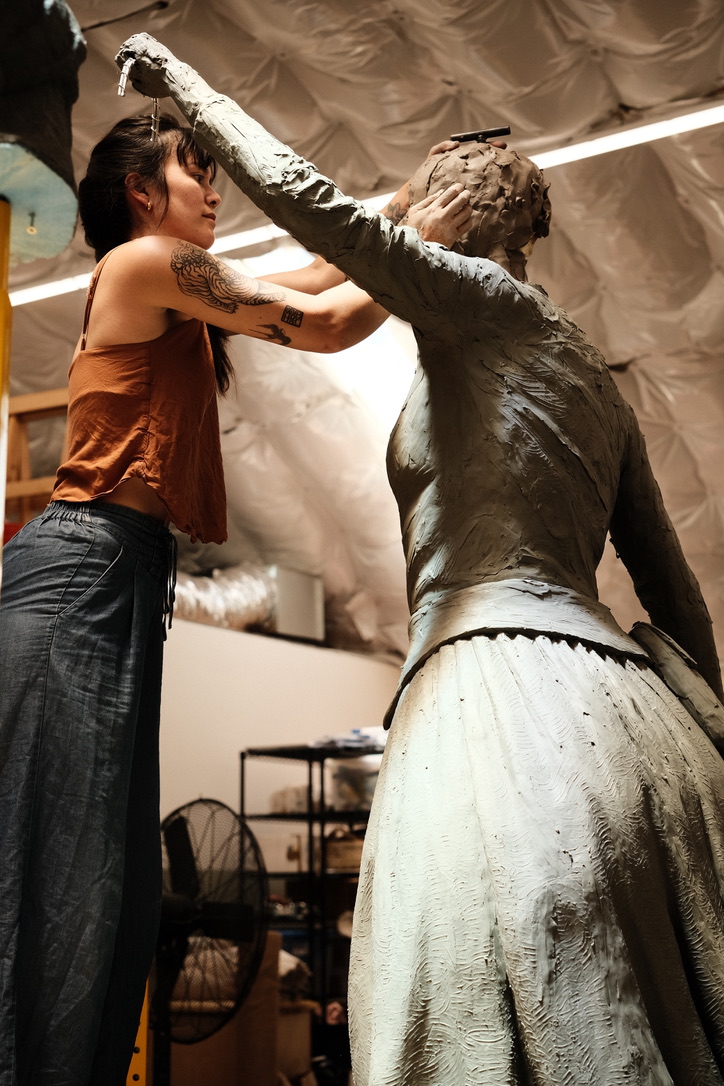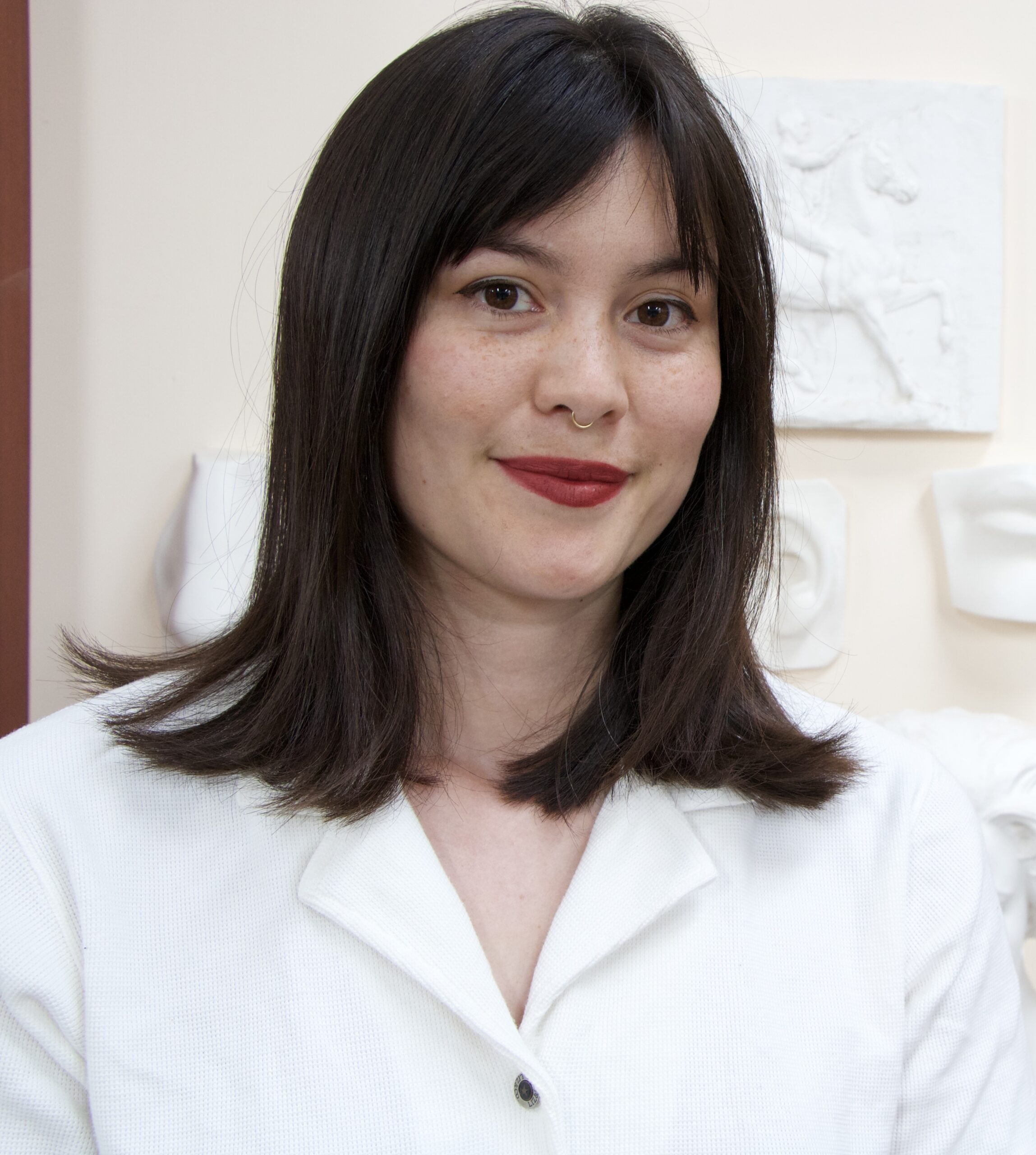
Zoe Dufour (b. 1990, Thailand) is an artist and sculptor, currently maintaining a studio in Northern California. Her work is primarily centered on the human form as a direct visual way to communicate to one another in an emotional or allegorical way. She studied with Gerald Heffernon and at the Ashland Academy of Art before graduating from Grand Central Atelier in NYC. Following her graduation, she worked at the prestigious Studio EIS and led the sculpture program at Grand Central Atelier until 2019.
After a decade of living and working in NYC, Zoe opened Saypience Sculpture in California in 2019 and continues to work on a wide variety of projects across the United States, the most recent of which is a monumental scale bronze sculpture of Harriet Tubman, installed on Binghamton University’s Campus in New York in 2025.
Our Culture spoke to Zoe about her early inspirations, artistic collaborations and all that we can learn about the human form from sculpture.
How did your love for sculpting begin? Was there a moment early on when you realised it was the right medium for you?
I think I always loved three dimensional mediums, I took ceramics classes when i was a child and would create all kinds of animal sculpture. I loved all tactile crafts, and would design and sew stuffed animals too. However, I didn’t know sculpting could be a career until I was 23, when I met my mentor and teacher Jiwoong Cheh. I took his class in my third year at Grand Central Atelier, and I immediately loved sculpting. It felt like something I could love, even on the days I was struggling with it. I saw how Cheh had made his career work, and it gave me some tangible examples of how possible it is to sculpt professionally, and I just threw myself in that direction.
In works like Mental Growth, you bring together florals and sculpture in a really distinctive way. How did that idea develop, and what draws you to working with floral forms?
For that piece, I worked with an incredible florist, Alyssa Benner, who I met through mutual friends. I had asked her if she wanted to collaborate with me on some new sculptures I was making that were also vessels, and she was excited to make compositions together.
I also personally just love growing things and including organic materials in my work. I come from a family of farmers and spent a lot of time outside with plants, and I am fascinated by ethnobotany. I think there is a lot to explore in how we co-evolve and intersect with our environment, and plants are a huge part of that equation.
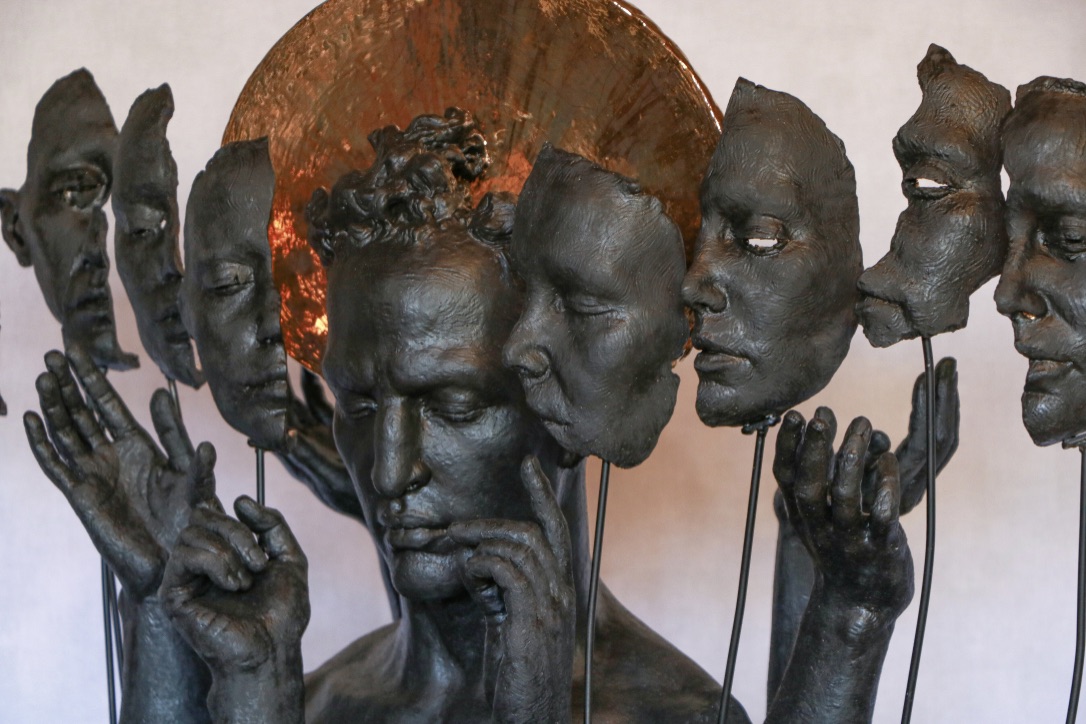
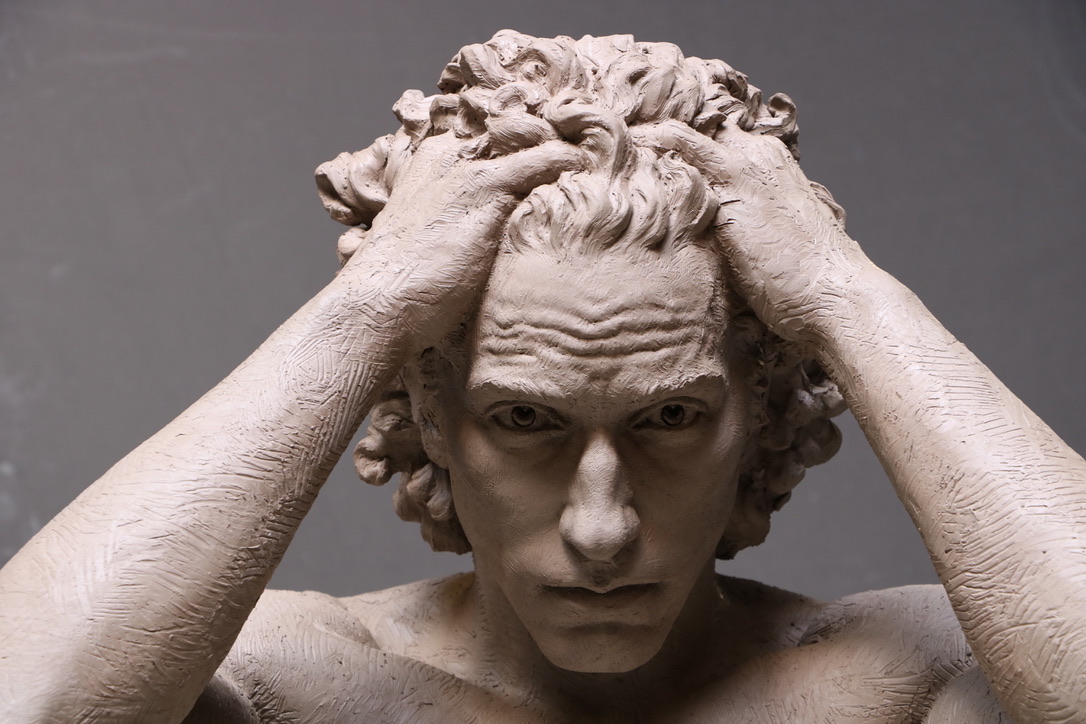
Your figures often emphasise expression rather than neutrality, from furrowed brows to subtle shifts in gaze. What draws you to capturing that fuller range of emotion?
I think as humans, we are all trying to understand the human condition. We all struggle with the meaning of life, love, loss, hope, joy, anger, sadness… and that overlap in experience we can share is what allows us to connect across time and social structures. I’m interested in being able to create reciprocal relationships between my work and the viewer that are built on pathos. Expressions are fleeting, so capturing one feels like a way to call a viewer into feeling with the art, rather that being a bystander.
What has working in sculpture taught you about the human form?
In my time sculpting, I’ve studied from life extensively, and I learned that we are all the same, essentially. We are all variations of the same pattern, which is really beautiful.
I love that the kind of observation required to study from life doesn’t contain the same type of negative judgments we often apply to people’s bodies societally. It’s an almost abstract way to see, where everything that makes up a person becomes a series of forms that just are, and are lovely the way they are. Observing people this way has made me more aware of my own subconscious biases.
Do you see your sculptures as portraits of specific individuals, or more as emotional states?
Generally a little of both. Most sculptures are based on an individual, but I do like the adage “in the specific lies the universal”. I’m trying to capture something that others can relate to, in that individual.
What are you currently exploring that feels new or different in your practice?
I’m experimenting with some new mediums, and some new methods of making that are textile-based. I’m sourcing more materials locally that are inspiring to me. I’m still in a research phase, but I’m hoping to have a small body of new work at the end of this year.
I’ve been trying to dissolve some of the rigidity I have in how I conceive of my work, that was created in my time in a hyper-academic training.
It is easy for me to stay in the pursuit of technical skill, rather than making art that has a narrative with the skill I have, because learning is such a rabbit-hole, and so compelling.
Are there any artists or creatives you have felt especially inspired by lately?
I love Ruth Asawa, and I’ve been looking at work by Noe Kuremoto, Hidaka Ohmu, and Do Ho Suh. I’m also rereading David Abrams.