

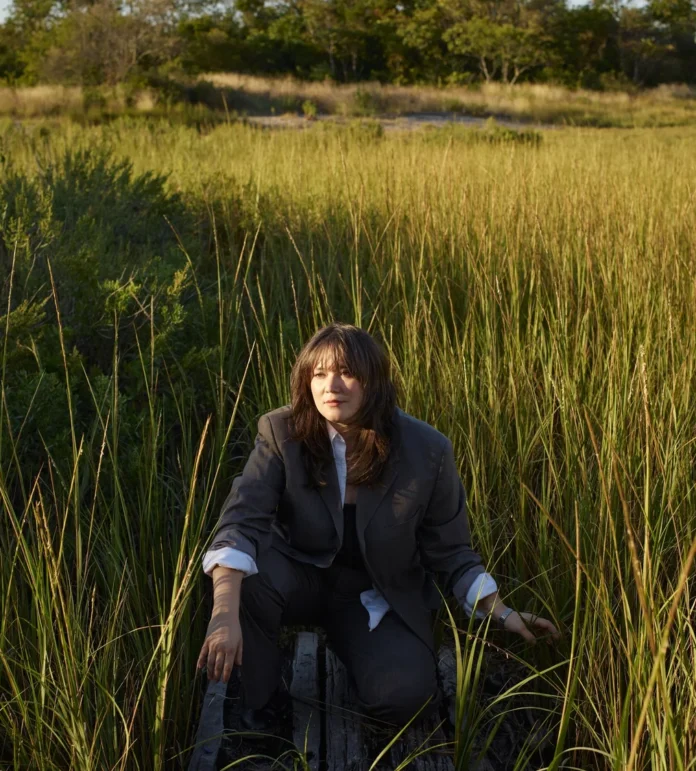
Wendy Eisenberg is a singer-songwriter, guitarist, and composer who grew up in Washington, D.C., where they started writing songs shortly after picking up their mother’s guitar as an 11-year-old. Jazz education became a part of their upbringing when they attended a preparatory school in Maryland, and they went on to study at the Eastman School of Music and the New England Conservatory of Music. A restless, ambitious collaborator, Eisenberg’s improvisational spirit and instrumental virtuosity have carved a luminous path from their early days in Birthing Hips to recent work as part of acts including Editrix, Squanderers, and the Bill Orcutt Guitar Quartet. But the New York-based artist has been equally flexible and curious in their solo output, which spans almost a decade.
If 2024’s Viewfinder sought to loosen the parameters of the conventional song form, their new, self-titled album leans into the timelessness – or, more precisely, the eternal weirdness – of classic songwriting, in part as a call back to the inner child that began to show curiosity around it. As playful and genuine as it is beguiling, Wendy Eisenberg is shaped by its contributors – bassist Trevor Dunn, drummer Ryan Sawyer, and co-producer Mari Rubio (aka more eaze) – in different ways than its predecessor, warmed by their camaraderie while mourning past lonelinessess. “Looks like luck’s inherent humour pushed you past your sense of loss,” they sing on the opener. So when Eisenberg describes self-titling as a “locus point for jokes” that “offsets its vanity by making you laugh,” it’s not a bad way of looking at what makes life itself transcendable.
We caught up with Wendy Eisenberg for the latest edition of our Artist Spotlight series to talk about their somatic understanding of songwriting, referentiality, their collaborators on Wendy Eisenberg, and more.
I get the sense that the new album emerged from a place of loneliness, or the memory of it, while reaching for a kind of communal embrace. How do you see that progression in your music?
I’ve been writing songs as an adult for a long time now. My first proper adult songs were when I was 22, and I’m 34, so that’s 12 years of really dedicated writing by myself, mostly, and then trying to affix a band to it after. The songs were so much more insular, they were about the impossibility of being known, and this record is so much more about the possibility of being known. It’s not exactly written for the band in a sense of I’m writing parts for these people, but it is written for a band in the sense that there’s actually people who want to go with me to make these songs sound complete. These songs are about how destabilizing togetherness can feel after feeling alone for a really long time. I felt really weird forever, and I imagine you do too, because you write about music, so you’re probably looking to music to provide you with this sense of comfort, challenge, interest, and mystery. But if you do that for long enough, and something changes, it’s totally freaky, because you’re like, “How is it possible that I’ve been living alone this life when I could have had these friends?” There’s a little grief for your younger self who could have really loved this other way of living, and there’s a lot of shock, where it’s like, “Why do these people like me so much?” It puts everything in check.
I think I wrote these songs for the parts of people who are unsure after long periods of solitude, how to re-enter the world, so it’s kind of a post-COVID record in that way, maybe. I think we become so used to one way of living that we create the script, and then we’re stuck in that way of living, like, “I’m a lonely person.” These statements become kind of dictums, maybe even religions. But the record is really about how that can change. I actually feel a relationship with the 12-year-old me who is starting to write songs – feel like these are the songs that would come from the world that you wanted to always be in.
You share a memory of that 12-year-old self on the final track, ‘The Wall’, where you realize that the songs you’d write then weren’t so different from the one you’re singing. When you follow the impulse to write now, how often does it feel new or childlike in that way, and how often does it feel haunted by past impulses?
I think when I write, I’m genuinely ageless. I try not to be present in the way that I’m talking to you now in an interview. I’m conscious of the choices I want to make musically, but they’re not coming from some definition of a self that has a personality that’s static in any way. It was an older song on the record, but it’s totally a through line to one I would write when I was younger. When I was younger, I felt like I was writing songs that an older person would write, kind of consciously, because I wanted to learn how to write. I think that’s pretty classic. But as I’ve gotten older, it’s not like I’m trying to write a song that my 12-year-old self would explicitly write, but I want her to be along for the ride. If I were to come into, like, “What’s a song your 12-year-old self would write?” self-consciously, you would create all these pre-existing misreadings of what they would want.
The memory will, because it’s memory, always be incomplete. And it will always be this misunderstanding, because if you assume the form of something that might come back, if you’re haunted by a past – which, I’m struck by that phrase in your question – it doesn’t really have form. You’re haunted by something that feels like a recollection you can’t see or really put your finger on, but you know it’s from someplace prior, some time prior. But, at least for me, my experience of that is never like, “I’m scared by this one particular form.” It’s actually, “I’m scared by the feeling that whatever thing that’s arising is eliciting in me.” And so the feeling is a little bit more diaphanous, a little bit harder to pin down. That’s kind of the feeling I want to write from, rather than saying, “I want to write a song about loneliness,” and then write a song about loneliness.
In order for me to actually make a thoughtful and equanimous understanding of loneliness, I actually have to be somatically in the feeling. Physically, I have to feel lonely, and then the writing comes out of a desire to maybe assuage the feeling of loneliness, or maybe to embody it. So all the cultural references that I might have at my disposal as a guitar player, that sound to me like loneliness, I won’t be so self-conscious about them. They might come out, or they might not, and then the whole song might be a gambit between a description of that haunting, or a feeling of the memory. But it’s separate from the actual aesthetics of memory.
That’s really important to me, because I think we’re at this kind of inflection point in artistic postmodernism, and we’ve been here for a while, where people are like, “You’re doing something referential.” And I think the way for me to circumvent “I’m gonna create referential music” and have it actually have an identity is to not be present to what’s arising until I’m trying to arrange it. When I’m writing, it’s just me and a guitar doing raw material. And I just really love the act of writing, because as I said at the beginning of this extremely long answer, it is ageless. It’s a process where your physical reality is marshaled into just relating something to somebody, and the somebody is not in the room, so you’re actually free to say whatever you want. You and all your complexity are there, but not in a way that’s showing anybody that. And then the paradox is that whatever you’ve written, hopefully, could only come from you.
Does the process of arranging, where some of that self-consciousness or referentiality creeps in, complicate things to a point where you sometimes need to step back?
It’s another fun thing, usually. References are why I have the relationship and the friendships that I do. I’m friends with a lot of people who see the world through the lens of the things they love. Ryan, who’s the drummer on the record, is an incredible DJ, and has a really kaleidoscopic understanding of music. He’s played such incredible music for such a long time; he’s on the first At the Drive-In, he’s in Gang Gang Dance, he’s on the fucking Scarlett Johansson record. His understanding of what might be helpful on a track is informed not by a reference, like, “I want to try to do this,” but by internal references, where if you listen to that much music, you know what might work just from your forebears. And I think Mari’s coming from the same perspective. We’re inspired by a lot of other existing things, like the production on the last two Aldous Harding records; the mixing has a really specific quality of air that was huge for us. So they just end up mostly helpful, like, “I would like this one piece to sound like it’s coming from a Celtic tradition, but as remembered badly by somebody in a bar.” They just become a fun way to communicate a musical idea clearer.
The misunderstanding of how an arrangement is working on another person’s thing can be so fruitful. I was speaking to somebody yesterday about how one of the biggest misunderstandings of jazz is that it can never be fixed. And I think that jazz education – not to just throw flame wars at my entire job, but the idea that there’s one normative way to get it right, and one way to deal in harmony – I don’t think any individual professor of jazz would say that that’s how it works, but a lot of students come away with that understanding because it’s taught within an institutional context. A lot of people approach thinking about arrangements referentially, maybe similarly, where it’s like, if I want it to sound like a John Prine song, I have to go method and do John Prine stuff. Or if I want it to sound like a Jon Brion song, I need to have a French horn on it. They think about these things in terms of neat aesthetic signposts, but not about the quality of the feeling. You don’t know exactly how every track was recorded, so your way of doing it will bear the trace of your own particular thing, both what you can afford in terms of gear, but also what your preferences are in terms of mix.
You mentioned Aldous Harding, who is another songwriter who writes from the perspective of being ageless. You listen to her latest single [‘One Stop’] and it sounds like she has, in the best way, never heard a song before. That rootlessness is a strength, but there must be some muscle memory setting in, which is mysterious in its own way.
Well, there’s tons, but you’re not really thinking about it in terms of when you acquired it. I don’t want this to sound pretentious or anything, but it’s like you disappear into the spirit of the song, and all the practicing you do to create that muscle memory is a compendium of things that are interesting to you, so that when you’re in the service of an overwhelming feeling, you can just perform it. It’s really an improviser’s mentality. I’m not thinking about songcraft in a “This verse has to do this thing” type way, I’m thinking about it like, “I’m gonna play a thing on the guitar, and if it doesn’t totally jive with the feeling I’m having, I’ll keep playing more until one makes sense. And then you can get compositional about it, but it’s coming from an impulse that’s just as instantaneous as a free improvisation.
Speaking of the core feeling, how easy is it for you now to get into the headspace of these songs compared to previous releases? I’m asking partly because I feel like there’s a clarity here – maybe a sense of self, if that’s not too strong of a word – that feels unique. I’m also curious if there’s more subliminal parts that are rising to the surface now that you may not have considered during the arrangement or production.
It’s striking that you picked up on that that would be a possibility. When I’m writing, I’m realizing just how many of the songs that I think are about other people are actually not – like, they’re just about people. ‘Curious Bird’ is written expressly about somebody’s life; which, I don’t know their interiority, I’m not them. But the more I sing it, I’m like, “Wait a minute, it’s actually another song about me being a baby and trying not to settle for things.” So maybe it’s less that parts of myself weren’t factored differently into the clarity that’s presented on the record – which, by the way, thank you, I was hoping it would sound clear, it’s like the only time in my life I’ve ever been clear. I think a song can be as much about me literally hating a person as it is about someone hating me, or me hating myself, or them hating themselves, or whatever – it’s a horrible matrix I just set up out of hatred. But either way, you don’t know what a song is about when you’re writing it.
You think you know what it’s about when you’re recording it, just in order to get there. I’m reading American Pastoral, this Philip Roth book; I’m listening to it on the road. I’m gonna absolutely butcher it, but he’s like, writers are trying to get to something that feels right, and they are wrong every single time, and it’s the promise of getting something right that makes them continue writing. My relationship’s a little bit different because it’s so much more coming from the body, but I am just trying to be honest to that. But you only figure out if something’s a misreading, maybe on your deathbed or something. So when I’m singing these songs now versus the recording, I just noticed all these different meanings that feel really kaleidoscopic. But my understanding of what these songs mean will always change, and I think it’s because they’re so clear that that’s possible. I think my earlier songs were much more specific to an experience, so they’re speaking very directly from a really weird subjectivity that was also compromised by a lot of self-loathing, a lot of feelings of not belonging, these darker states. But now that I feel better, I feel like I’m capable of writing songs that are more universal, even if they are not written towards an imaginary universal perspective, because that’s also something that avails itself easily to misunderstanding and assumption.
I’m curious, because you’ve said you had a significant backlog of songs for this record, how this understanding affected which songs you discarded or didn’t consider for the record.
There’s songs that I think would have fit perfectly on the record that are older. It was really, really hard. I really love writing songs, so there’s also songs that I’m like, “Damn, that would have been sick.” I think I was just talking with Mari about it – I’m so lucky to live with and be in love with my producer. It’s an embarrassment of riches, because she’s the best string arranger and the best mixing engineer. I got very lucky. But I was just talking to her about it all the time. I was like, “I think this record is really about childhood, and it’s about owing things to my little self.” This article came out in The Guardian today, and I talked about how I had this exorcism-type feeling when I was writing this record. I had this really cosmic couple-day period, which is written about in ‘The Ultraworld’; I felt like I had a direct link to something far bigger than me that didn’t actually result in me becoming some kind of mystic, the way that I was kind of hoping I would, when I was going through it. But I wanted the songs to be in accord with the person who was being freshly hatched.
A lot of the songs were written right before I met Mari, or as I was meeting her. She lets me feel like I did when I was a kid, in a happy mood – like, when I was a happy little dude I would be the same person that I am when we’re hanging out at home every night. I wanted the songs to be expressing something, or directed to myself as a kid, because it’s very 70s, and maybe out of style to talk about an inner child. But I do think that they’re often neglected, and I think we’re always avoiding painful things from our childhood because it’s scary to look at. The predominant directive of the record was these songs all have to have something to do with that level of timeliness about childhood, about the feeling of not really being a child anymore, but also having that self with you.
I want to talk more about Mari’s involvement in the record, but I’m curious how much you remember about that couple-day period.
I think this happens to all people at some point in their lives: the feeling that the old systems that had guaranteed, that had generated the quality of my movement through the world, were just vanishing. I had some notion of a way that I had to be that became ever more irrelevant, and because I’m really good at ignoring my body when I’m not writing songs, I just couldn’t tell that the signs were all there. All of a sudden, I realized I was just doing a bunch of stuff I didn’t want to do in order to appease an imaginary god, which was also an imaginary narrative. People are going through this right now, where it’s like, “Oh, I’m gay.” Which, I had known I was gay – why didn’t I act like it? Or I did act like it, why didn’t I make it central? I think, rightfully, I was critical of the notion that an identity would determine all facets of your meaning, and I wanted life to be more capacious than that.
I saw a friend who does amazing bodywork, and she and I had a vision of an iris that was wiping away all the past from me, all the parts of the past that felt coerced by some domineering forces that had nothing to do with what I actually wanted or who I actually was. And I also think that there’s a gracefulness that comes when you really accept your adulthood, that, paradoxically, makes you act more like a child, because the pressure is off to be assuming some sort of maturity. When you hang out with a really comfortable old person, like a person in their 80s and up who really likes themselves, they almost act like a child.
What’s that thing – “When I became a man, I put away childish things?” As you can tell, I’m really obsessed with misunderstanding, and I thought that putting away childish things was putting away things that made you act like a child. But the paradox, and the thing that period of my life was setting forth, is that actually who you were as a child is often compromised towards an ideal of maturity that’s forced upon you a little bit too early. I think children are the most misunderstood populace, they are the least representable, they’re the most vulnerable, and it’s because your entire life – if you believe in a normal life or whatever, if you care about consensus, is geared towards replicating systems that are explicitly about either abusing children or denying the freedom that a child wants or not protecting them. Just some idea of adulthood that then completely becomes adulthood in crisis forever, because you’re just doing something that’s what you think adulthood looks like.
For me, putting away childish things was putting away the desire to appear mature. And then my songs got better, because songwriting is, I think, an inherently childish thing to do. You do it because you’re playing. Mari and I have an inside-slash-outside joke, where it’s like, “It’s called playing music.” Whenever we’re getting too work-obsessed or whatever, we’ll say it to each other. It’s like a joke, but it’s everything. We are children playing music. The reason people go and see rock music shows, or any music shows, is because they want to see people engaged in the thing that their entire capitalist lives are trying to encroach on the time for them to do. So the record is really about that: How do you protect it?
And the exorcism – I’m regretting talking about it, honestly, because the main point that I was trying to make is: Your life will have to change if you’re living it underneath somebody else’s dictum of what right is. I think that there are moral standards that are great, things that are pretty good ideas for healthy living. But in general, I think people are born, for the most part, pretty wholesome, and then the world perverts that wholesomeness through its infinite violence. So I want to resist that as best I can, and the so-called exorcism was just an uncaking of all the mud of assumption of what you’re supposed to do. All of a sudden, I was cleansed of those exterior desires that were placed upon me.
This can be applied to songwriting, but if the appearance of maturity becomes something to avoid, for you, does it become meaningless? Or can it take on a wholesome meaning?
What you think maturity is is just another assumption; the way that, when you assume that you want a record to sound like Aldous Harding, your assumptions are informed by what you take away from the music. So what I saw as maturity before this period of my life was like: Here’s a set of things that you have to accomplish and actions that you have to perform and tendencies that you have to hew to. But now I realize maturity is a deep silliness. You have to be responsible to people, you have to keep your shit together, but fundamentally, I think maturity is really about comfort with yourself, and that happens only when you’re able to realize how ridiculous external standards are, if they’re just assumptions of good behaviour; good behaviour comes from a heart-centered place, I think.
Tell me more about the conversations you were having with Mari, ones that maybe didn’t concern the arrangement or the production of the record, in the initial stages of the record.
She’s so supportive, which is, I think, maturity that looks like immaturity. I mean this with so much love, but hanging with Mari feels like we’re just two babies hanging out. Hanging with her feels like hanging out with a baby, because a baby knows everything, but also a baby is a total goofball who’s pretty clumsy and smiley. I think really about our conversations that maybe didn’t make it so materially on the record, but informed it, was like, “It needs to feel light, this needs to feel playful.” The subject matter might be really heavy, and the lyrics could be heady and intellectual, as is somehow my bent, but we want it to feel how it feels to hang out. Mari and I, we like to jam, we like to listen to Ween.
Ryan, who is equally important to this record, we play a lot, and we play duo, and when we play duo, we play a lot of covers that are kind of in a free jazz style. And I think something that all three of us were noticing is that our relationship to song form music or serious composition was informed by similar assumptions of: you have to be serious to do this. When you’re doing free improvisation, you have to probably be wearing some kind of clothes that make sense; you’re performing the rituals of a religion that you’d never decided on, based on whatever older people who changed your life did. I think our general mission statement was songs and free improvisation can coexist. Even on a record like this, where it’s very classic songs, they’re played by people who have a relationship with experimental composition and free jazz. When you play free jazz enough, you can realize the shows that are serious can either totally fuck you up and be the best shows ever, or they’re the most boring, because the relationship of risk is different.
Something you point out in the bio for the record is “the inherent strangeness of the languages the guitar has spoken for decades.” When you’re playing with those languages, are you cautious of that weirdness feeling extraneous or inauthentic, the way that free jazz can appear overly serious?
In general, I think guitar is weirder than a lot of people want to think it is, because acknowledging the strangeness of guitar vocabulary would be acknowledging the strangeness of popular music for at least a century. I think a lot about how there’s a really specific indie rock, kind of post-emo guitar tone that’s got a rubber bridge and a certain level of chorus-feeling stuff on it. And I admire it, but I don’t think it’s any weirder than those renditions of so-called ancient Greek music where this is how it sounded, this score that somebody found on a dig. It sounds just as weird to me – all music sounds weird, that’s the best part. With guitar, I feel like I almost, for periods of my life, can’t hear it. I don’t know what my specific guitar sounds, I’m not really thinking about it being separate from my speaking voice. So when I try to speak a pre-existing musical language, this kind of Laurel Canyon-y thing, or if I’m strumming – I think strumming is incredibly fucking weird for me, because I really studied jazz guitar, where you’re not allowed to strum like a normal person. You’re supposed to strum like Freddie Green did when he’s trying to have his guitar be essentially a tuned percussion instrument way back when. That kind of comping is so huge that when you hear Jim Hall do it some years later, it sounds like a pastiche, but it’s so much deeper than a traditional one. It’s referential, but for a completely different purpose, with a totally different sound.
Playing with Bill Orcutt has been amazing, because he’s got these Billisms. The way that Ava [Mendoza] has Avivisms, and Shane [Parish] has Shaneisms. But Bill really has a pretty idiosyncratic, idiolectic thing going on, and it also sounds primordial, like rock guitar. I don’t think I have that. I think that I’ve been too multivalent, and I think it’s because when I was younger, I felt I was serving a lot of different sonic masters, where it’s like, “Actually, I do need to get the Freddie Green comping right,” or “I really need to be able to play like John McLaughlin,” which would be great. Or “I really want to learn how Ben Monder does this.” I heard Naked City really early, and I thought that a guitar player, to play interesting music, had to learn how to do all that. And I’ve realized since then it’s not exactly true. But I’m really glad that I had that pressure, because now I feel like I can make references that are 30 seconds long or less, and all of a sudden, in this moment I’m doing a Hendrix thing, which is very rare, or in this moment I’m doing a Sunny Day Real Estate thing. It’s a weird instrument, because in order to get it right, you have to get somebody else’s idea of it wrong. People play because their hands tell them to play a certain way. My hands are really small; I can’t do what Ben Monder does, but my inability to do that is why I play a lot of the chords I play.
When I’m talking about the strangeness of the language, it’s literally just because the guitar feels so blank, the way that a piano probably felt blank when it was first coming onto the scene. Even though, maybe 100 years into the piano, there’s all of these pan-European geniuses that are just carving their own language. Chopin sounds like Chopin, Scriabin sounds like Scriabin. They’re so different, and they are both the language of the piano, but they’re communicating absolutely different things than what Mozart did on what would have been a very radically different instrument. Having those things change, I feel very conscious of that, and that’s what this record’s kind of about. I can play these country things, but it’s not about me showing that off. The way that I misunderstand it, I think, can be expressive, and that’s how the guitar has always evolved.
I love the way that you’ve conceptualized the record and your relationship to the guitar, and I think I’ve spent so much time with this record that I’m drawn towards heady questions. But ‘It’s Here’, the focus track, is a song that just plainly made me emotional. I could ask about the strings coming in towards the end, which feels like a particular decision. But I’d also just love to know what makes the song special to you.
That’s really sweet. I don’t know how that song happened. I know what I mean when I sing it, especially the choruses. I mean, it’s a love song. That song makes me emotional. Not to compare myself to Bob Dylan, of all people, but when he talks about writing, some of the songs from his career, he’s like, “I don’t really know how I did that.” I feel like that about that song, it’s really miraculous. It was coming out of a period of listening so much to Elliott Smith; I was really on that level of misery and interested in craft, which I guess is pretty consistent. I think the song is really about this tendency of self-denial to burn itself out. How strange it is to feel like I’m receiving songs from a space that isn’t normal Earth. I don’t want to sound like some sort of genius mystic type person, although I do think I have some skills. But I think that song is about the strangeness of being creative and accessing things that are so much bigger than yourself. That song feels bigger than me.
For me, a sign of maturity as a songwriter has been embracing easier things to play, like bar chords. I would never have written a song like that for Auto, even though I love Auto. That record is so amazing as a guitar piece. I’m proud of it, but I don’t think I would have written something so simple if I hadn’t really tried to understand something simple about myself that was there, which is that you don’t have to always be doing the complicated thing, even though I think that song is also pretty complicated. It’s kind of hard to play, but it’s familiar. Songwriters like Glen Campbell and Jimmy Webb and John Hartford, who’s forever my guy – they can use these complicated forms to bring a simple or a familiar idea into an unfamiliar place. That song’s about how strange it is to be able to do it, but mostly just in terms of a life – and I get the sense from you, too, that you care about things a lot, and you’re curious about music enough to want to interview crazy people all day long. [laughs]
Guilty.
Yeah, that’s really not normal, which is awesome, and we need you. But it’s also quite a hard way to live, because sometimes it feels like work, and sometimes it feels like translation, and sometimes it feels like it should be more inauthentic than it is. There’s so many different thoughts that get brought into it. But for me, that song was like, “I’m living actually the way that I want to for the first time.” And when I’m saying “It’s here, little Wendy” – in songs early on, I would just sing names of people in the audience who were there, which is so sweet. And I would just be like, “It’s here, little Ryan.” He would be drumming with me.
Especially now, with the ever-multiplying horrors and abuses of the world, you have to remember that there can be sub-worlds within it where the true comrades are. If we always focus on this horrible world, we lose hope, and the song is kind of one that’s about hope, and a hope that’s brought by living idiosyncratically, but authentically, and not in a way towards a performance of authenticity, because I think that that’s ruining America, at least, if not everywhere else. But towards actual, like, “I need everybody to preserve the things about themselves that are curious, and the things that are fellowship.”
A lot of what we’re talking about is this record being bigger than yourself, so I’m curious if self-titling the record was a big decision, or if it just happened.
It’s so funny. I mean, it was a source of debate. I was thinking for years about calling it Little Wendy, because it’s like a biography of little Wendy told by older Wendy. But that somehow seemed more vain than calling it after my own name, which is strange. I’m a pretty restless, experimental person – I make weird music all the time, and I don’t think that that’s gonna stop. But the thing that I hold myself to the highest standard for besides music in general is specifically songwriting: it’s a very devoted, almost mystical practice that I have. And I feel like this is the first time that the songs have really felt in accord with how I want to see myself, which doesn’t mean that the sound won’t change as I age, hopefully. I want to see what else happens. But it felt like I was really writing as me, not me understanding this time in a way that I was incommensurate to the time.
Time Machine is about feeling out of time, Auto’s about the crisis of misnarrating yourself or misrepresentation. But Dehiscence is really the spiritual forebear, as is Bent Ring: these are songs that are actually closer to a classic songwriting tradition. When I look at my musical history, before I played jazz, it was an improvisational process, but I was always writing songs. And these songs feel like the batch that they’re about young me, so that it feels kind of like a debut record in that way. I felt like it was right to have a reset. But also, it’s a really good locus point for jokes, like, “Wendy Eisenberg’s is coming out April 3rd.” [laughs] That’s such a stupid joke, you know?
I’ve probably written that somewhere.
Yeah, that’s kind of remained at the forefront of my mind during this release cycle. Or like, “I’m so excited for you to hear about Wendy Eisenberg.” It’s like a vain joke that offsets its vanity by making you laugh, hopefully, and I feel like that is kind of how I work on stage, too; when I’m lucky, when the jokes work. But it’s a tall order. I’m obviously terrified. What if people don’t like Wendy Eisenberg? But people have been really nice about it, so maybe everybody likes Wendy Eisenberg, which would definitely make the people-pleasery little child at the heart of this record quite pleased.
This interview has been edited and condensed for clarity and length.
Wendy Eisenberg’s Wendy Eisenberg is out now via Joyful Noise.

