

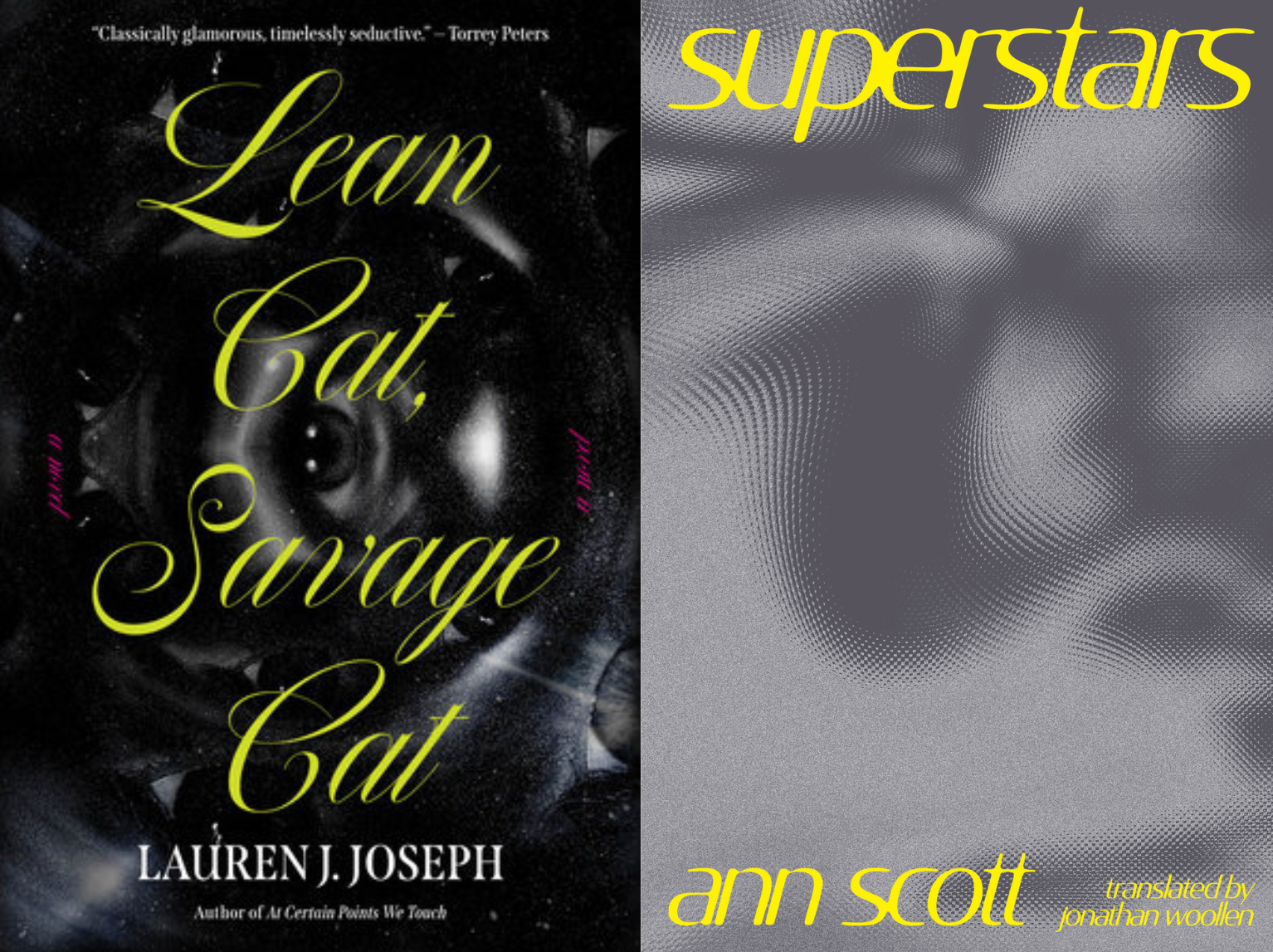
On Ann Scott’s “Superstars” and Lauren J. Joseph’s “Lean Cat, Savage Cat.”
The characters in Ann Scott’s Superstars are not strictly likable. Set in the 90s Parisian rave scene, the book follows a bunch of messy lesbians in a friend group held together by partying and drugs, threatening to collapse whenever one of them sleeps with someone else’s girlfriend, or someone they’ve slept with once, or someone unrelated, though the action pissed them off anyway, and all of this happens quite a lot—their fallout is always on the horizon, but somehow, never comes.
In the middle is Louise, a DJ in her early 30s who has just received a life-changing record deal—100,000 francs—from Virgin to put out a techno album at some point, a genre wherein “the real magic comes from your capacity to maintain some sonic unity while surging out in all directions.” And though she spends the first third of the book fiending for the freedom this will entail, when the money is wired to her account, the record she’s contractually obligated to produce barely takes up any space in her mind. A friend basically drags her to an electronics store where she fills her basket with equipment for a shrugging Louise to accept, still lounging in the car.
That’s because she’s preoccupied with Baby Inès, a teenager studying for her exams who made a flirtatious pass at Louise earlyish in the novel. Louise thinks she’s kidding, since she’s currently dating Alex, Louise’s former roommate and ex-girlfriend, except that a different friend says Inès is actually very down. The two engage in an irritating back-and-forth phone tag, wherein only Inès is allowed to call Louise, teasing that she’ll leave Alex soon, they’ll be together at last. Neither of them really says what they mean or mean what they say, though Inès once sends a revealing postcard where she writes, “I feel like a serial killer in some sadistic game, kindly offering to help a man who’s broken down on the side of the road only to fire a bullet in his head three minutes later—and you’re there, too, not far away, monitoring the scene through binoculars, aware that I’ll be coming for you next.” That clears things up—but also pushes Louise in further.
The majority of the novel follows these two circling each other—colliding sometimes—and the fallout that Louise’s actions have, not really about making a record. This style won’t command every reader, but Scott’s assuredness in narrative and clean, tight prose makes up for its lacking structure and relative failure of the relationship. Louise is brash and cutting, and often contradicts herself—she’ll shrug Inès off forever, before calling her back within the same paragraph (as she puts bluntly once: “fags love each other too much, dykes don’t love each other at all.”) But in shining moments, she’s awfully canny about their situation. “Most of all I hated the fear, the decree that every new beginning required thoughts about its end,” she thinks once.
Superstars, Scott’s second novel that made her a cult icon in her native France, is not so much about stars as they are black holes—these characters sleep in, shoot heroin (even the teen), and certainly make no progress on their records, though they attend and support each others’ DJ sets. (The huge cast gets lost in the grime sometimes, but a notable stand-out is Eva, whose litany of blonde jokes genuinely never gets old: “Why did the blonde have a triangular casket? She couldn’t close her legs!”)
The book is plenty funny, and there might have been some humor lying in other areas that didn’t involve sex—Louise showing up to a meeting with Virgin executives high out of her mind, defending her procrastination—but like the techno she’s obsessed with, it’s a propulsive, glittering read—a body high if you don’t think too much about it.
Another European novel that revolves around music, partying and the unstable realities of making it as a musician is Lauren J. Joseph’s Lean Cat, Savage Cat, though it’s supported by a stronger structure. Charli—somewhat of a distracting name due to the xcx of it all, not made easier by her clubrattiness—is a floundering writer whose latest reading, involving an embroidered curtain for some theatricality, ended in humiliation. But when she meets Alexander, who has a wild idea to set up shop in Berlin and become the greatest pop star of all time, she feels a duty to follow him.
As he hops from magazine shoots to television performances, Charli acts as his girlfriend/manager/tour planner, tied down to the minutiae of his schedule when she desperately wants to be free herself; to see friends, to have sex with other people—the latter of which Alex eventually forbids outright, making her call a former fling to say that it’s over. “He was so nervous about the tour that I didn’t argue with him,” she says, “just accepted my life as the little bird who hops into the crocodile’s mouth to clean his teeth.”
As one can imagine about a novel about a pop star, his narcissism and self-indulgence gets the best of him, to the point where Charli considers calling it quits. But his gravitas keeps pulling her back, or maybe it’s all a good imitation of someone who has star power—the reader never really knows. “He was an icing sugar phantom confected from art-school scrapbooks and Hollywood offcuts,” Charli thinks in a bitter moment.
Alex is a little vague and unknowable, and is better as a character rather than a performer. During one of his first sets, “He sang these very sad lyrics about love and heartbreak and everything pop stars usually catalog in their allotted three minutes thirty, only all the sorrow was set to a relentless, ecstatic score of synthesizers and arpeggiated violins,” Charli notes, the kind of analysis that could apply to anyone. His androgynous style and bratty personality doesn’t translate too much to the stage, and for all his antagonism towards journalists and fans, he’s sort of play-by-the-numbers otherwise.
But Lean Cat, Savage Cat’s dramatic flair and Joseph’s clear talent for storytelling offer something new to the story of admiration mixed with proximity (as well as her affinity for raunchy sex scenes that, surprisingly, are never corny). Destined for fame or not, Alex is one to follow around, though Charli keeps his danger in the back of her mind. In one of the book’s more overt moments, she looks onto someone’s newspaper article about Christ the Redeemer, in which a journalist writes, sort of sinisterly, “Don’t get too close. Icons are, after all, designed to be worshipped from below.” Charli shrugs this off and continues down her path—which, really, is Alex’s. But why get caught up in the details, when we’re dealing with superstars?
Superstars and Lean Cat, Savage Cat are out now.

