

There is no better way to achieve creative solutions than by leveraging advanced technology, such as using deepfake tools. However, not all options are created the same. Some are accessible, while others require technical expertise and powerful hardware. Accordingly, one effective way to see the difference is by comparing Simfa vs DeepFaceLab. Both appear to be capable of delivering high-quality results, but have apparent differences in the way they achieve them.
To help clarify these distinctions, we will closely compare and contrast these tools, focusing on the different approaches to providing creative solutions. By the end of this guide, users will determine which deepfake tool — Simfa vs DeepFaceLab — aligns with modern deepfake creation needs.
Simfa vs DeepFaceLab: Head-to-Head Comparison
- Key Features
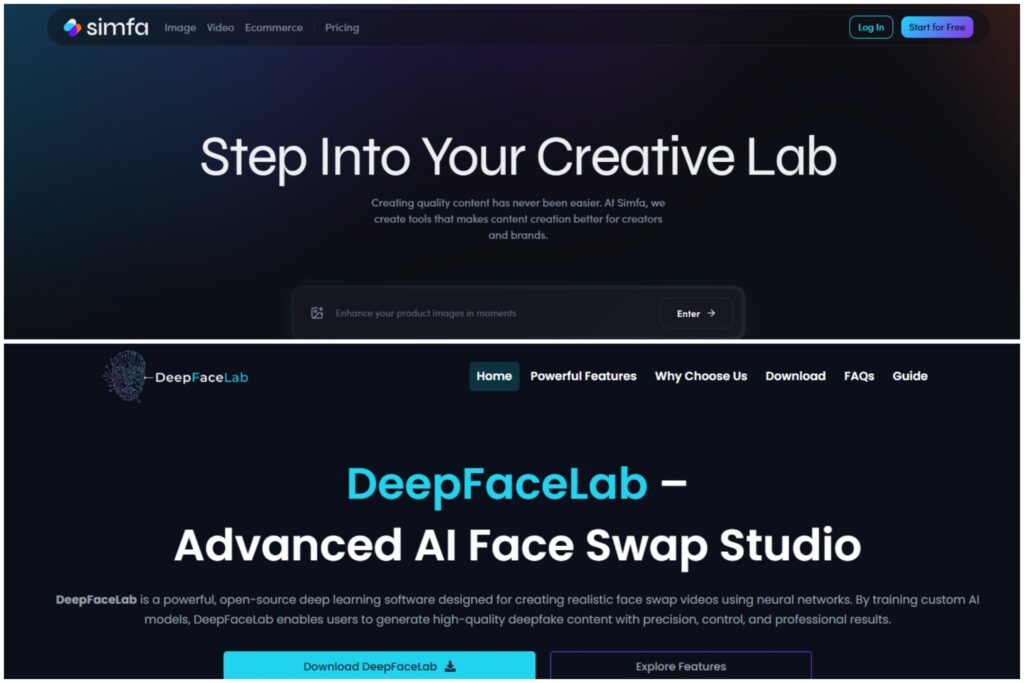
Simfa is an all-around creative lab. To be more specific, its offering is not limited to allowing users to swap faces. This toolkit boasts several features, including outfit swaps, an image upscaler, a product enhancer, an artificial intelligence image generator, and color grading. On the other hand, DeepFaceLab is an open-source software specifically designed to make face swap videos.
- Performance and Processing
By leveraging cloud-based infrastructure, Simfa handles processing remotely. This eliminates the need for advanced device capabilities. Meanwhile, DeepFaceLab relies entirely on local hardware. Although it is great for no-cloud upload practice, it requires a strong NVIDIA GPU.
- User Experience
Simfa utilizes a streamlined workflow that involves a few clicks to generate the output. More importantly, it integrates AI systems to analyze images and render highly realistic results without overly complex procedures. DeepFaceLab, by contrast, is not an automatic one-click tool. It gives users full creative control in creating industry-grade outputs. However, it entails a script-based, multi-step workflow. And that can take hours or even days to master and achieve realistic outcomes.
- Technical Flexibility
Direct customization is not Simfa’s strong point. But it removes the need for technical oversight and ongoing maintenance. Conversely, flexibility is the biggest strength of DeepFaceLab. Since it is an open-source software, users can completely modify models and training parameters to suit their needs and preferences. Moreover, its GitHub repository reflects a large community where users can get various resources.
- Privacy and Security
With Simfa, files are securely stored through AI providers and are retained for download purposes. Nonetheless, it allows users to request the deletion of the stored personal data and media. On the contrary, footage never goes to the cloud with DeepFaceLab. Its processing happens locally on the device.
Quick Comparison Table
| SIMFA | DEEPFACELAB | WINNER | |
| Key Features | Face & Outfit Swaps, AI Tools | Face Swap | SIMFA |
| Performance and Processing | Cloud-Based | Local GPU Required | SIMFA |
| User Experience | Beginner-Friendly | Complex, Manual Workflow | SIMFA |
| Technical Flexibility | Limited Customization | Fully Customizable | DEEPFACELAB |
| Privacy and Security | Cloud Storage, Deletable | Fully Local | DEEPFACELAB |
The Faceoff: Simfa vs DeepFaceLab
There is no denying that both deepfake tools are capable in their own right. However, considering the fast-paced digital landscape, DeepFaceLab can become a less practical choice for general use. This is despite offering full creative control. Nowadays, individuals want everything in a snap. Users increasingly prioritize speed and accessibility to focus on more important things in a shorter period.
With this in mind, Simfa mirrors a more modern approach to deepfake content creation. This web-based tool removes the technical barriers typically associated with its competitor. It allows users to focus on results rather than setup and configuration. Simfa’s simple but effective workflow makes it a more efficient choice for users.
Through Simfa, creators can achieve comparable realistic results as with DeepFaceLab in a fraction of the time with far less complexity.

