

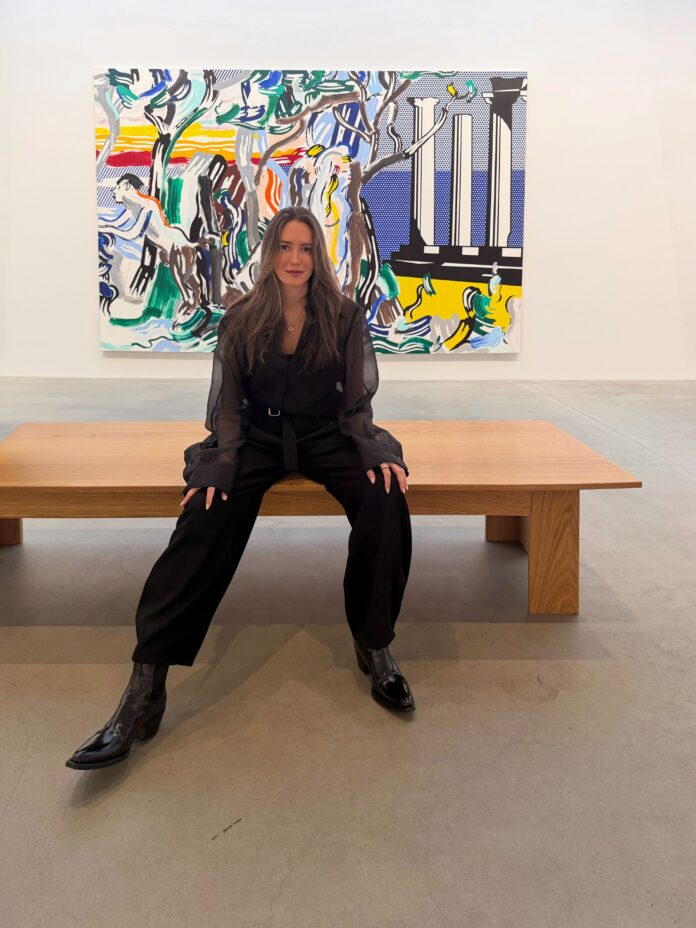
A Mexico City born art advisor commissioned Alma Allen for a luxury residential development years before the US government appointed him the country’s Venice Biennale representative. In the art world, that gap is the whole story.
When the United States Department of State announced in November 2025 that Alma Allen would represent the country at the 61st Venice Biennale — the world’s most prestigious contemporary art event — the art world reacted with a mixture of surprise and recognition. Allen, a self-taught American sculptor who left home at 16, sold hand-carved marble sculptures on the streets of SoHo, and eventually built a studio in Tepoztlán, Mexico, was not an obvious institutional choice. He had never had a major US museum survey. He was, by most accounts, an artist whose reputation had been built quietly, through a network of collectors and curators who knew his work before the institutions did.
Myrtha Herrera was one of them.
“I had been following Alma’s practice for some time before the Cero5Cien commission,” says Myrtha, a Mexico City-born, New York-based art advisor who founded Collēctum Art Advisory eight years ago. “The biomorphic language of his sculptures — the way they seem to be in the middle of doing something, in movement even when they’re completely still — felt exactly right for the architectural context we were working with. And his relationship to materials: stone, onyx, bronze, things that come from the earth. That mattered for the development.”
The development in question was Cero5Cien — a 65,000-square-meter luxury residential project in one of Mexico City’s most prestigious neighborhoods, developed by GICSA S.A.B. de C.V., one of Mexico’s largest publicly traded real estate companies, and designed by Grupo Arquitectura, the firm led by Daniel Álvarez that would go on to win the Black and Gold Medal — the absolute grand prize — at the XI Bienal Iberoamericana CIDI in 2021, the highest-prestige architecture and interior design competition in the Iberoamerican world.
Herrera was brought in to develop the art program from scratch. She produced a longlist of candidate artists, evaluated them against the specific architectural language of Grupo Arquitectura’s design, presented her recommendation to the development’s owners in a formal pitch, and secured approval to commission Allen. She then worked closely alongside Allen through the design process — bringing the spatial plans and dimensional constraints of the development into direct conversation with his practice, and guiding the sculpture’s scale, orientation, and relationship to the lobby environment. She also designed the water mirror base on which the sculpture sits, a site-specific architectural element that frames the works within the building’s material palette.
“The whole process took months,” she says. “Site visits, meetings with the architects, back and forth with Alma about what the space needed and what the work could be. You have to be present, and you have to know the work well enough to have a real conversation about it.”
The Cero5Cien installation was completed. The development won its CIDI Gold Medal. And Alma Allen continued building his practice in Tepoztlán, steadily and on his own terms.
Then, in November 2025, the State Department called.
Allen’s appointment as the US representative to the 61st Venice Biennale — with an exhibition titled “Call Me the Breeze,” curated by Jeffrey Uslip, formerly Chief Curator at the Contemporary Art Museum St. Louis, and organized by commissioner Jenni Parido of the American Arts Conservancy — was widely covered as a story about an unconventional choice: a self-taught artist, a slow-burn career, a practice built outside the mainstream. That story had a quieter prequel.
“I found out about the Venice appointment the way everyone did,” Myrtha says. “I remembered our site visits, the conversations about scale and material. And I thought — yes.”
Private curatorial judgment tends to move ahead of institutional recognition — that’s largely how the art world works. In Herrera Almanza’s case, the timeline is documented: a signed contract, floor plans, correspondence with the artist, a formal presentation recommending Allen to the owners of a publicly traded real estate company, before he was the USA’s official choice.
“I think one of the most interesting things about Alma’s practice has always been that it operates outside the normal systems,” she says. “He built his studio himself. He sources his materials himself. He developed his fabrication process himself. That kind of independence produces a very specific kind of work — work that earns its place in a room immediately. That’s what drew me to it.”
Allen’s Venice Biennale exhibition opens May 9, 2026. The US Pavilion’s previous representatives include Simone Leigh, who won the Golden Lion in 2022 and went on to a major Guggenheim retrospective in 2023; Martin Puryear, who preceded his 2019 Venice appearance with a major MoMA retrospective; and Bruce Nauman, who represented the country in 2009. Allen is now represented by Galerie Perrotin, with nine global locations.
In Mexico City, a bronze sculpture sits on a water mirror base at Cero5Cien. The building won a Gold Medal. The artist is going to Venice. The advisor who put them together is already working on the next one.
Myrtha Herrera Almanza is a New York–based art advisor and the founder of collēctum. She holds an MA in Art Business from Sotheby’s Institute of Art.

