

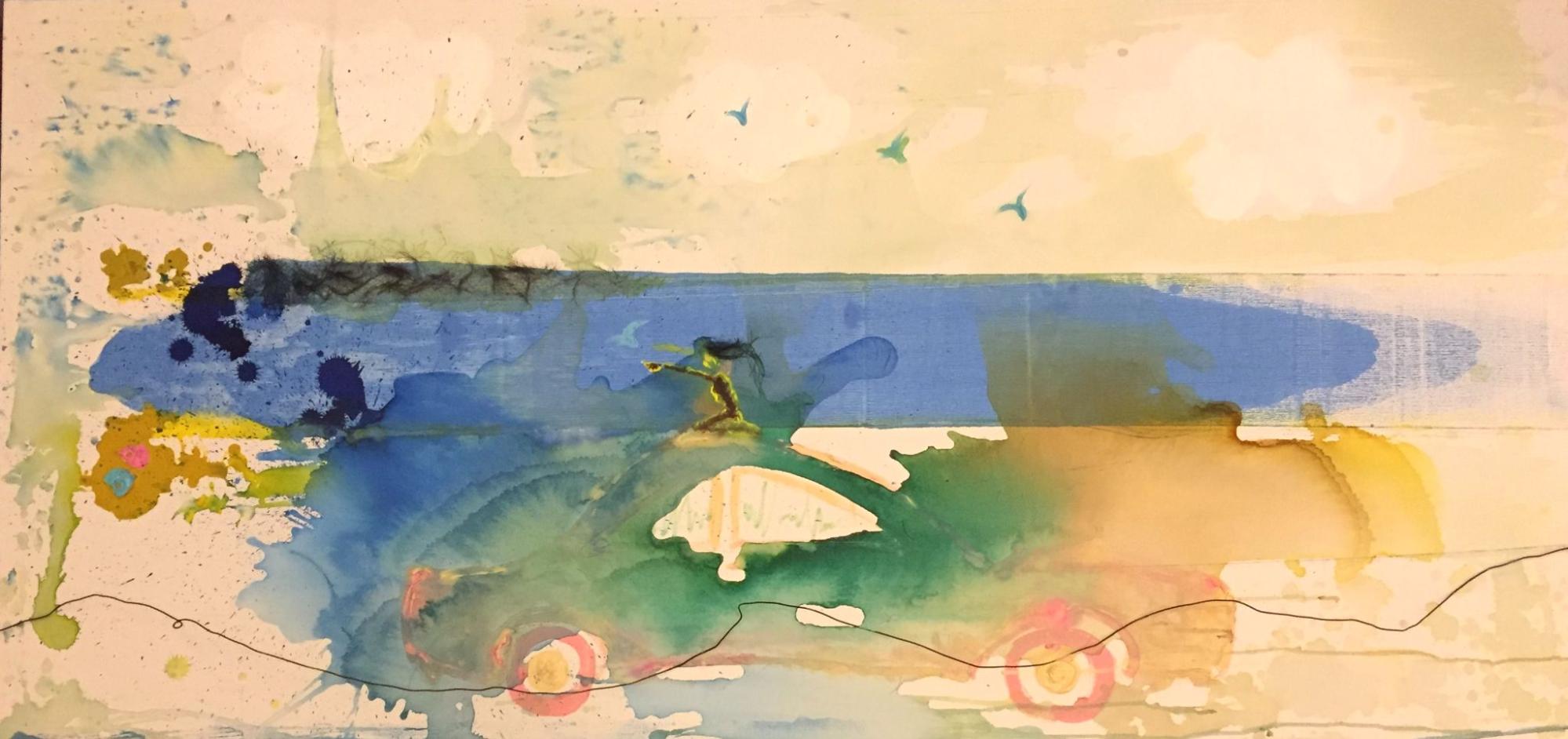
When I first look at Vidushi Gupta’s painting ‘The Tourist’, the colour and composition remind me of abstract expressionist painter Helen Frankenthaler. Yet when I look more closely, I see figurative elements, including birds and a person perched on a car, pointing in the opposite direction the car faces.
What is she pointing at? There must be something noteworthy just out of sight that she can see, but we can’t. It’s a tantalising approach that’s been used throughout art history in both abstract art, think Piet Mondrian, to more figurative painters such as Caspar David Friedrich.
In this case, the title of the work suggests it’s something that a tourist would spot, and it’s often telling that tourists are drawn to sights that are unfamiliar to them but familiar to locals. I remember visiting family in India and being shocked by how tourists would stop to take pictures of ramshackle huts by the side of the road. These dwellings were a regular sight for locals, but tourists were fascinated by them, a fascination that felt both voyeuristic and invasive.
The flip side of tourists is that they often draw our attention to wonders that we overlook. How many people live in a city like London, New York, Paris or Delhi and never visit the main tourist attractions, taking them for granted? It’s this dual role of tourism that often makes countries both value and despise it, and I see that complexity in this work.
The incorporation of human hair, copper wire, and other non-standard art materials also makes the work feel more grounded and, for me, references the litter and detritus that often accompany tourism.
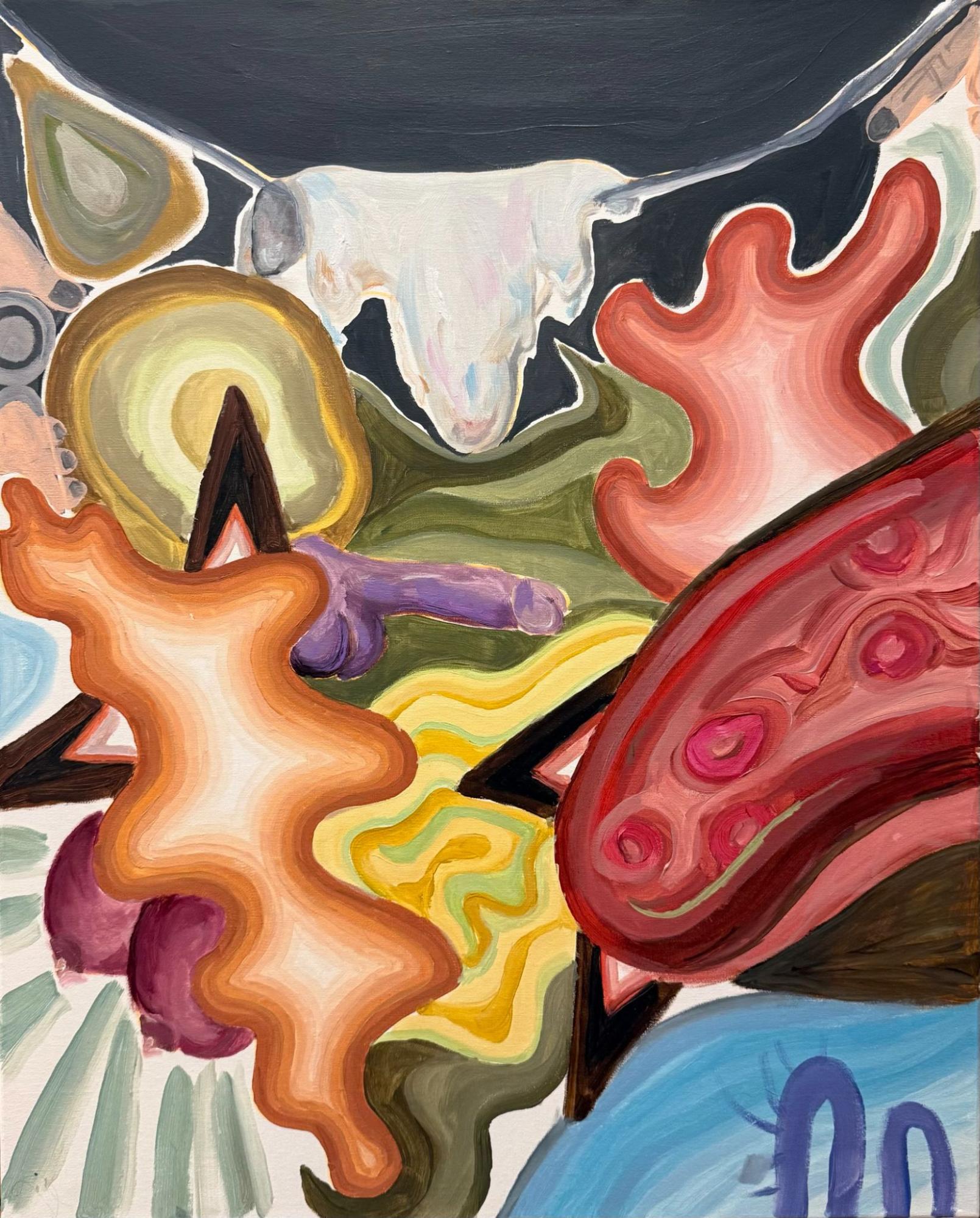
Gupta’s wider practice takes simple concepts such as flowers and fruit, before transforming them into forms that feel more suited to a hallucinogenic fever dream, transporting us into a more surreal world. It’s a journey into her subconscious that guides her hand to create works where the end goal may not be known to her, and we’re also unsure where it will take us.
While the works are colourful and vibrant, they also remind me of the symbolism of flowers in art: both symbols of fertility and reminders of life’s fleeting nature, as we see in 16th- and 17th-century Dutch vanitas paintings. They are beautiful things to behold, but also reminders that our time on this planet is a mere blink of an eye in geological timescales.
Her works fall into a long lineage of female painters who have used the symbolism of flowers, from Rachel Ruysch to Georgia O’Keeffe. When Gupta’s work is at its most abstract and reduced to simple forms, it recalls the more mysterious works of artists such as Hilma Af Klint.
I see the latter in her work ‘Dopamine Rush’ where amorphous forms fill the canvas, were they once people, pieces of clothing or something more otherworldly? It reminds me of our addiction to smartphones that create surges of dopamine, which is the real-world realisation of the drug Soma from Aldous Huxley’s A Brave New World, where masses were controlled through hallucinogenic visions. We’re lost in a world of bright colours, in our always-online culture, but can we escape it and become more grounded? My viewing of her work teases at this critical contemporary issue.
Yet it would be reductive to view her art through a Western art-historical lens, as she has lived across continents, in both Delhi and London. As her work evolves, I’d like to see this dichotomy explored further, incorporating the differences and similarities in both British and Indian cultures, what unites people in both countries and what sets them apart. The cities, tastes, smells, food, and flowers combine to create work that resonates with people in both places and reflects her own upbringing.
More information about Vidushi Gupta’s work can be found on her website and Instagram.

