

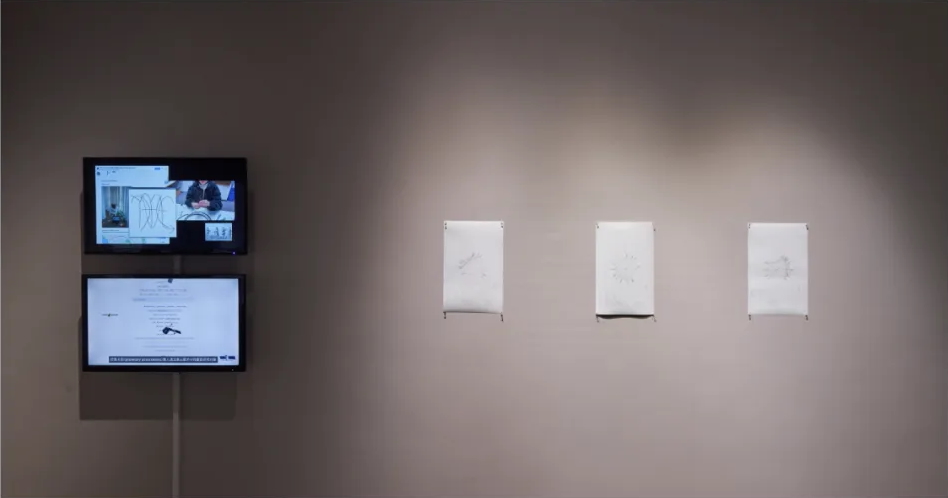
At Being Art Museum in Shanghai, the exhibition Weathering the Space, Orbital Echoes (opening September 20, 2025) situates itself amid the shifting ecologies of planetary infrastructure, tracing how rockets, satellites, and orbital debris entangle with earthly environments and imaginaries. Within this expansive framework, Zhanyi Chen’s Artificial Satellite Astrology (2023) offers a singular reorientation of how we think about connection, distance, and the sky.
Chen’s works probe how soft science fiction offers intervals to reflect on the tension between sky technologies, their environmental and psychological effects, and the cultures in weather and environments. Using weather satellite data, early Space Age archives, and speculative storytelling, she makes objects that propose how celestial and other infrastructural technologies, from language to electronics, can be strategically misused to prioritize human experience over functionality. She holds an MS in Art, Culture, and Technology from Massachusetts Institute of Technology and an MFA in Digital + Media from Rhode Island School of Design. She has exhibited at institutions including Rockbund Art Museum (Shanghai), the MIT Museum (Cambridge), and the Fall River Museum of Contemporary Art (Fall River). She was a recipient of the Harold and Arlene Schnitzer Prize in the Visual Arts (2024). She has co-organized symposiums on Sky Art at MIT and participated in residencies and research-based projects that interrogate the intersection of infrastructure, fiction, and affect.
The work appropriates the ancient language of astrology — a practice that has long linked human lives to celestial motion — and recalibrates it for an era defined by orbital technologies. In Chen’s reimagining, artificial satellites replace planets as the key bodies shaping cosmological charts. The work also includes antenna-like sculptural objects made of coaxial cable copper cores and tin, built to “receive” divinatory signals from spacecraft, as well as a fictional YouTube channel that instructs viewers in the art of satellite-based astrology, represented in two looping videos displaying alongside astrological horoscope drawings drawn by the artist herself. Through these gestures, Artificial Satellite Astrology proposes an alternative relationship between Earth and orbit, probing how our sense of connection to the distant might generate new forms of care, perception, and narrative.
For Chen, astrology functions not as superstition but as a technology of relation — a means of tethering ourselves to forces and scales far beyond human reach. By embedding contemporary orbital infrastructures into this cosmological framework, she invites viewers to reconsider what kind of stories we construct to endure, resist, and make meaning in a world increasingly shaped by remote, automated systems. When technologies fail or drift beyond their intended use, she suggests, they can become conduits for emotion and longing, revealing a deeply human desire for miraculous connection that persists even amid the most advanced technical landscapes.
Chen’s practice consistently explores such tensions between all kinds of sky technologies, their environmental and psychological reverberations, and the cultural narratives woven through weather and atmosphere. Working with meteorological satellite data, early Space Age archives, and speculative storytelling, she strategically misuses infrastructural technologies — from language to electronics — to prioritize individual subjectivity over technical functionality. Her work has been presented at institutions including Rockbund Art Museum (Shanghai), the MIT Museum (Cambridge), and Fall River Museum of Contemporary Art (Massachusetts). She is the recipient of the Harold and Arlene Schnitzer Prize in the Visual Arts and co-organizer of Sky Art 24, an interdisciplinary symposium at MIT.
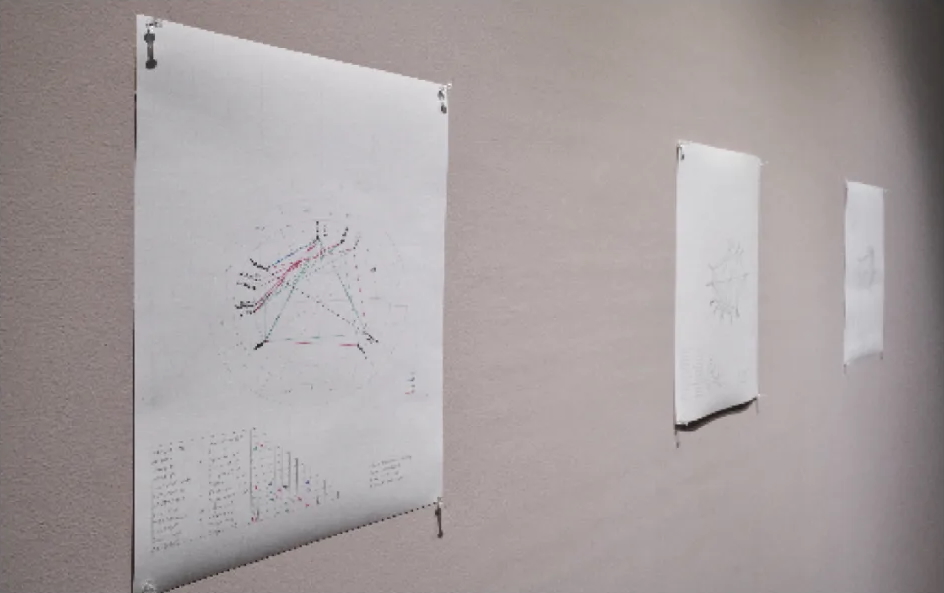
The exhibition in which Artificial Satellite Astrology appears, “Weathering the Space, Orbital Echoes,” is the first chapter of “Cosmic Arclight,” a research-based project by curator and scholar Iris Long, investigating the material and cultural afterlives of space infrastructures. Drawing on expeditions to recover spent rocket stages in China’s northwestern deserts, the project traces how debris re-enters ecological systems and becomes entangled with landscapes and communities. Artists in the exhibition work across three thematic spectrums — “Ground/Sea,” “Orbit,” and “Outer Space” — transforming decommissioned debris into installations, mapping the sensory and geographic traces of recovery expeditions, and imagining futures shaped by increasingly crowded skies.
Within this larger conversation, Chen’s work reframes the sky itself — what theorist Lisa Parks calls a “vertical public space” — as a site where infrastructures and cosmologies converge. It suggests that the stories we tell about satellites and orbits are not only technical but deeply affective, and that even the most remote technologies might be reimagined as participants in intimate human narratives.
Cloud Palace Resonance — Echoes Across Orbit was on view at Being Art Museum, Shanghai, from September 20 to October 25, 2025. Future chapters of the Cosmic Arclight project will continue to unfold across institutions and sites worldwide, expanding the dialogue around space, technology, and planetary life.

