

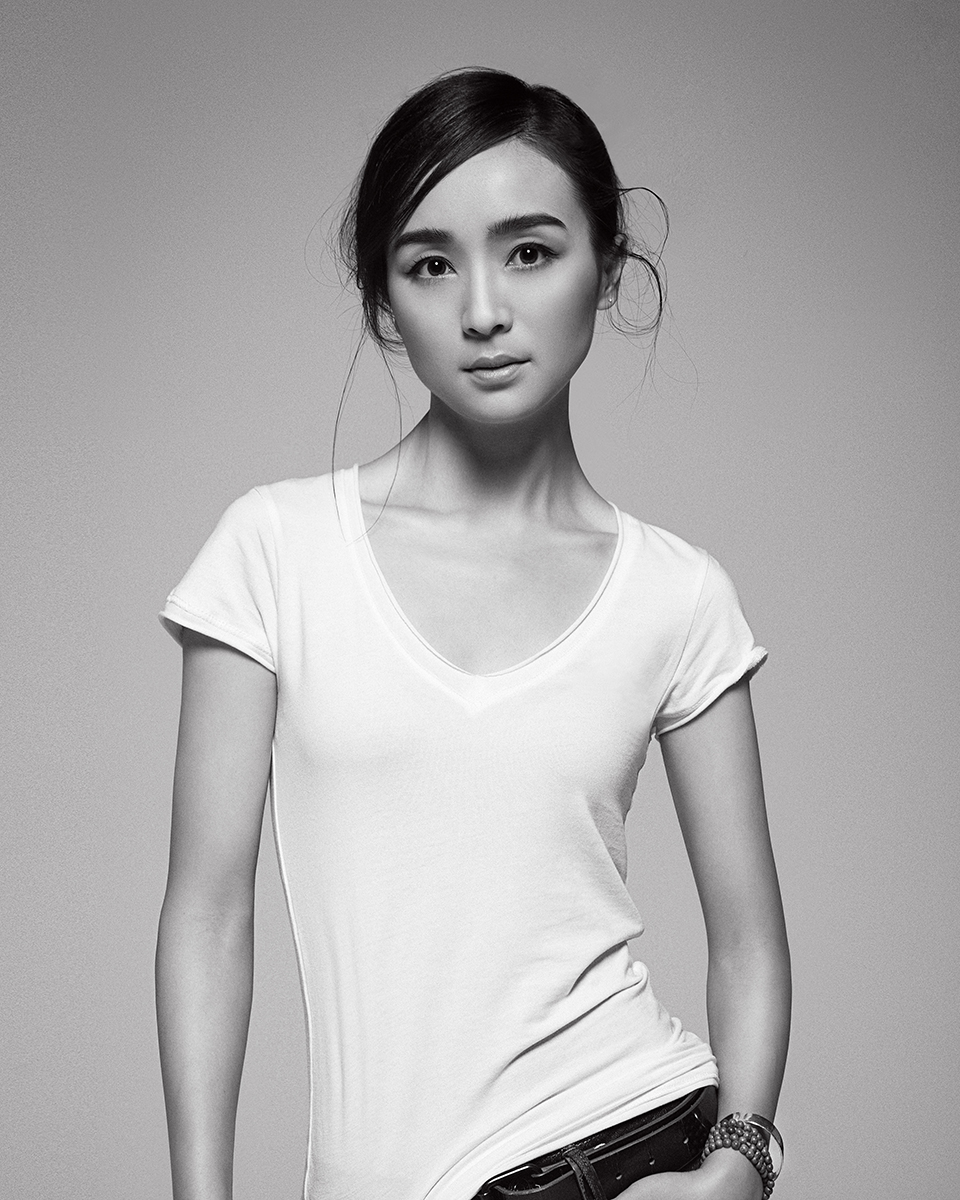
Han Yang is a London-based visual artist and photographer whose practice explores femininity, the body, queer identity, and the shifting relationship between humans, technology, and nonhuman entities. Working across photography, mixed media, and research-based practice, her images are often quiet yet emotionally charged, unfolding through symbolism, restraint, and a carefully constructed sense of tension.
Drawing from her Chinese cultural background, Han employs oriental metaphors and minimalist visual strategies to examine how identity is shaped, regulated, and reimagined. Her work is deeply informed by posthuman theory and feminist thought, approaching subjectivity as relational rather than fixed. Through collaborations with queer communities, cyborg imaginaries, and organic entities such as fungi, she challenges anthropocentric and hierarchical ways of seeing, proposing alternative visual languages for understanding embodiment and difference.
Han earned her MA in Fashion Photography with distinction from the University of the Arts London and later pursued practice-based doctoral research at King’s College London, where she developed a project on nonhuman photography through the lens of posthumanism. Her work has received international recognition, including the Women’s Emerging Artist Award, the Sony World Photography Young Talent Prize, and the Chinese Contemporary Vision Award for Overseas Artists. Selected exhibitions include Christie’s London (2025), Lishui Photography Festival (2025), Pingyao International Photography Festival (2025), Zebra One Gallery (2024), and her work has appeared in publications such as Vogue Italia, Vogue CS, Vanity Fair UK, and Harper’s Bazaar. Across all formats, her practice seeks to hold space for vulnerability, complexity, and new forms of collective becoming in a technologically mediated world.
When did you realise that being a visual artist was the life path you wanted to pursue?
I realised that becoming a visual artist was my life path not through a single decisive moment, but through a gradual return to something that had always been part of me. I grew up in a family of photographers, surrounded by cameras and images, yet I didn’t initially plan to pursue art as a career. After university, I followed a more stable and practical path, believing that art might remain something personal rather than professional.
It was only later, when everything in my life appeared settled, that I felt a strong inner rupture, a sense that something essential was missing. I realised that I could not continue without creating, without using images to think, feel, and exist in the world. From that point on, art was no longer a choice but a necessity. In many ways, I don’t feel that I chose photography; it chose me. Becoming a visual artist was my way of living truthfully, allowing inner emotions, cultural memory, and critical reflection to take visual form.

Your work often features striking, vibrant colours, yet there’s a dreamlike quality or softness that tempers them. It’s almost like there’s a veil or haze between the viewer and the subject, creating this otherworldly atmosphere. What draws you to this particular aesthetic tension?
Your observation about colour is very perceptive, and it’s something I’ve reflected on deeply in my own practice. I’ve realised that I have an unusual sensitivity to subtle differences in colour, almost an instinctive attentiveness. Interestingly, although many of my works are predominantly colourful, this doesn’t always align with the colours I’m personally drawn to in daily life. In some ways, there is a contradiction there. Vibrant colours carry intensity, desire, and presence, while softness introduces silence, distance, and fragility. Bringing these qualities together allows contradictions to exist within the same image, where strength and vulnerability, clarity and uncertainty, can coexist.
I’ve spent time trying to analyse why colour appears so insistently in my work, observing my decisions throughout the creative process, but I’ve never arrived at a clear explanation. Because of that, I’ve learned to trust intuition. At the same time, I consciously temper it, softening vivid colours so they don’t become sharp or overwhelming. I want colour to carry emotion without dominating the image. The veil or dreamlike atmosphere is not only a visual choice but also a psychological one. It suggests memory, perception, or something slightly out of reach. I’m less interested in showing things directly than in creating a space where feeling comes before explanation. The softness slows the viewer down and creates a quiet distance, inviting reflection rather than immediate consumption.
By resisting sharp clarity, my images leave room for ambiguity, allowing emotion to linger and unfold gradually. The haze becomes a way of holding what cannot be fully named, while still remaining present and deeply felt. This balance between vibrancy and restraint reflects an inner negotiation. Colour becomes a space where intensity and hesitation meet, where attraction and resistance coexist. In that sense, my use of colour isn’t about harmony alone, but about allowing contradiction to remain visible and emotionally present.
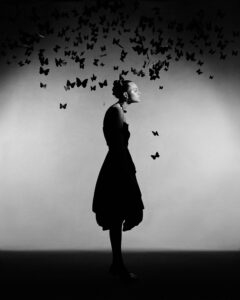
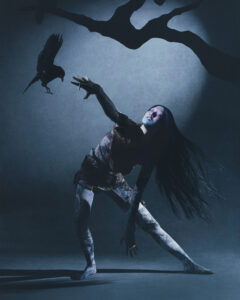
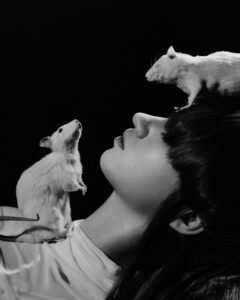
From ‘Butterfly’ and ‘Mouse’ to the crow outline in ‘Divine Punishment’, animals feature prominently throughout your work. In POSTHUMAN especially, you explore the blend between human and nonhuman. Why is it important for you to resist anthropocentric norms in your photography?
Animals appear in my work not as symbols that serve human meaning, but as subjects with their own presence and agency. From Butterfly and Mouse to the crow outline in Divine Punishment, they function as quiet counterpoints to the human figure, reminding us that the world does not revolve solely around human perception or control. I’m interested in what happens when the human body is no longer the unquestioned centre of the image.
In POSTHUMAN especially, resisting anthropocentric norms becomes essential because posthumanism asks us to rethink hierarchies that place humans above all other forms of life. Influenced by thinkers such as Donna Haraway and Rosi Braidotti, I see the human as entangled with animals, technology, and environments rather than standing apart from them. Animals in my work often operate as thresholds between worlds, blurring boundaries between instinct and consciousness, vulnerability and survival.
By introducing nonhuman elements, I try to unsettle familiar power structures embedded in visual culture, including domination, ownership, and categorisation. This resistance is also ethical. It opens space to consider coexistence, interdependence, and shared fragility. In my photography, the blend between human and nonhuman is not about fantasy alone, but about imagining alternative ways of being in the world, where identity is fluid and meaning is not exclusively human-centered.
Your work often centres sexual and gender minorities, vulnerable groups, the disabled, and what you call ‘marginal alien substances’—essentially anyone designated as ‘the other’. How do you see photography as a tool for resisting hierarchical understandings of the world more broadly?
For me, centring sexual and gender minorities, vulnerable bodies, and what I describe as “the other” is not about representation alone, but about forming alliances. Drawing from Rosi Braidotti’s posthuman theory, I understand subjectivity as relational and collective rather than hierarchical. Posthumanism resists anthropocentric thinking by rejecting fixed binaries such as centre and margin, subject and object, normal and abnormal. In my work, marginalised bodies are not positioned as deviations from a norm, but as equal participants within a shared field of existence. This becomes a way of resisting exclusionary systems and proposing interdependence, coexistence, and shared vulnerability instead.
Photography plays a crucial role in this process because images themselves are not passive. As Hall (1973) and Clarke (1997) suggest, photographic meaning is never fixed but negotiated through cultural, historical, and emotional contexts. Building on this, W. J. T. Mitchell argues that images possess their own vitality and desire, and function as active agents in shaping how we understand the world (Mitchell, 2005). Images do not merely serve a function; they participate in “worldmaking,” carrying political, emotional, and ethical force.
If we begin to imagine images as having personalities, it also opens another possibility: perhaps images do not want anything at all, or perhaps they are not as powerful as we assume. Humans tend to think in anthropocentric terms, treating images as objects to be controlled or decoded. But if the positions of subject and object were reversed, the image might ask a different question altogether: what do humans want to do? This shift unsettles the authority of the human gaze and forces us to reconsider responsibility, intention, and agency within visual culture.
From this perspective, photography becomes a space where hierarchy can be unsettled rather than reinforced. Meaning emerges through interaction rather than control. Nonhuman elements, materials, environments, and processes are not secondary but integral, contributing to the image’s affective power. As Mitchell (2005) suggests, images often act through desire before analysis, engaging viewers instinctively rather than didactically. In my practice, photography resists dominant structures not by offering fixed messages, but by sustaining ambiguity, complexity, and relational agency. Through this openness, photography becomes a tool for imagining more inclusive and non-hierarchical ways of being in the world.
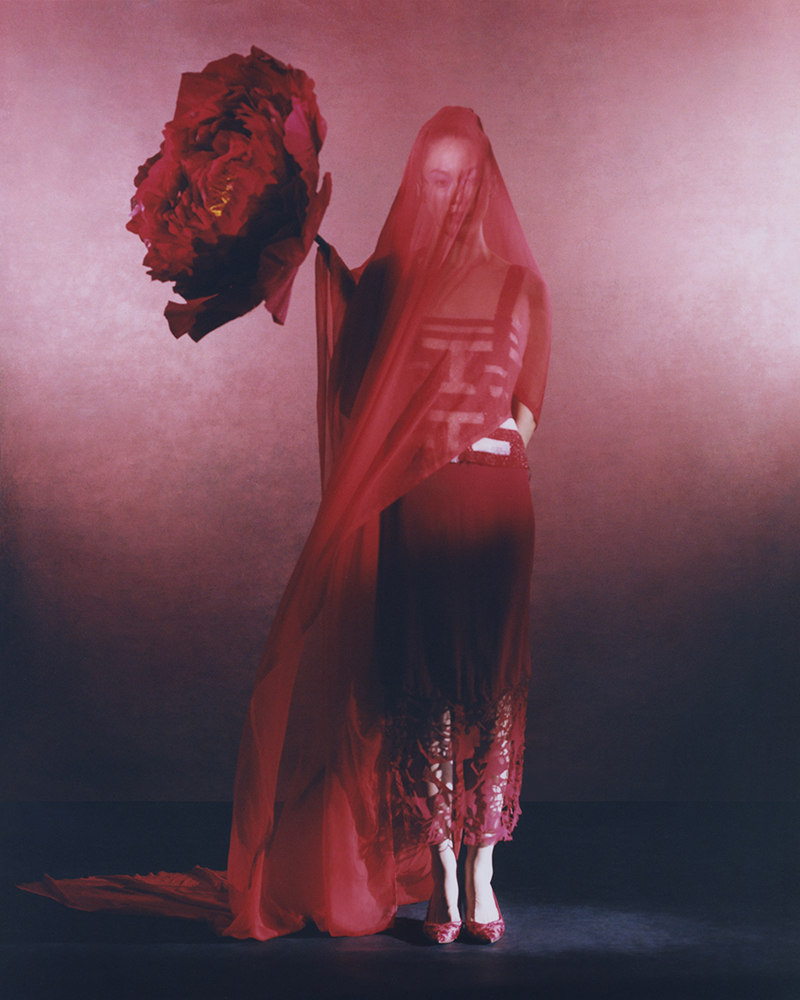
Your photograph 囍 is stunning, serving both as a celebration of Chinese cultural symbols and a critique of women’s oppression within that same culture. The peony, the veil, the double happiness wedding motif all work together in a complex way. How do you approach celebrating Chinese cultural symbols — which have often been exoticised or dismissed in Western-dominated fashion and art spaces — while still offering criticism of patriarchal traditions within Chinese culture?
In 囍, I was very conscious of holding two positions at once: celebration and resistance, intimacy and distance. The symbol itself is traditionally associated with joy, union, and good fortune in Chinese culture. Yet culture is never singular or innocent. Whether in Eastern or Western traditions, the symbols we continue to celebrate today often carry layered histories, including moments of struggle, silence, and deeply gendered pain. Remembering these histories is especially important when they hold the experiences of women whose suffering was normalised or concealed.
Because of my proximity to these symbols, I don’t approach them as decorative motifs or cultural explanations, but as lived structures that have shaped women’s bodies, roles, and emotional lives across generations. The peony, the veil, and the double happiness motif operate simultaneously as signs of beauty and expectation, celebration and restraint. They remind us that joy, when framed within patriarchal systems, can also become a form of obligation.
In Western-dominated art spaces, Chinese cultural symbols are often exoticised or flattened into visual spectacle. My intention is to resist this surface reading by returning these symbols to the body and to lived experience. They are not presented as timeless traditions, but as active forces that continue to influence how femininity is imagined and regulated.
Critique, for me, does not mean rejection. To question tradition is not to deny cultural belonging, but to engage with it responsibly. While we honour culture, we must also examine it critically, acknowledging the histories it carries, including those marked by silence and endurance. By holding celebration and critique together, I aim to create a space where cultural symbols remain alive, complex, and open to redefinition rather than preserved as unquestioned ideals.
Congratulations on your AAP Magazine #48 Portrait Award for In Between World, which explores how LGBTQ+ individuals construct and express identity within the space between private selfhood and public expectation. What has been the most rewarding aspect of working on this project?
Thank you. The most rewarding aspect of working on In Between Worlds has been the relationships and trust that developed throughout the process. This project was never about producing portraits alone, but about creating a shared space where individuals could be seen beyond labels, expectations, or fixed narratives. Each participant brought their own lived experiences, vulnerabilities, and quiet strength, and being invited into that space was something I didn’t take lightly.
What stayed with me most was witnessing how identity is not something static, but something constantly negotiated between the private and the public, the internal and the external. Many of the conversations we shared went far beyond photography. They were moments of reflection, uncertainty, and sometimes relief, where being photographed became a way of articulating something that is often difficult to express in everyday life. The camera functioned less as a tool of observation and more as a medium of listening.
On a personal level, the project also reshaped my understanding of portraiture. It taught me that visibility can be a form of care, and that slowing down, allowing ambiguity, and resisting spectacle can be deeply affirming acts. Knowing that the series has resonated with others, and that it has helped create moments of recognition or quiet solidarity for viewers, has been the most meaningful outcome of the work.

Beyond photography, what are you curious about right now? Are there other creative practices or art forms drawing your attention?
Beyond photography, I’m increasingly curious about practices that sit between disciplines, especially where theory, technology, and lived experience intersect. I’m drawn to research-based creation, writing, and experimental forms that allow ideas to unfold slowly rather than resolve visually right away. Reading philosophy, feminist theory, and posthumanist writing has become as central to my process as image-making itself.
I’m also exploring new ways of working with technology, not simply as a tool but as a collaborator. This includes experimenting with AI, generative systems, and text-based image processes, while remaining attentive to their ethical and emotional implications. At the same time, I continue to feel a strong pull toward tactile, time-based practices such as analogue processes and working with organic or non-human materials, where unpredictability plays a role.
What interests me most right now is how different forms can coexist without hierarchy. Whether through writing, research, collaboration, or emerging technologies, I’m curious about how creative practices can create spaces for reflection, care, and alternative ways of thinking about bodies, identity, and belonging.
References
Hall, S. (1973). Encoding and Decoding in the Television Discourse [Monograph]. University of Birmingham.
Clarke, G. (1997). The Photograph. Oxford University Press.
Mitchell, W. J. T. (2005). What do pictures want? The lives and loves of images. University of. Chicago. Press.

