

Within Qinyang Li’s creative system, “memory” does not function as a narrative source but as a structural force that is constantly folded, deconstructed, and reassembled. Rather than attempting to recreate the past, she forges a transitional space between the real and the recalled. Memory, therefore, is liberated from linear time and lingers around as a nonlinear, layered, and constantly shifting perceptual experience. Patterns, archival images, found objects, and installation-based spatial constructs all participate in memory’s reorganisation, confronting the viewer with a synchronic state suspended between “what once was” and “what is still forming.”
Li is not a chronicler of memory, but its reconstructor. In her visual language, memory appears as fragments, the reverse side of an image, the shadow of a material. These elements are not restored but are rearranged, thereby generating a multi-layered emotional topography. Memory becomes a field of constant cycle, fracture, and return. It is at once anchored and drifting, rooted in personal experience yet constantly generating new meanings upon material surfaces. It is precisely within this continual overlapping and displacement that Li constructs the “spatiality of memory”—memory no longer belongs to time, but to site; no longer to narrative, but to structure.
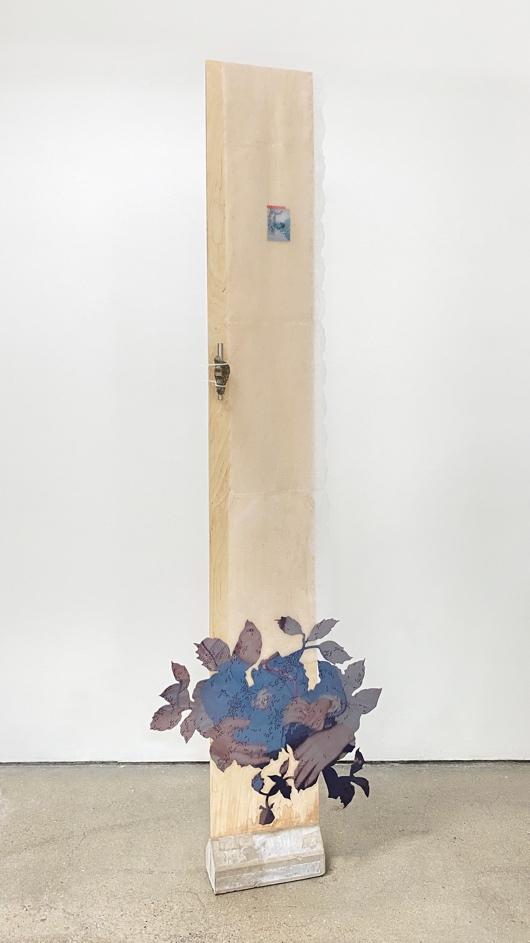
In Home Sweet Home III (previously exhibited at Gallery Where, Beijing), “door” serves as both the structural and symbolic core —an architectural boundary as well as a psychological threshold. The presence of the door points to “entering” and “leaving,” “opening” and “closing,” while alluding to memory’s oscillation between being recalled and forgotten. The surface of the door is covered with lace-like fabric made of silicone, behind which a family photo looms faintly visible. This fabric, carrying connotations of warmth and cherished sentiment, simultaneously suggests isolation. Below the door, fragments of family images carrying private memories are printed on a floral-patterned metal plate, while ants crawling across it alter the nature of memory, symbolising time’s constant erosion of emotion and remembrance. The door thus becomes a perilous passage into the interior of memory—a liminal installation that invites viewers to a site of memory that is being eroded, decaying, and disintegrating. Here, memory is not summoned as a nostalgic image but through the material traces of corrosion and the processes of temporal decay.
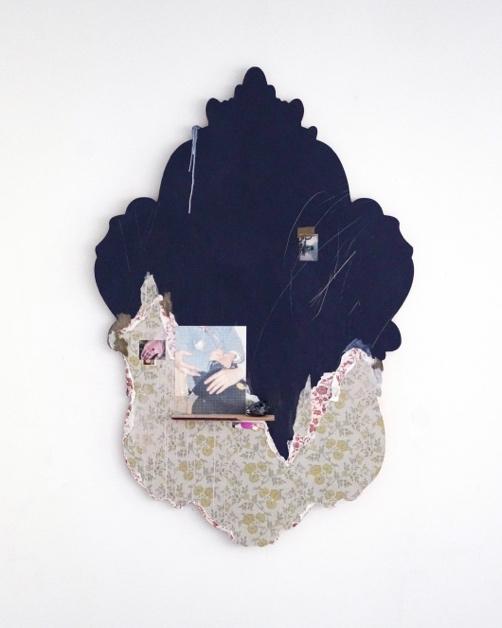
Whispers from the Shell (exhibited at Southwark Park Galleries, London; Cub_ism_Artspace, Shanghai; Spring Art Museum, Shanghai; Gallery Where, Beijing) presents a “family ruin” that resembles a space long inhabited yet hastily abandoned—a trace of life already dissolved yet still retaining warmth. Here, memory exists through materiality: blurred family photographs appear as fragments of identity, reflecting the out-of-focus state of memory, while layers of peeling floral wallpaper stand as remnants of repeated attempts at repairing relationships. Inside a mussel shell, a photograph of a mother and child is embedded, representing an idealised sanctuary that offers illusory security, while its inherent fragility hints at the unreliability of such a refuge. These visual elements collectively form a nonlinear narrative structure to be comprehended by searching for clues among surviving fragments—like reading a torn family history amid ruins. This work constitutes an irreparable space: one that cannot be restored or reassembled. This spatial fragmentation serves as a materialised expression of the unmendable aspects of intimate relationships, where memory is laid bare in its incompleteness.
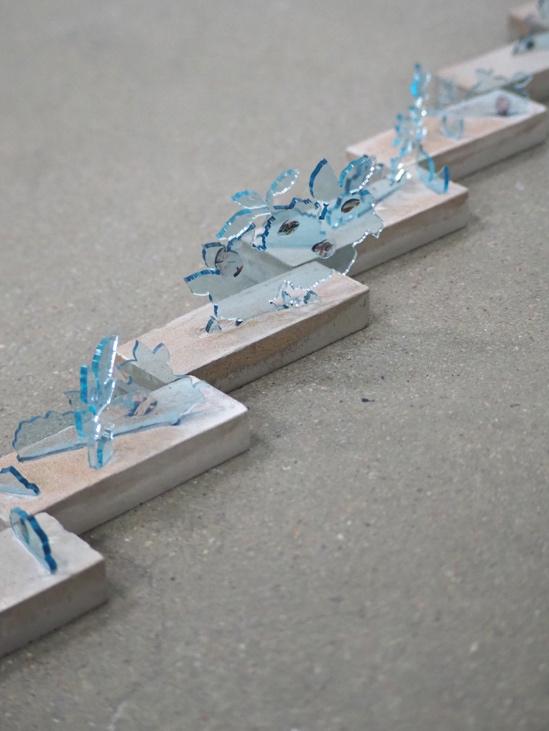
Qinyang Li’s choice of materials itself constitutes a metaphorical system for memory. Patterns become a “textural matrix” of personal history, evoking domestic warmth and the soft mediums to which memory clings. Images are recut, obscured, and corroded, freed from indexicality and transformed into narrative fragments that reveal memory’s fractures, gaps, and sedimentation. Objects such as doors, glass, peeling wall plaster, and domestic decorative materials gain a second life through being reassembled into components of a psychological apparatus. When folded into the same field, the materials create the most distinctive structure in Li’s work—its texture serves as the very materialisation of memory. Vice versa, memory becomes of texture and materiality, whose meaning is generated through processes of surface deposition, permeation, and erosion. What Li constructs is an artistic discourse on how memory becomes a material, a texture, a field. This discourse ultimately points to a crucial fact: what we remember is never the past itself, but a form of memory that is and will continue to be reconstructed, thus ever unfinished.

