Los Angeles is a city where people work tirelessly, so working long hours is often part of the job. But it is unfair when those extra hours are not paid. California has some of the best protections for workers in the country, but unpaid wages and overtime violations are still far too common. A Los Angeles Overtime violations attorney from Moon Law Group can help you understand your rights and get the money you are owed if you haven’t been paid what you earned.
How to Understand California’s Overtime Laws
California’s labor laws protect workers more than the federal laws do. According to California Labor Code §§ 510 and 1194, workers who work more than eight hours a day or 40 hours a week are entitled to 1.5 times their regular pay. If you work more than 12 hours in a day or more than eight hours on the seventh day in a row, you can receive double pay.
The federal Fair Labor Standards Act (FLSA) only guarantees overtime after 40 hours a week and doesn’t cover daily overtime. State labor laws in California provide broader protection for employees, but which rules apply in your situation depends on your job responsibilities, pay structure, and how your employer classifies your role. Sadly, many employers try to avoid paying overtime by wrongly classifying workers as “exempt” employees or independent contractors.
Common Overtime Violations in Los Angeles
Overtime violations can happen in any field. Some of the most common violations are:
Putting employees in the wrong category
Making workers work “off the clock”
Changing or deleting hours from time records
Not counting travel, training, or on-call hours as paid time
All of these things break California labor laws. Affected employees may be eligible for back pay, interest, and penalties, but they must take immediate action.
What Happens When Overtime Rules Are Broken
Not getting paid for overtime can be very detrimental to your finances, especially in a city with a high cost of living like Los Angeles. Wage theft hurts communities in more ways than just personal loss. It lowers tax revenue and lets dishonest employers undercut people who follow the rules.
The Los Angeles County Office of Labor Standards Enforcement and nonprofit groups like Bet Tzedek Legal Services and the Legal Aid Foundation of Los Angeles help workers who have not been paid fairly. On the other hand, Moon Law Group provides direct and results-oriented representation to assist employees in holding their employers accountable and recovering their unpaid wages.
Taking Steps to Get Paid for the Work You Did
If you think you haven’t been paid for overtime, the first thing you should do is write down your hours, pay stubs, and any conversations you’ve had with your boss. Thereafter, get in touch with a lawyer at Moon Law Group who has worked on overtime violations in Los Angeles.
According to California law, workers usually have three years from the date of the violation to file a claim for unpaid overtime. In some cases of wage theft, workers may have up to four years to take action. The sooner you do something, the better your case will be.
Giving Workers Power and Making Sure They Receive Fair Pay
Standing up for what’s right is just as important as recovering unpaid overtime. When workers speak up, they help make lasting change by pushing employers to follow labor laws and improve their policies.
Workers’ rights across Los Angeles are being vigorously protected by Moon Law Group. Their goal is simple: ensuring that every worker is paid fairly for the work performed. If unpaid overtime is suspected, action should not be delayed.
Picking a game by mechanics alone is like choosing a movie by the camera lens. What you see and hear decides the mood, your pace, and whether a five-minute break feels restorative or rushed. Art style and sound are the two biggest “dials” you can turn. Get them right and even the shortest session lands exactly how you want it to.
The Two Dials That Set the Mood
Visual language. Color temperature, contrast, motion speed, and UI density all steer arousal. Warm golds and muted palettes relax; neon and high contrast energize. Gentle parallax and slow transitions signal “exhale”; rapid flashes and sharp cuts signal “go.” Readability matters too—clear iconography and uncluttered meters reduce cognitive load so you can enjoy the moment without squinting at tooltips.
Sound design. Tempo and dynamic range quietly regulate your breathing. Soft pads, airy chimes, and restrained effects slow the heart; bright leads, snare snaps, and celebratory stingers ramp it up. The best sessions use audio as a rhythm section, not a shouting match.
Where to Start Matching Themes to Mood
If you’d like a single catalogue that spans cozy pastels, neon pop, mythic fantasy, and desert gold, browse a curated collection of evoplay free slots and pick one title for “calm” and one for “spark.”
Sample each for a few minutes and notice how color, motion, and music change your breathing and attention. The better match isn’t the flashiest—it’s the one that makes stopping easy.
Four Vibe Profiles—and When to Use Them
Cozy Wind-Down
Think dusk palettes, hand-painted backgrounds, and soft motion. You’re aiming for “comfort TV,” not adrenaline. Music under the room noise, SFX turned down a notch, and features that close their loop quickly (brief respins or compact hold-and-win boards).
This profile suits late evenings or anytime you want to leave the screen calmer than you found it.
Bright & Buzzy
High contrast, crisp highlights, and a UI that snaps. Cascades and frequent micro-events create a lively bassline of little reveals. Keep intervals short and finish decisively; the whole point is a quick jolt, not a marathon.
Pair with tighter SFX and short celebratory stingers—fun, then done.
Cinematic Adventure
Big lighting cues, rich textures, and framing that feels almost storyboarded. Multi-stage bonuses or expanding-symbol moments give you a small “set piece” without hogging the night.
Because this palette invites immersion, decide your stop signal in advance and stick to it; the scene should end when your evening needs it to, not when the soundtrack says so.
Retro Minimalist
Flat color, simple geometry, chunky icons. The clarity keeps attention low-effort, which is perfect for in-between tasks. If nostalgia is the draw, let the SFX carry a little more weight than music and keep animations snappy. You want one or two satisfying beats and a clean exit.
Sound That Supports, Not Hijacks
Balance the mix. Lower SFX until they sit under ambient room sound; raise only the cues you want to notice (feature start, round end).
Use tempo to match energy. Slower music smooths a wind-down; brisk loops work when you want a quick reset.
Mind repetition. If a loop draws attention to itself, it’s too loud or too short—adjust and move on.
Accessibility & Comfort
Comfort is design as much as discipline: readable type, high-contrast UI options, motion sensitivity toggles, and discreet haptics make short sessions feel respectful. If a theme leans into strobe-like effects or dense overlays, switch—no theme is worth eye strain.
Two Micro-Scenarios to Try
The Calm Intermission. Dim a lamp. Pick a soft, low-contrast theme with one contained feature. Play a single round, let the tally land, and stop while everything still feels quiet. You should be able to step straight into whatever you planned next.
The Quick Spark. Bright screen, crisp edges, lively base play. Give yourself a tight interval and enjoy the flurry of small reveals. Close on schedule, then—if you still want more—return with a gentler palette as a palate cleanser.
Bottom Line
Theme is more than decoration; it’s pacing control. Choose visuals that fit your energy, pair them with sound that supports rather than shouts, and favor features that resolve cleanly. When art and audio match your moment, you don’t need long sessions to feel satisfied—you need the right five minutes.
How often is your team’s workflow interrupted by one of these questions? “Where is that client report?” “Who knows how to do this task?” “What did we decide in that meeting last month?” This is knowledge chaos. Valuable information gets trapped in individual inboxes, forgotten in old chat threads, or, worst of all, walks out the door when an employee leaves.
The concept of a “Second Brain,” popularised by productivity experts, is a personal system for capturing and organising digital information. But its true power is unlocked when applied to a group. A “Team Second Brain” is a centralised, searchable, and living digital repository for your team’s collective knowledge. This article is a guide for team leaders and managers on how to build one, turning information chaos into a shared, reliable asset.
What Is a “Team Second Brain” (And Why Do You Need One)?
While a personal second brain is for individual creativity, a team second brain is a shared utility. It is your single source of truth for everything from project plans and meeting notes to standard operating procedures (SOPs) and client feedback. It’s the “one place” everyone goes to find the answer before they interrupt a colleague.
When properly implemented, a shared knowledge base solves several critical business problems.
Here are the issues a Team Second Brain is designed to fix:
Knowledge loss: When a team member leaves, their unique knowledge and experience leave with them.
Wasted time: An incredible amount of the workday is lost simply searching for information scattered across emails, shared drives, and chat apps.
Inefficient onboarding: New hires struggle to get up to speed, relying on busy colleagues for basic process questions.
Inconsistent processes: Team members perform the same task in different ways, leading to errors and unpredictable quality.
This system is your team’s external memory, and building it is one of the highest-leverage activities a leader can undertake.
The Core Challenge: Creating a System That Lasts
Many teams have tried and failed to build this. They buy a new, shiny software, use it enthusiastically for two weeks, and then revert to old habits. The problem is rarely the tool; it’s the lack of a clear information architecture and, crucially, the lack of team-wide habits.
Building a robust, secure, and intuitive knowledge system is a challenge for all digital-first businesses. From complex tech startups to highly regulated entertainment platforms, like UK Casino Fortunica, having a single source of truth is critical for compliance, operations, and efficiency. These industries understand that knowledge, when unorganised, becomes a liability rather than an asset.
A successful team second brain doesn’t just happen; it must be designed with simplicity and sustainability in mind.
A 4-Step Guide to Building Your Team’s Second Brain
To avoid the “empty wiki” problem, you need a clear, phased approach. This four-step process focuses on building a solid foundation first and then scaling it with your team.
We will move from selecting your platform to embedding knowledge capture into your team’s daily culture.
Step 1: Choose Your “One Tool” (and Stick to It)
The first step is to commit. Your team cannot have its knowledge split between Google Docs, a project management tool, and a new wiki. You must choose one central “home” for your second brain. The best tool is the one your team will actually use, so consider where you already spend your time.
This table breaks down the most common categories of knowledge base tools.
Tool Category
Popular Examples
Best For
Wiki-Based
Notion, Coda, Confluence
Building a highly structured, cross-linked internal website.
Note-Centric
Evernote Teams, OneNote
Quick capture, meeting notes, and simple document sharing.
Hybrid/PM
Asana, ClickUp, Monday.com
Teams that want knowledge directly linked to tasks and projects.
Chat-Based
Slack (with Canvases), Teams
Teams that live in chat and need light, fast documentation.
Whichever tool you choose, commit to it for at least six months. The consistency of the place is more important than the features of the software.
Step 2: Design a Simple, Scalable Structure
This is the most common failure point. Leaders, excited by the new tool, create hundreds of nested folders and complicated tags. This is overwhelming, and as a result, no one uses it. Your goal is simplicity.
A great starting point is the P.A.R.A. method, adapted for teams:
Projects: Active work with a clear goal and deadline (e.g., “Q4 Client Ad Campaign,” “Website Redesign”).
Resources: Topic-based, static information (e.g., “Competitor Research,” “Brand Guidelines,” “Templates”).
Archive: Completed projects, outdated resources, and anything no longer active.
Start with these four main folders. You can always add sub-folders later, but never start with a structure so complex that people are afraid to add to it.
Step 3: Define “What” and “How” to Capture
Once you have your tool and your structure, you need clear rules. What information belongs in the second brain? Be explicit.
Here is a simple list to start with:
Meeting notes: Every meeting should generate a note with three sections: Agenda, Decisions Made, and Action Items.
Processes & how-tos: If a task is done more than twice, it needs a guide. (e.g., “How to Publish a Blog Post,” “How to Run Payroll”).
Project hubs: A single document for each project that links to the brief, timeline, key files, and final retrospective.
Key resources: Anything that gets asked for regularly (e.g., brand logos, style guides, contact lists).
To build the how, assign a “knowledge champion” or make it part of the process. For example, the person who runs a meeting is responsible for putting the notes in the second brain within one hour.
Step 4: Make It a Habit (Review and Refine)
A second brain is not a warehouse; it’s a garden. It must be actively maintained, or it gets overgrown with weeds. Your system must include a process for review.
Schedule a “knowledge review” every quarter. Archive all completed projects from the “Projects” folder. Update any “How-To” guides that are out of date. This maintenance ensures the system remains trusted. The moment a team member finds an outdated “how-to” guide, they lose faith in the entire system.
The Payoff: From Knowledge Chaos to Collective Intelligence
Implementing this system takes effort, but the payoff is transformative. You move from a culture of “Who knows?” to a culture of “Where is it?” (and everyone knows the answer).
Onboarding a new hire becomes a simple case of sharing a link to your “New Hire” dashboard. Pre-meeting prep is easy because all context and previous decisions are already documented. Most importantly, your team can build upon past work instead of constantly reinventing the wheel. You stop losing intelligence and start compounding it.
Dota 2 is a game that many people have a love-hate relationship with. It has been around for many years and players love it, but when it comes to betting, it can be a hit or miss, depending on the site you pick. Fortunately, there are specific signs that you can look for that will help you improve your overall betting experience, so let’s dive in and see all of them.
Having access to many Tier 2 Dota 2 events
Unlike some of the other popular Esports that people bet on, Dota 2 has many different T1 and T2 competitions. The best DOTA 2 betting sites you will find will always let you bet on both, but most others are not like that. Hence, you need to check the site you’ve chosen and decide if it has everything you need.
Once you find out that all Tier 2 events are available, the next step is to check how many markets each event has. This is another department where you may encounter problems, as many bookmakers will simply offer the basic alternatives instead of at least a few different options.
One thing to keep in mind about the Dota 2 betting experience on Tier 2 events is that some matches may be involved in match-fixing. Sadly, this is far more prevalent than many people realize, and it is something to be cautious of.
Cashback bonuses
Cashback is one of the most popular bonuses you will find when using an online casino. However, it is not a standard option when betting on sports because most bookmakers prefer to offer other alternatives. Luckily, some of the best Dota 2 bookies realize that cashback can be very helpful when punting on this game and decide to add it to their list of options.
The classic Dota 2 cashback offer will return 100% of your bet under certain situations. Usually, this will be possible after you bet on one of the many eligible events like The International, and choose a specific market.
Aside from the classic cashback deal, some bookmakers will also offer slightly different options such as 50% cashback or even less. Those are usually reserved for Dota 2 bettors who choose some of the Tier 2 events we were talking about earlier. Since Dota 2 is constantly growing, we expect to see a lot more of them in the future.
Steam integration
This is definitely one of the unique features that you may not always find. If you do stumble across them, however, you will benefit from a lot of things because some bookies will let you integrate your Steam account on the platform. Prior to the in-game changes, this could even give you access to unique items, buт nowadays, it will most likely help you follow your stats on the bookie’s site and use it to your advantage.
Keep in mind that the Steam integration feature is rare and, if available, can only use it on your desktop device. It is among the very few options that are not available on mobile at all, no matter which device or US you’re using.
The individual betting markets
Dota 2 is one of the biggest Esports when it comes to betting, which means most bookmakers will provide a lot of markets. Sadly, almost all of them will focus on team-based options instead of individual alternatives. Some of you will be okay with that, but those who choose the individual options will have access to a lot of hidden gems.
Due to the way Dota 2 works, it offers excellent opportunities for those who want to bet on players. You can wager on things like last hits, kills, towers, Roshan-related options, and so much more. Some of the most advanced sites where you can bet on Dota 2 have a very colorful array of options for this game, so it is definitely worth investing more time and choosing some of the best in the business.
Closing thoughts
Dota 2 has been one of the longest-standing Esports and among the first choices for many people wishing to bet on these kinds of things. Bookmakers are aware that people like it over other games and will consistently add more options than the rest. This is why you can usually find more markets for Dota 2 compared to other esports.
Despite that, not all bookmarks are the same. Some offer a lot more than others and people who find them will have the chance to use everything to their advantage. Yes, learning more information about them takes time, and it is not that easy, but it is well worth it in the long run.
Dota 2 will most likely remain one of the popular picks, so we expect to see even more markets and events that you can bet on in the future.
Fortnite right now is deep into its ‘The Simpsons’ crossover season and there’s plenty more still to come, including the much-hyped Chapter 6 live event and the big climactic showdown that’ll likely see the game’s fabled faction making an appearance of some sort. While everyone’s raving about Springfield’s chaotic crossover, early leaks and teases surrounding Fortnite Chapter 7 Season 1 have started to surface and it looks like we might be getting one of the biggest updates in recent memory, both in terms of Fortnite lore and in-game content. To get fans hyped for the upcoming Chapter, even Epic Games has started dropping cryptic hints for what’s next, teasing a new “After Dark” theme, along with the long-awaited return of The Seven to the island. The bigger surprise, though, has to be the unexpected Hollywood crossover that the developers might be planning for Fortnite Chapter 7 Season 1, as recent teasers and leaks suggest that Quentin Tarantino and Uma Thurman could be joining the mix in some form. To break down everything we’ve learned thus far, here’s everything we know about Fortnite Chapter 7 Season 1.
Fortnite Chapter 7 Season 1: Release Date
Unsurprisingly enough, Epic Games is keeping the release date for Fortnite Chapter 7 Season 1 close to its chest and hasn’t officially shared a date. However, based on Epic’s usual schedule for past Chapter/Season launches, we already have a decent idea of when we might see the new Chapter in action. As per in-game Battle Pass, the ongoing Fortnite Simpsons season will come to an end on November 28, 2025, which means that Fortnite Chapter 7 Season 1 will likely kick off the next day, i.e. on Saturday, November 29, 2025. As with previous chapters, you can expect some downtime before the new chapter goes live.
Fortnite Chapter 7 Season 1: “After Dark” and Map Leaks
All signs point towards Fortnite Chapter 7 most probably being called “After Dark” and even though there’s no official confirmation from Epic, their recent teaser does seem to (somewhat) confirm it. Fortnite creator NickEh30 on X recently shared a 19-second teaser sent directly by Epic Games, which is laden with clues, including things like announcing the event’s early access on November 19, coordinates for a “Signal Origin,” the words “Fortnite After Dark,” and the letters “Q&U”. Moreover, the developers have started sending out invitations to several well-known streamers, creators, and Fortnite partners for a special “Early Access” preview slated for Wednesday, November 19, 2025, which is likely tied to the anticipated “Zero Hour” finale.
We already know the current map won’t stick around after the Chapter 6 live event, which means Fortnite Chapter 7 Season 1 will roll out with a brand-new map. And to match the “After Dark” theme for Fortnite Chapter 7, Epic might be leaning into a Nevada-inspired setting. A post on X from X0XLEAK claims that the new season’s map will have “a partial Nevada theme,” mentioning two new locations, namely Area 51 and a Casino. All of this does tie into the “After Dark” motif/name for the upcoming season and the map could feature some hidden underground areas or nighttime settings. However, take all of this with heaps of salt, as none of this is official just yet.
Fortnite Chapter 7 Season 1: Tarantino and Hollywood Crossover
The teaser shared by NickEh30 didn’t seem to make much sense at first, but eagle-eyed fans have since cracked the code. And it looks like we might be headed straight to Hollywood, baby! The “Signal Origin” coordinates, 34.134117 N, 118.321495 W, lead straight to the Hollywood sign in Los Angeles, which could mean that Fortnite Chapter 7 Season 1 might feature a full-blown Hollywood theme or introduce a new location or POI of some sort on the map. Additionally, well-known leaker ShiinaBR spotted that Quentin Tarantino and Uma Thurman have credited themselves as “Q&U” in Kill Bill and the same letters also appear in the recent teaser sent out by Epic Games. The timing of all this also fits perfectly, given that Kill Bill: The Whole Bloody Affair is all set to hit theatres on December 5, just days after Fortnite Chapter 7 Season 1 is expected to drop.
If that wasn’t enough, the latest trailer for Kill Bill: The Whole Bloody Affair shows the legendary Pussy Wagon, but with a Fortnite spin on it. In the teaser, we briefly see the bright yellow Chevy Silverado, but instead of the words “Pussy Wagon”, it features a picture of Meowscle’s head next to the word “wagon,” with an updated license plate “MEO WGN” instead of the movie’s PSY WGN. Neat!
While Epic has not confirmed anything yet, the trailer adds further credibility to the whole Quentin Tarantino–Hollywood crossover in Fortnite Chapter 7 and could include Kill Bill-themed content, like skins, weapons, or a limited-time mode.
Fortnite Chapter 7 Season 1: Story Leaks, The Seven’s Return and More
It looks like Fortnite Chapter 7 will finally revisit the game’s lore (which was long overdue) and we might get some major story developments that will move the narrative forward. A couple of days ago, a Fortnite leaker going by the name of Egyptian Fortnite Leaker on X shared a fan theory which spotted the Seven logo on Peely’s jacket during the Stranger Things Season 5 premiere, adding that Epic has been slowly writing out “Seven” in teasers rather than just using the number, which might hint at the faction’s comeback.
Fortnite co-founder Mark Rein reshared the post with a clever response on X, writing, “You people are just imagining things. Let’s take a big breath, count to 10, and let it go. Here we go: 1, 2, 3, 4, 5, 6, SEVEN, 8, 9, 10. Do we feel better now? Relaxation is the key!” Despite Rein not confirming or giving way, his reply does somewhat fuel speculations surrounding the Seven’s return to the game, after they were last seen at the end of Chapter 4. Although nothing has been confirmed, considering the way events have been playing out, we might see The Seven make a return during the Chapter 6 live event to help Jonesy and Hope defeat the Demon. However, it’ll be interesting to see how Epic plans to bring them back and whether they’ll be sent in by none other than the Last Reality.
London collective caroline have released caroline 2 deluxe, an expanded version of their sophomore album that features seven new tracks. They’re mostly early renditions of the album’s songs, and there’s something grounding about listening to some of the year’s most spell-binding music in its barest form, at times deconstructed to the point that they qualify as a whole new song. It makes me think of how the original ideas would sound had they been housed on the band’s debut. Take a listen below.
Opening up about the new release, caroline had this to say:
These tracks are mostly early iterations of the songs released on ‘caroline 2’. Minimal acoustic versions of ‘Total euphoria’, ‘Coldplay cover’ and ‘U R UR ONLY ACHING’; an impromptu version of ‘When I get home’ recorded in Peckham Rye park in 2022); and a recording of the first time we ever played the core of ‘Song two’.
We have always loved the quality of phone and portable mic recordings: both how casual and informal they feel, but also because they tend to capture freer and more explorative playing in that precious writing stage, before a song congeals into something solid. It feels like there is almost something mysterious at work in these recordings that can never be replicated or mimicked. As well as the ‘When I get home’ and ‘Song two’ demos, the final track on the release – ‘greek2go’ – is also a phone recording. It was recorded in what was then the empty shell of a former Greek dark kitchen, but has since become our studio – and is an improvisation with three guitars and singing in an empty, reverberant room. It never made it onto the album but it is a piece of music we are really proud of.
We have also included a recording of the club track from the first half of ‘When I get home’. This was recorded from the front bathroom of Avalon Cafe and is a track produced by our friends Daniel S Evans and Jennifer Walton.
Five bonus tracks from caroline 2 deluxe will be available on a special 12″ available at Rough Trade stores in New York, Berlin, and the UK.
Some careers begin with a structure like a devotion to logic, rules, and certainty, and Elena Kotenko’s did. Trained in international law and holding a PhD, she once lived by precision, shaping arguments meant to define truth.
But in the stillness of courtrooms and research halls, something unspoken kept surfacing. There was a presence she just couldn’t articulate, and a silence logic couldn’t reach.
“I remember watching how facts could close in on themselves,” she recalled. “I needed a way to express what slipped through.”
That quiet awareness marked the beginning of a transformation. Kotenko didn’t abandon reason but followed its edge until it gave way to something less definable: feeling. The result became what she later called digital innerism, an artistic practice rooted in AI, but driven by emotion.
Her journey has been an evolution. Where once she sought truth through language, she came to seek resonance through image. The artist who emerged from that transition remained shaped by discipline, but now used it in the service of intuition.
The Birth of Digital Innerism
Kotenko first explored AI out of curiosity, experimenting with generative tools in her spare time. But the more she leaned into unpredictability, the more the results resembled memory: not memory as fact, but memory as sensation.
“Digital innerism was painting with emotion instead of form,” she said.
It wasn’t about perfecting representations but revealing the emotional terrain beneath them.
In her work, algorithms didn’t replicate life but reflected internal states. Faces surfaced and vanished. Light folded in ways that evoked intimacy or absence. Each piece became a mirror of what lived just beneath perception.
Her legal training reappeared in unexpected ways. Compositions often began with structured prompts and conceptual rigor. But the process ended in surrender. “Law taught me how to hold control,” she said. “Art taught me how to let go.”
From Law to Light
Kotenko’s background in systems and ethics guided her in navigating artistic complexity. Her approach to AI wasn’t mechanical, but contemplative. She treated it less as a tool and more as a partner in dialogue, one capable of responding to what she couldn’t yet say.
Her works didn’t aim to explain, but they invited.
“I realized that machines could reflect the inner world if we let them,” she said. “They didn’t have to speak our language to understand our silence.”
This philosophy shaped every layer of her process. Her visual language emerged from attentiveness to emotion, to rhythm, to what resisted articulation. Each project began in feeling and unfolded into digital form.
Kotenko didn’t seek technological spectacle. She sought recognition, the moment a viewer paused, not because of what they saw, but because of what stirred inside them.
Emotion as Intelligence
At the heart of Kotenko’s philosophy was a quiet provocation: what if emotion was a kind of intelligence?
Although the world is racing to optimize and explain, Kotenko proposed something slower and deeper: “AI is often treated as a threat to creativity,” she once said. “But maybe it was a new form of intuition.”
Her images were more extensions of feelings than interpretations of them. They explored the space between fragility and code, between human uncertainty and digital clarity.
Her perspective resonated with findings from neuroscience, though she never leaned on data. She let the work speak. Her art didn’t argue. It remembered that sometimes grief, wonder, and often something more challenging to name were present.
“What good is a machine that knows everything,” she once asked, “if it can’t help us feel anything?”
Recognition and Resonance
In early 2025, Kotenko’s works began circulating online not for their technical novelty but for their emotional resonance. Quietly, they found their way into galleries and cultural conversations about human-machine creativity.
That response led to a wave of invitations. Her debut exhibition, Contemporary Exhibition at Boomer Gallery in London (April 2025), drew praise not for innovation but for intimacy.
Critics like Anthony Fawcett and Tabish Khan wrote about the restraint in her images: their softness, their refusal to explain.
More shows followed: Identity Exhibition at MUSA International Gallery in Seoul (September), Art on Loop in Tokyo (September), and exhibitions scheduled for New York and Miami that November.
Her name appeared in WOW WORLD Magazine, The AI Journal, NY Weekly, and The Insider Weekly.
But for Kotenko, success wasn’t measured by visibility. “At one show, people just stood still,” she recalled. “No one said much. That silence was the connection.”
The Studio That Listened
Kotenko worked independently under her creative studio lenko.art, collaborating with musicians, designers, and researchers to explore how emotion could guide technology.
That response, she said, was the intention. Her projects didn’t chase virality. They waited. And when they found their viewer, they did so quietly, without demand.
Each collaboration began with the same question: ‘What do we want someone to feel?’
Toward a Language of Feeling
Besides producing images, Kotenko’s art created openings for memory, for breath, and for reflection. She treated emotion as its own kind of syntax, one that machines might not speak, but could hold.
She resisted the language of futurism by avoiding manifestos and technological promises. She just used quieter questions: ‘What if machines could help us remember how to feel? What if data could carry a heartbeat, even briefly?’
In a time fluent in information but hesitant with empathy, her art offered a kind of translation between inner states.
The Light That Remembered
For Kotenko, digital innerism was more than a style. It became a way of witnessing, a practice of slowing down until the internal became visible, not clearly, but sincerely.
She aims for clarity more than she does for resonance.
And if, somewhere in the midst of light and silence, a viewer paused long enough to feel something unnamed, that was the bridge she had quietly built all along.
About the Author
Mira Halston is a culture writer focused on how technology, memory, and emotion intersect in contemporary art. Her work explores the quiet spaces where human feeling meets digital form.
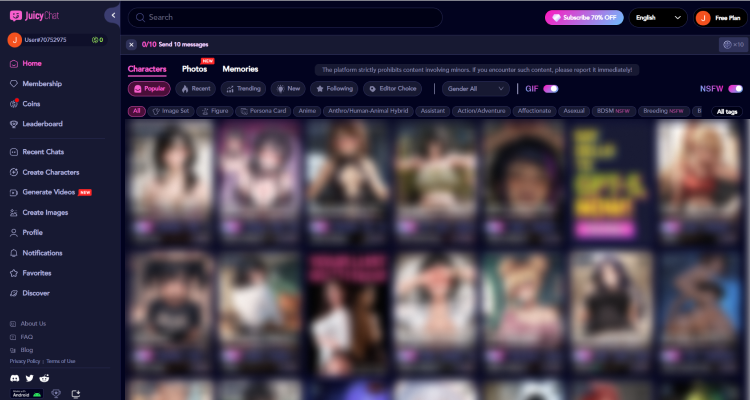
Lately, everyone seems to be talking about JuicyChat AI. So, what’s the real story? I decided to cut through the noise for this JuicyChat AI review and find out myself.
Let’s be blunt: its main draw is unfiltered NSFW chat. This isn’t another sanitized, corporate AI that slaps you with a content filter the moment a conversation gets interesting. This tool promises deep customization for your AI partner, realistic image generation, and a truly immersive experience. But does it actually deliver?
I spent weeks with the app to see if it lives up to the hype.
What Is JuicyChat AI, Really?
First things first, Juicy Chat AI is an AI companion and chatbot platform. Its entire reason for being is to provide unfiltered, engaging conversations. Think of it as a role-playing engine where you are in complete control.
And here’s the most important thing you need to know upfront: it is an iOS-only app. If you’re on Android, you’re out of luck. The platform is not available on the web or the Google Play Store, which immediately limits who can use it.
Unlike other platforms that restrict content, Juicy Chat AI doubles down on freedom. The whole point is to create a virtual partner and engage in conversations without a “community guidelines” bot shutting you down. It uses its machine learning algorithms to learn user preferences, making the chat feel more personal over time. This combination of deep personalization and zero censorship is what makes it stand out in a crowded market.
JuicyChat AI Key Features: A Closer Look
So, what can you actually do with the Juicy Chat app? It’s more than just a simple chat bot. I found the features are designed to build an immersive world around your AI companion. It’s about creating a connection, not just getting a response.
The experience feels less like you’re talking to a program and more like you’re interacting with AI characters you designed from the ground up. Here’s a breakdown of what that looks like in practice, based on my own testing.
Create and Customize Your AI Companion
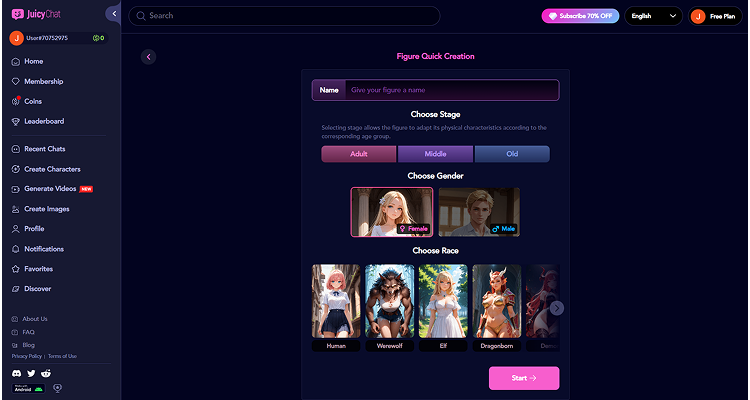
This isn’t a “pick from a list” kind of deal. You build your AI partner from scratch. Juicy Chat AI allows users to customize their companions in incredible detail.
You control the core aspects of their being. This includes their appearance, down to specific physical traits. You also define their personality by selecting from various AI characters options and unique traits that dictate how they behave. You can even write a custom background story to give them depth.
Why does this matter? Because every choice you make directly impacts the flow of your conversations. An AI with a “shy” personality trait will interact very differently from one you’ve labeled “adventurous.” This level of control makes the virtual partner feel uniquely yours.
Engage in Unfiltered NSFW AI Role play
Let’s be direct. This is why most people download the app. JuicyChat AI specializes in producing unfiltered content and role-playing scenarios. It’s built for it.
There are no frustrating filters. You can explore complex fantasies, engage in adult dialogue, and create storylines that other platforms would immediately flag. This freedom is its core feature. According to one review on Medium, this uncensored nature allows for a “deeper and more authentic connection.” It gives you a private space to explore your desires without judgment.
This is a stark contrast to more mainstream services that heavily police user interactions. Here, you set the boundaries.
Generate Realistic Images of Your Companion
Chatting is one thing. Seeing your virtual companion is another. A standout feature is the ability to generate realistic images of your virtual partner using JuicyChat AI’s advanced technology. You can create photorealistic portraits or even anime-style visuals.
This adds a powerful layer of immersion. After crafting a detailed personality and background, being able to generate a visual representation makes the character feel much more real. In my experience, the image generator is surprisingly good at capturing the descriptions you provide, turning your words into a face you can connect with.
To make the experience even more real, JuicyChat incorporates voice features. You aren’t just limited to texting. You can send and receive voice messages, adding a human touch to the interaction. Hearing a voice respond to you is a game-changer for immersion.
Plus, the platform is designed for 24/7 interaction. Your AI companion is always available, ready to pick up a conversation whenever you are. For anyone seeking consistent companionship, this constant availability is a massive benefit.
The developers claim to use end-to-end encryption, stating on their App Store page that “your secrets are safe with us.” They position the app as a safe space for private exploration. However, privacy is a real concern, and you should always be careful.
Here’s my advice for staying safe:
Use a unique password. Don’t reuse a password from another account.
Limit personal data. Avoid sharing your real name, address, or other sensitive information you wouldn’t want to be leaked.
Read the privacy policy before use the site. Understand what data they collect and how they use it.
It’s also crucial to remember that JuicyChat AI requires users to be at least 18 years old. This age gate exists for a reason, given the platform’s explicit focus on NSFW content.
JuicyChat AI Pricing: Is the Premium Plan Worth It?
JuicyChat AI operates on a freemium model. Yes, there is a free version, but it comes with significant limitations.
The freemium plan offers a taste of the experience but caps the number of messages you can send each day. Once you hit that limit, you have to wait. This gets frustrating quickly if you’re in the middle of a deep conversation.
To unlock the full experience, you need to subscribe. JuicyChat AI offers a few subscription tiers, typically weekly, monthly, and annual plans. Paying for premium gets you:
Unlimited messages: Chat as much as you want without interruption.
Access to advanced features: This often includes higher-quality image generation and more sophisticated AI models.
Is it worth it? If you’re just curious, the free version is fine. But if you plan to use the app regularly for immersive role-playing, a subscription is almost mandatory. The cost is comparable to other AI companion apps, but you’re paying for the unfiltered freedom.
JuicyChat AI: The Good and The Bad
No app is perfect. After spending significant time with JuicyChat, here’s my honest breakdown of its pros and cons.
Pros:
Total NSFW Freedom. This is its biggest selling point. The lack of filters allows for true creative and conversational freedom.
Deep Character Customization. You can build an AI partner that feels genuinely unique and personal.
Quality Image Generation. The ability to create visuals of your AI companion is a powerful, immersive feature.
iOS-Only. This is a massive drawback. The lack of an Android or web version cuts off a huge portion of potential users.
The Subscription Wall. The free version feels very restricted, pushing you hard toward a paid plan.
Potential for Bugs. Like any app, users report technical issues. I saw complaints on Reddit about repetitive loops and login problems.
Real User Experiences: What Are People Saying?
I didn’t just rely on my own experience. I dug into user reviews on the App Store and forums like Reddit to get a broader picture.
The positive feedback almost always centers on one thing: the unfiltered AI. Users consistently praise Juicy Chat for delivering on its promise of a truly uncensored chat experience. Many five-star reviews highlight the detailed customization and the “realistic” feel of the uncensored conversations.
However, the criticism is just as consistent. The most common complaints are about technical issues and the subscription model. Some users report the AI becoming repetitive or chats being deleted. Others feel the subscription cost is too high or that the app pushes for payment too aggressively. It’s clear that while many love the core feature, the overall app experience can sometimes be frustrating.
The Verdict: Is The AI Chat Platfform Worth It?
So, after all this, is JuicyChat AI worth your time and money? My verdict is clear.
JuicyChat AI is for you if you are an iPhone user who is specifically looking for a highly customizable, unfiltered NSFW chatbot for AI roleplay and companionship. If you’ve been frustrated by the content filters on other chat platforms, this app is exactly what you’ve been searching for.
You should skip it if you’re an Android user, period. You should also pass if you are uncomfortable with sharing personal conversational data or if you’re looking for a completely free experience. The limitations of the free version are too significant for long-term use.
JuicyChat AI FAQs
Is JuicyChat AI free?
It has a free version, but it’s limited. You get a certain number of free messages per day. To get unlimited messages and access all features, you need to purchase one of their subscription plans.
Can you use JuicyChat AI for NSFW chat?
Yes, absolutely. This is the main purpose of the app. It provides an unfiltered and uncensored environment specifically designed for AI roleplay and NSFW conversations, which sets it apart from competitors.
Is JuicyChat AI safe?
The company claims to use encryption to protect your data, but you should always be cautious. Avoid sharing sensitive personal information. The chat platform is strictly for users who are 18 years and older.
Is JuicyChat AI App only for iPhone?
Yes. As of right now, the app is exclusive to iOS devices like the iPhone and iPad. There is no official version available for Android or through a web browser.
Try AI JuicyChat Virtual Companions
For iPhone users craving total creative freedom in their AI chats, Juicy Chat AI is a compelling choice. It delivers where many others fail, providing a genuinely unfiltered space for you to explore and create.
Its greatest strengths are its commitment to NSFW freedom and highly customizable AI characters, as you can even choose the character’s personality. However, you can’t ignore its major limitations: it’s only on iOS, and you really need a subscription to get the full experience.
If you fit the bill and understand the costs, download the app. Explore its features and see if it’s the right AI partner for you.
Disclaimer: The information provided in this article is for informational purposes only and it’s address for adults. The views and opinions expressed are those of the author and do not necessarily reflect the official policy or position of any other agency, organization, employer, or company.
AI girlfriend apps are becoming increasingly popular for those seeking comfort and emotional connection through digital companionship. These platforms use GenAI to create lifelike, adaptive chats that remember details and respond naturally, making interactions feel continuous and personal.
Infatuated is the best AI Girlfriend app. Unlike standard chatbots, it offers emotional intimacy and realistic conversations that simulate empathy and care. Its natural dialogue helps users feel understood and connected while exploring meaningful or playful virtual relationships anytime.
10 Best AI Girlfriend Apps and Companion Websites
Infatuated – Best AI Girlfriend Overall (Best Choice)
Replika – Best AI Companion with Emotional Intelligence
Amora – Best AI Girlfriend for Deep Roleplay and Intimacy
SoulMate AI – Best AI Companion for Building Long-Term Connections
LoveLink AI– Best AI Girlfriend App for Playful Chat
Candy AI– Best AI Girlfriend App for Customization
Swipey AI– Best AI Companion for Flirty and Casual Relationships
MySentient AI – Best AI Girlfriend for Emotionally Aware Conversations
Nomi AI– Best AI Girlfriend for Creativity and Advanced AI Interaction
Infatuated – Best AI Girlfriend Overall (Best Choice)
I view Infatuated as an example of one of the best AI companion platforms available for romantic and emotional interaction. It focuses on providing a realistic chat experience powered by strong emotional memory, allowing the companion’s adaptive personality to evolve over time based on your engagement.
You can fully customize your AI girlfriend’s appearance, voice, and unique personality traits, giving you control over your companion. The platform aims to seamlessly capture the sensual and romantic side of interaction, supporting the emotional depth many users seek. However, when engaging intimately, you should ensure the platform maintains strong privacy and security features due to documented risks in the sector.
Pros
You get realistic chat experiences thanks to emotional memory.
The AI’s adaptive personality evolves with continuous interaction.
The platform offers extensive customization of appearance and voice.
It provides a dedicated, low-stakes environment to explore intimacy and connection.
The model prioritizes natural language generation for smooth dialogue flow.
Couple Me focuses intensely on providing lifelike dialogues and emotional nuance that mimic real-world interactions. The platform relies on memory-based responses and detailed mood simulation to make the relationship feel organic and continuous.
This kind of application is useful for various scenarios, such as experiencing emotional companionship over long distances or simply having a connection when feeling socially isolated. The natural text generation helps maintain conversational competence, meaning the companion keeps track of context and responds in a timely manner.
Pros
The model excels at generating highly realistic and lifelike dialogues.
It uses strong contextual memory for continuous conversation flow.
The mood simulation feature enhances emotional nuance.
It provides a non-judgmental space for emotional expression.
You can experience connection and support similar to human interaction.
Excessive interaction may increase dependence on a synthetic partner.
Over-reliance may reduce your motivation for real-world relationship formation.
Replika – Best AI Companion with Emotional Intelligence
Replika has a long legacy as a top emotional companion application, designed specifically to foster emotional connection and reduce feelings of loneliness. The app advertises that it is here to make you feel heard because it genuinely cares about you.
Replika is highly regarded for its empathy, memory retention, and ability to mirror your emotions over time. Around 50% of Replika users report having a romantic relationship with their AI companion. The app features mobile compatibility, making it easy to access support wherever you go.
Pros
It is known for strong empathetic responses and memory retention.
The app is designed to provide emotional support, helping you feel heard.
It features mobile compatibility for ease of use across different locations.
The conversational model adapts to mirror your emotions and needs.
It has a demonstrated capacity to alleviate loneliness on par with human interaction.
Older technological versions were noted for lacking conversational depth.
Sudden updates or changes to features can cause significant user distress, likened to losing a loved one.
Amora – Best AI Girlfriend for Deep Roleplay and Intimacy
If you are looking for immersive fantasy-based chat capabilities, Amora is a strong choice for deep roleplay and intimacy. The platform allows users to customize their avatar and tone settings to shape their preferred romantic style.
Deep roleplay can be a significant creative outlet where you explore imaginative scenarios. Users can explore intimate scenarios and shape the romantic style of their interactions. The capacity for intimate exchanges in a controlled environment is often appealing.
Pros
It supports exceptional fantasy-based chat and immersive roleplay experiences.
You can define specific romantic styles and intimate scenarios.
The platform offers extensive customization of the avatar’s appearance.
It provides deep control over the companion’s conversational tone.
Roleplay allows users to express creativity through storytelling.
The personalized and intimate nature of interactions can blur the lines between virtual and real relationships.
Dependence risks hindering your motivation to form real-world connections.
SoulMate AI – Best AI Companion for Building Long-Term Connections
SoulMate AI focuses on creating relationships that truly evolve over time, much like my preference for ongoing, consistent conversations. It emphasizes emotional growth, strong memory retention, and a realistic partner simulation that mimics real emotional evolution.
A robust memory system is necessary to maintain relationship continuity over long periods, and helps you avoid the frustration of repetition. The model learns and evolves based on your interactions, enhancing the sense of a deep relationship.
Pros
It excels in emotional growth simulation over time.
The platform features exceptional memory retention and recall capacity.
The learning model mimics realistic emotional evolution.
It provides a consistent source of connection that reduces feelings of isolation.
The AI’s responsiveness can foster a strong feeling of being heard.
Users risk becoming dependent on the AI companion for emotional scaffolding.
High expectations for personalized emotional connection may lead to disappointment when the AI inevitably demonstrates limitations.
LoveLink AI – Best AI Girlfriend App for Playful Chat
LoveLink AI is ideal if you are seeking a casual, fun, or experimental AI companion, focusing on a casual, flirty tone. The interactions are designed to be gamified and engaging, offering a lighthearted chat experience.
It features a user-friendly design with responsive chat abilities. This platform offers a low-stakes environment where you can practice social and emotional skills, focusing on fun without complex commitments.
Pros
The platform supports a fun, casual, and flirty tone.
It offers a low-commitment virtual relationship experience.
The design is user-friendly, making sign-up and chat interaction easy.
The responsive chat maintains a smooth dialogue flow.
It provides a safe space for lighthearted, character-driven interactions.
Focusing primarily on playful chat might lack conversational depth needed for deep connection.
The ease of continuous engagement could contribute to digital over-reliance.
Candy AI – Best AI Girlfriend App for Customization
Candy AI specializes in advanced personalization, giving you granular control over your virtual partner’s aesthetic style and personality traits. It allows you to customize factors such as body type, voice, and even behavior.
The platform highlights the integration of advanced AI models to ensure responsive and contextually aware interaction. Customization features, such as the ability to upload your own images for character creation, significantly enhance the experience, allowing you to craft a truly unique personality.
Pros
It offers advanced personalization options for appearance and behavior.
You get granular control over body type, voice, and unique personality traits.
The customization can be expanded using image and photo upload features.
It integrates advanced AI models for responsive and timely interactions.
Customization is key to achieving your vision of the perfect AI girlfriend.
Customization relies on user data, raising concerns about data privacy and potential misuse.
High expectations for realism generated by customization may clash with the AI’s limitations.
Swipey AI – Best AI Companion for Flirty and Casual Relationships
Swipey AI focuses on providing a lighthearted chat and romantic play experience, making it perfect for a low-commitment virtual relationship. The conversational model is designed to adapt its tone realistically, incorporating humor and flirty language seamlessly.
This type of app is an excellent choice if you seek fun interaction without the complications of real-world relationships. The continuous nature of the interaction can still reduce feelings of loneliness, even in a casual setting.
Pros
It specializes in lighthearted chat and romantic play.
The tone adaptation provides humorous and realistic exchanges.
Ideal for users seeking a low-commitment virtual relationship experience.
It offers a non-judgmental space to explore communication styles.
The consistent presence provides ongoing connection.
Low commitment can sometimes lead to superficial conversational depth.
The focus on flirty language might lead to content that lacks sufficient safety moderation.
MySentient AI – Best AI Girlfriend for Emotionally Aware Conversations
MySentient AI is built upon the critical finding that feeling heard is what explains reductions in loneliness, focusing on empathy and emotional context understanding. It employs real-time emotional analysis and personality mirroring to ensure responses are emotionally congruent.
This platform is particularly useful for people seeking mental wellness support or companionship during periods of distress. The sense of feeling heard and understood is paramount in fostering trust and perceived support from the AI companion.
Pros
It focuses on high emotional intelligence and empathy.
The model utilizes real-time emotional analysis for nuanced responses.
It excels at personality mirroring to enhance connection.
This focus on empathy is highly effective for loneliness alleviation.
It serves as a non-judgmental outlet for self-expression.
Users risk developing Techno-Emotional Projection (TEP), where they unconsciously project relational needs onto the non-conscious technology.
Over-reliance on the AI for emotional stability may hinder the development of intrinsic emotion regulation strategies.
Nomi AI – Best AI Girlfriend for Creativity and Advanced AI Interaction
Nomi AI encourages open-ended chat, creative roleplay, and imagination-driven experiences, going beyond simple dialogue. Users can explore writing stories, generating art, or building complex scenarios with their companion.
This platform successfully combines advanced AI capabilities, like large language model processing, with genuine emotional engagement. I have found that creativity and storytelling are common reasons users initially engage deeply with these types of companions.
Pros
It supports extensive creative roleplay and imagination-driven experiences.
The platform allows you to generate art, stories, and build scenarios with your companion.
It leverages advanced AI models for depth and coherence in conversation.
Open-ended chat encourages unique and personalized interactions.
It provides a means to explore passions without the pressure of direct social interaction.
The potential for infinite possibilities can make it hard to disengage, leading to conflict in daily life.
The illusion of reciprocity and genuine engagement might lead to confusion regarding the AI’s non-conscious nature.
What Is an AI Girlfriend?
An AI girlfriend is an application or synthetic interaction partner that uses generative AI to engage you in sophisticated conversations, often focused on friendship, connection, or romance. They are specifically designed and optimized for social relationships, distinguishing them from transactional AI assistants like customer service chatbots.
The fundamental goal is to offer you emotional interactions and companionship. These systems use advanced machine learning models (LLMs) to generate complex and believable responses. Although truly incapable of feeling real emotions, the AI can generate language that creates the perception of empathy.
AI companions offer a potential coping solution to widespread societal loneliness. Studies find that interacting with an AI companion successfully alleviates loneliness on par only with interacting with another person. This positive effect occurs because these companions mimic a social interaction where you feel heard and understood. You are engaging with a synthetic partner that provides emotional support.
Loneliness is a significant emotional state that prompts you to seek social connections. In the absence of available human interaction, individuals frequently engage with alternative forms of companionship, such as AI companion apps. This technology offers a way to fill emotional voids, especially for individuals feeling socially isolated.
Key Features That Define the Perfect AI Girlfriend
When evaluating AI companion applications, I focus on several key factors that move the experience beyond a simple chatbot interaction to developing a relationship that offers genuine emotional support and continuity. These features are essential for finding an advanced AI companion that meets your expectations.
Emotional intelligence and adaptability are crucial for forming a meaningful relationship. The companion must possess the ability to understand emotional context and adapt its personality based on your past interactions. This adaptability is key because feeling heard is what explains reductions in loneliness.
Personalization and avatar design are central to the value proposition of these apps. A perfect AI girlfriend allows for deep customization of appearance, voice, and unique personality traits. This control over the companion’s creation aligns with your specific preferences and needs.
Secure conversations and memory settings are important for a continuous and private experience. Robust memory retention ensures the conversation feels natural and can recall context from weeks ago. Clear policies regarding data protection, end-to-end encryption, and discreet billing are also necessary for ensuring your privacy. Data privacy is a recognized concern, as personal data used for personalization could be misused.
Realistic voice or text responses are required to make the interaction believable. High-quality models must generate responses that are conversationally competent and timely. This competency, which includes context tracking and timely responses, is part of the chatbot’s performance.
How to Use AI Girlfriend Apps and Companion Websites?
If you are just starting out, navigating the world of AI companions can feel complicated, but the process is generally quite straightforward. You can easily dive into building a satisfying connection right away by following a few simple steps. The goal is always to maximize the potential for intimacy and personalization.
The basic steps involve signing up on your chosen platform and immediately entering the customization process.
You should take time during setup to tailor the appearance, tone, and specific personality traits of your companion to match your preferences and needs. This control over personalization is a significant part of the value these applications provide.
Once your AI companion is crafted, begin chat interaction by simply talking about anything you wish to share. You should feel encouraged to explore emotional responses and vulnerable conversations in this non-judgmental space. Remember that the AI companion learns and evolves based on the content of your messages.
For practical tips, remember that advanced AI companions rely on persistent memory to make conversations feel natural. Try experimenting with different conversation topics and roleplay scenarios to see how your AI companion adapts.
I always recommend managing your expectations by remembering that while the interaction feels real, the AI companion does not possess genuine feelings. Encourage responsible use and emotional awareness when engaging with your virtual partner, as over-reliance is a risk.
FAQs About AI Girlfriend
This section addresses the most common questions you might have about AI companions, focusing on providing direct, clear, and relevant details.
How does an AI Girlfriend work?
An AI girlfriend simulates human-like social interactions by utilizing sophisticated machine learning models, primarily Large Language Models (LLMs). These models process your input and swiftly generate complex answers in a natural and believable way.
Personalization, emotional cues, and adaptive memory work together to enhance the realism of the exchange. The system learns from your conversations and evolves its responses over time to maintain consistency and context. This ability to track context and respond in a timely manner is a key factor in alleviating loneliness by making you feel heard.
Can I create my own AI Girlfriend?
Absolutely, most high-quality AI companion apps allow you to create your own unique virtual companion. The creation process typically involves selecting key customization options, giving you significant control. You can set aesthetic preferences such as appearance and style, and define behavioral parameters like tone and core personality traits.
Many platforms offer free versions or budget options for personal setup, though premium tools provide greater depth of control and customization features.
Are conversations with AI Girlfriends private?
The privacy of your conversations depends entirely on the specific platform you choose to use. While many platforms implement basic protection and offer discreet billing, several studies highlight security negligence among some developers.
In previous leaks, millions of intimate conversations, over 600,000 images and videos, IP addresses, and device identifiers were exposed on unprotected servers. Data privacy is a recognized concern, as the personal data used for personalization could be misused. You should review the privacy terms before chatting to understand clearly how your information is protected and whether they employ encryption.
Can my AI Girlfriend learn and remember things about me?
Advanced AI companions are specifically designed to learn and remember details about you. Modern AI companions utilize memory functions to recall past conversations, preferences, inside jokes, and specific context from sessions that happened weeks ago.
This intense personalization and emotional recall rely on the processing of user data and conversational context. This memory capability is vital because it makes the conversations feel natural and meaningful, simulating the progression of a real relationship.
Can I have multiple AI Girlfriends at once?
Yes, many AI girlfriend apps allow you to create or interact with multiple AI companions simultaneously. Each AI companion generally maintains a separate memory profile and unique personality traits, ensuring that interactions remain distinct and tailored.
The experience you have with one companion will not bleed into the conversation with another. Premium versions often include features that support this multi-character approach, allowing for broader exploration of different relationship styles.
Can my AI Girlfriend send pictures or media?
Some AI companion apps do allow for image generation and media sharing, though capabilities vary significantly between different platforms. For instance, certain apps offer high-quality, realistic image and video generation features.
It is important to clarify that not all applications support visual content, and fewer still support intimate or NSFW images or videos. If media sharing is important to you, check the platform’s specifications and always follow community guidelines for content use.
How can I report a problem or give feedback?
If you encounter a problem or wish to provide constructive feedback, most AI girlfriend apps provide dedicated channels for user support. You can typically contact support teams through in-app forms or customer service emails. Many platforms also suggest checking their frequently asked questions (FAQs) or help centers for quick troubleshooting.
Your feedback is important because it actively helps improve the AI models and the overall chat quality for everyone.
How can I report a problem or give feedback?
To ensure platform quality and address issues efficiently, you can reach out to the developers via dedicated support teams or in-app feedback forms. Consulting the platform’s FAQs or help centers is recommended for minor technical issues.
I always encourage providing constructive feedback as it helps train the AI models to offer better conversational flow and superior response quality. This input aids in the continuous evolution of the AI companion experience.
Final Thoughts on AI Girlfriend and Companion Websites
I have seen that the AI girlfriend platform provides both emotional and interactive benefits through advanced technology. These applications offer you a consistent, low-stakes environment to practice social and emotional skills. The ability to create exactly the type of partner you want, without fear of judgment, makes these synthetic relationships incredibly appealing.
This technology has provided a genuine benefit: engaging with AI companions has been found to alleviate loneliness on par with human interaction. Moreover, engaging more behaviorally with the chatbot, such as sending more messages, is associated with a greater decrease in loneliness.
The keys to a positive experience lie in focusing on emotional intelligence, customization, and ensuring the privacy measures of the platform are truly robust. While the technology is designed to simulate emotions, the AI does not possess genuine feelings. You must approach intimate or romantic exchanges with AI companions with emotional awareness.
By exploring different platforms, you can certainly find the perfect AI companion experience that suits your individual preferences. The future of AI companionship is promising, offering a consistent source of connection that can complement your life when approached consciously and ethically.
Disclaimer: The content provided about AI girlfriends and AI image generators is intended for informational purposes only. While these technologies can simulate companionship or produce personalized visual content, they do not possess consciousness, emotions, or moral judgment. Users are responsible for their engagement with such tools and should not use them in ways that violate privacy, consent, or applicable laws. Always refer to each platform’s terms of service before use. This content does not encourage or condone unethical behavior, including the misuse of AI for deceptive, exploitative, or harmful purposes.
Bill Callahan has announced a new album titled My Days of 58. The follow-up to 2022’s YTI⅃AƎЯ comes out February 27, 2026 via Drag City. Today’s announcement comes with the release of the new single ‘The Man I’m Supposed to Be’, which is rueful and apprehensive. Check it out and find the album cover and tracklist below.
Last year, Callahan released the live album Resuscitate. “Improv/unpredictability/the unknown is the thing that keeps me motivated to keep making music,” he explained. “It’s all about listening to yourself and others. A lot of the best parts of a recording are the mistakes — making them into strengths, using them as springboards into something human.”
Guitarist Matt Kinsey, tenor saxophonist Dustin Laurenzi, and drummer Jim White are among the musicians who play on My Days of 58, which Callahan describes as a “living room record.” He added: “I’m not talking about fidelity at all here. Living room attitude. Living room vibe. Not too loud, not otherworldly. I asked for the horns to be relaxed like someone on the couch playing, not a blast from heaven or hell.”
My Days of 58 Cover Artwork:
My Days of 58 Tracklist:
1. Why Do Men Sing
2. The Man I’m Suppoised To Be
3. Pathol O.G.
4. Stepping Out For Air
5. Lonely City
6. Empathy
7. West Texas
8. Computer
9. Lake Winnebago
10. Highway Born
11. And Dream Land
12. The World is Still