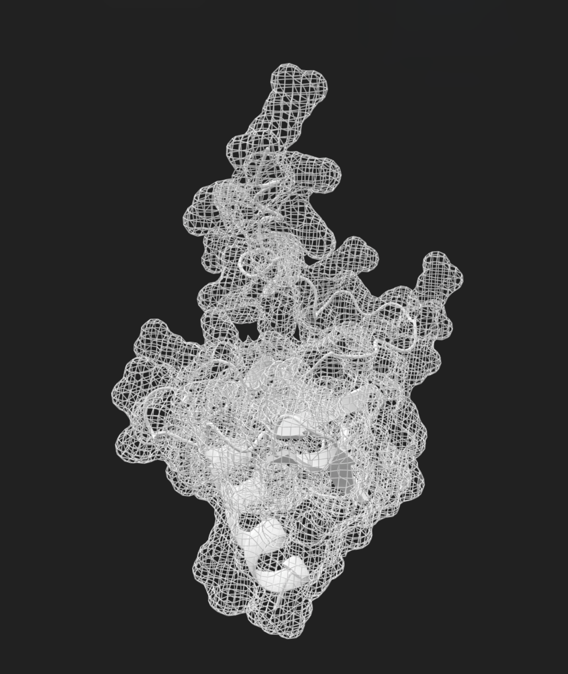
What might a protein sound like as it folds? How could a constellation of microtonal harmonics reconfigure our sense of space, attention, and temporal flow? For artist and researcher Haoxuan Zhang, sound is never merely a signal awaiting reception. It is an energetic agent – one capable of restructuring living systems and the material substrates that surround them.
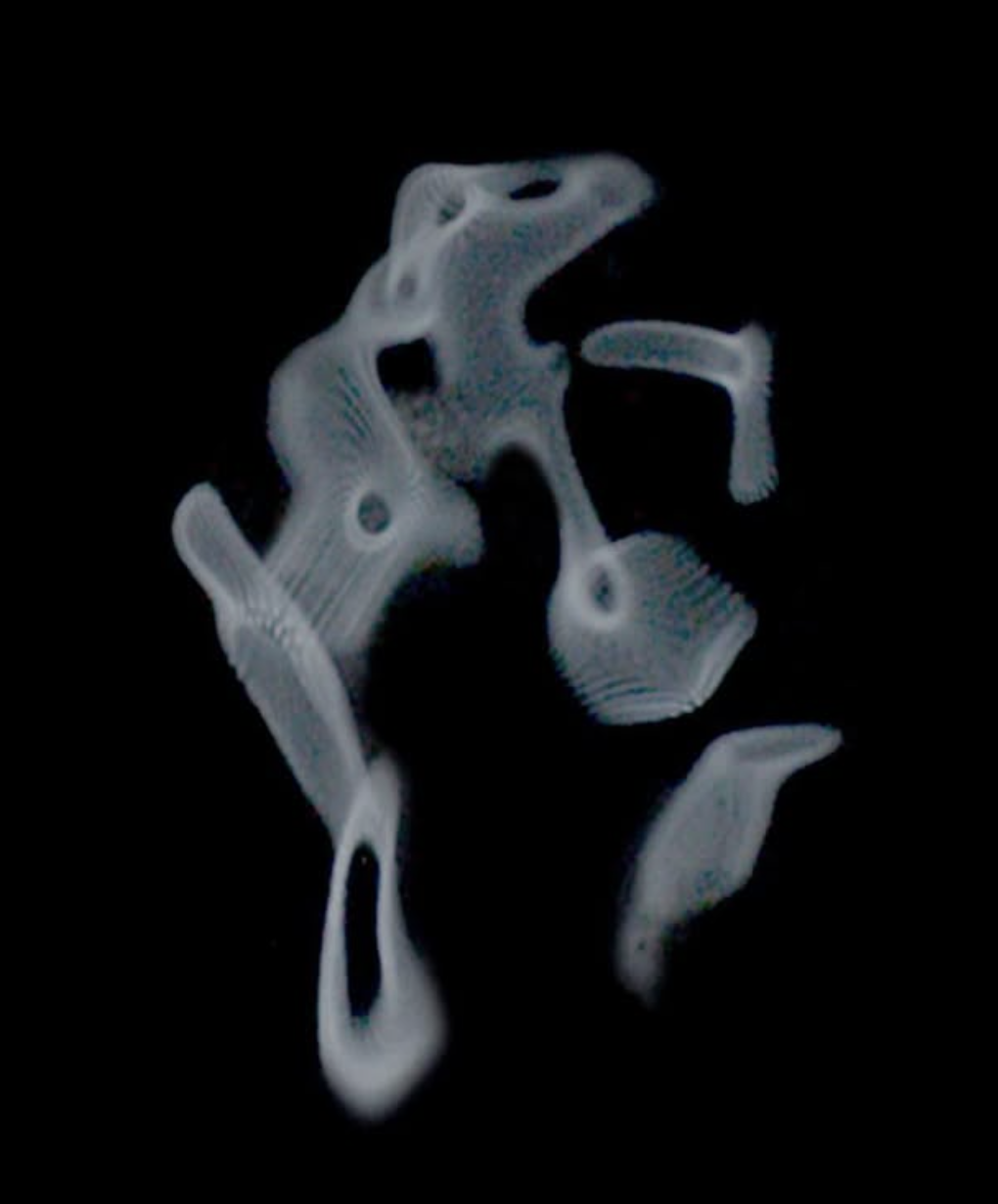
Digital visualization from The Blue Jet I, the artist’s ongoing body of research translating microscale vibrational phenomena into perceptible form.
Operating across sonic art, visual installation, computational modelling, and interactive environments, Haoxuan constructs multisensory experiences in which audiences encounter phenomena typically foreclosed from perception: acoustic interference patterns, material resonances made visible, infinitesimal modulations in amplitude and frequency, the liminal threshold where sensation dissolves into structure. Recent projects synthesise research undertaken between Imperial College London and the Royal College of Art, investigating whether particular frequency bands and material interfaces might influence biological processes-protein assembly, particle suspension dynamics at the molecular scale.
In Something Human 1, an audio-visual work premiered within the international digital exhibition thumb2 and physically launched at Ladder Space, Aarhus, Haoxuan weaves sine tones, band-filtered noise, and processed field recordings with visual elements into a gradually unfolding sensory field. The composition develops through calculated tensions: frequencies phase-lock before drifting apart, waveforms obliterate and regenerate one another, fragments of human respiration fuse with algorithmic architectures. Audiences describe the experience as simultaneously intimate and monumental – an encounter with vibration and materiality as sculptural media, and with attention itself as perceptual apparatus.
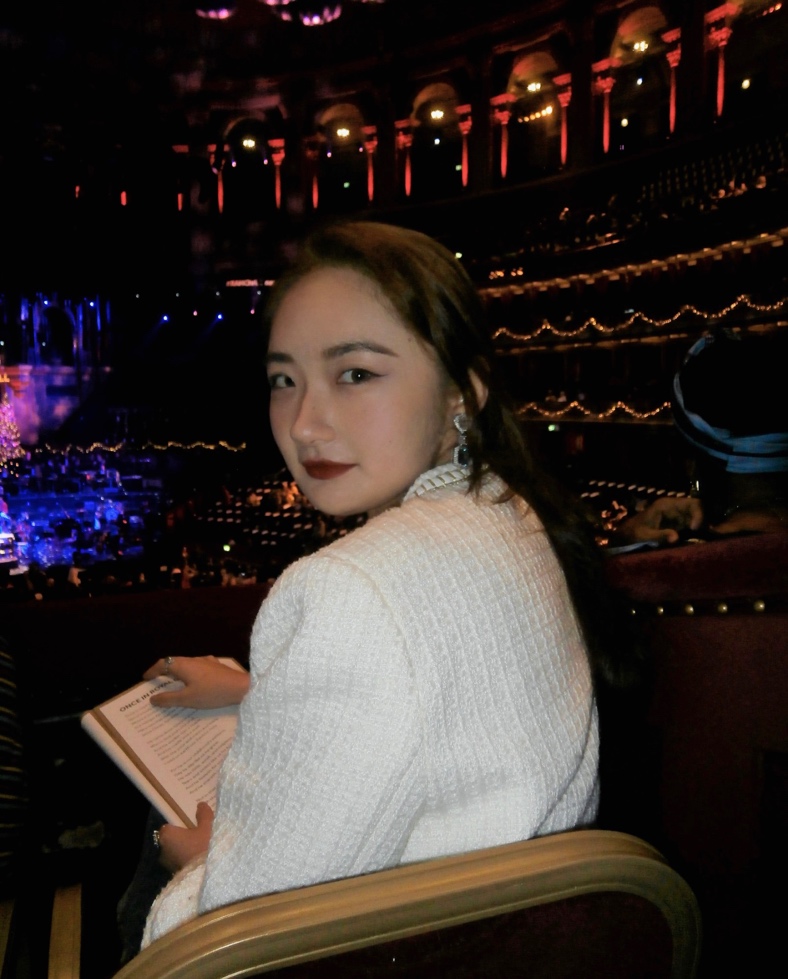
Haoxuan’s performances and installations have addressed audiences throughout the UK and internationally. At the Royal Albert Hall’s Open Stages programme, a site-responsive sound -visual installation and live performance transformed the Elgar Room into an active resonant chamber, bridging traditional piano and acoustic instruments with frontier sound technologies to reveal the architecture’s hidden sonic properties.
Within a clinical setting, Haoxuan contributed sound and material interface work to Design Innovation in Healthcare at Chelsea and Westminster Hospital NHS Foundation Trust, examining how multisensory design might enhance perceptual acuity and care protocols within public health infrastructures.
This research-led practice inhabits the intersection of artistic and scientific inquiry, yet studiously avoids reductive illustration but to manifest the fundamental relationships between sound, matter, and life. Rather than transcoding data into audible or visible equivalents, the works establish perceptual conditions through which audiences might apprehend how the universe organizes itself at multiple scales: the characteristic beating produced by minimally detuned sine waves mirrors protein oscillations; acoustic interference patterns echo quantum behaviors; material transformations rendered perceptible through carefully designed interfaces reveal the malleability of matter under vibrational influence. The implicit proposition is that perception is not passive reception but an active, continuously reorganised process – one fundamentally shaped by multisensory encounter and capable of accessing truths that remain perpetually unseen through conventional means.
Haoxuan represents a new generation enacting a paradigm shift in how art and science co-pilot human creation. Moving beyond the traditional divisions that have long separated artistic intuition from scientific rigor, this practice demonstrates that the two are not merely complementary but fundamentally unified, both modes of attending to and participating in the universe’s ongoing formation. The work refuses hierarchy between sensory knowledge and empirical data, between felt experience and measured phenomenon, proposing instead that genuine understanding emerges precisely where these seemingly disparate ways of knowing converge.
Haoxuan’s broader concerns encompass ecology and collective experience, realised through collaborations addressing climate consciousness, epistemic distortion, and communal modes of sensing. Exhibited at venues including the Grantham Institute Climate Research Showcase, Exhibition Road Festival, and London Design Festival, the practice maintains methodological consistency: establish lucid sensory parameters that bridge seemingly disparate domains, honour systemic complexity at every scale, and permit multiple modes of perception to uncover relationships that single-sense comprehension might miss.
In the year ahead, Haoxuan is developing a tripartite series engaging three scalar domains: the acoustic, the microscopic, and the subatomic. Each project will manifest as paired installation and performance, employing bespoke software alongside minimal transducer configurations and visual systems to generate granular, spatially distributed sensory experiences. The ambition is not sensory bombardment but refined sensitivity, an invitation to dwell within vibration, materiality, and visual resonance, and register their transformative effects.
When asked what audiences might derive from this work, Haoxuan gestures toward attention itself. “Perception operates as both action and instrument, it’s a transformation in how we understand existence itself. If we cultivate responsiveness to minute variation across sensory modalities, we may simultaneously cultivate responsiveness to one another and to the precarious patterns sustaining our shared world.”
Artist: Haoxuan Zhang Selected presentations/exhibitions: Royal Albert Hall Open Stages; thumb2, Ladder Space, Denmark; Design Innovation in Healthcare, Chelsea and Westminster Hospital NHS Foundation Trust; London Design Festival (with PriestmanGoode); Grantham Institute Climate Research Showcase; Exhibition Road Festival; Somers Gallery Affiliation: Royal College of Art–Imperial College London; Research Member, Edinburgh Futures Institute
Support:
Supported by The Blue Jet Foundation
Portfolio: www.thebluejet.com
Instagram: @haoxuan_3am
When guests arrive at your venue, the first person they are likely to meet is the valet. And that first impression is an important one – it’s what sets the tone for the rest of the experience they’re about to have with you. So, making sure your valet team looks the part is crucial – not just to show they’re professionals but also because it gives your brand its first big make-or-break moment.
One of the simplest ways to achieve that is to give your team a uniform that really stands out. Not just for making them look good, but also because it helps them feel good too. But how do you strike the perfect balance between looking sharp and feeling comfortable?
Building a great uniform is a lot easier said than done. You’ve got a bunch of factors to think about to make sure your team’s look represents your brand and keeps your team happy. To help you get it right, here are the main things to consider.
Make Sure the Uniform Reflects Your Brand’s Personality
You should choose a valet uniform that’s an extension of your brand – not just something that your employees put on because it’s required. The colours, materials and overall style should match the vibe you want to create from the very first second your guests arrive. That said, if you’re a high-end hotel or restaurant, you’re going to want to go for something smart and elegant, like tailored blazers and crisp shirts. On the other hand, if you’re a more laid-back venue, smart polos and lightweight jackets might be more up your street.
The colours you choose are also going to make a big difference, not just because they match your logo or interior design (although that helps). Neutral colours like black, navy and charcoal are safe bets because they look smart and professional. But if you want to add some personality to your team’s look, brighter colours can be a good way to go as long as they’re true to your brand.
Comfort and Functionality
Valet work is physically demanding. Your team is on their feet for hours, moving quickly, getting in and out of cars, carrying items and being active all day. That’s why comfort and functionality should be the top priorities when designing uniforms.
A comfortable valet uniform starts with breathable, lightweight fabrics that allow for full movement and temperature regulation in hot and cold conditions. Stretchy materials like cotton blends or performance fabrics with a bit of elastane make bending, reaching and walking much easier without compromising on style.
Functional details make a big difference. Think pockets for essentials, durable buttons or zippers and layers that can adapt to the weather. By combining comfort and practicality with style, you ensure your team can focus on providing great service without being held back by their uniform.
Durability and Maintenance
Valet uniforms need to withstand daily use. Between constant movement, weather and long hours, a uniform that’s not durable will quickly lose its professional look. Choosing high-quality fabrics that resist wrinkles, fading, and wear is key to ensuring your team always looks polished. Materials like polyester blends, treated cotton or performance fabrics are often great choices as they combine durability with comfort.
Maintenance is just as important. Uniforms that are easy to care for (machine washable, quick-drying and stain-resistant) save time and money for both staff and management. When your team can easily clean and maintain their uniforms, it ensures they always look crisp and professional, reinforces your brand image and avoids the frustration of constantly replacing worn or damaged clothing.
Seasonal Changes
Valets work outdoors in all weather, so their uniforms need to be versatile enough to handle seasonal changes. A smart approach is to design a uniform system with layers that your team can add or remove as the conditions change.
In warmer months, lightweight, breathable shirts or polos made from moisture-wicking fabrics will keep the team cool and comfortable. When it’s colder, add layers like vests, jackets or softshell outerwear to keep them warm without restricting movement.
Also maintain style and colour consistency across all seasons so your team looks the same whether they’re wearing short sleeves in summer or a jacket in winter. Water-resistant materials and weather-appropriate accessories (gloves, caps or rain gear) will make a big difference in comfort and presentation.
Personalise Your Uniform
Personalisation can do wonders. It’s what gives a standard uniform a bit of personality and shows off your brand’s unique identity. Adding some thoughtful touches, like embroidered logos, name tags or a splash of your company colour on the uniform, makes your valet team instantly recognisable and helps to reinforce your company’s image.
Even tiny details, think branded buttons, some colour on the collar, can make the uniform look far more polished and memorable.
About Creating A Uniform Policy That Really Works
Having a solid uniform policy in place is just as important as getting the design right. A clear policy outlines what your valet team need to wear, how to keep it looking good, and what’s expected of them in terms of presentation. This helps make sure that every team member looks their best, no matter who is working on any given shift and regardless of the time of day.
A good uniform policy actually has plenty of benefits beyond just looking good. It makes things easier for management by setting clear expectations, reducing the confusion of what is and isn’t acceptable and helping keep your brand image looking sharp all the time. You can also include guidelines for seasonal changes, replacing gear and looking after the uniform itself to keep it in good nick for longer.
But while all of that is great for the business side of things, a well-thought-out policy also encourages staff to have pride in their uniform and take care of it. When employees understand how important it is to keep themselves looking great, they’re more likely to present themselves with confidence and uphold the professional image your brand represents. In simple terms, a strong uniform policy makes sure everyone is on the same page – and that helps protect your brand’s reputation and keeps your team looking its best.
Astral Throne II: Age of the Phoenix has been recently announced by developer Zero Sun Games. This new title serves as a prequel and a sequel to the original game launched earlier this year.
While it might be too early for a new version, the developers said the changes they were adding were too fundamental. That is why they decided to make another one. In the same way, it could be a good move since the first game got positive community feedback despite dismal commercial performance.
While a new one is coming, the original title is not ending soon. In fact, there will still be another patch for it. The makers also believe it is okay to have both at the same time.
“We don’t intend to replace Astral Throne; we think the games can exist side-by-side,” Zero Sun Games said in the announcement.
Despite the changes, the studio said that the sequel will still offer a unique strategic experience.
Refined Gameplay Mechanics
According to the official Steam page, Astral Throne II leans more toward the Roguelite genre. Even so, the turn-based mechanics remain. Likewise, players can still build their army and go through a continent-spanning quest. Particularly, this popular SRPG lets players lead a team through tactical battles. It now also has smaller maps and shorter runs. Each run is different, with permadeath mechanics, randomized loot, and more. This change ensures that the process does not feel like a long grind. More importantly, the studio wants to focus more on meta progression.
Transformed Graphics, Better UI, and New Story
Aside from the fresh gameplay, Zero Sun Games said that Astral Throne II will now use a hybrid 2D-3D pixel art style for its visuals. Removing the 3D low-poly look fits with the player’s preference in the genre. At the same time, it enables the developers to add content more easily.
Similarly, they are working on improving the UI to support controllers. In particular, the studio wants the game to get the Steam Deck verification.
On top of that, players can look forward to a new story that is more linear. The creators are very excited, as award-winning fantasy novelist Shami Stovall will write it.
Upcoming Demo and Release Window
Fans can expect the first demo to be available in the first quarter of 2026. However, there is no official launch date for the game yet. Looking at the situation, developers could drop the game by the second half of next year. For now, players can Wishlist the game on Valve’s Steam.
‘Piece Together’ is an international exhibition of cutting-edge mosaic art, curated by the British Association for Modern Mosaic (BAMM). It represents a new era of collective authorship, where individual voices and shared creativity converge to redefine the boundaries of this timeless medium. The end result is a vibrant collection of 65 works inviting viewers into a captivating world of fine art mosaics . From glimmering tesserae that evoke light -dappled water to tactile fragments shaped into soaring birds or abstract rhythm, the collection celebrates the infinite possibilities of materials often underestimated.
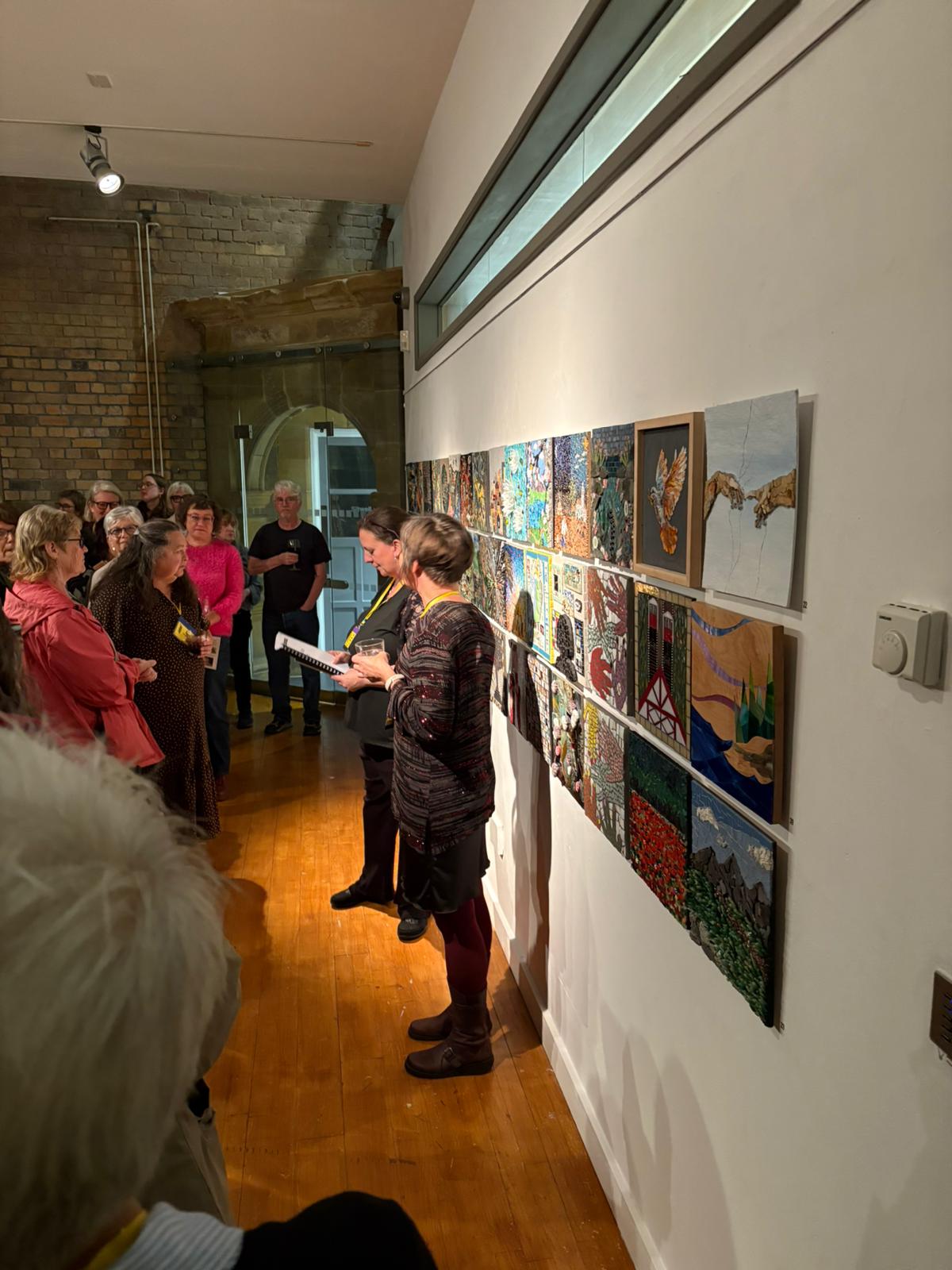
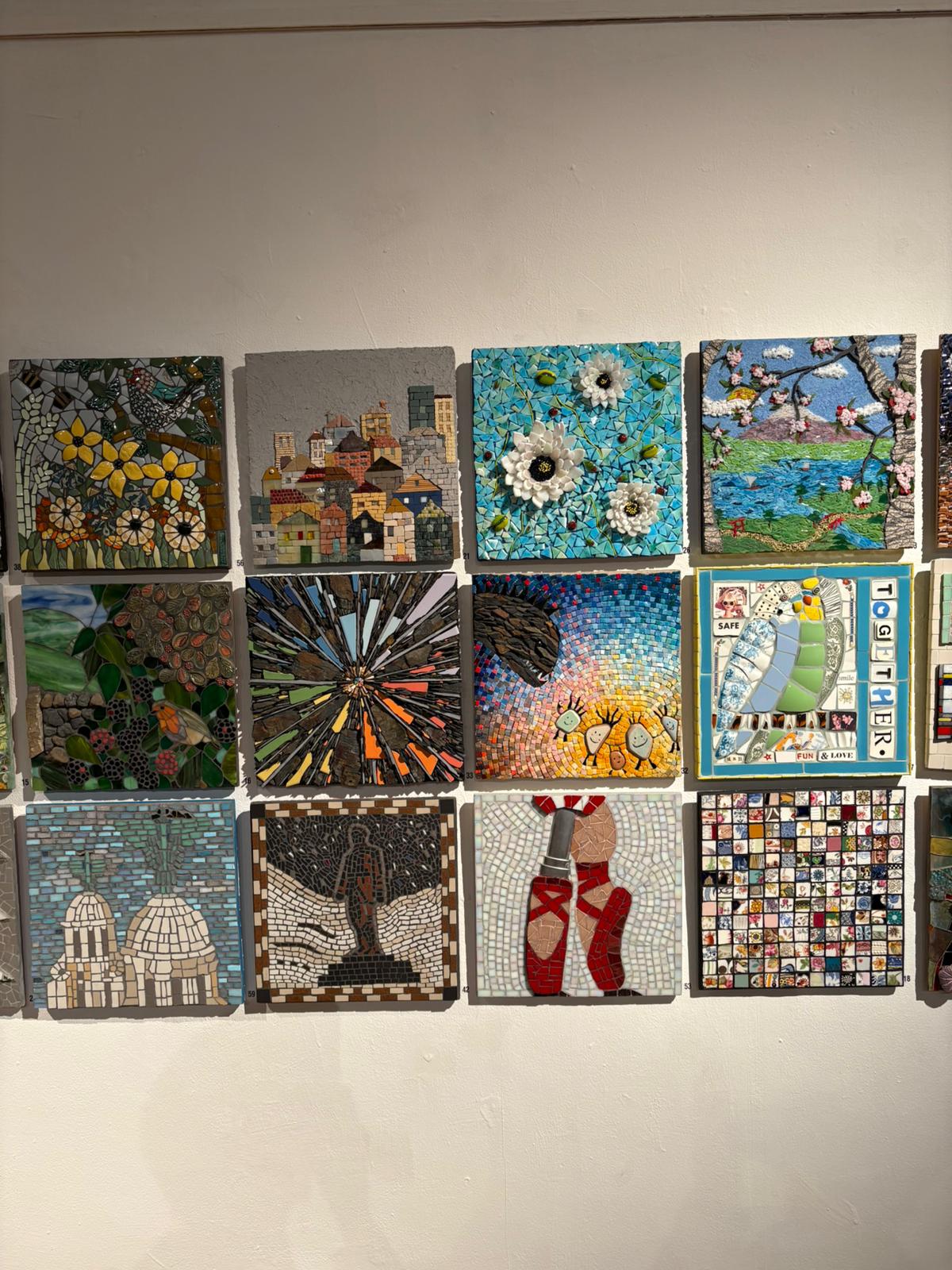
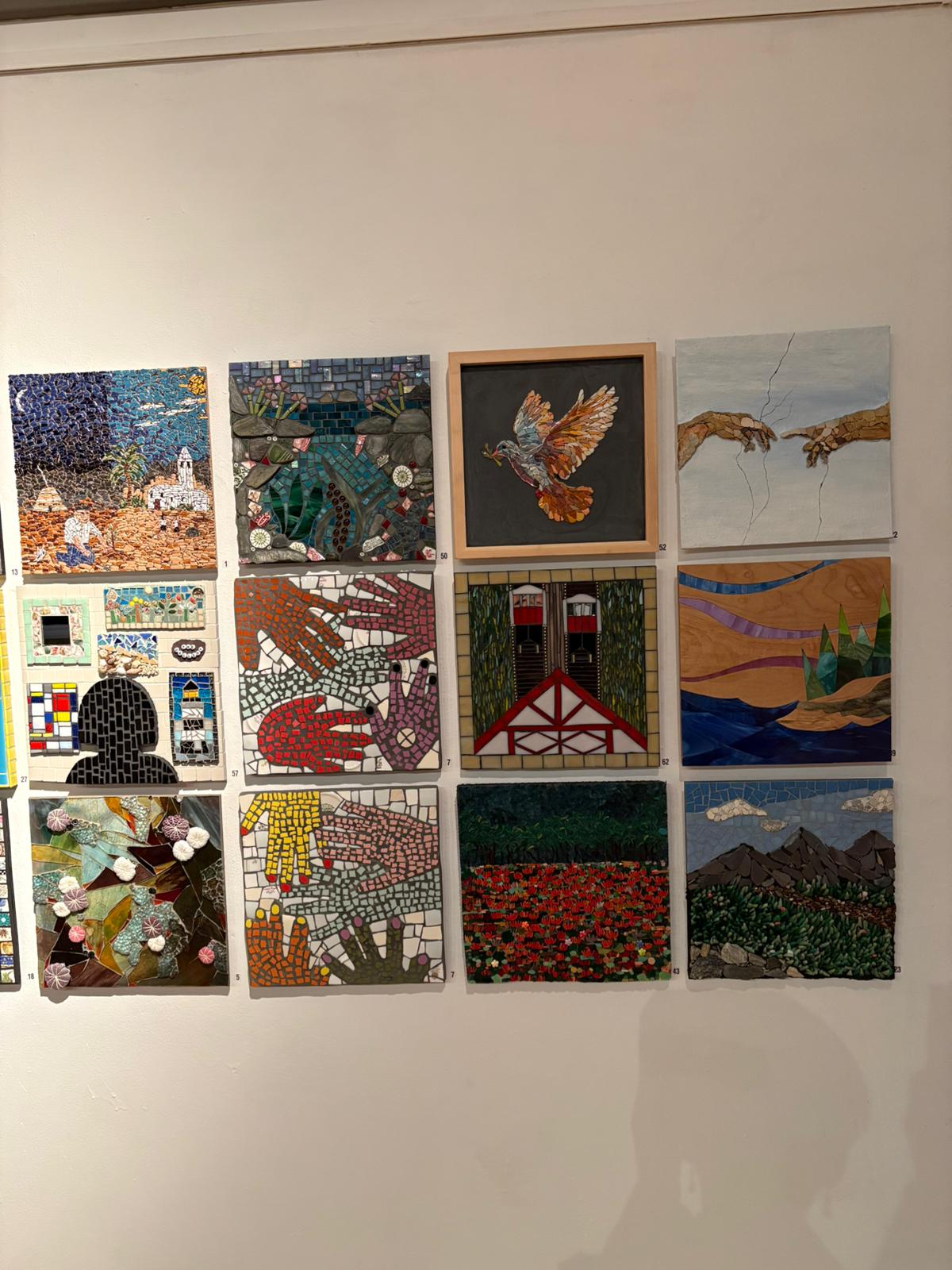
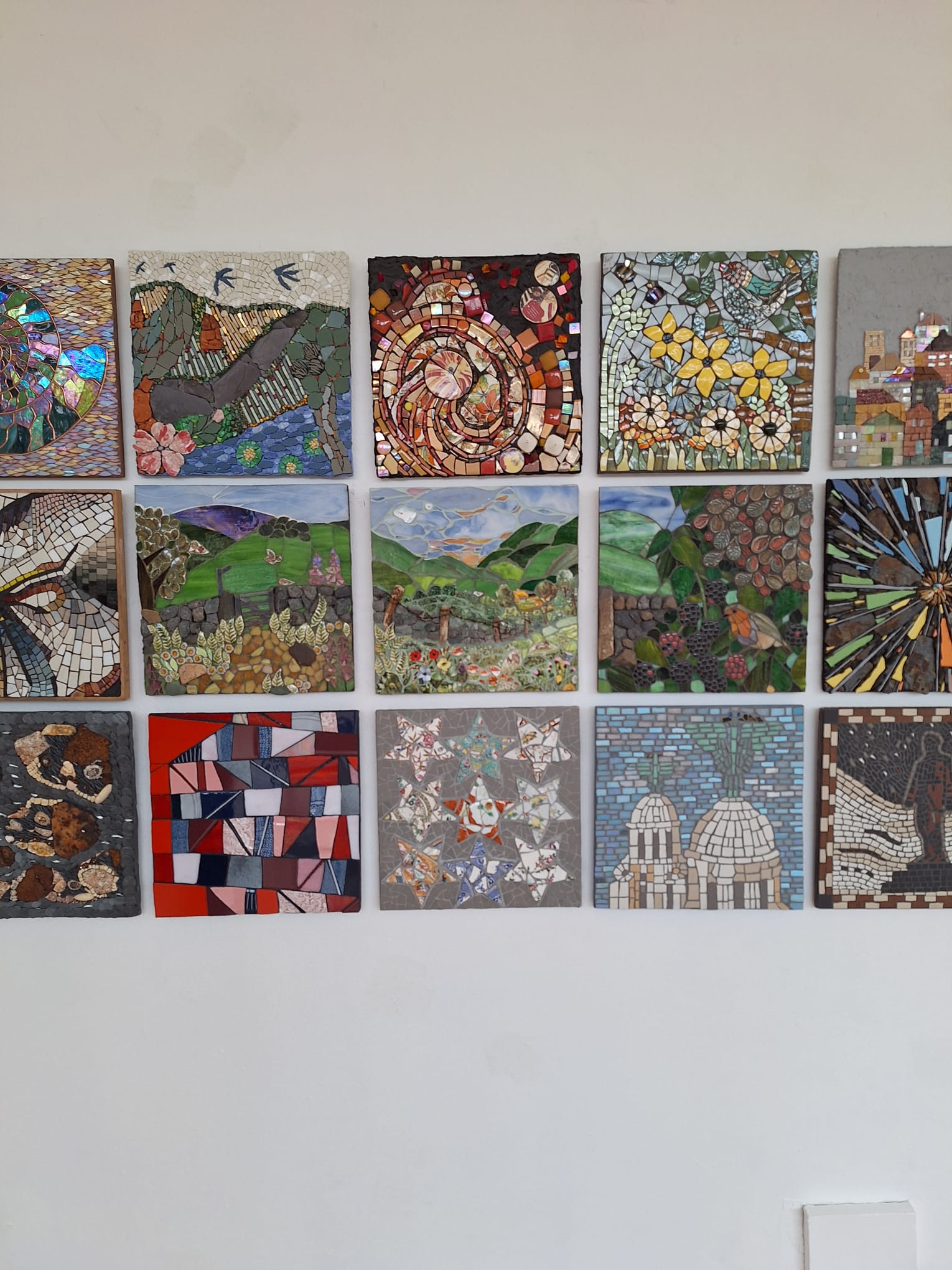
There is a long-standing contradiction between the singular and collective aspects of mosaic art. The individual tesserae of a mosaic rely upon one another to create a cohesive image, as do the artist’s decisions and skills, which are influenced by traditional techniques, artistry and the time-consuming process of assembling a mosaic. In Piece Together, this duality is expanded to include the actual creation of a collective mosaic. The theme of the exhibition is collaboration and, by working together or swapping materials. This exhibition has been curated by Crescent Arts, a contemporary arts charity based in Scarborough. Each artist involved in the project exchanged either materials, ideas or portions of their work in order to create a new piece of art together. The collective aspect of the exhibition is reflected in its layout. The 65 mosaics are arranged in rows on a wall, creating a 30 cm grid of panels that function as a sole entity made up of many individual mosaics of colour and texture.
While no two panels exhibit the same language, they are part of a common vocabulary. There are mosaics that shine with glass and light, while others rest in the grounded beauty of ceramic, stone and slate. While many of the mosaics exhibit recognizable images, others blur into abstraction, where the individual tiles become the subject rather than a tool used to depict a subject. When viewed collectively, the mosaics demonstrate a medium that is liberated from its historic associations with decoration and monumentalism, and are instead using the medium to explore experimentation, environmental awareness and emotional expression.
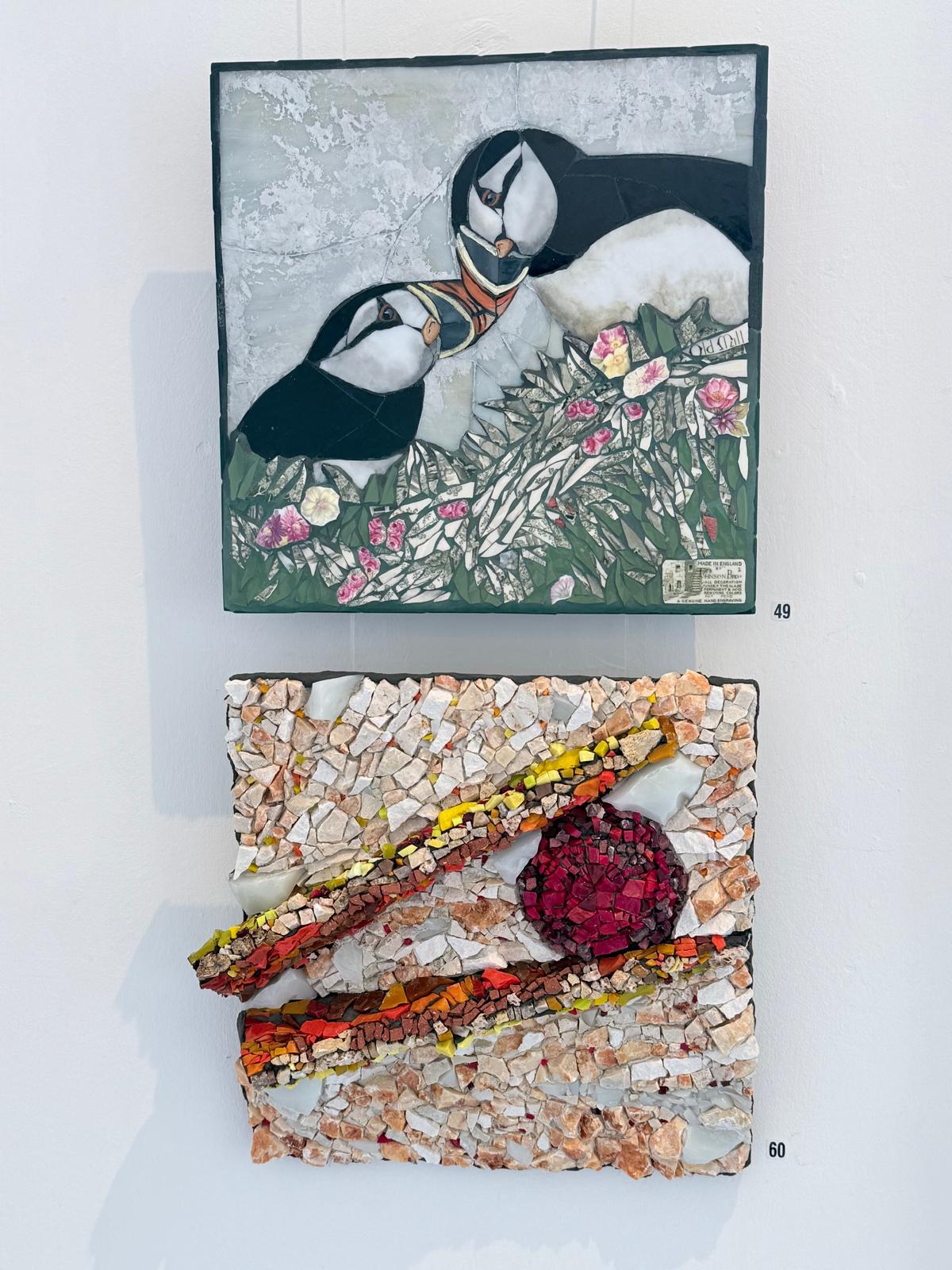
Several works exhibited at Piece Together illustrate this new direction for the medium. For example, a delicate depiction of two puffins titled ‘Puffins – A collaboration of Sea Clowns’ by Gillian Goldsmith. The puffins are rendered delicately out of handcut stained glass, against a grey-blue sky. The precision of the cuts creates a sensation of softness, and adds to the overall impression of delicacy. Next to this piece is a more tactile abstraction of thick shards of stone and glass in reds, ochres and sulphur yellows, that push mosaic towards the realm of sculptural relief. Titled ‘The red berry’ by artist Sandrine Soubes, it depicts a bird beak holding a little berry, tenderly. The uneven surface of this work casts shadows that change throughout the day, suggesting movement and instability. The juxtaposition of these two works illustrates the curatorial approach of the exhibition, which is based on contrast. The first work celebrates representation and gentleness, while the second work celebrates material energy and fragmentation.
In addition to exploring the potential for mosaic to express narrative, several works in the exhibition use mosaic as a way to tell stories. For example, a panel depicting a crocodile, a bird and a turtle in an unlikely co-existence, demonstrates a classically-arranged composition by Judy Tocher titled ‘Reaching for the golden pear’ Each animal is represented by tiles of varying scales and tonalities, creating a dynamic rhythm within the surface. Immediately below this work is a monochromatic geometric design in black, white and ochre titled ‘Posh not posh’ by Coralie Turpin, that recalls Roman pavement motifs, but updates them with broken symmetry and varying thicknesses of stone. Both works reflect the ability of the exhibition to balance history and innovation, without favoring one over the other.
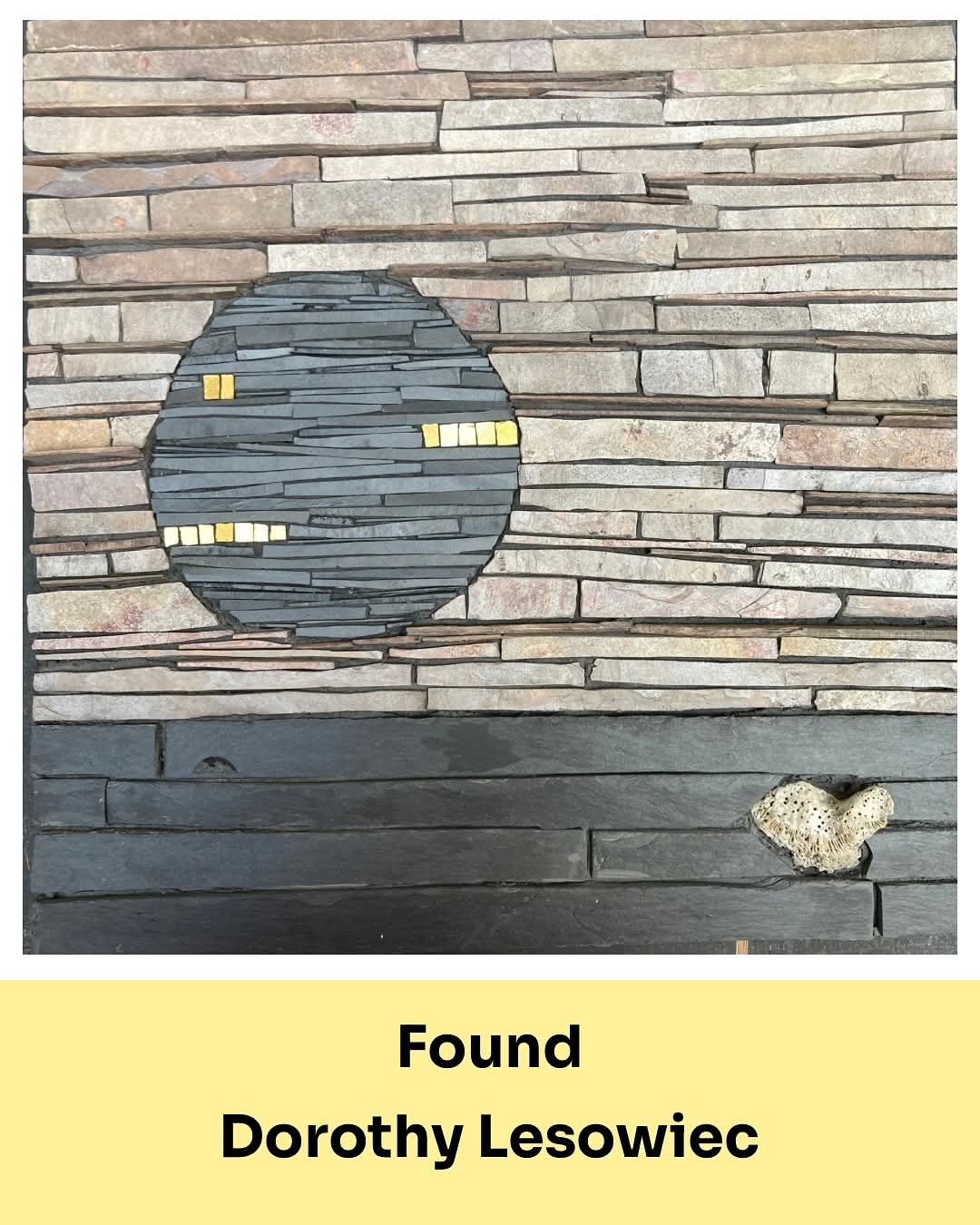
Dorothy Lesowiec’s Found brings a tender close – a deeply personal work celebrating the rediscovery of family. Gold smalti shimmers through the surface, symbolising the richness of love, belonging, and reconnection.
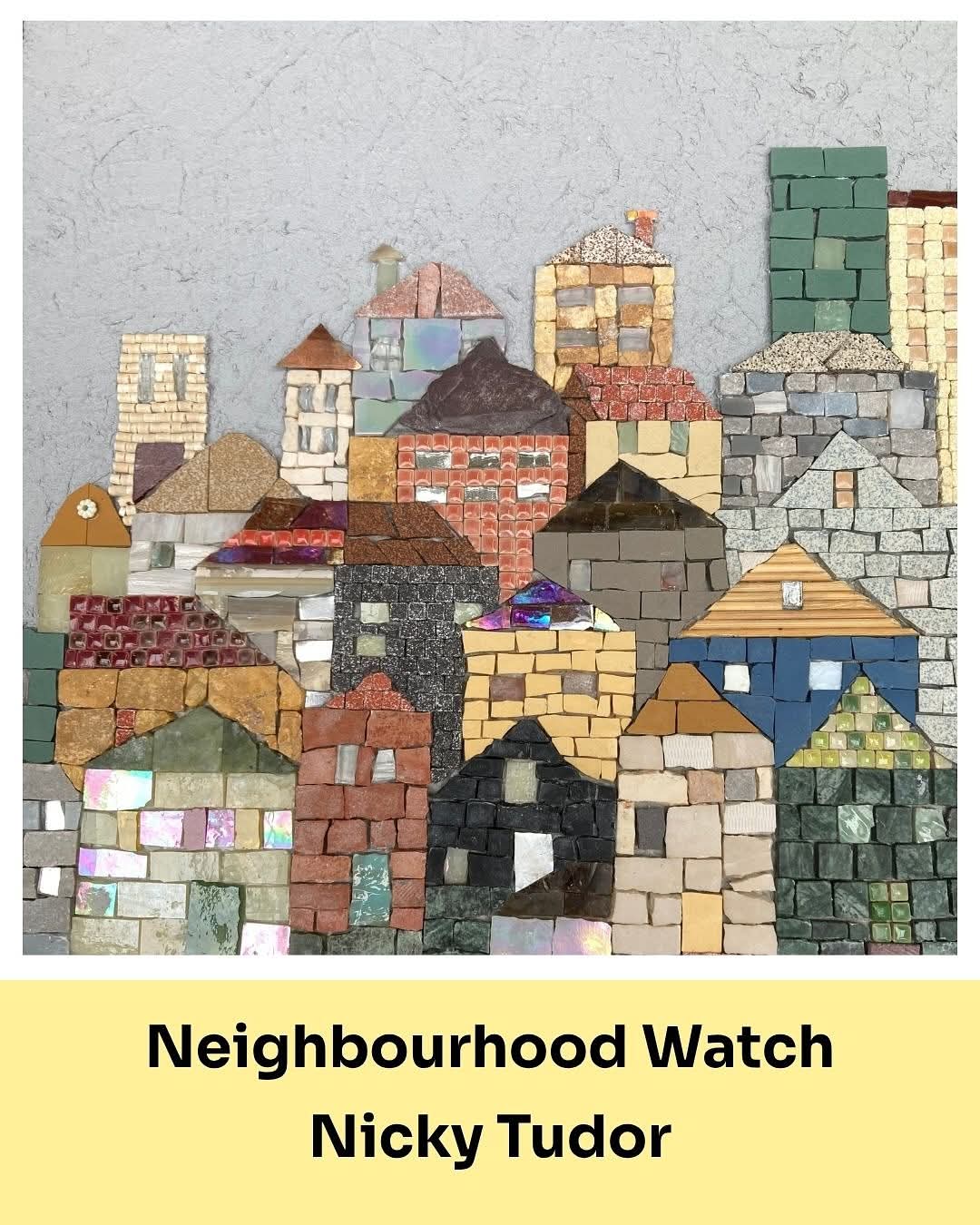
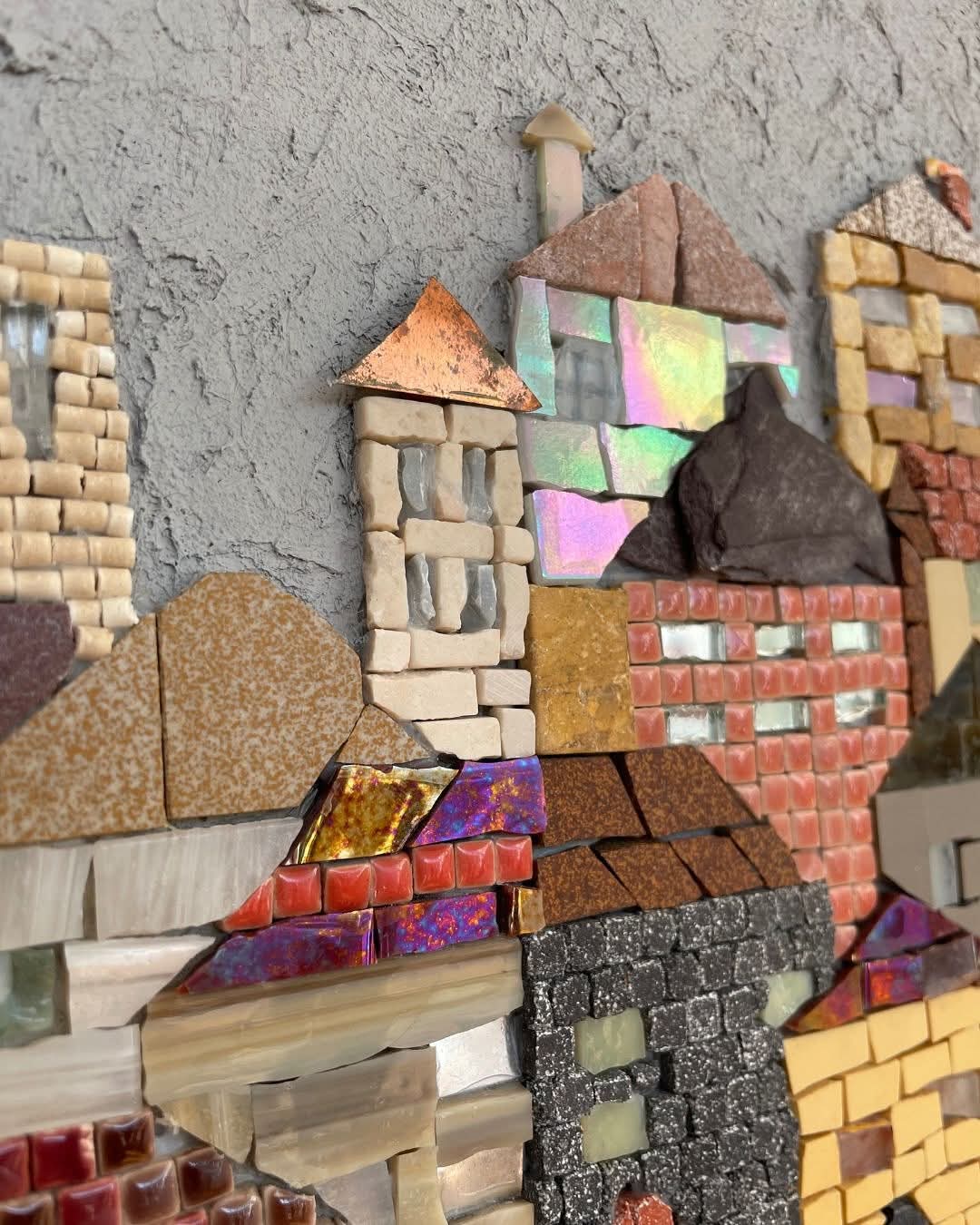
Neighbourhood Watch by Nicky Tudor celebrates the quiet strength of community – the everyday acts of care that bind neighbours together. Tudor has transformed the spirit of connection into a richly textured mosaic. Tudor assembles unglazed ceramic, stained and glazed tile, beads, bamboo skewers, marble, aluminium, copper, and mirrored fragments. Each material in the mosaic catches the light differently, like individual voices in a collective harmony. It’s a radiant tribute to the beauty of togetherness and the resilience of shared humanity.
When viewed as a whole, the wall of 65 mosaics functions as a musical score, where each work is a note contributing to a complex, cross-cultural symphony. Some of the works stand out for their luminosity, such as those created with iridescent blue glass that evoke water or the sky. Other works anchor the composition in earth tones and heavy textures. The natural tendency to interpret narrative or emotion in patterns makes it impossible to avoid reading the individual mosaics as a cohesive unit. The viewer’s eye moves from one fragment to another, following the visual threads of technique and colour that run through the wall like invisible lines of communication between the artists.
The decision by the curator to limit the works to uniform dimensions was crucial to the success of the exhibition. The decision eliminated hierarchy and emphasized dialogue. A larger-than-average mosaic could have asserted dominance through size alone; here, all the pieces share equal space, and require the viewer to focus on nuances rather than sheer scale. The exhibition rewards prolonged viewing. Each panel of the mosaic reveals subtle decisions: the tension between smooth and rough surfaces, the contrast between precise and spontaneous cutting, and so forth. Those contradictions mirror the collaborative process itself, where compromise and conflict can be creative catalysts.
. Piece Together locates mosaic in terms of collaborations, processes and global exchanges and therefore places mosaic within discussions of conceptual and social practice art. The artworks presented here are not just visual or aesthetic; they represent a record of communication, dialogue, and mutual trust. Each joint, each line of grout, serves as a testament to numerous decisions and layers of authorship.
Piece Together also acquires additional significance due to the inclusion of documents detailing the collaboration between Turner Prize winner Jeremy Deller and Coralie Turpin. Working with local communities, environmentalists, and archaeologists, the two artists created a permanent public mosaic installation on Scarborough Sea front. Inspired by Scarborough’s Roman past and the rich marine life of the local coastline, the work- Roman Mosaic c.2025 – forms part of the new Sea Watching Station on Marine Drive. This inclusion of documentation regarding the project, in the form of ephemera and preparatory materials, extends the conceptual scope of the exhibition. Piece Together thereby positions mosaic as a democratic art form which can connect local experience with global issues of environment, heritage and collective identity.
Both the intimate and the monumental, are represented in Piece Together. There are works which function in the manner of personal meditation, exploring texture and rhythm as metaphors for memory or emotion. There are works that directly address social or environmental concerns, utilizing recycled materials and/or found fragments as statements on sustainability. The inherent need to reuse and recombine in mosaic lends itself to such themes. In some of the artworks, the tesserae contain fragments of porcelain, mirror, or broken tile, and each fragment retains a remnant of its former life. The disparate components of these fragments achieve new coherence through careful placement, and reinforce the exhibitions’ overall message: that beauty and meaning arise from unity, not uniformity.
Formally, most of the artists in this exhibition resist the flatness that has traditionally been associated with mosaic. Relief and three-dimensional layering are common characteristics of these artworks. Examples include an abstract composition featuring alternating bands of red and orange. Additionally, there are surfaces which are intentionally irregular and force the viewer to interact with the tactile aspects of the medium. Such formal choices position mosaic back to its material basis, while liberating it from the attempt to imitate painting. The artists do not strive to create the illusion of depth, but instead, acknowledge the physical presence of stone and glass. The artworks appear to “breathe” with the rhythmic process of creating them, and surfaces rise and fall in a manner reminiscent of geological formations.
While the collaborative premise of the exhibition could easily lead to thematic repetition, the variety of results maintains the vitality of the exhibition. Some combinations of artists have resulted in harmonious blends of styles, while other combinations have resulted in deliberate dissonance. Where two artists with different sensibilities have combined their approaches, the resulting tension is evident in the structural elements of the artwork: sudden changes in the size, colour, or orientation of tesserae indicate the intersection of two sets of hands. The visible seams between these two sets of hands serve as metaphors for dialogue, indicating where two individuals have communicated and resolved differences and disagreements.
One of the successes of ‘Piece Together’ lies in how it transforms mosaic into a language of time. Each tessera represents a decision that has been frozen in time, yet collectively, the tesserae express movement and rhythm. The labor involved in cutting and placing tesserae is slow and meditative, and thus, it stands in direct opposition to the rapid pace of contemporary digital culture. As such, Piece Together functions as a quiet resistance to the rapid pace and isolation of modern society. Piece Together provides a reminder that creative endeavors can be communal acts of patience, and that dialogue can be sustained over distance and delays.
This aspect is heightened by the fact that the exhibition is located within the Scarborough Museum & Gallery. The white walls and soft natural light provide the perfect conditions for the artworks to demonstrate themselves without distraction. Light reflects off the glass, and textures change as the light changes, much like how dialogue changes based upon who is speaking and when. The spatial rhythm of the installation invites the viewer to walk through and revisit the installation. The installation viewed from a distance appears as one large tapestry, while up close, it breaks down into hundreds of separate decisions. The viewer oscillates between viewing the installation as a whole, and individually viewing the myriad of decisions that comprise it, mirroring the process of collaboration itself.
It should be stated that ‘Piece Together’ is an exploration of empathy. Collaborating with mosaic requires not only trust in another artist, but also trust in the ability of the material to unite elements. The title of the exhibition is a clear statement of this trust. While the title of the exhibition clearly states the concept of literal assembly, it also conveys the psychological process of assembling perspectives, aesthetics, and experiences. The final product is not a unified whole, but rather a mosaic of voices that retain their individuality while contributing to a greater shared entity.
About BAMM
Founded in 1999, The British Association for Modern Mosaic (BAMM) is a membership organisation which aims to promote, encourage and support excellence in contemporary mosaic art in order to raise public awareness of mosaic and of the artists creating it.
These vibrant mosaics are best viewed in person, so if you can make it to Scarborough to visit the exhibition, please do.! You won’t be disappointed.!
The Piece Together exhibition continues until 14th November 2025 at Woodend Gallery, curated and managed by Crescent Arts.
Slim Aarons, a name synonymous with elegance and leisure, left an indelible mark on the world of photography during the mid-20th century. His work beautifully captures the essence of luxury and the affluent lifestyle of his time, creating an inviting glimpse into a world of sophistication and charm. Today, Slim Aaron photography has transcended its historical roots, becoming a popular choice for home décor. This article will guide you through the enchanting world of decorating with Slim Aarons prints, offering tips and ideas to integrate these timeless pieces into your living spaces.
Why Choose Slim Aarons Prints?
There are several compelling reasons why Slim Aarons art prints have become a favorite in interior design:
Timeless Appeal: Aarons’ work captures a moment in history that continues to captivate audiences across generations. Each photograph tells a story of glamour and opulence, making them an enduring choice for any décor.
Historical Context: His photography offers a window into the mid-century era, showcasing the lifestyles of the rich and famous. This historical element adds depth and interest to any room.
Distinctive Qualities: The composition of Aarons’ photographs often features vibrant colors, captivating landscapes, and a sense of adventure that can invigorate any room with a sense of liveliness and elegance.
Versatile Aesthetic: Whether your home leans towards a modern sleek look or a more vintage style, Slim Aarons prints are versatile enough to enhance and complement various design schemes.
This combination of historical richness and visual beauty explains why they have become a cherished staple in numerous homes today.
Incorporating Slim Aarons Photography into Different Spaces
Decorating with Slim Aarons framed prints can add a touch of timeless elegance to your home. Whether you’re working with a minimalist style or a more eclectic mix, here are some practical tips for incorporating Slim Aarons art prints into various rooms:
Living Room: Choose a large print to serve as a focal point above a mantle or couch. Pair it with neutral-colored furniture to let the colors and details of the print stand out. Consider prints like “Poolside Gossip” for its vibrant depiction of luxury.
Bedroom: Opt for softer, relaxing images, such as those featuring serene landscapes or leisurely afternoons. Placing a Slim Aarons print above your bed can create a sophisticated ambiance.
Home Office: Inspire productivity and creativity with vibrant art prints that capture leisure in opulent settings. They can add a sense of inspiration and motivation to your workspace.
Designers often source curated framed photography selections from Leisure Piece, alongside boutique galleries and independent artists, to complement a range of interiors.
Styling with Vintage Slim Aarons Prints
Vintage Slim Aarons prints evoke nostalgia and bring a classic charm to any home. These prints work exceptionally well with mid-century modern decor styles, which emphasize simplicity, functionality, and a connection to nature. Here’s how to style these prints for a vintage appeal:
Theme Consistency: Choose vintage Slim Aarons prints that match the overall theme of your home. Prints that showcase retro leisure activities or glamorous holiday locations can complement a vintage aesthetic.
Color Palette: Select prints that share colors with your existing decor. This will help the artwork blend seamlessly with the room’s ambiance while still making a statement.
Room Placement: Highlight specific areas in your home, such as the entryway or a reading nook, with vintage prints to create a warm, welcoming environment.
These prints can stand alone as statement pieces or be combined with other decorative elements reminiscent of a bygone era. To delve deeper into vintage decorating trends, you can check out this detailed article by Architectural Digest.
The White Stripes were inducted into the Rock & Roll Hall of Fame on Saturday in Los Angeles. Iggy Pop gave the induction speech, beginning by singing the guitar riff to ‘Seven Nation Army’ just to “get that out of the way.” Praising drummer Meg White, he said, “Meg White had the most genuine and charming smile. She played the drums for the benefit of her band. She gave the drum kit a good whack. I think it was Meg’s support that helped launch the rocket of racket that was Jack White.”
He then paid tribute to to Jack White, saying, “Jack could screech like an owl. He could twang like a hillbilly. But he could also write. I hear the echoes of The Who, The Small Faces, The Beatles… in Jack’s playing. The writing he was capable of was not typical of of the great Detroit bands of the 60s and 70s.”
Meg, having completely left the music industry since the White Stripes broke up in 2011, did not attend the ceremony. Upon taking the mic, however, Jack said she helped him write his speech in recent days. “I spoke with Meg White the other day; she said she’s very sorry she couldn’t make it tonight, but she’s very grateful for the folks who have supported her throughout all the years, it really means a lot to her tonight,” he said.
He also gave a shout out to over 30 bands that inspired the White Stripes – none of which have been inducted – including Loretta Lynn, Fugazi, the Misfits, Emerson, Lake, and Palmer, The Strokes, Black Flag, and more.
Following White’s speech, Olivia Rodrigo and Feist teamed up for an acoustic rendition of ‘We’re Going To Be Friends’, a song from 2001’s White Blood Cells that the White Stripes played in their final performance on Late Night With Conan O’Brien in 2009.
Twenty One Pilots then delivered a performance of ‘Seven Nation Army’. Flea, who helped open the ceremony with an all-star tribute to Sly Stone, gave it a standing ovation. Check out the performances and speeches from the induction below.
The Rock Hall’s 2025 class also includes Soundgarden, Bad Company, OutKast, Cyndi Lauper, Chubby Checker, and Joe Cocker in the performer category.
Today we’ll be sharing our little secret, this is a gatekeeping-free zone. Truth is, when you see us strutting down the streets, looking polished and runway-approved, we’ve often just thrown on a faux fur coat over whatever we blindly picked from our wardrobe shelves. Oops, how could anyone resist? I can’t think of a better way of elevating a boring outfit, some days just call for a good big coat that’s going to hide everything beneath it, bonus points if it’s furry too. Here’s everything you need to know.
Our obsession started growing bigger back in 2024, with the rise of the mob-wife aesthetic. A movement that tells us, people no matter the time or year, will always reach for a piece closely connected to wealth, the kind that looks like a million bucks. Not necessarily for the status and the showing off of it all, but for the “I’ve got this” feeling of ease. And honestly, we get that, we like slipping into luxury without even trying, and we figured out, the best way to do that is the long-beloved faux fur coat.
But faux fur has grown on us, big time. We’ve now carved out a section in our wardrobes just for the coats, beige and brown, grey and black, colorful and vibrant, in countless animal prints, never skins. And the rest of the space seems to be filled up with other faux fur pieces too. Vests, pants, hoodies, boots, all the faux fur pieces we leaned on this winter.
Three decades of fashion obsessions, countless winter trends, and still faux fur never lets us down. We let everything hairy do the heavy lifting for our outfits. Cold, hard, chaotic days? Consider them conquered.
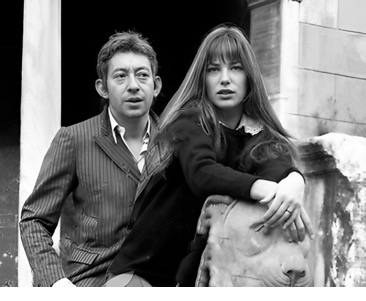
The name Birkin might be stitched forever into the story of the Hermès bag but before the legend there was the woman, and today we’re turning our gaze to her. Jane Birkin. English, outspoken and magnetic. She was an actress, a singer, a muse, but she also was a voice of compassion, philanthropy and authenticity. In fashion and culture, in a tilted basket, a slip dress and a song that won’t quit, her name refuses to fade, part tribute, part evidence that legends often outgrow the lives before them.
Photo by Umberto Pizzi, Rome 1976, via Wikimedia Commons
Behind the Name
Born in London on 14 December 1946, Jane Birkin drifted into cinema and music, and somehow, as if by accident, ended up a fashion icon. She moved to Paris at 18, dove into film and theatre, and met Serge Gainsbourg, a creative force in his own right, known for his lyrics and melodies that carried them. Together, they made some of the most iconic music of the era, like Je t’aime… moi non plus, originally written for Brigitte Bardot, Comic Strip, Ex-fan des sixties, and countless more that make you pause and feel like they never really aged. Birkin’s talent extended beyond music into film. She appeared in classics such as Blow-Up, La Piscine, La Belle Noiseuse, the Agatha Christie adaptation Death on the Nile, and even later works like Daddy Nostalgia.
Even as a kid, Birkin had a sense of justice. She spoke out against capital punishment, stood up for women, quietly helped immigrants, and backed HIV/AIDS causes. Her life was a blend of art, activism, and a kind of style that couldn’t be staged, the kind that comes from within. We’ve always believed the best look is one built on kindness.
From Basket to Birkin: How a Flight Inspired Fashion’s Most Famous Bag
Still, fashion has its language, so let’s shift from the spirit to the seams. Birkin’s style was effortless, entirely her own. She made the undone Parisian look famous, long before it hit our feeds. T- shirts tucked into high-waisted jeans. Translucent slip dresses. Mini skirts and menswear touches. The subtle audacity of skipping a bra. Casual met chic as masculine met feminine. Her approach helped define what we now think of as the French girl aesthetic, inspiring designers like Chloè and Céline, her influence still flows through generations of fashion devotees.
She used to carry a wicker basket as her bag almost everywhere, until her encounter with Jean-Louis Dumas, then CEO of Hermès, changed everything. On a flight from Paris to London, Birkin’s belongings tumbled to the floor as they sat side by side. In a CNN interview Birkin recalled telling Dumas “Why don’t you make a bag that’s sort of four times the Kelly, that you can leave open, and half the size of my suitcase? Because girls like to have things on the end of their arm to put all of their stuff in. He said, well draw it for me and so I drew it on one of those sick-bags, the vomit-bags in the airplane. He was true to his word”.
On July 10, 2025, the prototype Birkin bag, the one made for Jane Birkin herself, was sold to a Japanese collector at Sotheby’s iconic Paris auction for around $10.1 million, fees included. The sale quickly took over the internet, no one could look away, a reminder that myth and market still feed each other. But this wasn’t the first time one of Jane’s bags went under the hammer. Birkin herself auctioned this very same bag in 1994, after nearly nine years of use, in support of Association Solidaire Sida, a charity fighting for HIV/AIDS causes. In 2000, the bag resurfaced at auction and found a home with French collector Catherine Benier, who kept it for almost 25 years.
This time, Le Birkin Voyageur, personally owned and carried by Jane, is set to be auctioned during Abu Dhabi Collectors’ Week, on December 5 2025, following a public viewing from December 2-5 at the St. Regis Saadiyat Island Resort. Estimated between $240,000 and $440,000, the bag bears Jane’s handwritten note: “Mon Birkin bag qui m’a accompagné dans le monde entier”, “My Birkin bag that has accompanied me around the whole world.”
One of the few Birkins she held onto, long after the 1994 prototype was gone. Intimate and heavy with history. We hope those who carry her legacy feel more than the stitching in their hands, the pulse of her humanity, still alive in the spaces she once walked.
More than a bag, more than a sale, these Birkins carry traces of a life lived out loud, curious, kind. Beyond fashion and history, each bag holds Jane’s spirit, her art and activism, folded into leather and hardware. Her legacy isn’t measured in price tags, but in the footprints she left in the world, still echoing long after the auctioneer’s hammer falls.
CS2 has completely reshaped the skin economy for players, making cosmetic items highly desirable yet often costly. For avid players, building a premium inventory without spending money is a common challenge. Fortunately, there are reliable ways to acquire skins for free. This guide covers everything from daily bonuses to trade-up contracts and community events, giving players a comprehensive roadmap to expand their CS2 collection safely.
Whether you are a competitive player or enjoy casual matches, understanding the mechanics behind drops and rewards is essential for optimizing your free skin gains.
1. Daily Bonuses and Free Case Platforms
One of the most consistent ways to get CS2 skins without paying is through daily reward platforms. Sites like BloodyCase provide daily bonuses that can include balance credits, cases, or directly usable skins.
The process is straightforward:
Sign in with your Steam account.
Claim the daily free reward.
Open the case or use credits to receive your skin.
Daily reward platforms often include randomized items, which encourages regular visits. With persistence, even low-tier skins can accumulate, later becoming components for trade-ups. Players report that logging in every day for a month can yield multiple mid-tier skins suitable for upgrading.
Key tip: Avoid platforms that ask for excessive permissions or disable Steam security features. Trusted sites never request Steam passwords or recovery codes.
2. In-Game Drops: Maximizing Playtime Rewards
CS2 continues Valve’s tradition of awarding players with item drops. After matches, there’s a chance to receive skins, cases, or graffiti. Drops are affected by:
Match type: Competitive and Premier matches yield better drops.
Playtime: Weekly caps exist, so active players maximize rewards.
Account status: Public profiles with a decent Steam level are more likely to receive drops.
Strategies to Increase Drops:
Play multiple matches in drop weeks.
Focus on modes with higher drop frequency.
Keep the account level and profile status in mind.
Players aiming to farm skins should maintain a consistent schedule. Even lower-tier items contribute to trade-ups and gradually improve your inventory.
3. Trade-Up Contracts: Turning Common Skins Into Rares
The trade-up system allows players to combine ten skins of the same rarity to receive a higher-tier skin. While there’s an element of randomness, it’s a reliable long-term method.
Rarity
Items Needed
Potential Output
Consumer
10
Industrial
Industrial
10
Mil-Spec
Mil-Spec
10
Restricted
Restricted
10
Classified
Classified
10
Covert
Practical approach:
Collect duplicate drops and low-value skins.
Use them for trade-ups to aim for Restricted or Classified skins.
Keep track of trade-up probabilities; community tools can calculate expected outcomes.
This method encourages a strategic approach: even free daily rewards can be transformed into high-value items with patience and planning.
4. Community Events and Giveaways
CS2’s player community frequently hosts events offering skins. These include:
Discord giveaways by content creators.
Tournament participation rewards.
Seasonal promotions from community hubs.
Tips for safe participation:
Verify the legitimacy of Discord servers or social media pages.
Prefer official tournament events over third-party claims.
Avoid sharing private Steam information.
Community events often reward unique or limited skins that are otherwise unavailable, making them highly valuable. Tracking them is a key strategy for building an impressive inventory without spending money.
5. Steam Features and Market Awareness
Although Steam Points cannot be directly used to buy skins, they influence trading opportunities. Profiles with higher levels attract better trade offers, and being active in the market can help you identify free or low-cost skins suitable for trade-ups.
Monitor Steam Market for temporary giveaways or sales.
Trade low-tier skins with other players to acquire desired items.
Participate in community discussions to learn about hidden opportunities.
Combining these approaches can lead to a sustainable, growing collection.
6. Best Practices for Safe Free Skin Acquisition
Security is essential. Many platforms advertise free CS2 skins but aim to compromise accounts. Follow these principles:
Only use HTTPS and verified URLs.
Never share your Steam password or disable Steam Guard.
Read community reviews before interacting with new platforms.
Remaining cautious ensures your inventory and account remain secure while still benefiting from legitimate free sources.
7. Combining Strategies for Maximum Benefit
The most effective approach to building a free CS2 inventory is combining multiple methods:
Claim daily bonuses on trusted sites like BloodyCase.
Engage in regular competitive matches to collect drops.
Apply trade-ups systematically.
Participate in verified community giveaways.
Consistency is key: small rewards accumulate, and low-tier items eventually become high-value skins. With patience and careful strategy, any player can significantly grow their collection for free.
Can You Really Get CS2 Skins for Free?
Getting CS2 skins for free is absolutely possible with the right balance of patience and consistency. Daily cases, game drops, and community activities form a realistic path toward a rich inventory without spending a cent.
Start small—log in daily on trusted sites like BloodyCase and keep playing matches regularly. Over time, your inventory will grow naturally, and some skins might even become highly valuable collectibles.
With a careful approach, persistence, and a bit of luck, you can build an impressive CS2 collection — completely for free.
During a microneedling session, your skin becomes especially receptive to skincare ingredients. This means the serum you choose matters just as much as the device itself. Selecting the right serum can support healing, enhance results, and minimize downtime. The key is to opt for formulas that deliver hydration, support barrier recovery, and avoid harsh actives that may irritate.
Why the Right Serum Matters
Microneedling creates tiny, controlled micro-channels in the skin, which do two things: it stimulates the skin’s natural repair processes (such as collagen production), and it opens the door for topically applied ingredients to penetrate more deeply than usual.
Because of this increased absorption, the serum you apply should be gentle, supportive of healing, and free of strong irritants. For instance, usingmicroneedling serums from Meamo Shop can help achieve the perfect balance between hydration and repair.
These Korean skincare formulations are developed to calm the skin, replenish moisture, and support healing without irritation. Using gentle yet effective serums like these helps maximize the results of microneedling, encouraging smoother, more radiant, and healthier-looking skin.
What Serums You Should Consider for Microneedling
Here are several serum types commonly recommended for use in conjunction with microneedling, along with their benefits and considerations.
Hyaluronic Acid Serums
Benefits: As a powerful humectant, hyaluronic acid attracts and retains moisture within the skin, promoting post-treatment hydration, elasticity, and comfort.
Considerations: Choose a fragrance-free, alcohol-free formula. Because the skin is more absorbent after microneedling, you want to minimize the risk of irritation.
Best for: Almost all skin types after microneedling, particularly for calming the “thirsty” feeling post-treatment.
Peptide & Growth Factor Serums
Benefits: Peptides and growth factors signal the skin to rebuild and generate collagen and elastin. A key benefit of microneedling is that the channels allow these actives to reach deeper layers.
Considerations: These formulas can be more expensive and may require professional-grade sourcing or supervision. Always ensure the formula is suitable for post-procedure skin with open micro-channels.
Best for: Skin concerned with fine lines and texture irregularities, or for long-term regeneration rather than immediate soothing.
Niacinamide & Barrier-Supporting Serums
Benefits: Niacinamide (vitamin B3) supports skin barrier recovery, helps reduce redness, and supports even tone. After microneedling, your barrier is temporarily compromised, and this makes sense.
Considerations: While gentler than some actives, ensure the formula remains simple and free of irritating extras, such as strong fragrance or high-strength acids.
Best for: Sensitive skin, post-treatment redness, or skin prone to breakouts that needs barrier support.
How to Choose the Best Serum for You
Assess your skin concern: If your primary goal is hydration and calming, a hyaluronic acid serum is a strong choice. If your focus is texture or fine lines, consider peptides or growth factors.
Check formula purity: Fragrance-free, minimal additives, no irritating acids or exfoliants.
Confirm compatibility with treatment: If you’ve done more aggressive microneedling (longer needles), your skin may need gentler serums for a few days before introducing the stronger actives.
Follow timing guidance: Immediately after the procedure, your skin needs soothing and hydration. More active serums (such as those targeting pigmentation or deep wrinkles) may require 48–72 hours or as instructed by your practitioner.
The End Note
Choosing the right serum for microneedling isn’t about finding the most exotic or trendy formula — it’s about matching your skin’s post-treatment state with ingredients that genuinely support healing, barrier recovery, and collagen-building.
Hydration (via hyaluronic acid), signalling (via peptides/growth factors), and barrier support (via niacinamide or ceramides) are the key pillars. Avoiding harsh actives too early, and giving your skin the right ingredients at the right time, will help you optimise the benefits of the microneedling procedure.
Always consult with your skincare provider or practitioner to tailor the serum choice to your unique skin type and treatment intensity.




 Artist: Haoxuan Zhang