


Dijon was the musical guest on last night’s episode of Saturday Night Live, which was hosted by Melissa McCarthy. Backed by a full ensemble, the neo-soul singer delivered a splendid performance of ‘Higher’ and a medley of ‘Baby’ and ‘Another Baby’ from his record Baby – one of the best albums of 2025. Watch it happen below.
Dune: Part Three: Release Date, Cast, Plot and More

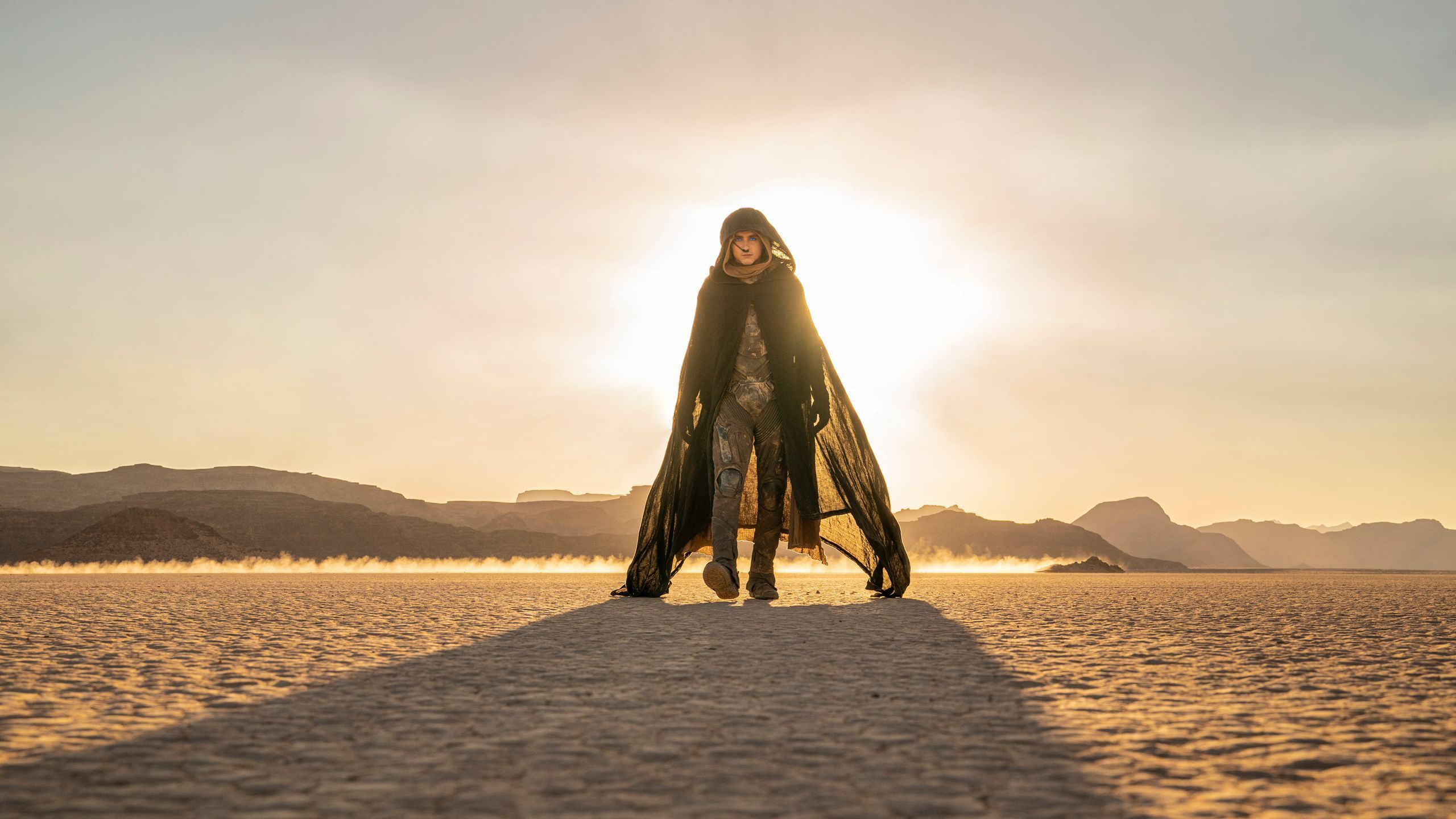
Denis Villeneuve made it clear right from the start that his adaptation of Dune would take three films. The first two would cover the first book and a third one would wrap up the full arc he set out to tell. That plan is finally coming to fruition with Dune 3, which, according to lead star Timothée Chalamet, has already wrapped filming and is set to hit theatres in 2026. Officially titled Dune: Part Three, Villeneuve’s planned final film will adapt Frank Herbert’s second book, Dune Messiah and will most likely explore the aftermath of Paul’s ascension, the cost of the war that began the moment he claimed power, and the political and personal consequences.
With an all-out galactic war about to reshape the Known Universe, here’s a complete guide to everything we know so far about Dune: Part Three, from the release date and cast to plot details, trailers and what Villeneuve’s final entry means for the franchise’s future.
Dune: Part Three: Release Date
Mark the date, as Denis Villeneuve’s spice-fueled sci-fi saga will return with Dune: Part Three on December 18, 2026.
Dune: Part Three: Cast
If you felt the cast of the first two Dune films wasn’t already stacked with top talent, Dune: Part Three adds even more star power, pulling in some big new names while also bringing back the main ensemble from the first two films. Warner Bros. has yet to announce the official cast lineup, but it’s almost certain that Dune: Part Three will see Timothée Chalamet reprising his role as Paul Atreides alongside Zendaya as Chani. Rebecca Ferguson has already announced she’ll be back as Lady Jessica, while Florence Pugh has said Princess Irulan will return in the next chapter.
Jason Momoa has also revealed that he’ll reprise his role as Duncan Idaho, despite the character’s death in the first film. Other cast members, including Josh Brolin’s Gurney Halleck, Christopher Walken’s Emperor Shaddam IV, and Léa Seydoux’s Lady Margot Fenring, are expected to show up as well, though nothing has been officially announced yet.
As for newcomers, the biggest addition has to be Robert Pattinson as Scytale. Pattinson confirmed his involvement in Dune: Part Three by joking about just how hard it was to film in the heat, saying, “When I was doing Dune, it was so hot in the desert that I just couldn’t question anything. And it was so relaxing, like my brain actually wasn’t operating, I did not have a single functioning brain cell.”
Additionally, Dune: Part Three will see Momoa’s son Nakoa-Wolf Momoa make his big-screen debut as Leto II Atreides, while Ida Brooke will star as Ghanima Atreides. Here’s the current expected cast lineup for Dune: Part Three:
- Timothée Chalamet as Paul Atreides
- Zendaya as Chani
- Robert Pattinson as Scytale
- Rebecca Ferguson as Lady Jessica
- Florence Pugh as Princess Irulan
- Jason Momoa as Duncan Idaho
- Nakoa-Wolf Momoa as Leto II Atreides
- Ida Brooke as Ghanima Atreides
- Josh Brolin as Gurney Halleck
- Christopher Walken as Emperor Shaddam IV
- Léa Seydoux as Lady Margot Fenring
- Charlotte Rampling as Reverend Mother Mohiam
- Javier Bardem as Stilgar
What Will Dune: Part Three Be About?
Now, this is where things get interesting. Dune: Part Three still doesn’t have an official plot synopsis, but all signs point to it adapting Frank Herbert’s second book, Dune Messiah. If that holds true, the upcoming film is unlikely to pick up where Part Two left off, instead moving the story about 12 years, as the events of the book transpire long after Paul first seizes the throne.
In an interview with Deadline, director Denis Villeneuve dropped some major hints about where things might be headed, teasing that the upcoming film will “finish the Paul Atreides arc.” As Villeneuve puts it, “Like Herbert did with Dune: Messiah, I think it’ll be a great idea to do something completely different. The story takes place like 12 years after where we left the characters at the end of Part Two. Their journey, their story is different this time, and that’s why I always say that while it’s the same world, it’s a new film with new circumstances.”
Herbert’s Dune: Messiah’s synopsis reads, “Dune Messiah continues the story of Paul Atreides, better known—and feared—as the man christened Muad’Dib. As Emperor of the known universe, [Paul] possesses more power than a single man was ever meant to wield. Worshipped as a religious icon by the fanatical Fremen, Paul faces the enmity of the political houses he displaced when he assumed the throne—and a conspiracy conducted within his own sphere of influence. And even as House Atreides begins to crumble around him from the machinations of his enemies, the true threat to Paul comes to his lover, Chani, and the unborn heir to his family’s dynasty…”
If Villeneuve sticks to the book, Dune: Part Three will pick up in the aftermath of a galaxy-spanning jihad that has killed billions. Chalamet’s Paul, now Emperor, will face growing resistance as the Bene Gesserit, Spacing Guild, and Tleilaxu team up to topple him. Given that Momoa, along with his son and Ida Brooke, are in the film, we can expect the film to feature some important bits from Herbert’s book, like the return of Duncan Idaho as a clone, the birth of Paul and Chani’s twins, as well as Paul confronting his own future as he goes blind but continues to “see” through prophetic visions tied to his children.
The ending of Dune: Part Two teases some of these story bits as Paul secures the imperial throne by agreeing to marry Princess Irulan while sheltering himself from the Bene Gesserit and the royal court. He even unleashes the Fremen across the galaxy, which triggers the holy war he has foreseen from the very start. Devastated by his political choices, Chani walks away from him, but Paul’s visions show that the two of them would eventually meet again, something the book explores in painful detail.
Are There Any Other Films Like Dune: Part Three?
Well, you can start by catching up on the first two Dune films, and if you are already done with those, we’d recommend that you check out Denis Villeneuve’s Blade Runner 2049 and Arrival. Moreover, you can also watch 1968’s 2001: A Space Odyssey, which continues to be a cult sci-fi classic even today, as well as Ridley Scott’s Alien and James Cameron’s Aliens.
Threads of Light, Threads of Us: Sope Adelaja’s Meditation on Connection

Sope Adelaja‘s relationship with light began in the densely built Lagos neighbourhoods of his childhood, where narrow alleys framed shifting rays and power cuts meant evenings spent under moonlight. Light, he learned young, doesn’t simply illuminate — it remembers and welcomes, weaving meaning into the mundane. Now, in Threads of Light, Threads of Us, the Nigerian-born photographer returns to light as both subject and methodology, travelling across Africa with only natural illumination to guide his lens. For this project, Adelaja worked primarily in Nigeria and Senegal, moving away from his established documentary practice to create something more introspective: a meditation on how light connects us to place, heritage and each other.
Light is a multifaceted creature in Adelaja’s work, at times crystallising striking beauty, at others wrapping around the human form like something protective and tender. In some photographs, light remains just out of reach, belonging entirely to its subjects in ways we can only witness but never possess. What threads these images together is light’s capacity to bring beings closer to themselves: cities become more familiar to their inhabitants, individuals inch nearer to their own essence, and communities discover the fabric that binds them.
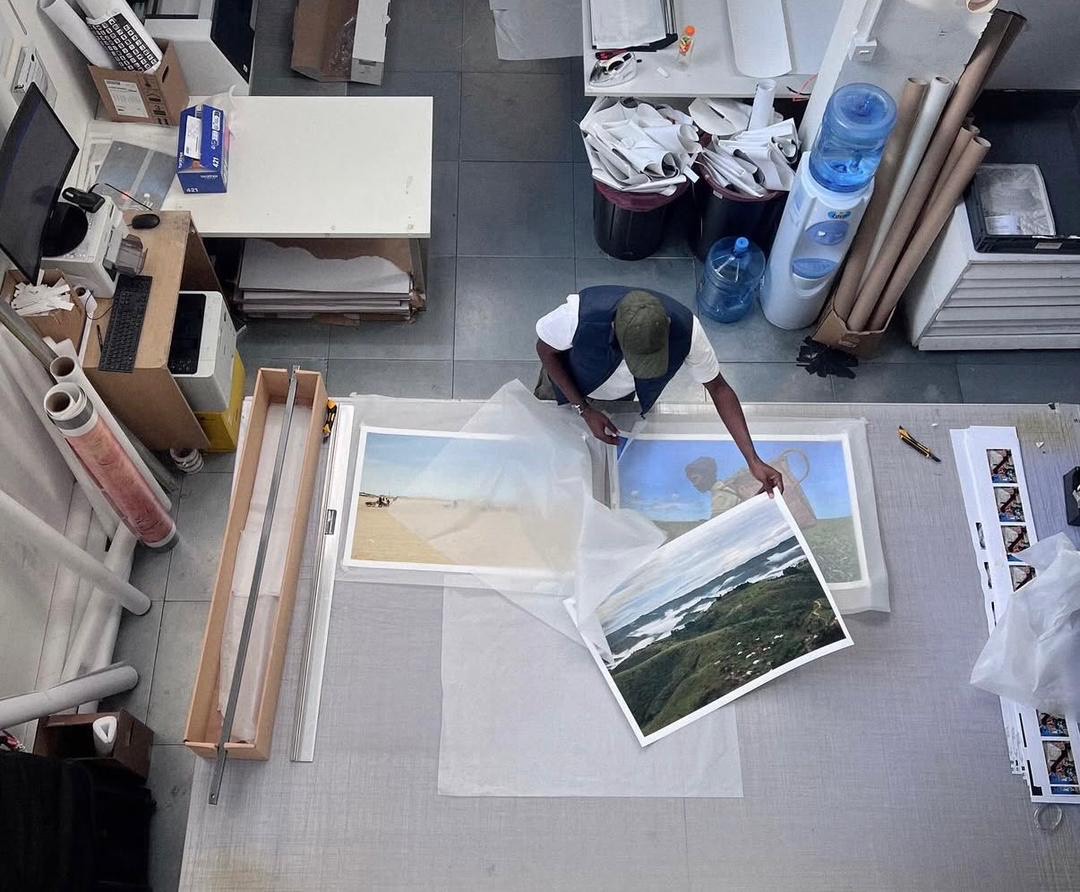
The choice to work exclusively with natural light seems at once practical and philosophical. Rejecting the controlled precision of studio lighting or flash, Adelaja grants the sun the authority to dictate mood and timing. This approach is rooted in patience. It relies on waiting for the right hour, the right angle, light naturally falling across skin, stone, water. The methodology is rooted in trust, both in his subjects and the environment; trust that authenticity emerges when you work with what’s already there rather than imposing artificial conditions. His travels confirm that light can make even distant places feel like home, that familiar warmth can emerge in unfamiliar landscapes, extending visual threads across borders.
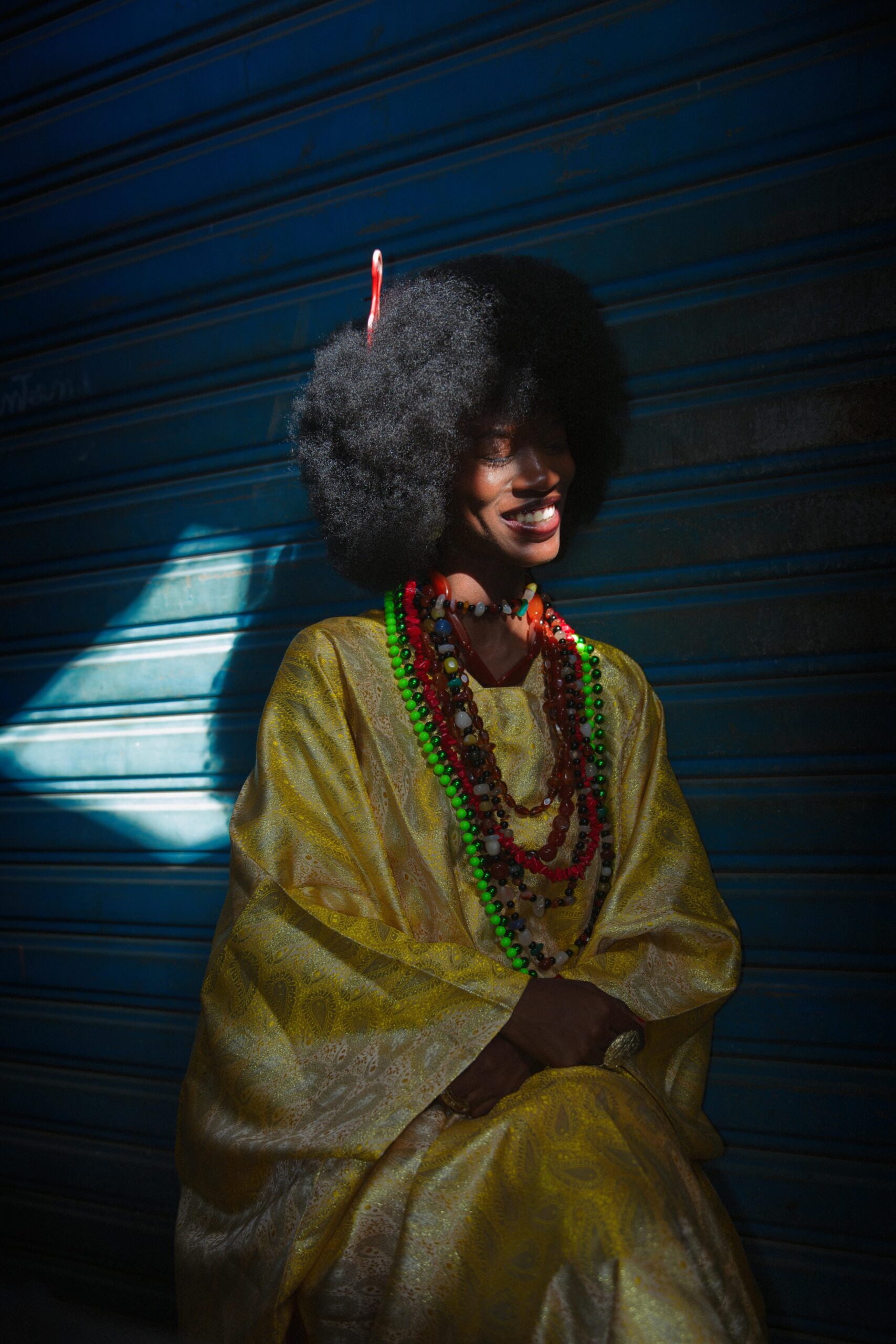
Adelaja’s portraits radiate intimacy, signalling relationships built beyond the lens. In one striking image, a sliver of light catches one side of a woman’s face: her skin, hair and smile illuminated, while the rest sits in shadow. The light and woman seem to animate each other: she glows more radiantly, the light seems warmer for touching her. It’s a celebration of her beauty, yes, but more significantly a capture of character and the fullness of being. The light reads as almost parental, gently cradling half of her face as if calling that smile into being.
That same thin ray illuminates just a fraction of her outfit: a few beads from the many vibrant necklaces draped over her shoulders, a section of her golden robe rich with texture and intricate detail. Most of it remains untouched by light. Still, the garment creates its own subtle gleam, inviting our eyes to rest in the darkness and linger there with equal attention. What is hidden holds as much gravity as what is revealed.

While close portraiture comes naturally to Adelaja, the artist also excels at capturing the expansive, traversing landscapes and cityscapes that speak to collective memory. Silhouetted against a misty waterscape, a fishing boat carries several figures across calm water, palm trees and waterfront buildings visible in the distance. The scene is drenched in sepia tones, as if light itself is remembering rather than illuminating. What is captured is daily labour and ancient practice coexisting — fishing methods passed down through generations continue against a backdrop of shifting histories. The image reflects continuity, portraying cultures rooted in the past yet fully alive in the present, where tradition and modernity are in quiet conversation.
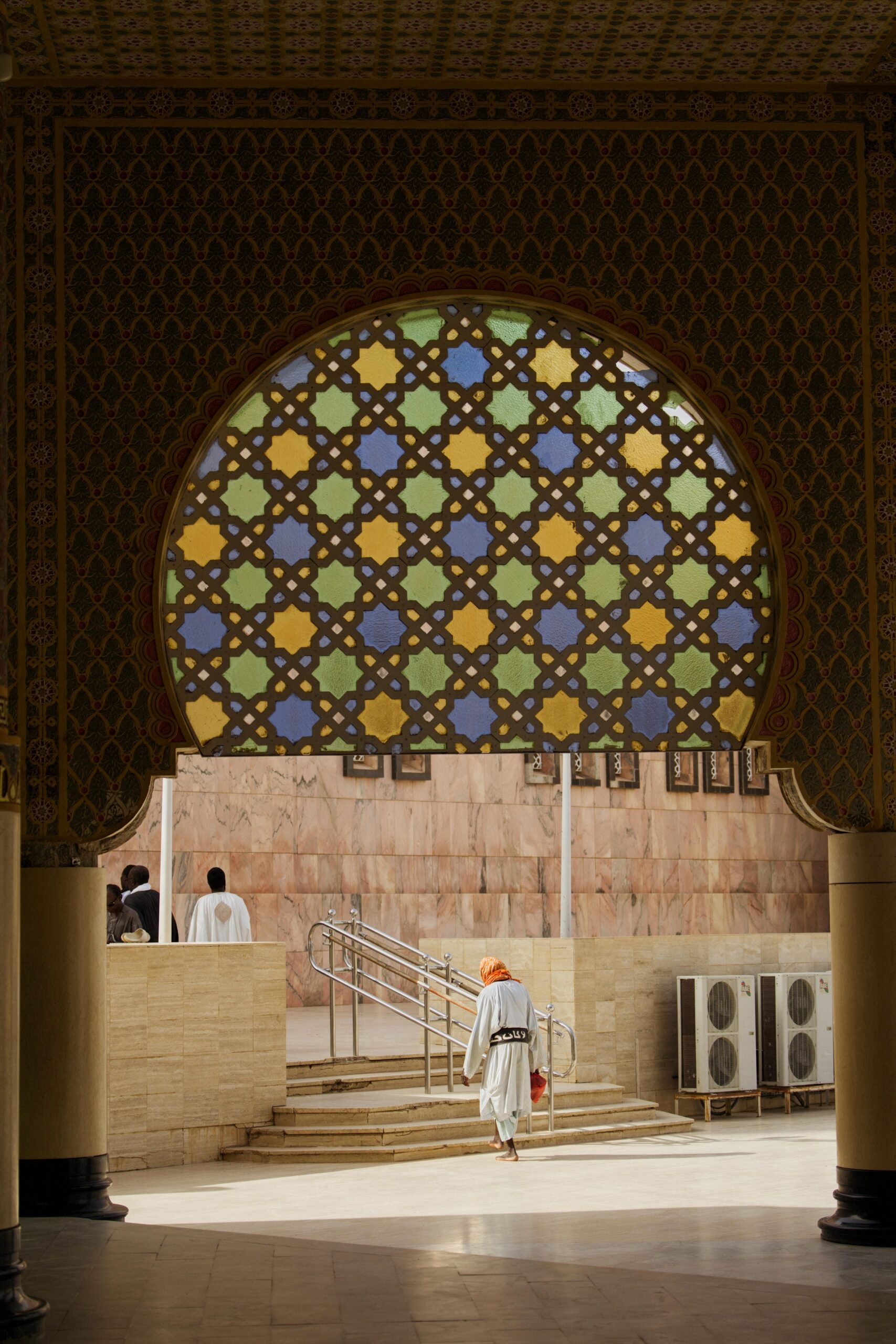
In another image, Adelaja photographs from within shadow, looking through a columned archway toward light and community beyond. The composition is architectural and deliberate. Ornate geometric patterns frame the upper portion of the entrance, leading our eyes toward the glowing centrepiece — a circular window of stained glass in gold, blue and pale green. The dynamic, repetitive pattern energises the eye, while the interplay of colours offers visual balance. Below, warm stone and a lone figure in white ascending stairs roots the celestial beauty in human scale. Two figures ahead of him traverse the same shadowed path, suggesting a shared journey from darkness toward light, from solitude toward gathering. The viewer is reminded that beauty and connection are amplified when approached from a place of quiet observation.
Elsewhere, light is something that does not belong to the viewer, nor even to the eye behind the camera, but rather entirely to the subject. A woman sits centred in the frame, hugging her chest, backlit by a sun we never directly see. Light drapes across her, illuminating her kufi’s golden threads, resting on her face, pooling in her lap. We see only a gentle suggestion of dimming golden rays and can only guess at how they adhere to her body. Her posture, back straight with legs extended toward the light source, suggests serene absorption in this private moment. The light is hers, and hers alone; we’re only permitted to witness its effects.
This withholding becomes an act of respect, a photographic gesture that honours the boundaries between observer and observed. Such restraint acknowledges that not everything ought to be revealed, that certain experiences transcend documentation. Some moments of connection with light — and with oneself — deserve to remain beautifully uninterrupted.
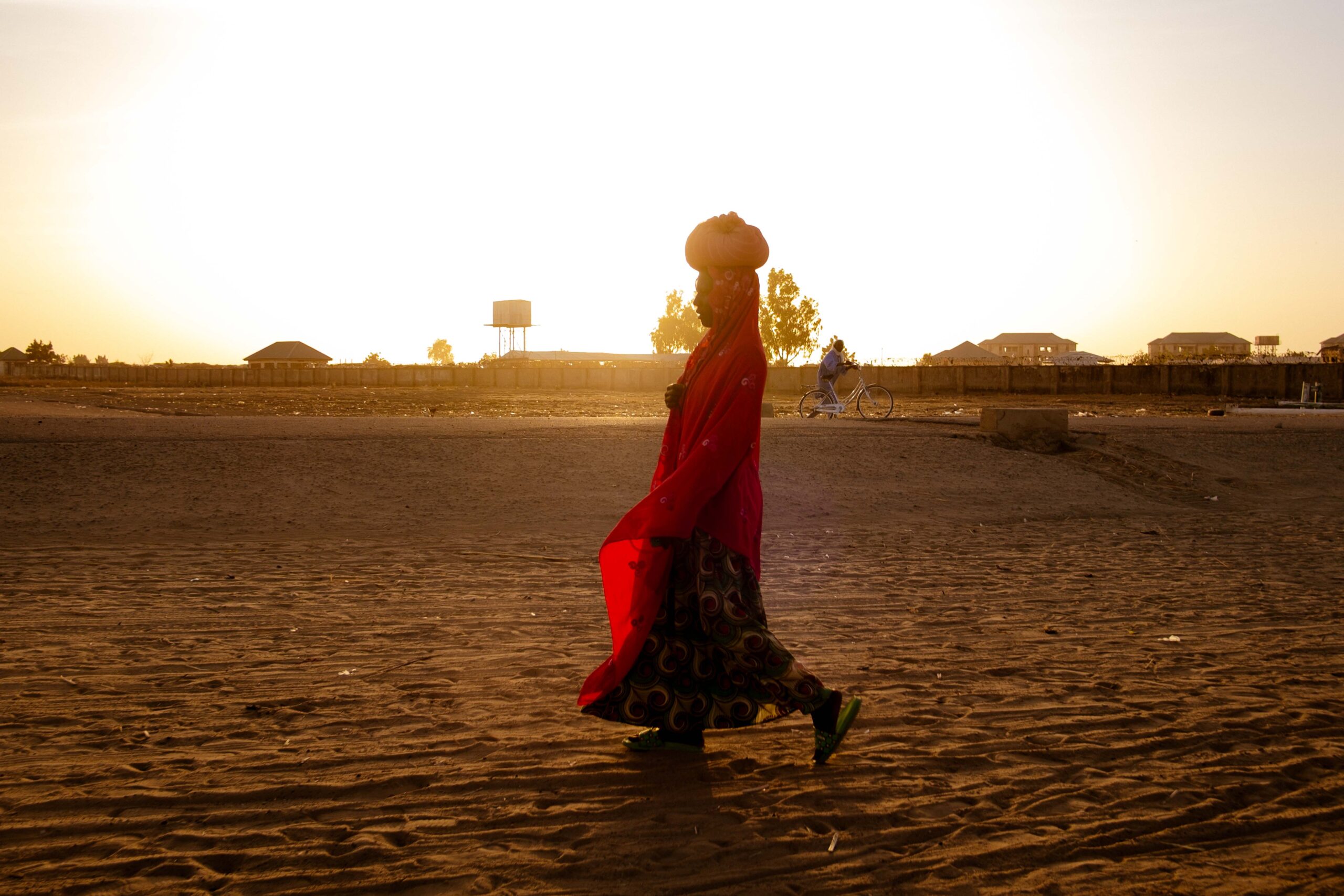
Threads of Light, Threads of Us represents both a homecoming and an expansion for Adelaja. This work will be open to viewers in both London (6-7 December 2025) and Lagos (6 January 2026), two cities that anchor his artistic life. Beyond his near-decade career documenting humanitarian crises and underrepresented communities — from northeastern Nigeria’s conflict zones to climate-affected regions — this time Adelaja turns his lens inward, asking questions about his own connection to African heritage and about the ways light can elucidate what is shared across borders. His commitment remains: to craft narratives that challenge dominant media frames and to spend time truly listening before translating stories into image. In doing so, he crafts an atmosphere so resonant that even when the light dims, an afterglow lingers.
The Pressure of Being Seen: Kai’s Exploration of Visibility and Truth
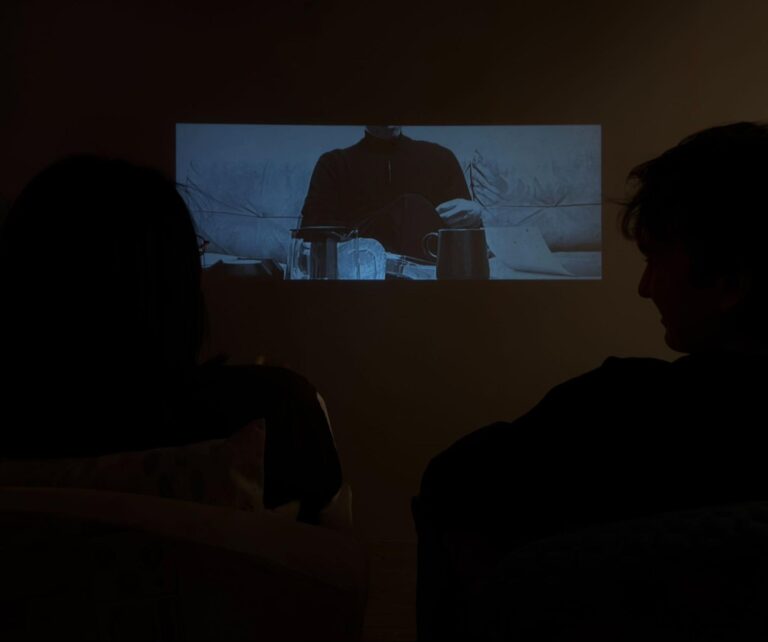
We carry out so many everyday activities without thinking about them, getting out of bed, taking a shower, and even more complicated activities like walking to a nearby train station or driving a car without remembering the journey. We are on autopilot a lot of the time, but we never stop to think deeply about these mundane activities.
Artist Khine Mye Kyaw, known as Kai, challenges this idea by filming themselves eating a piece of cake. It’s an activity we’d do without thinking. Even when around others, we’re talking between mouthfuls, we never believe anyone is studiously observing us eating a slice. However, that all changes once the camera turns on, and now eating becomes performative, feeling unnatural.
We become self-conscious when the lens is upon us, just as we would when dancing or exercising in front of others. In this age of social media, Jeremy Bentham’s concept of the panopticon has become part of everyday life, and everyone has a phone that can capture a moment. Does that mean we must be self-conscious all the time, and is this a significant cause of anxiety in society today? It’s particularly relevant to the generation that has grown up in the age of smartphones.
Yet there’s also humour and a sense of the absurd in this film, which recognises that it’s highlighting the mundane, much as you would see in the conceptual video works of Bruce Nauman.
The use of cake as a simple item to convey a deeper concept is prevalent in 20th-century art history. American painter Wayne Thiebaud used cakes to capture the colour and vibrancy of the USA in the 1960s, when the country was moving toward mass marketing and billboards filled with bright colours. His cake paintings are aesthetically beautiful and capture the sense of the USA as a land of plenty, success, and glamour.
Claes Oldenburg also sculpted cakes, taking the mundane to create surreal artworks that resembled both regular and oversized cakes – constructing them out of enamel, latex, canvases and other everyday art materials.
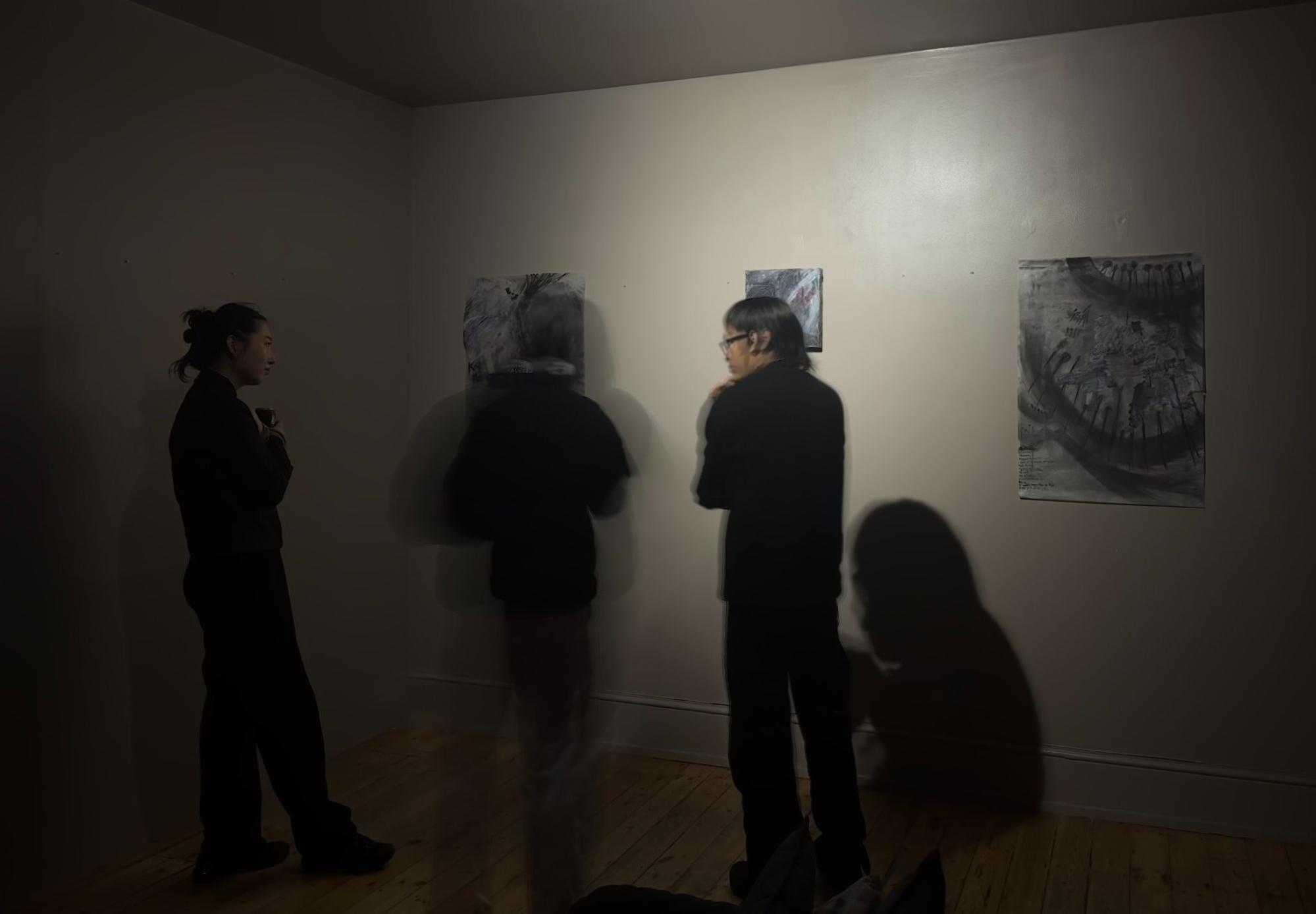
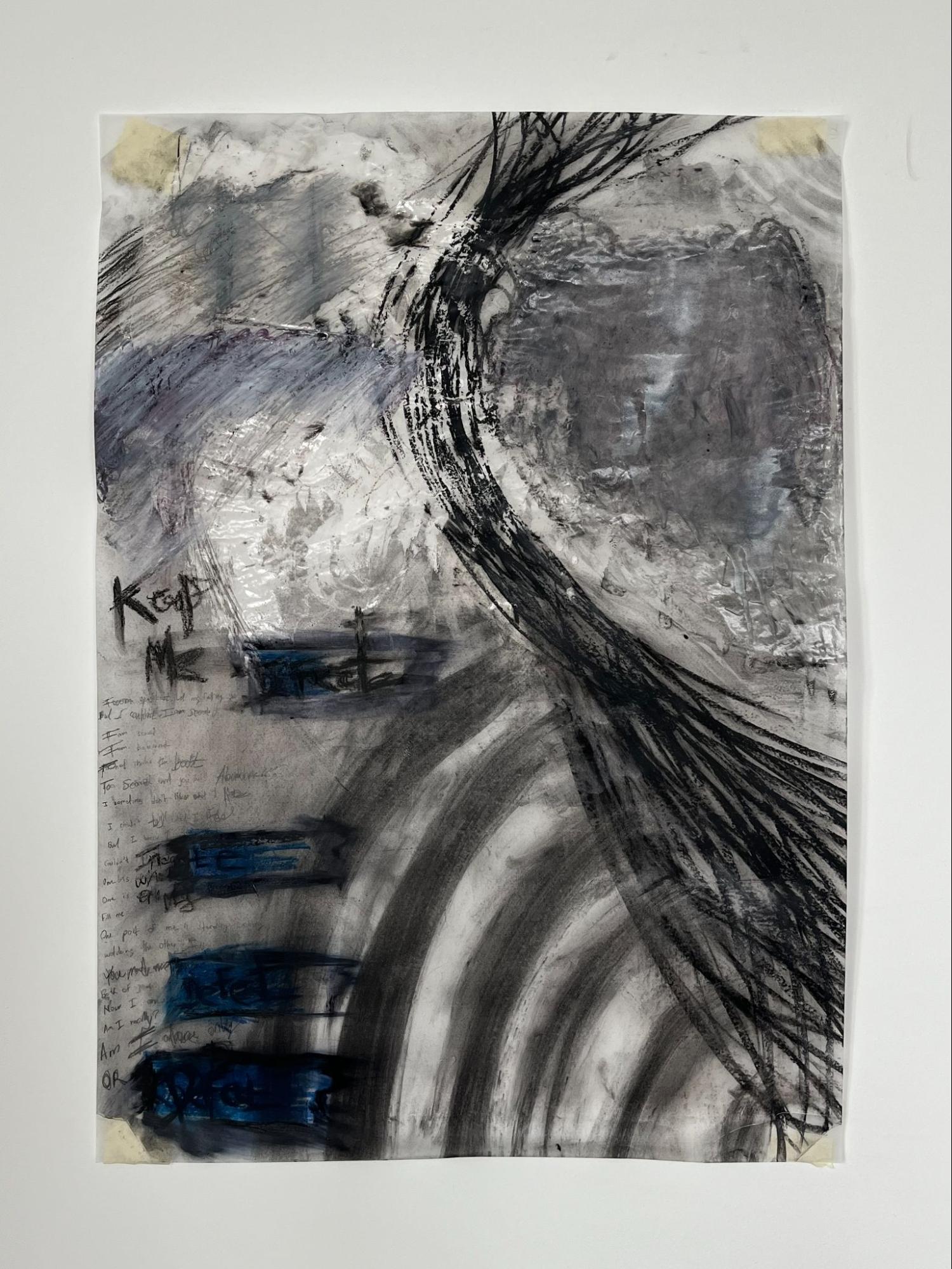
While his film work explores how we’re seen externally, his paintings explore the internal tensions we must overcome. The work To Cassandra is abstract, but there is a chaotic energy that reflects the story of the prophetess Cassandra, who was condemned by the god Apollo to speak the truth but never to be believed. It symbolises the internal struggles we all face when we want to talk about the truth but hold back, whether to avoid repercussions or to avoid hurting others. Yet we often look back and wonder whether telling the truth would have been the right choice at the time, or whether mis-speaking has led us down the wrong path.
The more we look at the works, the more figurative elements we see. It’s a similar experience when looking at past abstract painters such as Willem de Kooning or Helen Frankenthaler. However, these works have an intensity that’s close to that of Jackson Pollock’s.
Whether we are considering the world outside us or our inner emotions, Kai’s work asks us to slow down to consider them all. We live in a fast-paced world where it seems we have endless tasks to complete, but it’s only when we slow down and sit with our thoughts and our actions that we appreciate their gravity. While at the same time, it’s asking us to question our position as the voyeur, watching someone eat, reading their innermost thoughts, and asking how that makes us feel.
More information on Kai may be found on his Instagram.
How Litigation Consulting Can Help Attorneys Win More Cases

Trials are never easy, even for simple cases. Attorneys can prepare for weeks, maybe months, and still watch things unravel once you step into the courtroom. A juror might not connect with your main argument. A witness might freeze or ramble. Evidence that looked strong on paper suddenly feels flat. Everyone who has been there knows that sinking feeling. It is why more and more lawyers lean on litigation consulting. While itt does not replace skill, it does add another layer of preparation so that when the big day comes, the story lands the way it should and the case is presented in a way that maximizes the chances of a positive outcome.
What Litigation Consulting Brings to the Table
Litigation consulting is about looking at a case from the outside. Lawyers get too close to the case and having a fresh pair of eyes can make a difference. The lawyers know the facts so well that they forget how little sense it makes to someone hearing it for the first time. A consultant steps in, listens, and points out what is missing. They might run a mock trial. They might test different ways of framing an argument. They might watch how people react when a piece of evidence is introduced.
It is work most attorneys cannot squeeze into their schedule. They are already juggling filings, motions, client meetings. A trial consultant can sit quietly in the back of the courtroom and notice things that the lawyer, locked into the heat of argument, simply misses. A raised eyebrow from a juror. A shift in posture when a witness hesitates. Those little details tell you whether the case is connecting or falling flat.That perspective matters. It is not legal advice. It is practical advice. Feedback without the stress of being in the middle of the fight. Sometimes that is all it takes to sharpen the delivery and presentation of the case.
Shaping a Strong Strategy from Day One
By the time jurors are seated, the main story should already be solid. Litigation consultants help carve out that story early. They ask the questions jurors will ask. What is this case really about? Is it about trust? Is it about negligence? Is it about fairness? Once that theme is locked in, everything else can be built around it.
Too many cases drown jurors in detail. Dates, documents, witnesses, all stacked together like a wall. People stop listening. Consultants push back against that. They remind attorneys to strip it down to what matters. This helps keep it clear and clean.
That preparation shows in the courtroom. Jurors notice when the case flows. They feel it when one piece connects neatly to the next. It builds confidence and builds trust. Without that kind of structure, even a strong case can slip away.
Helping Juries Understand Complicated Information
Think about how overwhelming it is to be a juror in a technical case. Medical terms, financial charts, timelines stretching years. Most people have no background in any of that. They come in cold. If they get lost, they stop paying attention.
Consultants know this. They help lawyers cut through the noise. Turn spreadsheets into simple charts. Legal jargon into plain language. Turn a complicated sequence of events into a timeline that makes sense. None of this changes the facts. It just makes them easier to see.
Preparing Witnesses to Tell Their Story Clearly
Witnesses can make or break a case. Everyone knows that. But even honest and confident people struggle on the stand. Nerves get in the way. The pressure of being questioned in front of strangers takes over.
Consultants spend time with witnesses so those nerves do not control the testimony. They run practice sessions. They ask the hard questions. They point out where a witness sounds unsure or drifts off point. The goal is not to coach them into a script. It is to help them tell their story without panic taking over. Jurors see the difference right away. A calm, steady witness is easier to trust. That credibility strengthens the case, sometimes more than any piece of evidence.
Giving Lawyers an Edge Where It Matters Most
No one can control everything that happens in a trial. Surprises are part of the job. However, lawyers who bring in consulting support walk in better prepared. They have a strategy that holds up. They have witnesses who know what to expect and they have ways to make complicated information clear.
It is still the attorney doing the arguing, cross-examining, persuading. Consultants do not take that away. What they do is clear the road so the arguments land. For lawyers handling high-stakes cases, that small edge often turns into the difference between winning and losing.
Just Alice Season 2: Cast, Rumours & Release Date

A telenovela with a wild premise might be just what the doctor ordered for the festive season. Between the shopping trips and holiday preparations, you deserve a steamy love triangle as a little treat.
Just Alice recently premiered on Netflix and is charting in 12 countries this week. While the first season consists of 19 episodes, many viewers have already reached the finish line. Should they expect a sequel?
Just Alice Season 2 Release Date
Netflix hasn’t renewed the show for more episodes, at least not yet. That doesn’t mean an announcement isn’t just around the corner. Still, the ending of the first season provides a sense of closure, so fans should be satisfied if the show doesn’t return.
The premise is also tricky to sustain over a long time. That said, you never know. Just Alice season 2 might be in the cards, especially if more Netflix users become smitten.
Just Alice Cast
- Verónica Orozco as Alicia
- Sebastián Carvajal as Pablo
- Michel Brown as Alejo
- Constanza Camelo as Susana
- Julián Román as Marcelo Beltrán
- Leo Deluglio as Benjamín
What Could Happen in Just Alice Season 2?
A romantic dramedy, Just Alice centres around the title character, a woman hiding a dangerous secret. Caught in a love triangle, she is married to two men at the same time.
In one corner, there’s Alejo, a writer. In the other, Pablo, a former priest. Alicia’s life becomes a complex juggling act of love and lies. All the while, pressure builds as she tries to maintain both marriages without either husband discovering the truth.
The show mixes romance, comedy, and soap opera twists. The result is an emotionally charged story that challenges traditional ideas of family.
Without spoiling too much, the first season ends with an unexpected decision. There’s growth for everyone involved, especially as fresh responsibilities force them to figure out how to make things work.
That makes Just Alice season 2 unlikely, but not impossible. After all, love triangles have a knack for reshaping themselves the moment you think everyone’s finally moved on.
Are There Other Shows Like Just Alice?
If you devoured Just Alice, you might like some of the other international shows currently making waves on Netflix. We recommend checking out Dynamite Kiss, Old Money, and Genie, Make a Wish.
Keen for even more romance? You can’t go wrong with Nobody Wants This, Bridgerton, Emily in Paris, or Forever. Watch them one after the other, and you’ll kick off 2026 with a bang.
Missing: Dead or Alive? Season 3: Cast, Rumours & Release Date

Will we, as a society, ever overcome our dark obsession with true crime? If Missing: Dead or Alive? is any indication, not anytime soon. Following the release of season 2, the Netflix docuseries quickly became the #7 most-watched show on the platform.
With 5.2 million views this week alone, it would have probably climbed even higher if it weren’t for the massive popularity of Stranger Things. Does that mean a third season is just around the corner? Here’s what we know so far.
Missing: Dead or Alive? Season 3 Release Date
At the time of writing, Netflix hasn’t officially renewed the series for more episodes. That doesn’t mean it won’t. The service may still wait to assess how season 2 performs.
With solid viewership numbers, it’s looking good. As long as people keep tuning in, Missing: Dead or Alive? season 3 could arrive in late 2026 or early 2027.
Missing: Dead or Alive? Cast
- Vicki Rains
- P. Smith
- Heidi Jackson
- Nina Mauldin
- Lorraine Garcia
- David Taylor
What Is Missing: Dead or Alive? About?
The true-crime docuseries revolves around the work of the missing persons unit of the Richland County Sheriff’s Department in Columbia, South Carolina.
Each episode focuses on a real missing-person investigation. Viewers follow the case from the moment someone vanishes as the police hunt for clues, interview witnesses, and canvass neighborhoods. All in an effort to bring closure to the families, when possible.
The most appealing thing about Missing: Dead or Alive? is that it doesn’t just present the facts. The show tries to immerse you in the investigation, showing the complexity of real-time police work.
In season 2, the show remains intense, with the core team of detectives returning. Cases involve a man with schizophrenia who disappears from his apartment complex and a woman who vanishes in the middle of the night. The procedural aspect makes the show feel more urgent, while the high stakes reflect the emotional toll the proceedings take on victims’ families and investigators.
As long as the show gets renewed, Missing: Dead or Alive? season 3 will likely follow the same pattern. The nature of the show translates to long-term potential, so we wouldn’t be surprised to see it run for years.
Are There Other Shows Like Missing: Dead or Alive?
If you like true crime, you might want to check out some of the other docuseries available on Netflix. Recent hits include Mob War: Philadelphia vs. The Mafia, Beauty and the Bester, Love Con Revenge, and Amy Bradley Is Missing.
How casino aesthetics influence contemporary art

Bold splashes of color. The flickering lights captivate your attention. Surfaces you just want to touch, humming with hints of excitement or intrigue. Casino settings have always fascinated people, mixing anticipation and spectacle into a charged atmosphere. In the past twenty years or so, a shifting group of artists and designers have begun pulling from this world, weaving its boldness and energy into the framework of contemporary art; think dreamy installations, high-tech digital works, and even outbursts onto city streets. Flaunt Magazine’s 2024 report points out that the pull comes from more than just looks; there’s psychology in play, too. As online spaces eagerly borrow casino visuals and rules, artists keep returning to this theme, their fascination not fading but deepening.
Immersion tactics in the new art scene
These days, it’s common to see immersive installations that borrow right from the playbook of classic casino environments. Some artists recreate the overload of the casino floor, massive LED grids, pulsing color fields, and gadgets that demand attention. According to a 2025 survey, almost 40% of big-name installations now feature clear nods to casinos, from their unpredictable architecture to the way light shapes emotion. The goal often seems not simply to dazzle but to let audiences feel a rush, anticipation, and the strange thrill of being somewhere outside regular time.
You’ll find digital artists especially eager to blur those boundaries, using patterns of flashing lights, endless audio loops, or even sculpture that moves and spins, pushing the atmosphere into the realm of the unreal. This is hardly accidental. Many artists seem to deliberately reach for the same psychological levers casinos use to keep people entranced, translating those effects into something new for the gallery or streetscape.
The casino as symbol and its online evolution
When artists pull in game-room imagery, they are often hinting at life’s uncertainty, risk, shifting fortunes, and the distraction of the modern world. Crafting Multidimensional or Computing Art often builds on these same ideas, and that whole visual language, once tied to smoky rooms, has quietly migrated into digital art, too. On major platforms, the familiar cues of the casino, flashing interfaces, spinning reels, and modular layouts, now frame both gaming and artistic contexts. Current numbers from Flaunt Magazine 2024 show that more than a quarter of interactive digital exhibits copy their look straight from online casino setups.
Plenty of projects use digital slots and roulette to comment on what it means to participate in today’s algorithm-driven landscape. Some even poke at how much time we engage online, seeking validation or little bursts of recognition. This is not just copying surface style. If anything, it reveals how casino logic and uncertain dynamics now shape the way all sorts of internet interactions unfold, changing what people expect from interactive art itself.
Spectacle, architecture, city spaces
Casino architecture’s boldness has become a deep well for artists to draw from. Instead of delicate gallery spaces, you now see walls and façades inspired by the outsize confidence of Las Vegas, big statements, strange floor plans, and plenty of light. New Wave Magazine notes that a significant number of new galleries, over 30%, in fact, are weaving casino signatures directly into their designs, swapping predictable layouts for something more disorienting or dramatic. This push spills out onto the street, too. Muralists and street artists have been lifting bits of gaming culture for a while now—slot icons, those old-school felt patterns, neon-style glow, all of it.
They twist these pieces into public art, blending quiet, reflective moments with the kind of visuals you normally see flashing in a casino hallway.What used to hint at exclusivity, a sort of members-only atmosphere, now shows up casually on city walls and storefronts. The line between fine art and everyday entertainment grows flatter by the year. And casino design, once locked away inside carefully controlled interiors, has slipped into the rhythm of daily visual culture.
Fashion, performance, and where they meet
There’s no reason to stop with paint and architecture. The charged spirit of the casino has jumped into fashion, music, and live shows. Understanding Casino Dress Codes helps explain part of this crossover, as designers dip into this visual vocabulary of shimmering sequins, metallic glints, and bold geometry not just for taste but for the way these elements feel to look at. On stage, musicians and performers pull from casino imagery to summon nostalgia, glamour, and occasionally an edge of decadence.
The blend goes both ways; See Great Art found that since 2020, joint ventures between musicians, visual artists, and designers have gone up by 22%, all fueled by casino themes. Out of this mix springs a new culture, one that is hybrid and loud, setting intrigue and spectacle as the norm. Instead of keeping the casino in its own little box, artists and performers use its symbols as shorthand for big emotional swings, a kind of currency for the digital, attention-hungry age.
Approaching casino themes with care
While borrowing casino drama provides artists with powerful tools, it also carries certain limitations. Harnessing spectacle or borrowing psychological tricks can bring unintended side effects, trailing close behind the challenges that actual casinos can carry. The National Council on Problem Gambling emphasizes the importance of transparency and urges viewers to delve deeper, rather than succumbing to superficial attraction.
That means artists, curators, and audiences alike need to stay mindful and aware of the power these motifs can wield. If art is shaped from casino cues, responsibility ought to be part of the process, a quiet companion to creative exploration. Sensation matters, but insight and a little self-awareness should tag along for the ride.
Alo Yoga’s Latest Arrivals and Style Notes for the Season

Alo Yoga has introduced its newest collection for the holiday period, continuing to demonstrate why it holds a steady place in the contemporary activewear landscape. The brand remains consistent in its design philosophy—prioritising detail, quality fabrics that feel comfortable throughout the day, and silhouettes that follow the evolving language of modern sportswear.
Alongside its new arrivals, the brand is preparing for a series of seasonal events. Readers browsing the New Arrivals section will find a mix of performance staples and pieces suited to daily wear, reflecting Alo Yoga’s increasingly lifestyle-oriented direction.
Highlights from the New Arrivals Collection
Alo Yoga’s recent drop blends smooth, supportive textiles with clean, body-flattering outlines suitable for fitness, travel, and everyday movement.
- The Airlift Leggings remain a key item, crafted from a stretch-focused fabric that creates a sleek, sculpted fit.
- The Winter Warm Long Sleeve Airbrush offers an easy layering base during colder months.
- Lounge essentials such as the Serenity Wide-Leg Sweatpant and the Accolade Crewneck bring softness and structure into relaxed dressing.
Bright Red Launch (12/03/2025) — Featured Within New Arrivals
This season’s New Arrivals also introduce a notable colour addition: Bright Red, described by the brand as a hue designed to “turn up the heat, no matter how cold it gets.”
Integrated directly into the leggings, bras, and performance tops category, Bright Red adds a sharper visual accent to Alo’s typically neutral lineup. The Bright Red Airlift Barre Bra brings a sculpted, studio-ready profile that pairs naturally with black Airlift leggings for a refined contrast.
These pieces offer a more dynamic interpretation of Alo’s usual tonal approach. A Bright Red fleece worn over Espresso leggings, or a Bright Red bra layered under a Winter Frost jacket, provides season-appropriate visual depth while maintaining the brand’s polished, understated character.

The brand’s approach to styling is intentionally effortless:
- The Airlift Legging with the Suit Up Bra forms a polished studio look that easily transitions into daytime wear with the addition of a cardigan or pullover.
- The Airbrush Winter Warm Long Sleeve provides thermal comfort without heaviness, pairing naturally with high-waist leggings.
- The Serenity Wide-Leg Sweatpant layered over a hoodie emphasises ease of movement, while the Accolade Crewneck offers a more refined lounge aesthetic—versatile enough for streetwear when worn with Suit Up Trousers, bras with subtle cut-outs, and knit layers suitable for outings.
Quick Notes for Shoppers
- Matching sets typically sell out quickly
- Seasonal colourways are limited
- Leggings, bras, and winter tops often provide the strongest value
The brand continues to expand its winter offering, giving shoppers new opportunities to build a versatile wardrobe for colder months and early-year transitions.
Alo Holiday Gift Guide (Nov. 1 – Dec. 25)
For those browsing with gifting in mind, the Alo Holiday Gift Guide offers a curated overview of pieces suited for different routines and personal styles.
The guide highlights soft sets, winter-ready layers, and signature items such as Airbrush leggings and Alosoft hoodies—items that naturally align with the season without leaning into excessive holiday messaging.

Summary
Alo Yoga’s holiday-season releases and events offer an opportunity to rethink everyday dressing while incorporating pieces that transition seamlessly from movement to daily life. With new colours, refined silhouettes, and the option to explore both performance and lifestyle categories, shoppers can assemble outfits that feel comfortable yet distinct—suited to workouts, casual outings, and the quieter moments in between.
4 Albums Out Today to Listen To: Melody’s Echo Chamber, Dove Ellis, Joanna, and More

In this segment, we showcase the most notable albums out each week. Here are the albums out on December 5, 2025:
Melody’s Echo Chamber, Unclouded
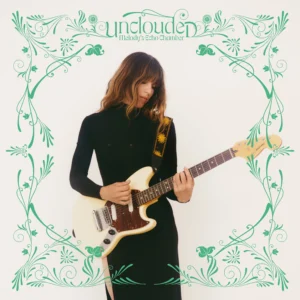 “You must see with eyes unclouded by hate. See the good in that which is evil, and the evil in that which is good. Pledge yourself to neither side.” That’s the Hayao Miyazaki quote that gives the latest Melody’s Echo Chamber album its name, and that sense of equilibrium translates to some of Melody Prochet’s most clear-eyed and translucent arrangements, though the music remains as ethereal as ever. “The music I create unusually inhabits the liminal zone between realism and fables,” Prochet remarked. “But the more experience I have of living, the deeper I love life and the less I need to escape. If my heart still belongs to the blue hour, it also feels like I’ve gathered up all the pieces of myself that were scattered everywhere and glued them together with gold like Japanese kintsugi.” The record was previewed by the singles ‘Daisy’, ‘In the Stars’, and ‘The House That Doesn’t Exist’.


Dove Ellis, Blizzard
 Having recently opened for Geese on their US tour dates, Dove Ellis has released his debut album, Blizzard. Little is known about the Irish singer-songwriter, though the record’s release during the first week of December – like Cameron Winter’s Heavy Metal – makes one wonder if we’ll end up hearing a lot more about him this time next year. But this auspicious, sensitive, and self-produced debut also feels timely, the kind of indie record you can play on repeat around the holidays. “I’ll be gone by Christmas,” he sings on ‘It Is a Blizzard’. Yet you get the sense that Blizzard will stay with you quite a while longer, especially as it ends with the breathtaking ‘Away You Stride’.
Joanna, Hello Flower
 In the late 1980s, Joanna – vocalist Neil Holliday, bassist Terry Lloyd, guitarist Tyrone Holt, and drummer Carl Alty – were on the cusp of superstardom. In 1990, NME called them “the most popular band without a record out.” But a record deal never fully materialized, and recordings behind their debut album, Hello Flower, were left to gather dust. Upon coming across the long-forgotten ¼-inch reel tapes from their album sessions in a Manchester loft, the band “realised we were actually as good as we remembered,” Alty said in press materials, leading to a renewed effort to get it out into the world. Hello Flower is out today via New Feelings, and it’s a fascinating time capsule.
Voices From the Lake, II
 Over a decade after the release of their self-titled debut, Voices From the Lake have returned with their second LP. Since launching as a one-off live performance at Japan’s Labyrinth festival in 2011, the project has released a handful of EPs, worked on installations, and formed record labels; II is out on their own Spazio Disponibile. “The project was never meant to become what it did,” Voices From the Lake explained. “At one point, we even paused it. Only to later embrace it in all its forms. II is both a continuation and a reinvention.”
Other albums out today:
TEED, Always With Me; Ólöf Arnalds, Spíral; Caution, Peripheral Vision; Anna of the North, Girl in a Bottle; Roddy Ricch, The Navy Album; Retail Drugs, Factory Reset; Isobel Waller-Bridge, Objects; Tutafarel, Monte Casanova; Tom Smith, There Is Nothing In The Dark That Isn’t There in the Light; Black Rain, Obliteration Bliss.
