

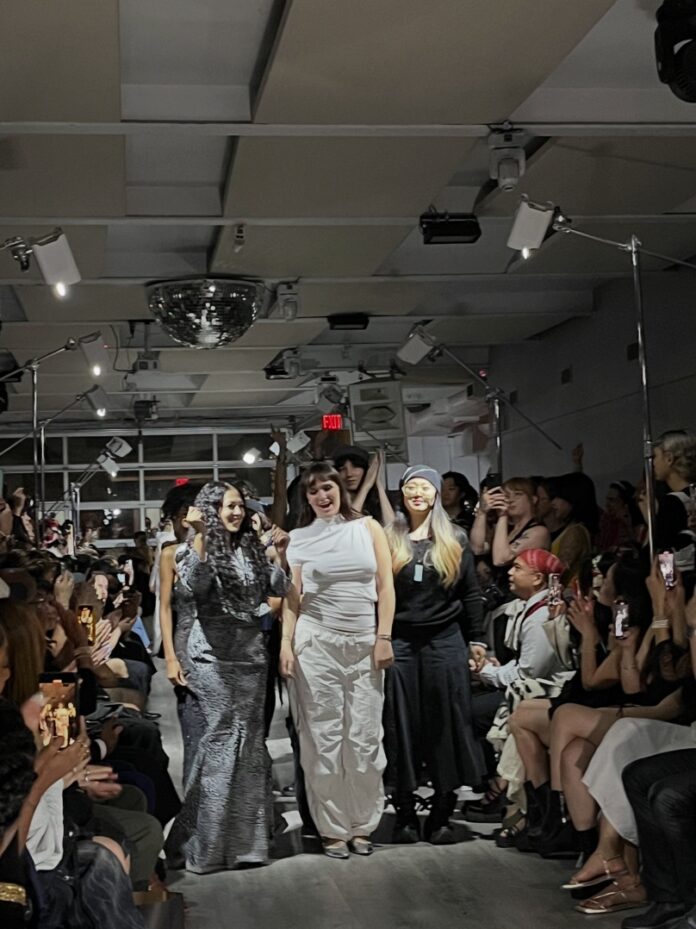
Fashion, performance, and nightlife came together at Brooklyn’s Bogart House on September 13, 2025 when Heavensgate NYC presented The Elephant in the Room. Produced by Ella Xu and Ni Ouyang, the group runway brought seven independent designers into the same space before the venue shifted into a late-night afterparty.
The collections shared little visually, and that contrast gave the evening its shape. Futuristic tailoring appeared alongside gothic drama, historical references, intimate one-of-one garments, and work concerned with identity, vulnerability, and social expectation.
Among the featured designers was Ying Kimily Jiang, whose practice bridges sculptural construction, spatial design, and narrative-driven fashion. Rather than approaching garments as standalone objects, Jiang treats fashion as a medium through which emotional experience, memory, and psychological transformation can be physically expressed. For the event, she presented Memories of Matsuko, a six-look runway series inspired by the Japanese film of the same name.
Jiang’s interest in the film began with its central character rather than its costumes or visual setting. Matsuko’s repeated pursuit of love, despite rejection and emotional harm, remained with her after the film ended.
“The first thing that stayed with me wasn’t a particular scene,” Jiang says. “It was Matsuko herself. She continues looking for love even after experiencing so much disappointment. That persistence became the starting point for everything I wanted to make.”
Instead of translating the film literally, Jiang reconstructs its emotional progression through silhouette, material, and spatial composition. The collection demonstrates an approach to fashion in which construction functions as narrative, allowing garments to communicate psychological states rather than simply illustrating them.
This emphasis on emotional narrative made the presentation a natural fit for The Elephant in the Room. The event’s open framework allowed each designer to address its premise independently, without requiring the participants to follow a common visual direction.
When Jiang’s first model entered the runway, a cage-like framework surrounded the body. Origami cranes and flowers softened the structure, while oversized bows introduced the visual language of childhood. The delicacy of those elements sat against the physical distance created by the frame.
For Jiang, the space between the garment and the wearer is as important as the garment itself. Her interest in architectural design led her to think about clothing in terms of structure, volume, and the way a body occupies its surroundings.
“I became interested in how architecture shapes the way people move through space,” she says. “I started thinking of a garment as a space around the body, not only as something worn on it.”
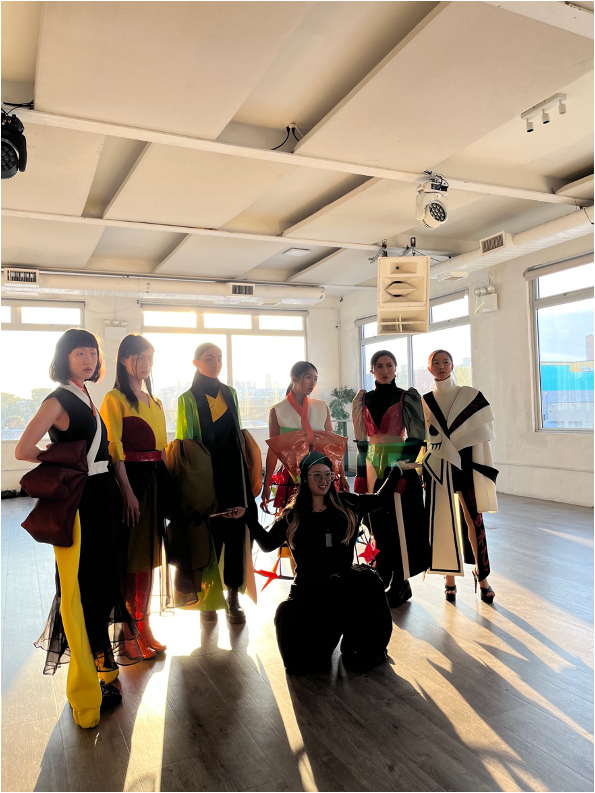
That approach runs throughout the runway series. Frameworks and padded forms extend the silhouettes outward, while organza, lace, patent leather, spray-painted surfaces, and shape-holding air-cotton create differences in weight and transparency. Glossy materials appear beside softer layers, and bright color is interrupted by black fabric and red markings.
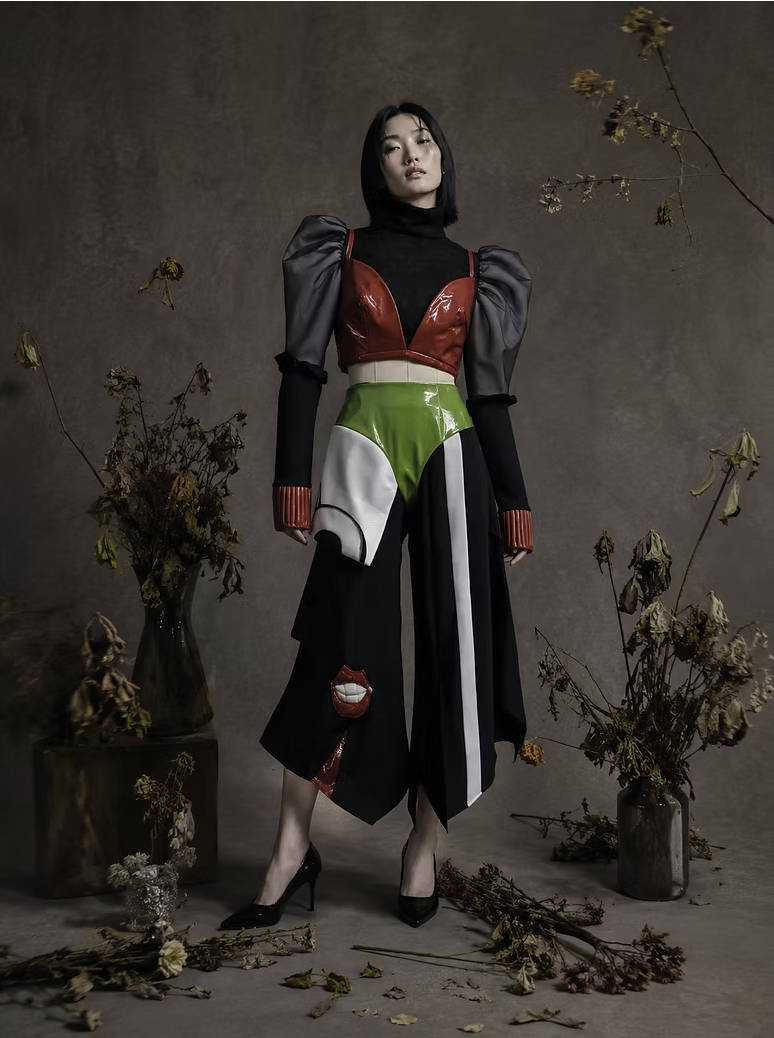
The effect became clearer in motion. Enlarged sleeves changed shape as the models walked, and sheer layers revealed different parts of the garments under the venue lighting. Structured sections altered the models’ proportions and created a visible boundary between the body and the audience.
Jiang describes Memories of Matsuko as a collection built through sequence. Viewed together, the collection unfolds less as six independent garments than as a single narrative sequence, reinforcing Jiang’s interest in fashion as a time-based and experiential medium rather than a series of isolated looks.
“This time, I wanted the collection to tell a complete story,” she says. “Every look belongs to the one before it and the one after it.”
The presentation gradually became denser through its middle passage. Volume accumulated around the body, and layered materials gave the silhouettes a heavier physical presence. The progression reflected Matsuko’s emotional and psychological burden without turning the garments into literal illustrations of the film.
Jiang’s interpretation of the character avoids reducing her to tragedy. What interested the designer was Matsuko’s continued belief in love, even when that belief repeatedly led her toward disappointment.
“Matsuko isn’t a perfect character, and many people may not understand her choices,” Jiang says. “What moved me was that she never stopped hoping to be loved. That hope felt more important to me than the tragedy itself.”
The closing look brought a marked change in scale. After the enlarged and heavily layered forms that preceded it, the final silhouette became restrained. Its wrapped construction drew from the traditional Japanese kimono, while black and white replaced the earlier use of vivid color.
Across the garment appeared the red Japanese phrase “生まれて、すみません,” translated as “I’m sorry for being born.” A single tear beneath the left eye completed the image.

For Jiang, the reduction of volume did not suggest a simple release from the emotional weight carried through the earlier designs.
“I didn’t want the final look to feel dramatic,” she says. “For me, it isn’t about liberation. It is more like a quiet acceptance.”
That restraint gave the runway a clear final image. The structure remained controlled, but the layers that had previously surrounded and enlarged the body were gone. The emotional state of the character was no longer expressed through accumulation. It had been drawn closer to the figure.
“I hope people can find something of themselves in it,” she says. “Everyone experiences disappointment differently, but I think everyone understands the desire to be accepted and loved.”
Once the runway ended, Bogart House shifted into the event’s afterparty. DJs Evaneven and Elladotnet changed the pace of the room as the formal presentation gave way to a shared social space.
The transition reflected Heavensgate NYC’s broader approach to the evening. The seven designers had been presented side by side without being made to resemble one another, and the afterparty carried that exchange beyond the runway.
At The Elephant in the Room, Memories of Matsuko demonstrated Jiang’s ability to translate cinematic narrative into sculptural fashion without relying on literal adaptation. Through controlled construction, spatial experimentation, and emotionally driven design, the collection reflected a practice that moves fluidly between fashion, architecture, performance, and storytelling. Rather than treating garments as static objects, Jiang positions them as environments through which memory, vulnerability, and identity can be physically experienced, reinforcing her distinctive voice within contemporary conceptual fashion.

