

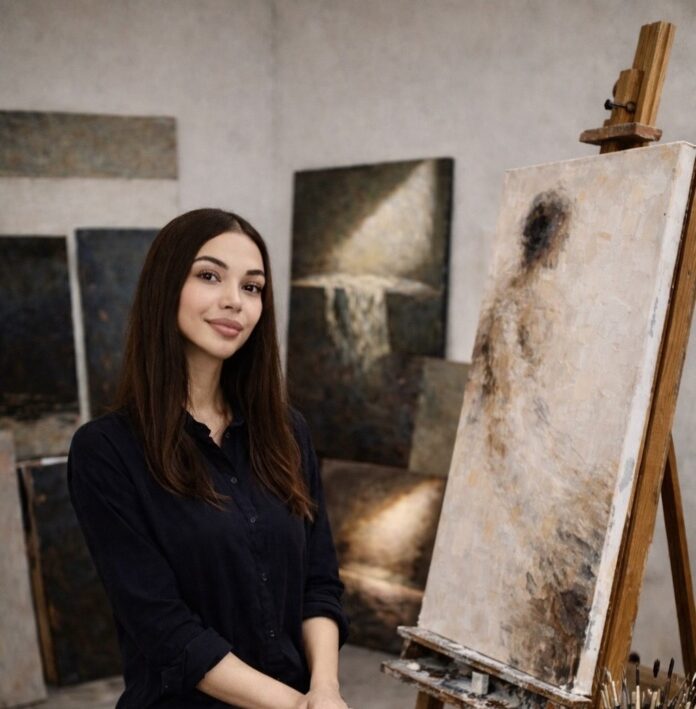
Light next to dark on a canvas may seem like opposites, but one cannot exist without the other. If there are no lighter colours to compare it to, how can the richness of the darker elements be evocative? It’s this dual harmony and tension that lies at the centre of the work of Azerbaijani artist Zibeyda Seyidova.
Works such as ‘Threshold of Night’ bring to mind those of the Abstract Expressionists and Colour Field paintings, particularly Mark Rothko’s Seagram Murals at Tate Modern. Both his works and those of Seyidova’s draw you in with the depths of their darkness, and the longer you stare into the darkness, the more they peer into your soul. Are they doorways to somewhere spiritual or something altogether darker?
Limiting her work to the lens of Western art history only highlights half the story. Her works draw upon Islamic philosophy, particularly the dialogue between ẓāhir (the manifest) and bāṭin (the hidden). Heavily layering her works gives them a sense of texture. Still, her process also involves scraping back layers to reveal what’s beneath, prompting questions about what she has revealed to us through her paintings and whether more elements will reveal themselves the longer we gaze at them.
Islamic art has a long history of excluding figures, a practice known as aniconism. Through Seyidova’s abstract works, she is channelling human emotions through abstraction in a process known as dhikr, or remembrance.
Her abstract works do feature representational elements, as we see in her work ‘Point of Equilibrium’, where the dark triangle slashing across a pale canvas suggests something in the foreground is casting a shadow. It’s a recognition that there are architectural elements in abstract art, and she uses this to significant effect when she displayed her work in a hospital with the pale colours and clean lines mirroring those of the institution where they were housed.
The interplay of light and shade continues in her representational works, including ‘Veil’, in which a cloth is lit by sunlight streaming through a window. The haziness of the light suggests a moment captured in a dream, while the thick impasto texture suggests we can reach into the painting and grab the cloth.
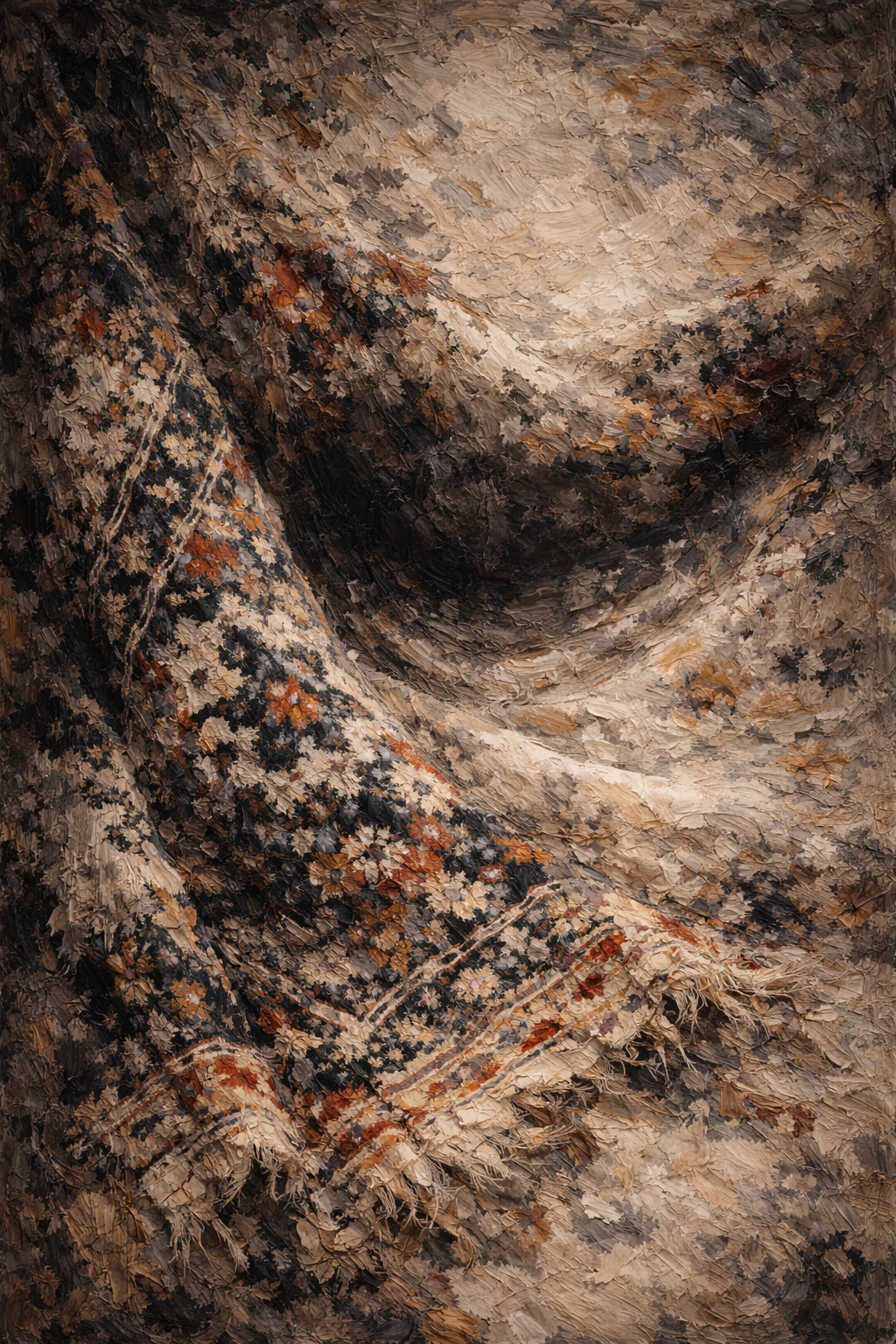
We see this again in her work ‘Transmission’, exploring the textures of a rug that makes you want to run your fingers along it. ‘Carried by Duration’ is the one piece where a human figure does appear, but it’s subtle, as it may not be noticed on first glance. Yet in the work, it feels less about the figure and more about how the light interacts with the textures of her hair and skin.
Spirituality is an essential part of Seyidova’s work, and these pieces, with their use of light, evoke the religious paintings of the Renaissance and Baroque eras. Whether viewing her abstract or more representational works, we’re asked to look deep into them, to discover what sits between the manifest and the hidden. Combining Islamic philosophy and Western art history gives her a unique voice within the world of abstract contemporary art.

