

Jenny on Holiday is the solo project of Jenny Hollingworth, who has been making whimsical, glimmering alt-pop as one half of Let’s Eat Grandma since she was 16. Although she and Rosa Walton wrote the songs for 2022’s Two Ribbons separately, that album saw them untangle loss, love, and their own evolving friendship with renewed confidence, which is the same feeling that drives Jenny on Holiday’s debut album, Quicksand Heart. The pair may be pursuing individual projects, but they still turn to each other as they do; in addition to hearing the demos – later fleshed out in London with producer Steph Marziano (Hayley Williams, Nell Mescal), who helped find their quickened pulse – Walton also sings backup on several songs on the record. Soaring, childlike, and ultimately swept up in desire, Quicksand Heart feels like shifting up a gear, bracing for the interlocking joys and horrors a new year brings. “Sixteen and then/ Before we knew it, we were spent/ It was coming to an end,” Hollingworth sings on ‘Do You Still Believe in Me?’. These songs make it all sound like a new beginning.
We caught up with Jenny on Holiday for the latest edition of our Artist Spotlight series to talk about writing in Norwich, sharing demos with her Let’s Eat Grandma bandmate, working with Steph Marziano, and more.
You started writing a couple of the new songs in the summer of 2023, the first one being ‘These Streets I Know’. When I listen to it, I can hear the heart that ended up being a major theme of the record swelling with all the associations of being in your childhood home. How would you describe this pull of inspiration and emotion that you feel when you’re back there?
It’s funny, because I’m actually here right now. I think a lot of it’s to do with people here, my family and my friends here, and there’s also a kind of remove in Norwich. It’s quite an isolated city in some ways. I think when I’m here, I feel far away from anyone’s expectations, especially in this room. It’s different to being in a big city like London, where there’s so much busyness and so many eyes on you at all times. Maybe because I tie it to my childhood as well, but there’s a sort of magical feeling here. A lot of the time when I was writing the record, especially that song, I would go for these really long runs around Norwich and out into the countryside, and that song was really inspired by that as well. I was just looking at the landscapes, and it’s very flat here, so I was describing how the skies feel really wide for that reason. I kind of feel like they’re out of a storybook. People often have quite complicated relationships with their hometown, but for me, I feel like the people here and the place have made me who I am, in a way.
Do you struggle to write in other places?
I think I can write in another place, because I’ve done it before. Obviously, when we did the tracks with SOPHIE, we didn’t feel like Sophie would do a day in Norwich. [laughs] I don’t know if she would have been down. I just need somewhere where I feel really comfortable and able to relax. I can imagine that I’m probably gonna write music in other places, but it just feels like I don’t have to think about whether people are gonna like the songs – or not yet – when I’m here.
I’m curious if ‘Dolphins’ was the other song you wrote in that earlier phase, because it has a similar kind of childlike wonder.
That’s really interesting, I see why you would think that. Funnily enough, it was actually ‘Good Intentions’. ‘Dolphins’ was a bit later in the process, which is interesting, because I do hear that childlike quality in ‘In These Streets’ as well. After I wrote ‘Good Intentions’, I was like, “I can kind of hear where this is going.” It set the feeling of the kind of songwriting I was doing. But ‘Dolphins’, when the lyrics are just written down, they sound so simple, I almost thought they looked a bit stupid. I didn’t know if they were decent or not. But with the music, it started to make a lot more sense. Obviously, the Beach Boys wrote about the ocean – the songwriting is quite simple lyrically a lot of the time, but there’s something quite magical about it. I was quite inspired by that.
I feel like the vocals on ‘Good Intentions’ reflect that dynamic of time leaving you “soaring high or nothing at all.” Was that part of what made you invite Rosa to back you on that one?
I do think some of the vocal performance in that song is a bit more understated in the verses, compared to some of the other songs, like ‘Quicksand Heart’, which is quite in your face. Rosa is towards the end of the song – to be honest, the lyrics are about a lot of different things, but that song to me was also partly about me and Rosa’s relationship. There’s so much in our lives we’ve gone through together. At the end, I say, “We had, we had good intentions,” rather than I, and that was kind of about me and her. I wanted to go from this more closed-in beginning to more of a communal experience, and it made sense for her to join me, for the meaning of the song, and also for the uplift.
At what point did you start sharing ideas and demos with Rosa during the process? How was the experience different from songs destined for Let’s Eat Grandma?
I think that I shared all of the demos with Rosa when I finished the songs. I didn’t really send many work-in-progress ideas, because I was sitting on them for quite a long time. But every time I finished a song, I would send my little demo to Rosa, and I’d send it to Tim [Dellow], who works at my label as well. And because I was writing them all here, I’d show my mum as well. [laughs] So I’d get different feedback from different people, which was really helpful for me. I think Rosa really understands what I write my songs about, because a lot of the time, Rosa and I’s emotional lives mirror each other, so we often go through similar experiences at the same time. And Rosa really listens to my lyrics and the meaning of the songs. Basically, I knew that the song was right if I felt like she was having an emotional response to it. Also, she was just really encouraging and supportive about the whole thing, which was very helpful for me, because I was very nervous about writing songs of my own.
Do you feel like it was kind of liberating for both of you to depend more on that emotional response than any other feedback?
I think so, because rather than it being like, “I made the beginning of this idea, could you add your ideas to it?,” it was, “Here’s the mostly finished song.” I’d often write a song that I felt was a happier, upbeat song, and Rosa would be like, “I just cried.”
What song might that have been?
I never really thought of ‘Groundskeeping’ as being a particularly sad song, for example. I don’t know why, but then you realize that other people would see it differently, and then I’m like, “Oh, maybe it is a sad song.” ‘Dolphins’ as well, I thought it was kind of uplifting. [laughs] Going through the process of doing individual music, Rosa and I have really supported each other at the same time. Even though we haven’t been making the records together, we’ve still got a dual process, which has given me a bit more confidence.
When you got back to writing most of the album in 2024, was there a shift in your mindset?
I started to write a lot more quickly the further I got into it. The first two songs took quite a long time for me to write. You can make anything when you start records – it’s quite scary how open the canvas is. As I got into 2024, and I’d already found the sound and maybe the feeling behind the record by that point, the speed of the writing started to increase quite a lot. It felt a bit more clear to me what kind of record I was making.
What does that clarity look like for you? Is it realizing there’s something tying the record together?
That’s such an interesting question. I did realize at that point: the core feelings of every song are kind of in the same space. Obviously there’s all the heart stuff, but I feel like there’s also a lot of yearning, and at points desperation in the record. There’s a lot of wanting in the songs, and that became more and more apparent the more songs I wrote.
Speaking of trading demos, when did that process start with Steph Marziano? What was it like getting to know each other before going into the studio?
We originally met each other because we’d done that Bad Omens remix of ‘[JUST PRETEND (CREDITS)’] in December of 2023, when I’d only written a couple of songs. Tim had sort of sneakily suggested that we work together, probably thinking there should be an album, and also just thinking we would get on really well. A lot of it was just that Steph – I feel so comfortable with her. We have quite a lot of creative chemistry, and we like a lot of the same music. I only feel I can really do a good job with music if I feel comfortable with someone, because otherwise I can’t share how I feel or my songs without feeling self-conscious.
We recorded our first batch of songs in April of 2024, and in the time before, I’d finished another song – I think it might have been ‘Do You Still Believe in Me?’. Tim kind of suggested, “Why don’t you record them with Steph?” I think he had this plan the entire time when we’d met before, because he’s very like that. [laughs] He lets me think that things are my idea. I just thought it would be a lot of fun to work together, which is an important thing as well. It was quite scary sending over my demos, because they were kind of a mess as well. If I know that we’re going to be recording something in the studio with actual good synths, with my demos I’ll just be like, presets, everything’s out of time – but the song’s there. I found it exciting working with her. The last two records we did with David Wrench, who I also love, but I think with this record, it made sense to work with someone new.
How much did you feel the songs changed shape during the recording?
For the more upfront pop songs on the record, we’d end up simplifying them in some ways – not simplifying, but trying to find the hook. Sometimes I’d have an extra bit that was too long that wasn’t actually useful. Steph’s production brought a lot of life to the songs, and some of them changed more than others. ‘Every Ounce of Me’ changed quite a lot from the demo. It was originally almost ballad-y. It had the same key parts, but it was not this big pop song. And I think Steph saw it as a big pop song, because we’d already done ‘Quicksand Heart’.
There’s a playfulness to ‘Every Ounce of Me’ – a line like “I’m like, kill me” works very well with this kind of gleaming production.
Totally, because I had that line before, but it sounded so different in a ballad form. It didn’t make sense. In the big pop song, it sounds like how I wanted it to sound, which is just funny and a bit ridiculous.
‘Do You Still Believe in Me?’ has some of my favorite production on the album, especially with those guitar sounds. You mentioned it being written before April 2024 – I assume it was around the New Year?
I can’t remember exactly when, but it would have been around the New Year, I expect. New Year is a constant reference in the LEG lore. I feel like there’s a lot of passing of time in the record, me saying I’m older now, and New Year always reminds me of that. Now that I think about it, I really wanted a lot of guitar on this record, but I can’t play guitar. My guitar playing is so rudimentary, so I’d write loads of guitar parts on the awful Logic presets. I’d kind of have a vision for the guitar sounds, but then Steph would just be able to find the perfect guitar sound for the song. Steph’s a drummer as well, and I wanted the record to feel really driving. I can’t drum, so having Steph was very helpful.
I have such a distinct memory of ‘Happy New Year’ coming out, and I’ve made a habit of revisiting Two Ribbons at the start of every new year. I get a similar feeling listening to ‘Do You Still Believe in Me?’, specifically being in transit and reflecting on time passing – “Another train, another new year.” How significant is the timing of the release of Quicksand Heart for you? What thoughts does it stir up now?
Now that I think about it, it wasn’t initially my plan – we discussed it with the label to work out good times to release things, but for me, I really wanted this record to be out quicker and quicker for ages. Obviously, they have to do their job of getting everything. But it feels really special having the records out now. Thinking about that song and New Year, I feel reflective on what a journey it’s been, being in LEG and making music for this time. Just how much it means to me, thinking back to being a teenager and starting making music, releasing the music. I keep meeting people in stores who are like, “I started listening to you just before you put your second record out.” It just feels like stepping into a new chapter in my life – it feels like shaking off all the cobwebs of the last year. It makes me excited about making music in the future as well.
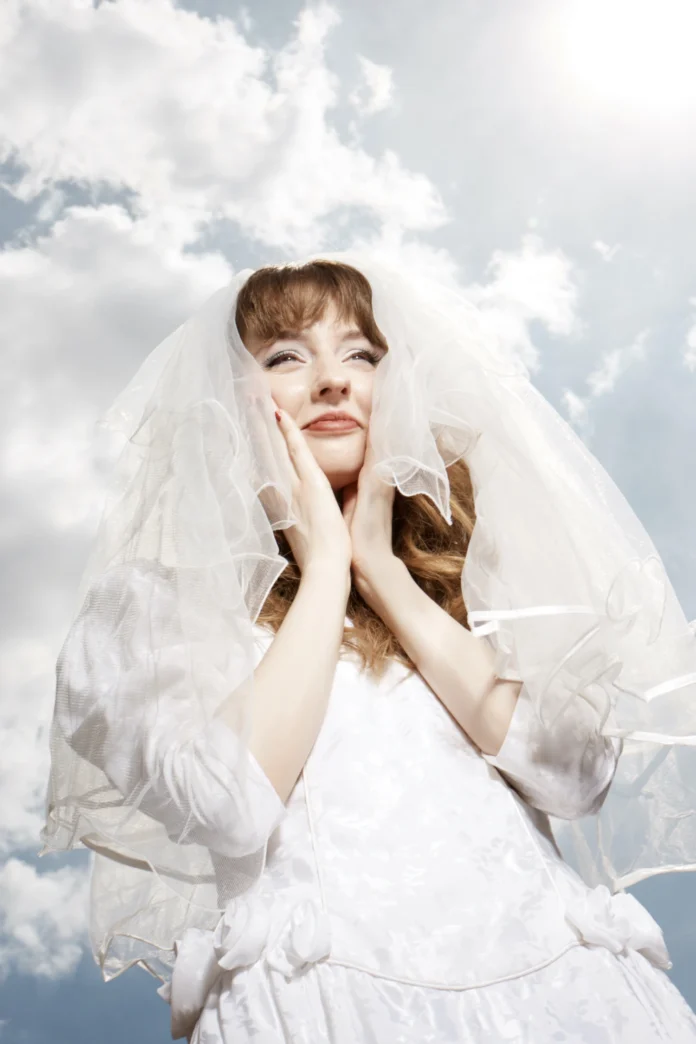
You mentioned showing some of the demos to your mom, and I wanted to ask about the album cover, shot by Steve Gullick, where you’re wearing your mother’s wedding dress. Was there any conversation around it?
I still have a Tumblr account to this day, and I like looking at old shoots and fashion things. I was really fixated on all the pictures of wedding dresses for ages while I was working on the record. I realized there was something about the wedding dress that really represented something to me about the record. For the album cover, I was like, “I really want to wear a wedding dress.” I’d been talking to my mum about my life and what was going on in it, and my mum was talking about the fact that she got married when she was my age. I kind of knew about that, and I made the connection suddenly that there was some significance to me about my mum getting married at the age that I was making this record. The wedding dress symbolizes commitment and dedication, and I feel like the record’s kind of about me being committed to my music. It was moving to me to wear her dress as well.
Have you gotten a reaction from her about the album?
She heard all of the songs in their infancy, because she would make me finish them. I’d have a deadline and be like, “Mom, I can’t finish this song, I’m having a breakdown.” And my mum would be like, “Jenny, it’s good, it’s fine, go and record it!” I think my mum just really wants me to pursue my music and do that, and same with my dad, actually. I’m really lucky in that respect.
How did you kind of land on that expression for the cover?
It’s hard to explain, because the idea for the wedding dress and the screaming – I really felt pulled to do them, and at the time, I didn’t know why. It kind of felt like an instinct. When we were taking the photo, at first, there were a lot of shots of me with a blank expression. That’s actually probably the only shot on film of me doing the screaming. I kept doing it all the time – in fact, there’s some Polaroids I have of me doing a few weeks earlier in a photo booth. When I look at it, it kind of reminds me a bit of ‘The Scream’ by Edvard Munch. It was just a feeling of overwhelming emotion. There’s something about the really intense sky, but obviously this feels more euphoric than it does horrifying.
Is there something you hadn’t realized about the record that recently dawned on you?
One of the things that was interesting came to me a while ago, before the album came out. I did an interview where I was talking about Rosa and I’s relationship as sort of being running together, and I felt that neither of us wants to be ahead of the other. We want to be keeping pace with each other and helping each other run faster. I talked about how I was doing a lot of running at the time, and it was about my heart rate monitor – I’d be like, “I’m alive because I can literally see it on my wrist.” I think the running was also to make me feel alive, because it felt good that I had this body that I could see moving. The song ‘Pacemaker’ was inspired a lot by the wrist, but I realized the word pacemaker is also the person who sets the pace in a race of running. Other people run with them so they’re all running at the same speed. Rosa and I both seem to run faster than we did individually, because we’re trying to push the pace the whole time.
This interview has been edited and condensed for clarity and length.
Jenny on Holiday’s Quicksand Heart is out now via Transgressive.

